|
When it comes to motivating people to do the right thing, let's face it, nothing works better than good old pressure delivered by a skillful hand, and at just the right time. I can remember when I was a kid growing up in the foothills of the Smoky mountains. My mom didn't know "nary a thing" about human psychology, nor was she concerned about my fragile ego (or hiney). What my mom did know was that when it came to making me do right, pressure was her best friend. If I did something I wasn't supposed to do like "talk back", or God forbid, utter a "bad word" under my breath, I was faced with immediate and unapologetic pressure from General Mom.
The pressure of my mom staring at me with that "I know what you've done" kind of look always brought my guilt straight to the surface, and I knew it was dang-sure time to do the right thing. But just in case I was slow in repenting, mom always had a fresh-cut hickory switch to back up her stare. I admit, under the pressure, I folded every time, lest mom bring out the water-board! Just joking, of course. In horse lingo, I guess you could say that I was smart enough to "give to the pressure"! One thing's for sure, it didn't take me long to figure out that giving in was a whole lot better than holding out and risking a hiney-whoopin'. Speaking of giving to pressure...
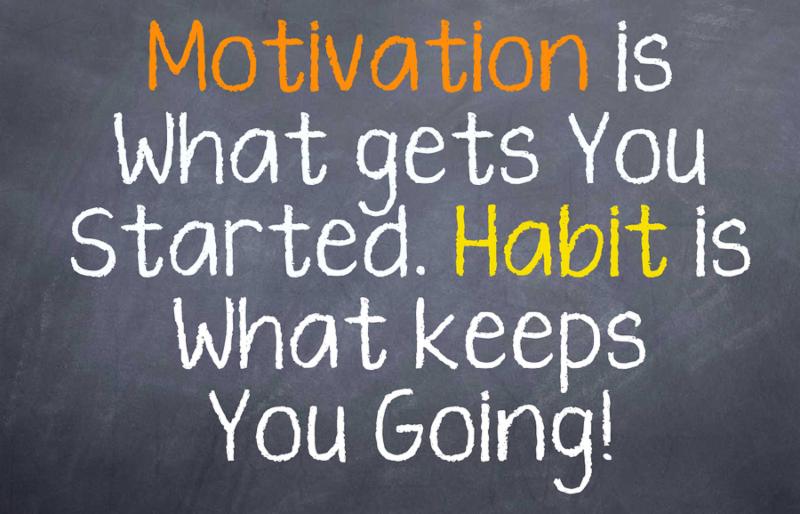
I want to start out today's horse ministry by talking a little bit about how pressure is used to train horses. Then we'll talk about pressure and one of its purposes in our lives. When it comes to horses, we simply couldn't train them to do the right thing (i.e. what we want) without the use of pressure. Yeah, it would be nice (and a lot easier) if we could just tell our horses to do something and they responded with a "Yes, Ma'am, or Yes, Sir, I'll do that!" But the truth is, horses are a lot like people. That means that sometimes just telling them the right thing to do doesn't get the job done. Just like people, some horses need convincing. That's where pressure comes in. The right kind of pressure, at the right time, can be a great motivator. And once we establish motivation in our horse, we can begin to build new and better habits that he will, hopefully, remember for a lifetime.
PRESSURE = MOTIVATION = HABIT
"Consider it pure joy, my brothers and sisters, whenever you face trials of many kinds, because you know that the testing of your faith produces perseverance. Let perseverance finish its work so that you may be mature and complete, not lacking anything."
(James 1: 1 - 16, NIV)
Definition of perseverance: steadfastness in doing something despite difficulty or delay in achieving success.
Okay, let's get back to horses for a moment. Horses instinctively move away from pressure. Ahhh, if it were just that simple concerning people. Unlike horses who move away from pressure instinctively, people sometimes gravitate towards pressure, even if subconsciously, and then wonder why life is so complicated! Horses, on the other hand, seek out an uncomplicated life. When it comes to pressure, the horse always asks the right question, "What must I do to alleviate this pressure from my life?" People, on the other hand, generally ask, "Why me, Lord?" The fact that the horse usually asks the right question in the first place is why it's easier to train a horse than it is to train people! Suffice to say, there's no right answer if we're asking the wrong question! Alright, you know the drill. Tighten that cinch and let's go further...
In the fundamental or beginning stages of horse training, we teach our horse to yield his hindquarters. It would be nice if simply asking, "Would you like to yield your hiney?" got the results we were looking for. Alas, that's not usually the case. Instead, it usually takes pressure to get the horse to seek the right answer, or in other words, do what we want (i.e. the right thing). There are several ways that we can pressure a horse. We can pressure him with our eyes by giving him that "you'd better move or I just might eat you for lunch" type of stare. Or we can pressure our horse by using a handy-stick as an extension of our arm to motivate him to move. The length of the handy-stick allows us to direct our horse's movements while at the same time staying at a safe distance. And finally, we can use the handy-stick to administer a well-placed whack, if necessary, to remind our horse, "I mean business".
Exactly which kind of pressure, and how much of that pressure we use, depends completely on how smart the horse is, i.e, how quickly he comes up with the correct answer to the pressure. This is a good place to point out that once a horse graduates from a simple snaffle bit, and becomes a mature bridle horse (in the bridle, shank bit), he should be able to handle multiple pressure at once without losing his cool or blowing up.
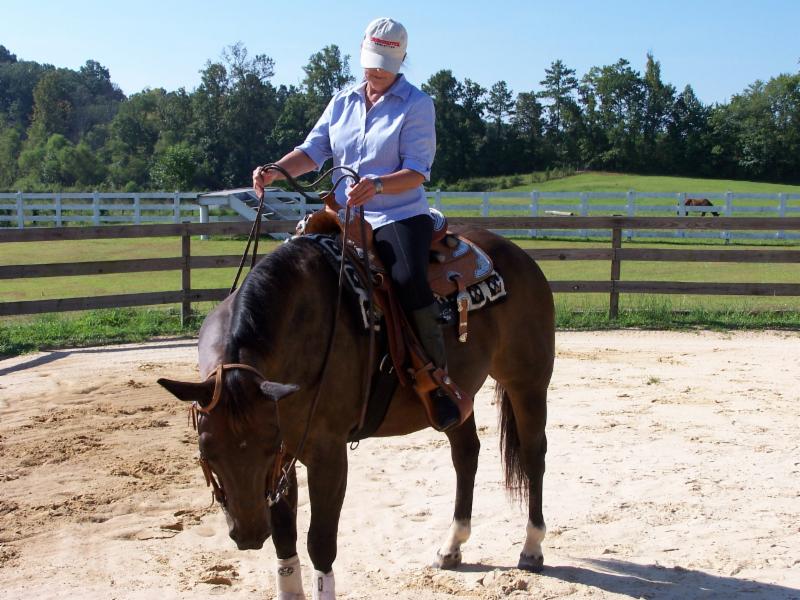
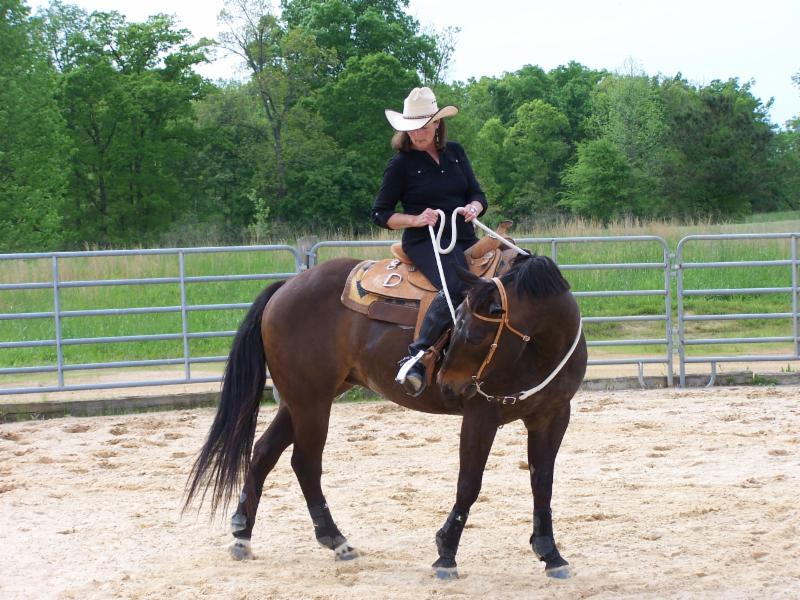
My horse, Samson, responding correctly to multiple pressure at the same time without losing his cool or blowing up. Can you look at the picture and identify all
the places where I am placing pressure on my horse?
In the above picture, I'm asking my bridle horse to calmly handle multiple pressure. I'm asking him to not only lower his head, but to give me his face (in this case, his left eye), collect his body, and round-up his top-line (his back). In other words, I am not just pressuring him about one thing - I'm pressuring him to do several things at once. Chances are good that if my horse has not learned how to handle small, basic pressure (an example would be yielding the hindquarters, or moving off my leg), then he could lose his cool altogether, or blow up when I add multiple pressure.
Back to the picture - the most obvious pressure that you can see me applying is lifting my reins. But I am applying more than rein pressure. Let's break it down. When I lift the reins, it causes the mechanical action of the bit's shanks to place pressure on my horse's mouth. This encourages him to lower his head in order to get away from the pressure and find that place of release. Keep in mind, it's not the pressure that teaches my horse to lower his head when I lift the reins. It is the "release of the pressure" that teaches the lesson when he answers the question correctly (does the right thing). In other words, when I release the pressure and my horse finds his comfort zone, a light bulb goes off for him. With repetition, he will quickly learn to seek out that comfort zone every time.
The second point of pressure is much more discreet, but my horse feels it just the same. My hand "feathers" the left rein and asks my horse to give me his face (in this case, his left eye). I'm not looking for a severe turn of his entire head. Instead, I am applying just enough pressure to get the job done. If there is any resistance, I will increase the pressure until I get the desired result. The third point of pressure is in my legs (calves). I bring my legs closer to my horse's sides to ask him to collect up. And finally, the fourth point of pressure is applied with my heels (or spurs) as I pressure my horse just behind the girth area with a roll-up action to ask him to round-up his top line. If I stay consistent in training my horse with pressure and a well-timed release, then pretty soon he will "get it", and the right behavior will become a life-time habit.
Lifetime Habits
and
HELICOPTOR MOMS
"All scripture is breathed out by God and profitable for teaching, for reproof, for correction, and for training in righteousness."
(2 Timothy 3: 16, ESV)
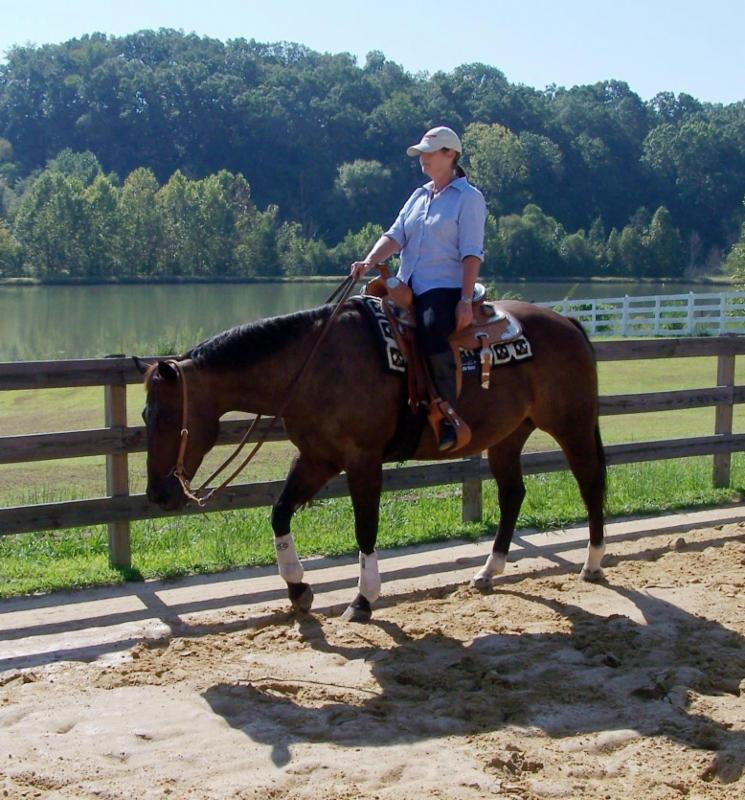
Samson wasn't born knowing how to be a gentleman,
nor did he know how to do a near-perfect western pleasure walk. It took years of consistent teaching, reproof, correction, training, and yes, pressure, to turn him into a winner.
Let's just go ahead, get down and dirty, and talk about helicopter moms (and yes, helicopter dads, too). The dictionary describes a helicopter parent as someone who pays "abnormally close attention" to a child's experiences and problems, and is "excessively involved" in the life of his or her child. God surely knows, I made my share of mistakes when raising my two boys, but being a helicopter mom wasn't one of them!
If anything, I probably erred on the other side. With memories of my mom and that hickory switch firmly etched in my mind's eye, I usually only gave my boys two "pressure" warnings when it came to my parenting style. One was that intimidating stare I'd inherited from mom, and the other was the guts to back it up with a swift spank to their gluteus maximus, with a promise of more where that came from just for good measure! I must confess, my parenting style back then would probably land me in the slammer in todays politically correct world. What can I say? My kids grew up as preacher's kids, and we all know that's a tough road to hoe when it comes to pressure. All I can say is, if I had been a helicopter mom with all those hover routines and maneuvers, I would probably have crashed by now!
The truth is, we have to allow people (especially our kids) to experience the consequences of their actions in order to allow them to learn. When we remove pressure, and continually "fix" people and their world, we take away the very experiences that are meant to teach them valuable life-lessons. And what kind of life-lessons are those? The life-lessons that someone else may be more than willing to teach them somewhere down the road. There's no denying, pressure is tough. It can be uncomfortable, unpleasant, and yes, sometimes it's even painful. But it is a necessary part of life. And why is it necessary? It's necessary to motivate us to not settle for less than our best. You see, pressure always has been, and always will be the greatest motivator for producing winners. And we, my friend, were born to be winners. So, got pressure? As Jeff Foxworthy would say, "That's your sign!" Now's the time to get motivated, and yep, it's dang-sure time to do the right thing!
|