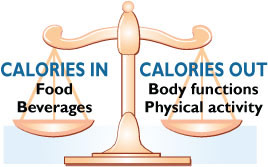
When we gain weight it is because our relationship with food has become out of balance. There is the obvious imbalance of eating and drinking more calories than our body needs which provokes it into storing the unnecessary calories in fat, but there is also the imbalance of using food for reasons other than hunger - that topic is for another day however, for now, let's deal with the fundamentals. Losing weight involves eating and drinking less calories than your body needs. The body then finds the additional calories it wants by taking them from the fat stores in your body and thus burns off the unwanted fat. Simples!
Weight maintaining involves only eating and drinking the number of calories necessary to maintain your body weight. You can calculate how many you need quite simply by taking your weight in kgs and multiplying it by 25. So, if a client has successfully slimmed down to 10 stones 7lbs (66.8kgs) she will need to consume no more than 1,670 calories a day to maintain that new weight. If she wants to consume more calories than that then she needs to burn some off, for example, a 30 minute run at 5mph will give her a further 348 calories to consume that day.
So, is the balance all about just recording how many calories you consume and use? Far from it, and that is where most traditional diets go wrong because that is all they focus on. If we just stick with the practical elements for now - to successfully maintain your weight loss you will need to gain an awareness of four key elements:
1. The calorie content of what you eat and drink.
2. The nutritional content of it
3. The GI level
4. The amount
If you focused purely on calories and nothing else you would probably go back to choosing the foodstuffs you liked when you were a lot heavier and those 1670 calories would be gone in no time. Eg: Medium sized Latte (201 cals), 4 bar Kit Kat (210 cals), Chicken Sandwich (410 cals), bag of crisps (169 cals), can of Cola (140 cals), McDonald's McChicken Burger (360 cals), small fries (230 cals) - oops gone over by 50 cals already.
If we then looked at the nutritional content of the above choices, there is 79.8grams of saturated fat (think 'Lard'), 205grams of simple carbs (mainly sugars) and a considerable amount of caffeine, the detrimental effects of which are a whole other subject!
Then look at the GI level. GI or Glycaemic Index, determines how long it takes food to burn off in the body once consumed. The longer is takes (i.e. the lower on the GI scale), the longer you feel satisfied for and don't experience hunger. There is nothing in the above list that is low on the GI scale, it is all high on the scale which means it will burn off relatively quickly and you will feel hungry again.
However, if you were to take your 1,670 calories and use it like the sample daily menu I've outlined below, you will not only weight maintain you will also be giving your body a high level of nutritional content from the low GI foods which will mean your blood sugars will be balanced giving you optimum energy (no mid-afternoon sugar dips), balanced mood, optimum brain function, and, when at the end of the day you go to bed, a more peaceful and uninterrupted sleep. Sounds like a pretty good deal really:
On waking:
Large glass of water, ideally mineral (0 cals) to rehydrate your body after a long period of no hydration.
Breakfast:
Scottish Porridge Oats made into a Porridge with water, a teaspoon of Xylitol (sugar substitute) to sweeten, a sprinkling of sunflower seeds and a dessertspoon full of blueberries. (around 200 cals) The total size of the meal to be no bigger than the size of your fist (yes, it will be enough - when you are at your healthy BMI weight your stomach will have returned to its natural size which is the size of your two fists put together. Decaff tea or coffee (0 cals if taken black, add in 35 cals if you have it white)
This starts the day with complex carbs in your system that will burn slowly over the next four hours giving you sustained energy, Vitamins E and B complex in the seeds and Vitamin C from the Blueberries to ward off colds and flu.
Mid Morning:
By now you should ideally have drunk a further two large glasses of water to keep yourself well hydrated and continue to do this during the day (0 cals). It's important to go no longer than four hours without eating and ideally no more than three. It's all part of the balance that is so vital. The body needs fueling to perform. Long periods of not eating, or eating the wrong things, is not good for it. A good mid-morning snack could be a small handful of natural almonds still in their brown "skins". (60 cals). Gives you magnesium, calcium and iron.
Lunch:
Those who normally skip breakfast and have eaten crisps or chocolate bars during the morning will now be hungry and more likely to overeat as the snacks will have pushed up their blood sugar levels and they will have then come crashing down about an hour later. You should be ready to eat but not hungry as the aim with a balanced intake of food and water is that you never feel hungry or thirsty. If you are on the move, you could use a LighterLife Management bar designed to replace a breakfast or lunch (this is not the same as a weight loss bar). It is packed full of nutrients and will keep you going for at least four hours (226 cals). Never leave the house in the morning assuming you will be able to find healthy, good quality food to eat. Always plan ahead and take food with you if necessary.
Mid Afternoon:
The Mid afternoon snack is to stop the afternoon sugar dip, and, to sustain you until you have cooked your evening meal so you aren't tempted to snack in between arriving home and eating. Half a small tub of low fat Houmous (or make your own to be super healthy) and some celery and carrot sticks are a great snack. (around 100 cals).
Dinner:
Ideally no later than 8pm so your body has chance to digest it before sleep. Our bodies were designed to have their main meal at the beginning of the day and for this meal to be the smallest, but for most of us this isn't practical, however, the total amount of food on your plate should not be any greater in volume than your two fists put together (remember, the natural size of your stomach). Half of the plate should be green leafy veg or salad (Vitamins A, E, Iron and Magnesium), a quarter of the plate can be a mix of starchy veg (carrots, parsnips, etc) and a complex carb of your choice such as Sweet Potato, Wholewheat Pasta, Brown Basmati Rice etc then the remaining quarter of the plate is for your protein choice. Aim to only have two servings of red meat a week and otherwise have white protein such as chicken, Quorn, fish etc. The amount of your protein choice should be the size of your cupped hand. In this example menu you still have most of your daily calories remaining which means you can also afford to have a small glass of red wine which is full of antioxidants (c 120 cals) and a dessert such as fruit.
This is just an example. If you don't like the food choices in the example don't despair, there are far more healthy, nutritionally sound choices than you think. These choices tick all four boxes, you won't have felt hungry or thirsty, your blood sugar levels will have remained balanced as will your energy levels, mood and concentration and you won't have gained weight. Your body will have received all the good nutritional elements and avoided the unhelpful ones such as saturated fat, sugar and caffeine.
"This is all very well", you may now be saying, "but that's just one example - how do I get to learn all of this stuff?" Simple - join one of the LighterLife Programmes and complete it to the end which includes the Management Phases during which you get a full education on nutrition, how to gauge the right volume of food for your body, GI principles and loads of tasty recipes as well as lots of back up support and guidance.
Put this together with what you have learned about yourself and your use of food and attraction to food during the counselling sessions when you lose the weight and a slimmer, fitter future is yours for the taking.
LighterLife is genuinely different. It isn't a miracle, it isn't new (we've been around for over 20 years now) but it is tried, tested, well established, successful and has thousands of happy, slim, healthy clients. Why don't you come and meet me and investigate whether or not it could be the thing for you? Give me a call on 01509 234433 or email me at debbie.ford@lighterlifecounsellor.com or text on 07860 017700 (text only, this is not a mobile phone no.) and I'd be delighted to meet you and tell you more about the Programmes we offer in a relaxed environment with absolutely no "hard sell" involved, I promise and you could start the journey to a NEW you!
I look forward to meeting you. Best wishes,
Debbie Ford
LighterLife
By confirming your subscription you're granting LighterLife permission to email you. You can revoke permission to mail to your email address at any time using the Safe Unsubscribe link found at the bottom of every email.
|