|
Interact for Health says thank you!
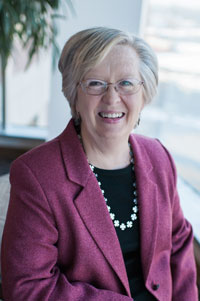 Today is a bittersweet day as we say goodbye and thank you to one of our founding leaders as she retires. Dr. Patricia O'Connor, Executive Vice President and COO, helped to create Interact from its inception and today is leaving us for her next endeavors. Today is a bittersweet day as we say goodbye and thank you to one of our founding leaders as she retires. Dr. Patricia O'Connor, Executive Vice President and COO, helped to create Interact from its inception and today is leaving us for her next endeavors.
As the ChoiceCare Foundation was selling off its assets, leading to the creation of the Health Foundation of Greater Cincinnati, Pat guided the board through a strategic planning process that built the footing upon which the Foundation's work still rests today. Her vision and expertise in healthcare and business were vital to the organization's development and ability to meet community needs.
Pat O'Connor's leadership guided the Foundation to take on cutting-edge strategies to improve the lives of the most vulnerable people in our communities. Each year more than 25,000 local children have access to healthcare through school-based health centers, 2,500 adults with severe mental illnesses have a medical home, communities are bringing back positive messaging and activities about appropriate use of substances, and our local healthcare safety net is prepared to thrive through the implementation of the Affordable Care Act (ACA). None of this would have been possible without Pat O'Connor.
Pat's passion for health policy led to the creation of the Health Policy Institute of Ohio, to the Foundation's submission of an amicus brief to the U.S. Supreme Court about the ACA, and to the development of an economic analysis of Medicaid expansion in Ohio. Recently, Pat has directed her passion toward the development of a regional trails system. Pat's belief that a lot can be accomplished if it doesn't matter who gets the credit has been a guidepost for us internally and externally.
Pat has left an indelible mark on Interact and we will miss her leadership, vision and friendship. We wish her well in her retirement!
|
|
|
Data Watch
Kentucky adults evenly divided on opinion of soda tax; most favor soda health warning labels
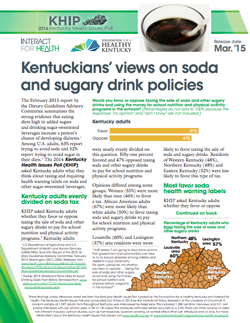 The Kentucky Health Issues Poll (KHIP) has found that Kentucky adults are nearly equally divided about whether soda and other sugary drinks should be taxed to pay for school nutrition and physical activity programs. Fifty-one percent favored and 47 percent opposed a tax. Women (55 percent) were more likely than men (46 percent) to favor a tax. African American adults (67 percent) were more likely than white adults (50 percent) to favor a tax. Louisville (60 percent) and Lexington (57 percent) area residents were more likely to favor taxing the sale of soda and sugary drinks compared with other areas in Kentucky. The Kentucky Health Issues Poll (KHIP) has found that Kentucky adults are nearly equally divided about whether soda and other sugary drinks should be taxed to pay for school nutrition and physical activity programs. Fifty-one percent favored and 47 percent opposed a tax. Women (55 percent) were more likely than men (46 percent) to favor a tax. African American adults (67 percent) were more likely than white adults (50 percent) to favor a tax. Louisville (60 percent) and Lexington (57 percent) area residents were more likely to favor taxing the sale of soda and sugary drinks compared with other areas in Kentucky.
KHIP asked respondents about health warning labels such as "Studies show that daily consumption of soda and other sugary drinks contributes to diabetes, obesity and tooth decay." Seven in 10 Kentucky adults (71 percent) favored requiring this type of health warning label on soda and other sugary drinks.
Substantial majorities of all demographic groups favored requiring warning labels on soda and other sugary drinks. Likewise, substantial majorities in each of Kentucky's regions favored such health warning labels on soda and other sugary drinks.
To see more information about Kentucky adults' views about soda and sugary drink policies and other topics, download the 2014 KHIP data release available at: www.interactforhealth.org/kentucky-health-issues-poll or www.healthy-ky.org. For more information about the poll, contact Jennifer Chubinski, Director of Community Research, at 513-458-6608 or jchubinski@interactforhealth.org.
|
Interact for Health Events
April 2015
- Thursday, April 16, Health Promotion 101
- Tuesday-Wednesday, April 21-22, Introduction to Fundraising
- Thursday, April 23, PRIME for Life - Part 1
- Monday, April 27, Successful Collaboration for Healthy Communities
- Tuesday, April 28, How to Develop Strategic Successful Special Events
- Thursday, April 28, Plan Your Way to Nonprofit Sustainability
May 2015
- Friday, May 1, Telling Your Unique Story
- Friday, May 8, 1 - 2:00 P.M. - COMPLIMENTARY WEBINAR: Pivotal Points: The Board's Role in Leadership Transitions
- Tuesday, May 12, Social Media for the Social Good
- Thursday, May 14, Public Relations/Promotion 101
- Thursday, May 21, Minimize Risk - Maximize Life
June 2015
|
|
Other News and Events
InterAct for Change announces annual nursing awards
Two distinguished nurses and 20 students will be recognized May 6 at the annual Nursing Excellence Awards event presented by InterAct for Change and the Deaconess Associations Foundation.
The awards honor people who demonstrate outstanding contributions to nursing in Ohio, Kentucky or Indiana. Amy Haering, clinical director of Cincinnati Children's Hospital Medical Center's Pediatric Primary Care Center, will receive the award for leadership. Susan Williamson, clinical nurse and lactation consultant at the University of Cincinnati Medical Center, will receive the award for clinical practice.
Twenty students will receive scholarships:
- Anna M. Drake Scholarship: Miquita Carter
- Ida W. Casey Memorial Scholarship: Diana Wyrick
- Laura Rosnagle Memorial Scholarship: Nicole Richardson
- Rose Hook Scholarship: Elizabeth Foltz
- Deaconess School of Nursing Alumni Scholarship: Amanda Jennings
- Deaconess Associations Foundation Nursing Scholarships: Kristen Banks, Meredith Bechtle, J Garrett Chunn, Kadori Ngirabakunzi and Katharine Vincent
- Deaconess Associations Foundation Advanced Practice Nursing Scholarships: Karen Burke, Adelaide Harris, Teaera Roland, Yuan Shang and Tristen Yarborough
- Deaconess Associations Foundation Allied Health Scholarships: Master of Social Work students: Amy Snow, Antione Spriggs and Aimie Willhoite; dental hygiene students: Caitlyn Capek and Alicia Ledford
Leaders, volunteers talk trails at Regional Trails Summit
|
| |
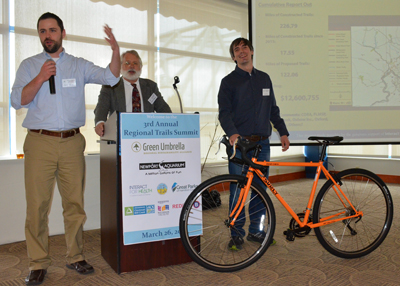
Joey Hood of Human Nature (from left), Frank Henson of Queen City Bike and co-chair of the Regional Trails Alliance, and Jason Reser of Reser Bicycle Outfitters prepare to present Brewster Rhodes of Green Umbrella with a bicycle at the Regional Trails Summit on March 27. Rhodes is retiring later this year.
|
On March 27, Green Umbrella hosted the Third Annual Regional Trails Summit: Making Connections at the Newport Aquarium. The summit brought together more than 120 volunteers and leaders in trails, health, planning, sustainability and transportation from across the region. It celebrated the accomplishments of the Regional Trails Alliance (RTA), the future of the Regional Trails Plan and strategies to collaborate in connecting our regional trails to make this area a world-class trails destination.
A highlight of the day included a "leading by example" session in which participants learned from the success of other trail networks in the region.The Louisville Loop, Indianapolis Cultural Trail and Miami Valley Trails presented their efforts for planning and implementing trails.The group was inspired to hear the stories of success and gather new ideas for the future of trails in Greater Cincinnati. Another key session was led by representatives of the OKI Regional Council of Governments, who discussed active-transportation planning. Anderson Township representatives also shared how they have secured active-transportation planning.The day was capped with impressive reports about the successes during the past year of the many trail groups in the region.
As the weather warms up, get out and get active on the many trails the region has to offer. Find a trail near you: https://www.google.com/maps/d/viewer?mid=z-vYdeA0nKDU.knf4hMZmg5Gg. And join the Regional Trails Alliance for its next quarterly meeting from 9 a.m.-noon July 16 at Interact for Health.
Celebrate public health on Fountain Square April 11
The Cincinnati Health Department will celebrate public health 11 a.m.-4 p.m. Saturday, April 11, 2015, on Fountain Square in downtown Cincinnati. The free event will include Body Mass Index checks and referrals, healthy snacks, dancing, local health organizations, and giveaways and door prizes.
Follow Interact for Health on social media
Follow Interact for Health on Twitter (@Interact4Health) and like our page on Facebook to stay informed about our funding opportunities, grantees' success stories, Affordable Care Act information and other news about health promotion. Click here to go to our Facebook page. Click here to go to our Twitter page.
|
Soapbox Media
Talbert House celebrates 50 years, honors top employees
Tuesday, March 17, 2015: To celebrate 50 years in the community, the Talbert House recently honored key employees who work day-in and day-out to uphold the nonprofit's standards of excellence.
Hughes STEM High School a springboard for effective community-based learning
Tuesday, March 17, 2015: Because of strong community partnerships that result in events like speed mentoring and with lots of opportunities for experiential learning, Hughes STEM High School students are a step closer to bright futures.
|
News from American Health Line
HEALTH PROMOTION: Ind. Gov. To Declare Public Health Emergency Amid HIV Outbreak
Indiana Gov. Mike Pence (R) on March 25 said he is preparing to declare a public health emergency in the state's Scott County amid a growing HIV outbreak stemming from injection drug use. Indiana health officials have said that 72 HIV cases have been confirmed in the southern region of the state, while seven other individuals have been diagnosed with preliminary positive HIV infections. That number increased from 26 confirmed infections last month. All infected individuals either live in or have ties to Scott County. Further, state health officials expect the number of HIV cases to increase as they work to contact as many as 100 individuals linked to those with confirmed cases. According to Pence, the county usually sees about five HIV cases annually. According to state epidemiologist Pam Pontones, injection drug use has been identified as the means of infection in almost all of the cases (Callahan, AP/Sacramento Bee, 3/26). To address the issue, Pence on March 26 issued an executive order to override state law and implement a short-term needle exchange program in the county. Pence's order will last for 30 days, at which point he can decide whether to extend the program for an additional 30 days (Callahan, AP/Miami Herald, 3/26). Click here for the AP/Sacramento Bee article. Click here for the AP/Miami Herald article.
SUBSTANCE USE DISORDERS: Ohio Boosts Funding for Community Heroin Recovery Pilot
Ohio Attorney General Mike DeWine (R) on March 16 announced additional grant funding for a heroin recovery pilot program in Lucas County. The state last year provided $650,000 in state funds to create the program. A majority of the funding went to renovations for a recovery housing facility (AP/Dayton Daily News, 3/15). The new grant is worth $150,000 and is meant to expand the program, known as the Drug Abuse Response Team, or D.A.R.T. The funds will be used to hire more full-time D.A.R.T. deputies to help guide individuals who were hospitalized because of an overdose to resources for long-term recovery and housing. DeWine in a statementsaid, "By increasing the number of full-time deputies working as part of the [D.A.R.T.] team, it will enable them to help more people struggling with addiction get on the road to recovery" (Office of the Attorney General release, 3/16). Click here for the AP/Dayton Daily News article. Click here for the Office of the Attorney General release.
MEDICAID: Healthy Indiana Plan Enrolls More Than 100K
Indiana's alternative Medicaid expansion under the Affordable Care Act, known as the Healthy Indiana Plan, has enrolled more than 100,000 low-income individuals since the plan was approved by the federal government two months ago. The 100,000 new enrollees add to the 180,000 Indiana residents who were enrolled in the original HIP plan or Hoosier Healthwise programs that were converted into the new HIP plan. Overall, state officials estimate that about 350,000 Indiana residents could be eligible for the program (AP/Fort Wayne News-Sentinel, 3/19). Click here for the AP/Fort Wayne News-Sentinel article.
SUBSTANCE USE DISORDERS: Ky. Legislature Reaches Deal on Heroin Bill, Signed by Gov.
Kentucky Gov. Steve Beshear (D) on Wednesday signed a comprehensive bill aimed at addressing the state's heroin epidemic (Pilcher/DeMio, Cincinnati Enquirer, 3/25). The measure was the legislature's top priority this session, as Kentucky has seen heroin overdose deaths increase to 230 in 2013 from 22 in 2011 after the state made prescription painkillers harder to obtain (Beam/Schreiner, AP/Washington Times, 3/25). The bill permits heroin users caught with a small amount of the drug to receive treatment, while increasing penalties on dealers, requiring those caught with 100 grams or more to serve at least 50% of their sentence (Cincinnati Enquirer, 3/25). The bill also allows local governments to establish needle exchange programs where users can switch used, dirty needles for clean ones (AP/Washington Times, 3/24). In addition, the bill will expand use of naloxone -- an anti-overdose drug -- and create a "good Samaritan" measure that protects individuals from prosecution for drug charges if they call for help in the case of an overdose as long as they provide a valid name and address. Further, the bill calls for $24 million from budget savings over two years to treat individuals with heroin-related substance use disorders -- including those who are in jail -- and infants born to mothers with heroin dependency, as well as to fund additional educational programs (Cincinnati Enquirer, 3/25). Click here for the Cincinnati Enquirer article, here for the first AP/Washington Times article and here for the second AP/Washington Times article.
HEALTH PROMOTION: Ky.'s Largest Health Plan Launches Diabetes Prevention Effort
Kentucky Employees' Health Plan will allow its nearly 300,000 beneficiaries to enroll at no cost in the National Diabetes Prevention Program. Members of the plan -- which covers local and state government employees and retirees and is the largest health plan in Kentucky -- will be able to sign up for weekly classes under the program. Coaches of the classes help individuals monitor their physical activity, nutrition and weight loss. Individuals who participated in a pilot version of the program at King's Daughters Medical Center in Ashland, Ky., lost 23 pounds on average. According to state Department of Employee Insurance Commissioner Joe Cowles, at least 85,000 state health plan enrollees have a high risk of eventually developing Type 2 diabetes (AP/Sacramento Bee, 3/18). Click here for the AP/Sacramento Bee article.
Rx DRUGS: Ind. Legislature Approves 'Right-To-Try' Bill
Indiana Gov. Mike Pence (R) has signed into a law a "right-to-try" bill (HB 1065) that expands access to certain drugs for terminally ill patients. Specifically, the bill gives such patients access to drugs that have passed just the first phase of FDA's approval process. The measure, which passed the state House and Senate unanimously, does not require insurers to cover the cost of such drugs, nor does it require drugmakers to supply the drug to patients (Firger, CBS News, 3/25). Eight other states have passed similar right-to-try bills (AP/Fort Wayne News-Sentinel, 3/20). Click here for the HB 1065. Click here for the CBS News article. Click here for the AP/Fort Wayne News-Sentinel article.
ACCESS TO CARE: Report Links Access to Care to Health Outcomes in Ky.
The Robert Wood Johnson Foundation's annual county-by-county health rankings released March 25 show that access to care and incomes in some Kentucky counties are linked to individuals' health outcomes. According to the rankings, Kentucky's Perry County ranked lowest for health outcomes. Renee Neace, health education director for the Kentucky River District Health Department, noted that individuals in Perry County are "really restricted" and face difficulties accessing physicians' offices and hospitals because it can take one hour to travel from one side of the county to the other. In addition, she noted that smoking rates in the county are high. Conversely, Kentucky's Oldham County ranked on top of the list for health outcomes. The county is situated close to Louisville, meaning residents can easily access hospitals, primary care physicians and specialists. In addition, the county offers access to healthy food options, walking trails and other exercise areas (O'Donnell/Ungar, USA Today, 3/25). Click here for RWJF's rankings. Click here for the USA Today article.
MEDICARE: CMS Considering Whether To Allow Coverage for Type of Cancer Scan
CMS last week accepted a request from a group of physicians to consider providing Medicare coverage nationwide for a type of scan used to discover whether cancers have spread to patients' bones. A positron-emission tomography scan injects a tracer into a patient. Physicians then analyze the tracer's path through the body to glean information, such as whether a patient's cancer has spread. Last month, physicians who oversee the National Oncologic PET Registry in a letter requested that CMS allow Medicare to cover a version of the test nationwide that uses a type of sodium fluoride to determine if patients have abnormal growth in their bones. CMS currently only reimburses providers for such tests if they participate in NOPR, which the agency created in 2006. In their letter, the physicians stated that data submitted to NOPR show that Medicare should cover the PET test across the U.S. Physicians reported to NOPR that using the type of PET test meant they were able to avoid requesting additional invasive tests in 66% of cases and avoid requesting additional noninvasive tests 71% of the time. CMS said it will accept comments on the national coverage request through April 15. The agency is scheduled to release a proposed decision by Sept. 16 and release a final decision by Dec. 15 (Young, "Healthopolis," Roll Call, 3/19). Click here for the National Oncologic PET Registry's letter. Click here for Roll Call's "Healthopolis" article.
HEALTH CARE REFORM: About Half of U.S. Households Expected To Have To Repay Some of ACA Subsidy
About half of U.S. households that qualified for health insurance premium subsidies under the Affordable Care Act likely will have to return part of the money to the federal government, according to a Kaiser Family Foundation report. The subsidies are available to residents with incomes between 100% and 400% of the federal poverty level. Subsidy amounts are determined based on an individual's projected annual income, which can change over the year (Rubenfire, Modern Healthcare, 3/24). Between 4.5 million and 7.5 million households are estimated to have received subsidies for 2014. According to the report, almost all U.S. families who received subsidies either will have to repay a portion of the subsidy or receive a refund because their income changed from their initial calculations. Overall, just 4% of households received a subsidy in the correct amount (Ferris, The Hill, 3/24). The report found that while around half of U.S. households are expected to have to return part of their subsidy, roughly 45% are expected to receive a refund. According to the study, households that have to repay part of their subsidy will pay between $667 to $1,380, with an average repayment of $794. By contrast, households eligible for a refund will receive between $412 and $1,601, with an average refund of $773 (Modern Healthcare, 3/24). Click here for the Kaiser Family Foundation report. Click here for the Modern Healthcare article. Click here for The Hill article.
HEALTH CARE REFORM: Number of Uninsured Down by 11.4M Since ACA Passage
The number of uninsured U.S. residents reached its lowest level in more than 15 years, dropping by more than 11 million residents since the Affordable Care Act was signed into law five years ago, according to a CDC report. The report compared the uninsured rate from the first nine months of 2014 with annual statistics from the National Health Interview Survey as far back as 1997. The number of uninsured U.S. residents declined from 48.6 million in 2010 to 37.2 million between January and September of last year, marking a drop of 11.4 million individuals since the ACA was signed. Meanwhile, the most significant decline in the number of uninsured residents -- 7.6 million -- occurred between 2013 and the first nine months of 2014, as major provision of the ACA went into effect, according to the report. According to the report, states that expanded Medicaid saw larger drops in their share of uninsured residents (Alonso-Zaldivar, AP/U-T San Diego, 3/24). Click here for the CDC report. Click here for the AP/U-T San Diego article.
|
|
|
|
|