Carpe Diem
                                                                      January 2015
Greetings!


Hello All,


Welcome new and returning members of CFPA! My name is Karen Higgins and I will be your CFPA president for 2015. I am looking forward to a great year. I can admit though, that my writings will lack the animation of our 2014 president, Marisa Green. Thank you Marisa for all you did for CFPA in 2014 and 2015 as this year's head of the PR committee.


Your board of directors and committees are busy working on upcoming events for 2015. We will have some evening mixers where we can meet together, network, enjoy an adult beverage, and generally unwind after work. We will do other fun activities such as bowling as well as various fundraising events for our 2015 charities (Women's Residential Center and Best Buddies). We will have opportunities to give to those in need through donations of in-kind items or time.


Additionally, CFPA will be offering CLE seminars such as our get away to Cocoa Beach. I hope you will plan to join us! We have such a great time while also getting those CLE credits! You can also gain CLE credits by signing up for our Certified Paralegal exam review course. You take just certain portions you want for refreshing your skills. Taking the exam is not required. CFPA's CP review course is a great benefit to our members for enhancing your skills (and employability), and the best part is, our review course is among the most economical in our area.


Please feel free to talk with us (your board of directors and/or committees) by emailing us anytime with your suggestions and questions. Check out our website at CFPAinc.org for various email addresses. 


JUST AN FYI ... NEWSLETTER IS GOING QUARTERLY!! 


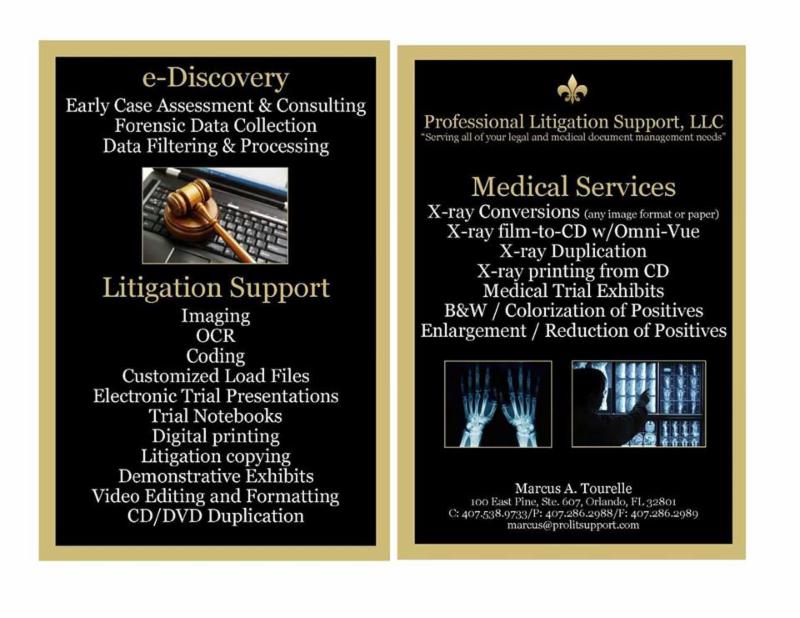
We appreciate Professional Litigation Support's sponsorship of our newsletter this month and as continued supportive Patron Members of CFPA. If you wish to know more about Professional Litigation Support, please click on their logo which will take you to their website.    


Karen Higgens, FRP
Florida Registered Paralegal
CFPA President - 2015
 President@cfpainc.org
Highlights from CFPA's Annual Holiday Social ...

If you were unable to attend the Annual Holiday Social in December, this is the time of year where CFPA recognizes certain individuals for the President's Award, Paralegal of the Year and also announces the Scholarship winners.

Please join me in congratulating the following:

2014 President's Award went to  

Micaela Gomez


2014 Paralegal of the Year went to  

Meredith Gibson Zornek


Student Scholarship went to  

Anne Hughes


ACP Scholarships went to  

Jean Hinton and
Leslie Brown


Upcoming Mixer ...

MARK YOUR CALENDARS to attend CFPA's upcoming mixer ...
on February 4th!!

Evite will be forthcoming!!


Downtown Luncheon ... 

THE NEXT DOWNTOWN LUNCHEON WILL BE HELD ON

 February 17, 2015
at 12:00 p.m.
at

110 W Church St, Orlando, FL 32801

(321) 319-0600


PLEASE RSVP TO ESTHER ENGLISH AT
ELWOOLSEY@GMAIL.COM   


Winter Park/Maitland Luncheon ...

CFPA's Next Winter Park/Maitland Luncheon
will be held
on
February 19, 2015
11:45 a.m. 
at
Olive Garden
665 N. Orlando Avenue
Winter Park, FL 32789
(Across from the Winter Park Village)

Olive Garden 2

If you are planning to attend PLEASE email your RSVP to

Janet Scott, FRP at Janet@YourCaringLawFirm.com
by no later than February 17, 2015.


Sponsor of the Quarter ...

Thanks to Professional Litigation Support and their continued support of our association!!


Be sure to check them out at www.prolitsupport.com or call or email Marcus or Tess with all your litigation support needs.

Avoiding Ethical Minefields in Social Media ...

Avoiding Ethical Minefields in Social Media


The growing world of Social Media has become an increasingly important tool for attorneys that presents a new set of ethical issues in practice.


The social media sites most widely used by attorneys include Facebook, Twitter, Youtube, LinkedIn, Google Plus and Avvo. Facebook is used to build a client-fan base and offers new ways to communicate with possible clients. Twitter is used for microblogging and helps attorneys brand themselves to a new, younger clientele. LinkedIn is a professional networking site similar to Facebook but widely used by professionals and employers.


The following scenarios explore some of the ethical issues attorneys face in using social media:


Obtaining Evidence from Social Media

A question many attorneys face is whether or not they may use a social media site to obtain information about someone for use in litigation. One of the main aspects of social networking sites is that the user sets their own privacy standards and determines what information is provided or shared and who that information is accessible to. For the attorney seeking information for litigation, the best chance you have is for this person's profile, page or feed to be available to the public. Information offered to the general public is fair game for litigation. However, for the person whose privacy settings are tight, you will not be able to access their information without connecting with this person. The ethical issue arises when the attorney uses deceptive practices or a third-party agent to gain access to this persons information; in other words, deceiving the person into giving you access to private information. An attorney must never use deception, misrepresentation or under false pretenses obtain access (become friends) with someone for the purpose of using that information in litigation.


Impeachment with Social Media

When using social networking sites to gain information for purposes of impeaching a witness, the same rules of deception and misrepresentation discussed above will apply. Additionally, the rules will also apply if another attorney in your firm or an investigator you have hired is seeking to gain the information for impeachment. If you request to become a witness's friend on Facebook  for the purpose of obtaining this information for impeachment, their lack of wariness in accepting your friendship is immaterial. However, whatever information is obtainable without seeking access to private material - information not protected by privacy settings - is always permissible.


Always remember in every situation, an attorney should never contact a person represented by counsel in litigation. This includes connecting with this person on social networking sites. You should avoid adding or communicating with represented parties through social media in the same way you would in real life. The court will extend the rules regarding contact with represented parties to include adding as a friend on Facebook or asking to follow their Instagram account.


Using Social Media for Outside Juror Investigation and Communication

With the advent of internet-based social networking services, additional complexities are introduced to the traditional rules barring contact between attorney and jurors during trials.


As a matter of law, ethically an attorney can not have either direct or indirect communication with jurors outside the courtroom The main rule in investigating jurors on social media is you can only passively monitor information accessible to the general public. It is proper and ethical under to undertake a pretrial search of a prospective juror's social networking site, provided that there is no contact or communication with the prospective juror and the lawyer does not seek to "friend" jurors, subscribe to Twitter accounts, send tweets or otherwise contact them. Further, the attorney may never act in any way by which the juror becomes aware of your monitoring. And of course, no deceit or misrepresentation may occur in order to monitor information from these sites. You must be careful here, it is always better to steer clear of all communication with jurors outside of the courtroom. As for post-trial communications, the general rules apply regarding harassment and unwanted contact with jurors.


Ex Parte Contact

Many attorneys question whether a friend or connection request constitutes an unethical ex parte contact. The general rule is that an attorney who makes an ex parte "friend request" to a represented party is making ex parte contact and such contact is prohibited. However, attorneys may ethically view and access the Facebook profiles of a party other than the lawyer's client in litigation as long as the party's profile is available to all members in the network and the attorney neither "friends" the other party nor directs someone else to do so. The attorney-client privilege does not protect anything a party posts on their Facebook page, even if the page is accessible only to a limited circle of people.


Social Media may present a whole new set of ethical issues to your practice but it's importance in growing your firm or your own career should not be overlooked. The risk is highly outweighed by the reward if you are mindful of the ethical pitfalls.


Article Courtesy of:
Legal Ink Magazine
Practice Management Series
January 2015
http://legalinkmagazine.com


CFPA on the Web ...

You can find CFPA on these social networking sites:


Find us on Facebook  

Facebook


View our profile on LinkedIn 

Linked In


Follow us on Twitter  

Twitter  


Please Sign My Name ... NOT! ... 
Voisin

Please Sign My Name...NOT!

By Vicki Voisin, ACP


Consider this scenario: You have been employed as a paralegal for the same attorney for several years. He happens to be out of town taking depositions. A deadline looms...a document absolutely has to be filed with the Court by 5:00 o'clock. No problem, you think. Your boss is expected back in the office by 3:00 so that will allow plenty of time for him to review the final draft, sign it and for you to file it with the Clerk before closing time. 


Then you get the dreaded call. The attorney has been held up and won't be back in the office until the next morning. But what about the filing deadline? "No problem," he says. "Go ahead and sign my name."


What should you do?


A. Sign the document, make copies and rush to the Court House?


B. Remind your employer it's unethical for you to sign his name to a pleading?


Do tell me you chose 'B'! This is the correct answer...the ethical answer. Signing your employer's name to the document constitutes the unauthorized practice of law. Only the attorney of record has the authority to sign a pleading. You cannot sign your employer's name (or your own name) even at his direction. Here's the reasoning behind this statement.


This issue is generally addressed in each state's Court Rules. For instance, the Michigan Rules of Court at 2.114 state that every document of a party represented by an attorney shall be signed by at least one attorney of record. Similar language is found in the Nevada Rules of Court at Rule 11(a). 


Let's take this one step further by reviewing the Model Rules of Professional Conduct.  ABA MRPC 5.5 deals with the unauthorized practice of law and states that an attorney shall not assist a person who is not a member of the bar in the performance of any activity that constitutes the unauthorized practice of law. Further MRPC 5.3 refers to an attorney's responsibilities regarding nonlawyer assistants and states that an attorney shall be responsible for conduct of such a person that would be a violation of the rules of professional conduct if engaged in by an attorney if the attorney orders or ratifies the conduct. 


The ABA and many states have adopted Model Guidelines for the Utilization of Paralegals. These guidelines generally state that an attorney may ethically assign responsibility to a paralegal for the performance of tasks related to the representation of a client and the law firm's delivery of legal services, commensurate with the experience and training of the paralegal and where the attorney directly supervises the paralegal and reviews the paralegal's work product before it is communicated outside the law firm. 


The following is a direct quote from the Comments attached to Guideline 2 of the Guidelines for the Utilization of Legal Assistants adopted by the Connecticut Bar Association: A legal assistant may not appear in court to plead, to try cases, to argue on behalf of another person, or to sign pleadings, except as expressly permitted by statute, court or administrative agency regulation. This does not, however, prohibit a legal assistant from signing documents as a witness or notary public, or in some other nonrepresentative capacity.


How can you ethically handle this situation? If there is more than one attorney in the firm, another attorney may sign on behalf of the absent attorney. If you work for a sole practitioner, it's possible that the Clerk will allow you to file an original document with a faxed signature page. The document could then be sent by fax or e-mail to the attorney for his review. If it met with his approval, he could sign and fax back the signature page. You would file the page with the original signature as soon as it is available. Still, you may be out of luck if you're filing a motion because often Clerks will only accept a motion bearing original signatures. In more and more instances, electronic filing is allowed. Still, the attorney must review the work product before it is filed. 


Should your firm adopt the attitude that "no one will ever know" if you sign the attorney's name to the document? The answer is NO! Please remember that there are sanctions for violations of the Court Rules. In addition, attorneys have a duty to supervise their employees and to be certain that their actions are ethical. Again, the duty to supervise includes the review of all documents before they leave the office. 


Of course there is an exception! In 2006 the North Carolina Bar Association issued Ethics Opinion 13 stating that an attorney may allow a paralegal to sign his name to court documents so long as it does not violate any law and the attorney provides the appropriate level of supervision. This is to be done only under exigent circumstances when the attorney is not available and no other attorney in the firm is able to do so. Again, this is for emergency purposes only and applies only to paralegals working in North Carolina. 


There are other instances where you should refuse to sign your name (or someone else's) to a document. Be especially careful when you're witnessing or notarizing someone's signature. It's unethical and illegal to sign as a witness to a signature unless you actually see the person sign. Further, you must be certain of the identity of the person signing the document. Is it really Jane Doe? Imagine your embarrassment (not to mention the legal ramifications) of having to tell a Judge, "Yes" that's your signature as a witness to a wife's signing a mortgage but "No" you did not actually see her sign it! 


Another area where you should use caution is the signing of correspondence on behalf of your firm. You must be sure that any correspondence signed by you clearly identifies your status as a nonlawyer and covers only information or procedure. Providing legal advice is the responsibility of the attorney. If you sign a letter that contains legal advice, you will be committing the unauthorized practice of law. 


Your challenge: Remember that signing a document is an important step in the legal process. Only an attorney may sign his or her name on a pleading. Only an attorney may sign correspondence that offers legal advice. Whenever you put your name on the dotted line as a witness or a notary, be sure you actually see the person sign the document and always be certain of his or her identity. Last, review your jurisdiction's Court Rules, Model Rules of Professional Conduct, and (if available) the Guidelines for the Utilization of Paralegals/Legal Assistants to be sure that your actions always comply. 


Article Courtesy of: 

Vicki Voisin, "The Paralegal Mentor", delivers simple strategies for paralegals and other professionals to create success and satisfaction by achieving goals and determining the direction they will take their careers. Vicki spotlights resources, organizational tips, ethics issues, and other areas of continuing education to help paralegals and others reach their full potential. She publishes a weekly ezine titled Paralegal Strategies and co-hosts The Paralegal Voice, a monthly podcast produced by Legal Talk Network. More information is available at www.paralegalmentor.com  


From the Editor ...
Cassie Snyder, ACP, FRP Editor - Carpe Diem Editor@cfpainc.org

If you would like to advertise or if you have any legal related articles or topics of interest that you would like to see covered in the next issue of the Carpe Diem please feel free to share them with me.

Article submissions by CFPA Members on legal related subjects are published upon approval and discretion of the Editor.  There is no charge for these items to be published


Advertising Rates for 2015:


$30.00 per Issue; or 

$100.00 for 4 Issues (CFPA Patrons Members only) 


HAVE YOU MISSED AN ISSUE OF THE CARPE DIEM??

Here is a link to all of our archived issues since 2011:

Carpe Diem Archived Issues


In This Issue
Highlights from Annual Holiday Social
Upcoming Mixer
Downtown Lunch
Winter Park/Maitland Lunch
Sponsor of the Quarter
Avoiding Ethical Minefields
CFPA on the Web
Please Sign My Name ...
From the Editor
Membership Corner
Newsletter Sponsor
Membership Corner


Teresa Albin 

Danielle Archer 

Carrie Dobbs  

Katie Erkens   

Rory Floyd
Kamaran Gay
Jonathan Michael Noguera


For Membership Information and Application CLICK HERE  

Quick Links
Newsletter Sponsors: 


CFPA Contact:

Tess Tourelle
or

Marcus Tourelle

100 East Pine Street Suite 607  

Orlando FL, 32801


407.286.2988

www.prolitsupport.com