|
KDHE Division of Environment Regulatory Agenda
KDHE's Division of Environment has numerous regulations currently in process. To view the regulatory agenda, click the link below.
DOE Regulatory Agenda
|
KDHE Hosts the 2015 Kansas Environmental Conference
|
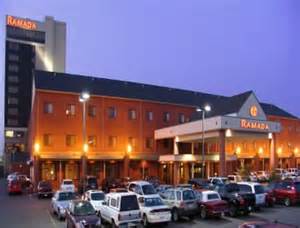
| | Ramada Hotel & Convention Center |
The 2015 Kansas Environmental Conference was held August 18 - 20 at the Ramada Topeka Hotel & Convention Center. The conference, which focused on environmental compliance, pollution prevention, and sustainability, recorded an attendance of 375 individuals participating throughout the event.
On Tuesday, August 18, the KDHE Bureau of Waste Management hosted a Basic Hazardous Waste Generator Workshop and an Advanced Hazardous Waste Generator Workshop. Over 100 individuals attended these workshops to learn more about hazardous waste generator requirements and other topics. The Brownfields Workshop also took place on Tuesday with over 50 in attendance to learn about Brownfields properties and how to fund successful redevelopments through different available resources.
The conference commenced Wednesday morning with a plenary session on the "State of the Kansas Environment" presented by John Mitchell, Director, KDHE Division of Environment. In conjunction with Mr. Mitchell's presentation,
KDHE Bureau Directors provided updates on each of their respective
bureaus; Leo Henning/Bureau of Environmental Remediation, Mike
Tate/Bureau of Water, William Bider/Bureau of Waste Management, and Rick Brunetti/Bureau of Air.
Following Mr. John Mitchell's and the KDHE Bureau Director's presentations, David Cozad, Regional Counsel for EPA Region 7, gave a presentation addressing the topic of "EPA Enforcement Theory".
|
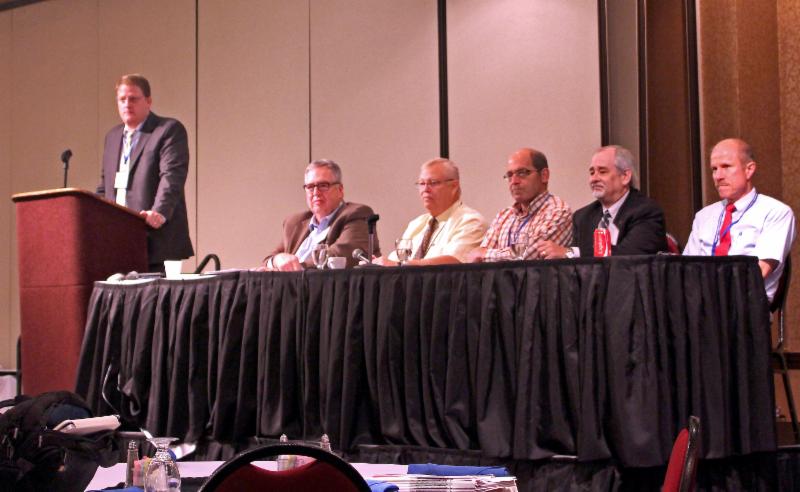
| | "Ask the Regulators" Q & A Plenary |
Concurrent sessions covered various topics related to air, water, waste, remediation, sustainability and pollution prevention. Following the concurrent sessions, conference attendees attended a special question and answer plenary entitled "Ask the Regulators". This Q & A plenary enabled conference attendees to ask questions regarding environmental regulations and receive answers from the business perspective.
The closing plenary session entitled "Mars: Sustainability in a Generation" was presented by Mark Baker, Site Engineering Manager of the Mars Corporation. Mr. Baker's presentation reviewed the Mars Topeka building sustainability initiatives which enabled LEED Gold certification. In addition, Mr. Baker also discussed the sustainability goals and current practices of the Mars Corporation.
Thirty-three vendors displayed their products and services at the conference. A vendor reception was held on Wednesday evening. This was a great opportunity to visit with the vendors in a relaxed atmosphere. New to the Kansas Environmental Conference, was a poster session held in conjunction with the vendor reception. Kansas college students and Pollution Prevention (P2) interns displayed five poster boards.
Conference presentations are now available online at http://www.kdheks.gov/sbcs/environment_conf.html. If you would like to participate in the planning of the 2016 Kansas Environmental Conference, please email Melissa Hammond at mhammond@kdheks.gov.
Photos courtesy of Diana Lehmann of KDHE's Bureau of Water.
|
|
KDHE Recognizes the Pollution Prevention Efforts
of Four Kansas Companies with Awards
The Kansas Pollution Prevention Program promotes pollution prevention as an environmental ethic to achieve improvements in public health and environmental quality. The P2 Award recognizes projects that eliminate or reduce the generation of pollutants or wastes at the source or projects that conserve natural resources. The Pollution Prevention with Distinction Award is for companies that go above and beyond the Pollution Prevention Award by meeting at least one of the following distinctive qualifications:
- Quantitative environmental health impacts (workers or the community).
- The project can be used by similar organizations in different locations within the state.
- P2 projects encompassing multiple processes or media.
The Kansas Department of Health and Environment (KDHE) announced the 2015 Pollution Prevention (P2) Award recipients during an awards luncheon at the Kansas Environmental Conference, held August 18 - 20 at the Ramada Topeka Downtown Hotel & Convention Center. KDHE's Division of Environment Director, John Mitchell, provided a synopsis of each award recipients' project(s) and presented the awards.
"We are happy to honor these companies with this year's P2 awards for their success in planning and implementing a variety of waste reduction and conservation projects," Mitchell said. "In addition to recognizing these companies for their environmental accomplishments, the P2 awards allow us to showcase specific efforts that other Kansas businesses can incorporate into their manufacturing processes."
|
| |
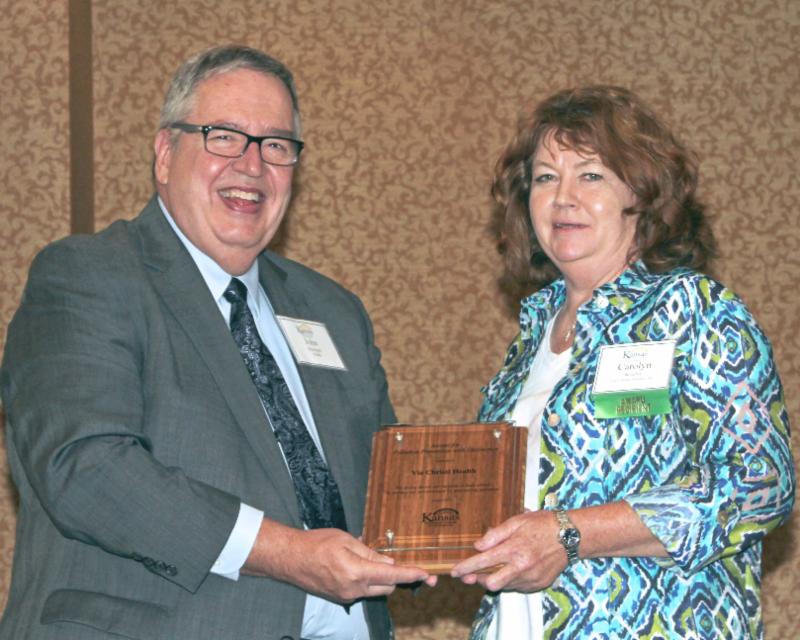
KDHE's Division of Environment Director
John Mitchell with Carolyn Koehn of Via Christi Health
|
Via Christi Health, Wichita, is a provider of health care services in Kansas. Via Christi Health was awarded the Pollution Prevention with Distinction Award for its "Greening the OR" initiatives and efforts in energy conservation. Following are highlights from their application:
- Operating Room teams at Via Christi use hundreds of single use devices and instruments every week. Instead of discarding the devices, Via Christi Health now works with a vendor to reprocess and reuse these devices. Nearly five tons of devises that were incinerated or landfilled are now reprocessed annually, at a cost savings of approximately $159,000.
-
Each of Via Christi Health's nineteen surgical rooms has one light fixture that supports two spotlights. By upgrading the original spot lights to the Steris Harmony LED 585 in all nineteen OR surgical rooms, Via Christi Health saved 84,840 kWh, reduced GHG's by 83 MTCO2e, and experienced a savings amounting to $8,484. The cost to replace these units was approximately $40,000 per room.
- Via Christi Health also replaced their conventional lighting with LED's in underground passageways that connect the hospital to the distribution and energy centers, parking lots, garages, and ongoing remodeling projects.
The lighting fixtures replacement documented savings of 135,200 kWh/year, representing a 50% reduction in energy use.
|
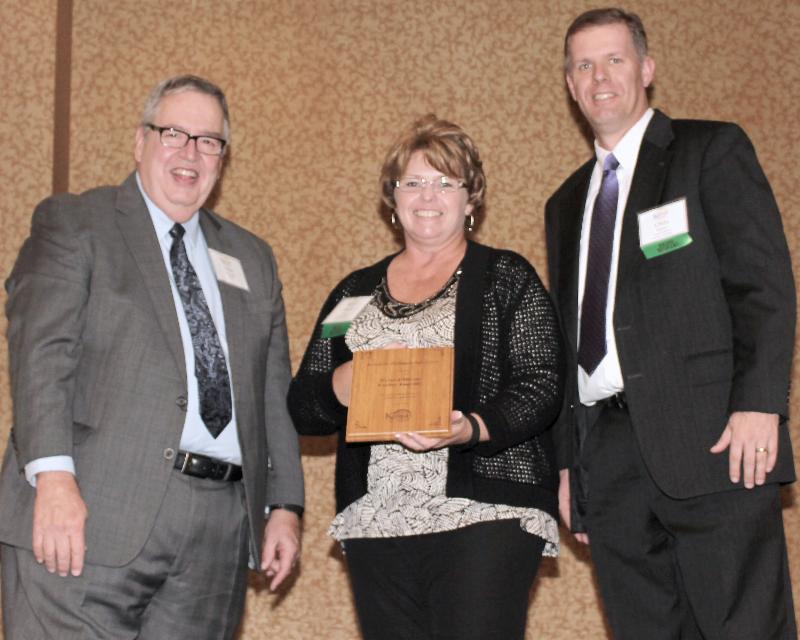
| KDHE's Division of Environment Director
John Mitchel with Thomas Williams and Jason Williams of DoubleTree by Hilton Wichita Airport |
DoubleTree by Hilton Wichita Airport, Wichita, is a hotel serving Kansas. DoubleTree was awarded a Pollution Prevention Award for its efforts in reducing energy and water usage. Following are highlights from their application:
-
Lighting upgrades involving the replacement of T-12 ballasts with T-8 and T-5 ballasts, the replacement of incandescent lights in the lobby and restaurant areas with fluorescent lighting, and the update of incandescent bulbs to compact fluorescent lighting (CFL) in each of the 302 guest rooms' ten lamps resulted in a decrease of 327,436 kWh/year.
- DoubleTree also changed out all 302 guest room sink aerators from 2.2 gallons per minute (gpm) flow to 0.5 gpm resulting in the conservation of 1,201,387 gallons of water annually.
|
| |
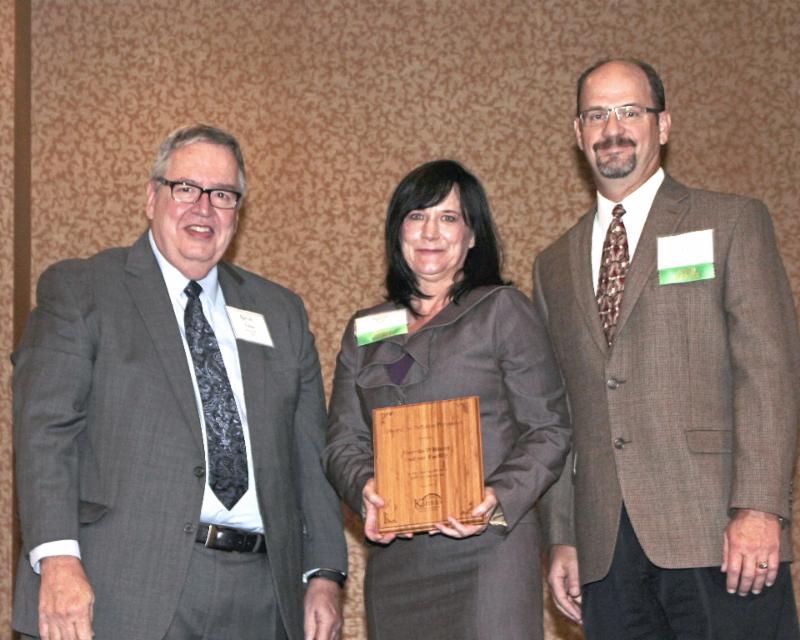
KDHE's Division of Environment Director
John Mitchell with Sherri Zeller and Chris Degner of
General Motors Fairfax Assembly
|
General Motors Fairfax Assembly, Kansas City, assembles the Chevrolet Malibu and the Buick Lacrosse. General Motors was awarded a Pollution Prevention Award for its Purge Thinner Reduction Project. Following are highlights from their application:
- The main purpose of the Purge Thinner Reduction Project was to reduce the usage of thinner that is used to purge paint from the lines (piping) to the painting equipment and used to clean the painting equipment between color changes. By creating a Purge Reduction Committee that met monthly and examined everything related to how the thinner was used, General Motors decreased its thinner use by 101,894 gallons, lessened VOC emissions by 92,700 pounds, and experienced a savings of $405,500 over 12 months.
|
| |
KDHE's Division of Environment Director
John Mitchell with Judy Ulmer and Mike Strickland of Sherwin-Williams
|
Sherwin-Williams, Andover, manufacture protective and marine paint coatings. Sherwin Williams was awarded a Pollution Prevention Award for its reduction in groundwater and energy usage. Following are highlights from their application:
- Sherwin-Williams' prior fire suppression system utilized two, 200,000 gallon tanks that drew 26.1 gallons per minute of groundwater. Installation of an enhanced fire suppression system resulted in less than 30,000 gallons of ground water needed for the facility's protection.
- An employee Sustainability Team was created to focus on electricity usage reduction and their efforts have reduced the amount of electricity consumed for every 100 pounds of product produced from 10.18 kWh in 2013 to 8.52 kWh in 2014.
Congratulations to the 2015 award recipients!
Learn more about these projects and the Pollution Prevention Awards by visiting http://www.kdheks.gov/sbcs/p2_pollution_prevention_awards.html.
Photos courtesy of Diana Lehmann of KDHE's Bureau of Water.
|
|
A Special Recognition Award for Railroad Tie Cleanup
by Bob Medina, KDHE's BWM
For nearly 20 years KDHE has worked with concerned citizens, local government officials, and responsible parties to address large accumulations of waste railroad ties resulting from routine replacement of ties and line abandonment. Such projects may generate many thousands of railroad ties which are at times left in large piles along the rail lines.
Dumps of stored railroad ties can create aesthetic problems for neighbors, fire hazards, and even habitat for some undesirable animals as we have seen at various locations. The Bureau of Waste Management has worked with responsible railroad companies to address these accumulations without enforcement actions. Last year two railroad companies were recognized for managing their waste railroad ties.
This year we added Kyle Railroad to the list of companies that have responsibly cleaned up a large number of railroad ties
The Kyle Railroad is owned by Genesee & Wyoming Inc. which operates the largest regional and short line railroads in North America. They transport coal, farm products, lumber, paper, fertilizer, grain products, roofing materials, frozen food, minerals, chemicals, and steel products. In Kansas, the Kyle operates 447 miles of track in the northwestern/north central Kansas.
During 2013 through 2015 the Kyle worked on repairing their track from Downs, to Solomon. The distance was approximately 110 miles of track. The amount of waste ties generated was approximately 73,000. Kyle Railroad developed a plan and properly disposed of these ties at a permitted Construction and Demolition landfill. By carrying out this clean-up and disposal work, Kyle is helping protect the environment and the scenic beauty of Kansas.
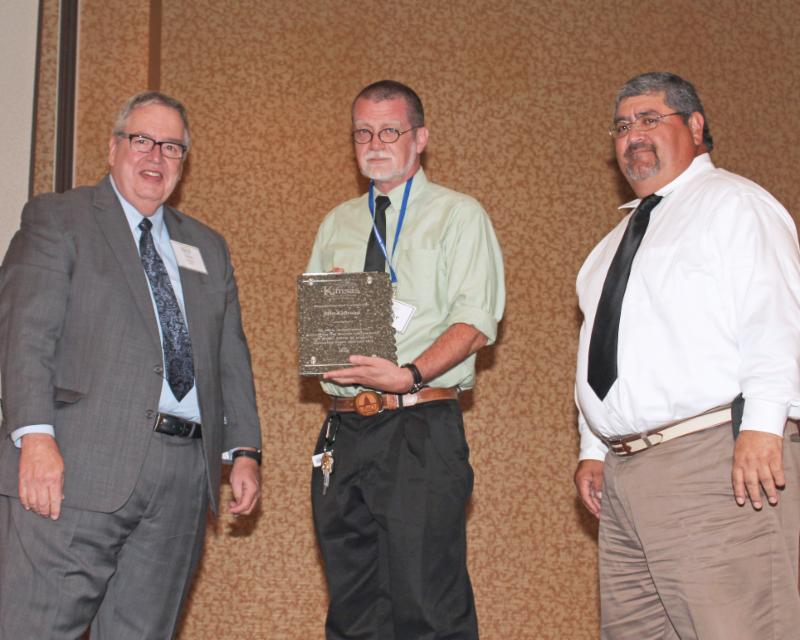
KDHE and the State of Kansas would like to recognize Kyle Railroad as the 2015 recipient of this recognition award. Clark McAllister accepted the award on behalf of Kyle Railroad.
|
| | KDHE's Division of Environment Director, John Mitchell with Clark McAllister of Kyle Railroad and Bob Medina of KDHE's BWM |
Photo courtesy of Diana Lehmann of KDHE's Bureau of Water.
|

EPA Region 7 Seeks Green Power Partners:
Businesses, Non-profits, Universities, and Communities
by Tegan Vaughn, U.S. Environmental Protection Agency
Are you currently or have you considered getting some of your electricity from wind, solar, or other renewable energy sources? If so, then you may qualify to become an EPA Green Power Partner. The Green Power Partnership is a voluntary program that encourages the use of green power as a way to reduce the environmental impacts associated with conventional electricity use.
The Partnership currently has more than 1,300 partner organizations nationally who, together, are voluntarily using billions of kilowatt-hours of green power annually. Partners include a wide variety of small, medium, and large businesses; local, state, and federal governments; as well as colleges and universities. The Green Power Partnership is designed to provide recognition to all active participants, regardless of size. The following Kansas businesses are currently receiving the benefits of being Green Power Partners:
By joining EPA's Green Power Partnership, your organization can take advantage of the following benefits:
- Expert advice- EPA can help you identify the types of green power products that best meet your organization's goals. EPA is also available to answer your questions about the procurement process and Partnership requirements, which can help save you time and money.
- Tools and resources - As a Green Power Partner, you can take advantage of the tools and resources for Partner organizations. EPA can also assist you in communicating the environmental benefits of green power use.
- Credibility - Partnering with EPA also provides credibility to your green power use. It signifies that your organization's use meets nationally accepted standards in terms of size, content, and resource base.
- Publicity and recognition- Using green power and becoming a program Partner can help bring positive attention to your organization, and can help to differentiate your company and brand from your competition.
|
|
ImageNow - that's how! KDHE's Bureau of Air completes paper saving project.
by Kathleen Waters & Linda Vandevord , KDHE
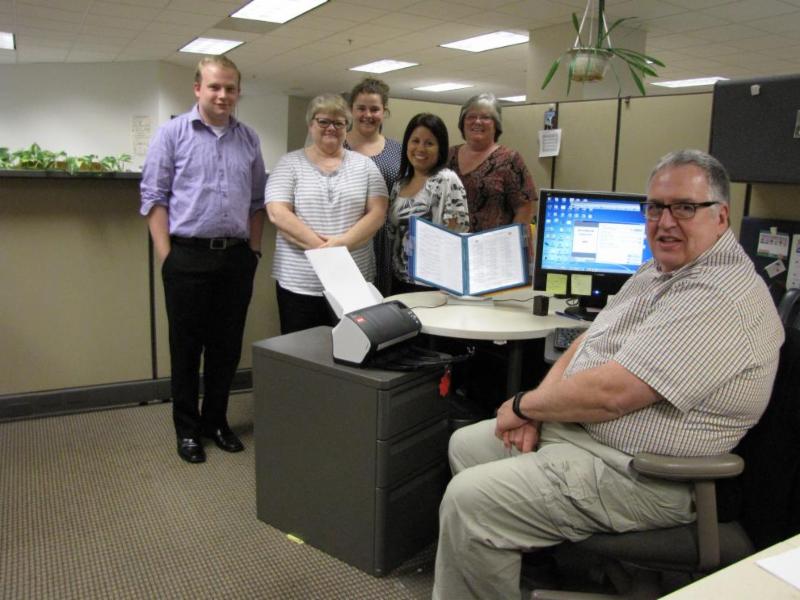
The ImageNow system was introduced to the Bureau of Air (BOA) in 2007. The system allows on and off-site access to public documents for staff, the districts, local agencies and the public without the need for printing and mailing large amounts of paper. Bureau support staff began scanning and indexing the contents of the file room in 2009. "These files document all permitted source activities and any compliance and enforcement activities performed by the Bureau." said Linda Vandevord, project manager.
To date, there are an estimated 91,873 multipage documents that now reside in the ImageNow system with a total page number estimated at 4 million. The final document was scanned by Division of Environment Director, John W. Mitchell on July 7, 2015. The original scanned files will be kept on-site until the files reach the official disposition date. The ImageNow system will continue to serve as the record storehouse for BOA.
|
| |
July 7, 2015 group shot of final scan, from left to right: Matthew Parnell, Cindy Moon, Sophia Brunetti, Sherri Walker, Linda Vandevord, and KDHE's Division of Environment Director, John Mitchell.
|
Photo courtesy of Kathleen Waters of KDHE's Bureau of Air.
|
P2 and compliance, too!
(Compliance with Subparts DDDDD and MMMM)
by Barb Goode, K-State Pollution Prevention Institute
If you are a growing business that is currently an area source, you are encouraged to carefully track your products usage so you don't "accidentally" become a major source without knowing it. Once you become a major source, even if only for one month, and if there's a major source National Emission Standard for Hazardous Air Pollutants (NESHAP) that applies to your business, then you will always be subject to that major source standard. Using less product isn't the only way to avoid becoming a major source of HAPs. Consider the following pollution prevention (P2) methods:
- Change the material. Have you looked at using less harmful products? They may seem more costly, but may not be if you have less regulatory requirements and less waste disposal costs.
- Change the technology. Is it a good time to invest in new equipment that uses less raw material, reducing emissions and costs?
- Change the process. Are you doing things the way they've always been done? Are employees trained to optimized use of products and minimize waste and unnecessary emissions?
This article features two major source NESHAPs to avoid, if possible. The compliance deadline for existing major source boilers (Subpart DDDDD) is January 31, 2016, so there is still time to become an area source. The compliance date for Subpart MMMM has past so those subject to the rule will always be subject to the rule. However, if you think you are getting close to becoming a major source for hazardous air pollutants and could be subject to Subpart MMMM, then we strongly encourage you to evaluate your operations to see if you can remain an area source.
Boiler MACT - Subpart DDDDD
If you are a major source of hazardous air pollutants (HAPs) and have a boiler at your facility, you may be subject to 40 CFR Part 63, Subpart DDDDD - National Emission Standards for Hazardous Air Pollutants for Major Sources: Industrial, Commercial, and Institutional Boilers and Process Heaters ("boiler MACT"). If the boiler is considered an existing source (constructed or reconstructed on or before June 4, 2010), you must be in compliance with the requirements by January 31, 2016. After January 31, 2016 even if your facility reduces its HAPs to where it would be defined as an area source, you will still be subject to major source requirements.
Now is the time to evaluate whether you can reduce HAP emissions at your facility, become an area source of HAPs, and have less stringent environmental requirements. One example where this would be advantageous is with natural gas-fired boilers. Major sources of HAPs with natural gas-fired boilers are subject to the boiler MACT. Area sources are not, even if oil is used as backup fuel. Refer to the KDHE two-page summaries of Subpart DDDDD and Subpart JJJJJJ (area source boilers) for a quick comparison of the rules.
Whether you are a major source or an area source with boilers, the requirements promote pollution prevention. The rules set emission limits, work or management practice standards (tune-ups), emission-reduction measures and energy assessment requirements, depending on the subcategory of the boiler.
EPA and Kansas Small Business Environmental Assistance Program (SBEAP) have several online resources to help with determining requirements for your particular boiler(s). Helpful videos, developed by EPA, are posted on the SBEAP boiler web page. Initial notification forms are also available for your convenience. The forms include EPA and KDHE addresses where notifications must be submitted.
Subpart MMMM - National Emission Standards for
Miscellaneous Metal Parts and Products Surface Coating Operations
Facilities that apply coatings to metal parts and products (those metal parts and products not covered under other NESHAPs), use 250 gallons or more of coatings, and are a major source for HAPs are subject to this regulation. The EPA has outlined three methods with which you can comply with the established HAP emission limits in the rule.
- Use compliant coatings (the HAP content of each coating is less than or equal to the HAP emission limits).
- Use an averaging approach (the average HAP content of all coatings is less than or equal to the HAP emission limits). Refered to as "emission rate without add-on controls."
- Use a capture system and control device that limits the HAP emissions from the affected processes to less than or equal to the HAP emission limits.
Many facilities are using the second method to achieve compliance. SBEAP has a tool for the required monthly tracking of primer, paint, and thinners used. It performs the calculations needed to determine compliance. Additionally (not needed for Subpart MMMM), the tool can calculate monthly VOC emissions and 12-month rolling totals for facilities required to track VOCs, such as those subject to prevention of significant deterioration (PSD) of air quality requirements.
SBEAP can help with calculating air emissions to determine whether your facility is an area or major source of HAPs. SBEAP can also help with evaluating P2 methods that could help your facility minimize its environmental compliance requirements. If you have questions or need additional information, please contact SBEAP at 800-578-8898 or sbeap@ksu.edu or Tim Evans with KDHE at 785-296-1542 or TEvans@kdheks.gov.
|
|
Free Hazardous Waste Generator Workshop
Presented by the Kansas Department of
Health and Environment
Bureau of Waste Management
COME LEARN ABOUT KANSAS HAZARDOUS WASTE REGULATIONS
The basic workshop (offered in the mornings) is designed as an introductory course in Kansas hazardous waste regulations (RCRA), including:
- Waste Determinations
- Container Management
- Generator Classifications
- Emergency Preparedness and Training Requirements
- What to Expect During an Inspection
The advanced workshop (offered in the afternoons) will provide a more detailed look at the following (plus additional advanced topics):
- Review Solvent-Contaminated Wipes Rule in KS
- Changing Generator Status (routine and one time events)
- Notification Forms
- Used Oil Requirements
- Used Antifreeze
- Aerosol Cans
- e-Waste
- e-Manifesting Update
- Universal Waste
- K, U, and P-listings
- F001-F005 Listings
- Solvent Recycling and Accounting
- Navigate the KDHE Website
- Enforcement Case Overview
- Outreach - Compliance Training Manual
- Outreach - Waste Determination App
Feel free to attend one or both workshops!
Registration is required to ensure there are enough seats and to be able to contact participants in case cancellations due to weather, or change in venue due to size constraints.
Certificates will NOT be provided. In confirmation of attendance is needed, a KDHE representative can sign forms provided to them at the time of the workshop. No confirmations will be provided after the date of the workshop.
Presentation slides will be available at the same website prior to the workshops. Hard copies will NOT be available at the workshops.
City
| Date
| Times
| Location
| Chanute
| 9/10/15
|
9:00 to 12:00 (Basic)
1:00 - 4:00 (Advanced)
| Memorial Bldg, Alliance Rm, 3rd Floor, 101 S. Lincoln, park west of Memorial Bldg and enter from north street level doors. | | Kansas City Area |
9/15/15
|
9:00 to 12:00 (Basic)
1:00 to 3:30 (Advanced)
| Johnson County Dept. of Health & Environment, 11811 S. Sunset Dr, Rm 1075, Olathe KS 66061 | Salina
| 9/17/15
|
9:00 to 12:00 (Basic)
1:00 - 4:00 (Advanced)
| Chamber of Commerce, Annex Room A, 120 W Ash St, Salina, KS. Park in parking lot east of building. | |
Garden
City
| 9/22/15
|
9:00 to 12:00 (Basic)
1:00 - 4:00 (Advanced)
| Southwest Research and Extension Center, 4500 E Mary St, Garden City, KS 67846 | |
Wichita
| 9/24/15
| 9:00 to 12:00 (Basic)
1:00 - 4:00 (Advanced)
| Sedgwick County Extension Office, Sunflower Room, 7001 W 21st St North, Wichita, KS 67205-1759 | | Kansas City Area | 9/29/15
|
9:00 to 12:00 (Basic)
1:00 to 4:00 (Advanced)
|
Johnson County Dept. of Health & Environment,
11811 S. Sunset Dr, Rm 1075, Olathe KS 66061
|
|
|
Introducing
EPA's SAFER CHOICE
program!

Please use EPA's on-line interactive map to see where you can use Safer Choice products! The map also tells you which products have earned the Safer Choice label.
Visit the website:
|
|

Upcoming Events
Class of 2015 Pollution Prevention Institute (PPI) Intern Presentations
September 11, 2015
Manhattan, KS
The Coleman Company, Compass Minerals, CST Tank Manufacturing, and Wolf Creek Nuclear Operating Corporation all hosted pollution prevention (P2) interns this summer. The interns have worked on specific P2 projects and will present their findings, complete with environmental and cost savings data in room 206 of the K-State Student Union. Two other PPI interns that worked on related environmental projects, will also present. Presentations will be held between 1:00 p.m. - 5:00 p.m. and you can join in person or listen in via webinar. Contact Nancy Larson at nlarson@ksu.edu if you would like the webinar link.
8th Annual Growing Sustainable Communities Conference
October 6-7, 2015
Dubuque, IA
Hosted by the City of Dubuque, Iowa and Sustainable City Network, the Growing Sustainable Communities Conference will be held at the Grand River Center located in the Port of Dubuque at 500 Bell Street. The 8th annual Conference is two days of education, inspiration and collaboration on topics of interest to anyone who cares about the convergence of economic prosperity, ecological integrity and social/cultural vibrancy in community design and development.
2015 Groundwater Foundation National Conference
"It's Just the Beginning...Let's Get Started"
October 20-22, 2015
Lincoln, NE
The 2015 Groundwater Foundation National Conference will serve as a call to action on behalf of groundwater. Through knowledgeable speakers, educational workshops, and unique tours, conference participants will find tools and experiences to help them take action to protect groundwater in their communities.
To learn more and register, please visit: http://www.groundwater.org/conference.html
|
|

Are you a small business that has questions regarding compliance with environmental regulations or permits? Don't hesitate to call Kansas State University's
Small Business Environmental Assistance Program
for free, confidential technical assistance!
Call 800-578-8898 or visit www.sbeap.org. |
|
Our Vision
Healthy Kansans living in safe and sustainable environments.
Our Mission
To protect and improve the health and environment of all Kansans. |
|