|
Lab Action Highlight: Hoenger, Detweiler Freezer Share Promotes Energy Conservation
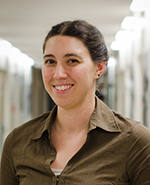
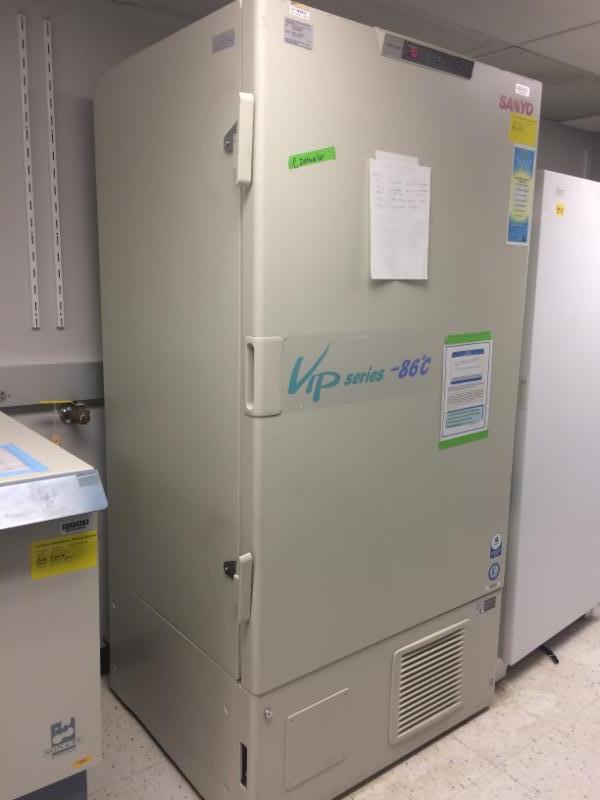
Following the failure of the Hoenger Lab's ultra low temperature (ULT) freezer in 2012, Principal Investigator (PI), Andreas Hoenger, was in need of ULT freezer space to house his lab's samples. The Green Labs Program was able to connect Hoenger with another lab in the same department that had unused space in its ULT freezer.
Corrie Detweiler, PI of the Detweiler Lab, previously reached out to the Green Labs Program advertising space in an ULT chest freezer. A former PI's samples, that were to be discarded, occupied half of the space in the freezer. In an attempt to conserve energy, Detweiler was willing to offer that newly available space for use by another lab.
Both labs operate within the Department of Molecular, Cellular, and Developmental Biology making the proposed freezer share a plausible solution for Hoenger, who was able and willing to consolidate his samples to half a freezer's volume.
According to metering performed by the Green Labs Program, the Hoenger Lab's former freezer was typically using 15 kWh/day. This is roughly equivalent to the electricity used by a small house. By engaging in a freezer share with the Detweiler Lab instead of replacing the defective freezer, the Hoenger Lab was able to eliminate that 15 kWh/day electricity consumption.
The Green Labs Program is very excited about this action and applauds the Hoenger and Detweiler labs for their continued actions to conserve energy in their labs.
|
|
Q & A With Theresa Nahreini From the Cell Culture Facility
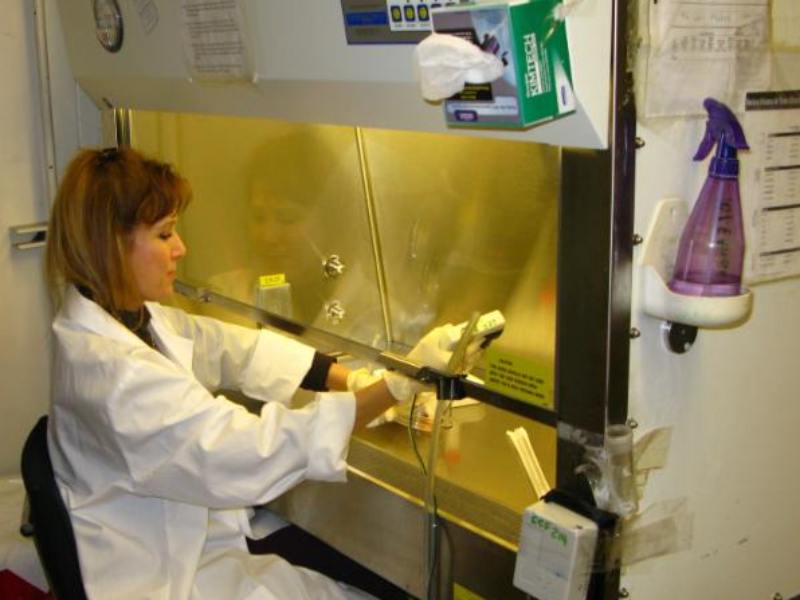
Green Labs: How did you become involved with the Green Labs Program?
Theresa Nahreini: I've known [Kathy Ramirez-Aguilar, CU Green Labs Program Manager] for many years, since she was working in the lab. Since then we've been taking lots of small steps within the laboratory. You have to be patient and make sure actions won't be detrimental before taking them.
GL: What actions have you implemented within the Cell Culture Facility to promote conservation?
TN: Biosafety cabinets that aren't externally vented are turned off. We use a source of clean ethanol from a lab on campus and recycle polyethylene #2 and #4 plastic film in addition to traditional materials. A lot of items we use are single use, so we like to recycle whatever we can.
GL: What sort of efforts would you like to see the Cell Culture Facility take in the future?
TN: Our next big effort is to update our cryostorage inventory! We are exploring a few options at the moment, but we need to invest time in order to have room for new users. This is an important green lab initiative because we wouldn't have to purchase another unit and would be saving a lot of money in addition to liquid nitrogen costs.
GL: What do you believe would be a good starting point for labs interested in creating a more environmentally friendly lab?
TN: It can seem overwhelming, but it is all about taking little steps where possible. People should try to be aware of what they're throwing into the garbage. Things that are recyclable often get mistakenly thrown [in the garbage], so education and awareness is a good place to start. Kathy at Green Labs understands what actions are practical based on her previous lab experience, so she is a good resource and can help [with financial incentives], too.
|