- Sponsored By -  |
|
|
New on Policetraining.net
Sign up for custom notifications today! Whether you are interested in a particular training topic or classes in your specific region or zip code, we make it easy for you to receive an email notification when a new posting meets your criteria. We also make it easy to cancel, so why not customize your notifications today?
You can choose multiple topics and any combination of search criteria!
|
|
Instilling Hesitancy
An officer shouldn't have to contemplate whether or not their agency will support them if they do the right thing.
By Kevin R. Davis
Reprinted from Law Office Magazine
Advising officers to approach dangerous locations and suspects cautiously is a wise recommendation. Waiting for backup is a sound tactical suggestion and advisement. Far too often officers overextend themselves in situations, handling the call themselves instead of waiting for back-up officers to arrive on scene to provide cover and additional sets of eyes, ears and guns in a worst-case scenario. A supervisor who encourages the officers in his charge to slow down and arrive to the call alive vs. driving too fast and exposing themselves and the citizenry to risk is certainly a life-saving responsibility.
Yes, sometimes officers "Colonel Custer" it-that is, rush headlong into a problem and are up to their rumps in alligators before they know it and get hurt in the process. Certainly officers drive too fast, and in many cases, too recklessly and should be reminded that such actions are stupid and will be disciplined if continued. Such recommendations as exercising caution, calling for back-up and waiting until they get there and slow the heck down, are all sound advice for supervisors to reinforce to their troops.
But in this case, we're not talking about safe and wise admonishes to officers. We're instead talking about instilling hesitancy in officers that may get them hurt or killed.
article continues >
|
|
~~~~~~~~~~~~~ A Message From Our Sponsor ~~~~~~~~~~~~~

American Military University is a leading online education provider to the law enforcement community, offering more than 87 different undergraduate and graduate degree programs in areas beyond criminal justice, such as intelligence studies, homeland security, emergency and disaster management, public administration, and management. AMU maintains active education partnerships with the National Fraternal Order of Police, FBI National Academy, Los Angeles County Sheriff's Department, Los Angeles Police Department, and Southern Police Institute. If education is an incentive or requirement within your department, contact AMU today to find out if your academy or in-service training qualifies you for credits that may place you closer than you think toward earning your degree.
~~~~~~~~~~~~~~~~~~~~~~~~~~~~~~~~~~~~~~~~~~~~
|
|
 Don't Be A Sitting Duck Don't Be A Sitting Duck
3 skills for shooting while moving
By Dave Spaulding
Reprinted from Law Office Magazine
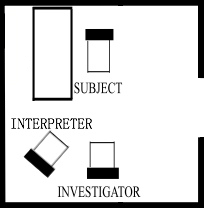
The lateral movement: 1. Stop and get stable. 2. Draw while taking a step sideways. 3. Stop and stabilize the upper torso; then deliver the shot. Illustration Daniel DiPinto
Some firearms trainers classify shooting while moving as an advanced skill. Nothing could be further from the truth. It's an essential, lifesaving skill we should consider one of the fundamentals of combative pistol craft, right alongside grip, body position (I don't use the word "stance"), sights, reloads and malfunction clearances. We all know hitting a moving target is harder than hitting a stationary one. Sitting ducks in a gunfight get hurt or killed. So, don't just stand there move! Here are three techniques to help you out.
Shooting While Moving Forward
The most commonly taught shooting-on-the-move technique is moving forward, but unless you serve on a SWAT or entry team, this is the least desirable movement in a fight. Take a moment to think about what you do when you perform this technique: You move closer to your opponent. Unless you relocate to a more strategic position, moving closer to your opponent reduces your skill advantage and makes his ability to hit with lucky shots far less lucky and far more likely. That said, moving forward is the easiest of the three shooting movements to master..
|
Firearms Safety for a Crimefighter's Family
BY SGT. BETSY BRANTNER SMITH
Reprinted from Officer.com
It takes very little strength to pull the trigger on a gun, so we must be diligent in the safe handling and storage of our own firearms, beginning in our homes.
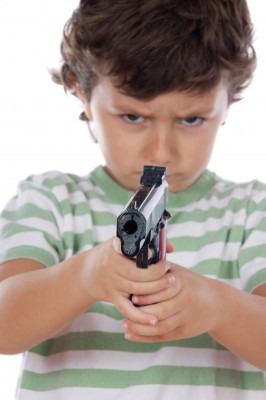
There are few topics in the news today as hot as firearms. Guns and ammo are flying off the shelves even as others are calling for stricter gun laws and less access to firearms for the average citizen. Wherever you stand on the "gun debate," as a law enforcement officer firearms are a part of your everyday life. We all know that owning and using a gun comes with incredible responsibility, but cops also need to see themselves as role models, advocates and resources for firearms safety. About 600 people die each year in the United States from accidental gunfire, including police family members, primarily children. It takes very little strength to pull the trigger on a gun, so we must be diligent in the safe handling and storage of our own firearms, beginning in our homes.
Gun safety starts at home.
In the academy we all learned the basic rules of firearms safety. Those are the same rules you should be sharing with your family, and you need to do it early and often. If you have young kids in the house, you must make sure that they do not have unsupervised access to a loaded firearm. Several times each year a cop's kid is killed with that officer's firearm. Because we are so comfortable with guns, we can become a bit too relaxed, leaving a loaded gun where little ones can access it. This has lead to tragedy for more than one police family, including criminal charges against the officer. You have to balance your own accessibility to a loaded gun so protect your home and family with safe, "kid-proof" storage.
article continues >
|

Prescription-Drug Epidemic: Building a Case Against Potential Pill Doctors
By Leischen Stelter, American Military University
The drug landscape has shifted dramatically in recent years and law enforcement agencies now find themselves battling the legal system. Prescription drug abuse-the intentional use of medication without a prescription or taken in a way other than as prescribed-has skyrocketed in recent years.
One of the primary issues for law enforcement is that many people are obtaining prescription drugs through legal channels. "Unfortunately, there are more of these pill doctors out there than most people realize," said Jim Deater. During his 24 years in law enforcement, Deater spent 15 years in the Homeland Security and Intelligence Bureau. He investigated large-scale national and international drug trafficking organizations, homicides and gangs. He found that the average case involving doctor prescriptions and illegal drug prescriptions took about 18 months. Read more about a 10-month investigation that resulted in $1.4 million in cash deposits from illegal prescriptions as well as Deater's recommendations for police officers pursuing cases of potential pill doctors. more >
|
View a list of law enforcement training offered throughout the country.
|
|