Mark Obert-Thorn - 25 years in the restoration business
A look back to where he started - and what's changed
This week's new release
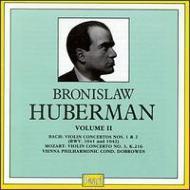
Bronislaw Huberman's Bach & Mozart recordings
 |
| Huberman |
This week I'm handing you over to Mark Obert-Thorn for his reflections on 25 years in the restoration business. Mark's first releases came in October 1988 on the Pearl label, and included the recordings he's returned to here - Bronislaw Huberman's recordings of Bach and Mozart Violin Concertos.
The original Pearl release included the three 1934 commercial recordings with Issay Dobrowen and the Vienna Philharmonic, but not the later, live 1945 recording in New York with Bruno Walter of the 4th Mozart Concerto we've added for our release today.
The latter work turned into something of a collaboration between Mark and myself - he sent it to me a few weeks ago for pitch stabilisation treatment, something we now do quite regularly together where it's needed (I'm currently working on this for the next volume of Beethoven Centenary Symphonies - Weingartner's 1926/7 recordings in this series have always been particularly troublesome in this respect).
In the instance of the Huberman/Walter recording I wondered whether the radio broadcast sound was doing full justice to what had been heard on the evening, and took things a step further than usual and applied my XR remastering to Mark's already excellent transfers. I sent both versions back to Mark to audition - the repitched-only version and the repitched XR version - and I'm delighted to report that he liked what I'd achieved in further improving the sound quality of the recording.
Thus we present our first fully collaborative recording - and I couldn't be more honoured than to have this on the same release as Mark's 25th anniversary special. Over now to Mark.
Andrew Rose25 Years as Producer and Audio Transfer Engineer
Reflections by Mark Obert-Thorn
 |
| Wolfgang Sawallisch, my wife Cathy, me, and my daughter Cate at the PO Centennial set's release at Tower Records, Philadelphia, in 2000 |
Twenty-five years ago this month, I was hard at work on my first releases as a professional transfer engineer. The story actually began fourteen years earlier, when, as a college freshman, I made my first crude transfers of 78s at the college radio station, joining the sides using a razor blade on open-reel tape, as was the general practice in those days. After several years of honing my skills as an amateur (and after I had graduated and begun a full-time job in an area far removed from music), I proposed to my local Philadelphia public radio station to do a recurring series of monthly specials devoted to historical recordings, which I called "Rare and Well Done".
After two years of doing that as a side interest, my regular job required that I go on special assignment in another state; and when I returned, the radio station had changed its format, dropping most music programs. Looking for a new outlet for my transferring interests (and in the meantime married with a baby on the way), I was keen to find a way to make the skills I had gained and the record collection I had been actively acquiring pay off in a more remunerative way. I put together a demo tape and a list of several dozen reissue proposals, and sent it to several labels which were active in historical reissues. I happened to be, as they say, in the right place at the right time.
Back then, the historical CD reissue scene was much different than it is today. Although 1982 is usually given as the beginning of the CD era, we in the States did not start seeing CDs in our local record shops until a couple years later. Initially, those older recordings which the major labels reissued on CD came from the stereo tape era, which tended to better show off the capabilities of the new medium. I recall the excitement when the first monaural recordings, still from the tape era, began to show up in the ad pages of Gramophone, iconic performances like the Ferrier/Walter Das Lied von der Erde and the Callas/de Sabata Tosca. I remember ordering the latter direct from Harold Moores in London as soon as it was announced, thinking, "A mono CD! This will never stay in the catalog! I'd better order it now!"
By 1988, historical CD reissues - even those derived from 78s - were more common, though still hardly the norm. EMI hedged its bets, releasing single CD compilations on their midpriced Références series while still bringing out some new reissues only on LP in their HMV Treasury series. RCA had an equally spotty record; although they had begun a midpriced series (Papillon) focusing on reissues of stereo recordings, some quite recent, they had only released a handful of single, full-priced historical CDs of their more famous artists like Rachmaninoff and Kreisler. Some smaller, independent labels had gotten into the act as well, notably Pearl, which I recall by the fall of 1988 had only two historical CDs available in US stores.
Pearl was one of the labels to which I sent my demo tape and proposals, and they were the first to write back, commissioning me to do three releases in my first month and two the following month. (I had only expected to do that many in a year.) By this time, I had perfected overlapped side joins, and was using quieter American Victor and Columbia pressings in contrast with the cracklier British pressings and spliced joins utilized by Pearl's engineers. When my first projects arrived at their UK headquarters, Pearl's director wrote to me that "although they are not quite the 'Pearl sound' to which we are used, there is no doubt that they are most professional. We will certainly try them on the market, so to speak, and hope that they are greeted with much joy."
Within three years, two of the three nominees in the Gramophone Awards historical category (R.I.P.) were projects I had done for Pearl. By that time, I had expanded my work to other labels, which would come to include Biddulph, Romophone and Music & Arts. Two further milestones arrived in 1998: the Philadelphia Orchestra hired me to be the adviser for their Centennial CD set, and I began to work for Naxos, for which I eventually was to do the bulk of my transfer work over the next 15 years.
The Naxos connection came about, interestingly, due to the Internet, which was making increasing inroads during the '90s. On a Classical recordings discussion group, someone had mentioned that good CD transfers were needed for Felix Weingartner's (mostly) 1930s cycle of Beethoven Symphonies. I replied that I had pitched this idea to every label I worked for, but no one was interested. A Scandinavian correspondent then e-mailed me privately, suggesting that I contact Klaus Heymann of Naxos directly and propose the idea. Again, I put together a list of project suggestions, and Naxos Historical was expanded from a series of Toscanini and Met broadcasts into a line mostly devoted to public domain commercial recordings, which offered high quality transfers at budget prices throughout the world.
The early years of the new century brought changes to the established order. Economic upheavals wrought in part by the Internet brought down major retailers like Tower Records, and took with them many independent reissue labels like Pearl, Biddulph and Romophone. And an EMI lawsuit that challenged the copyright status of Naxos reissues of its material in the USA led to a withdrawal of its historical series from that large and crucial market, and contributed to the eventual dwindling of physical releases of their historical material. Web-based CD sales and, increasingly, downloads and streaming were becoming the new norm.
Into that new world, Andrew Rose brought Pristine Audio; and in 2008, he invited me to join him. Although I had been fortunate to be able to work on as many reissues as I had up to that point, I was always frustrated that certain "pet projects" were deemed to be uncommercial (and rightly so) for labels that had to sell several thousand copies - or even just several hundred - to break even. Because of Pristine's lower overhead and burn-on-demand approach, risks could be taken with "nichier" releases.
I don't see the sales figures, but I'm sure that some of my Pristine productions have only sold in the high single digits, if that. But without such an approach, I guarantee that collectors would never have seen a physical CD reissue of Fabien Sevitzky's Philadelphia Chamber String Simfonietta recordings (just named by a couple Fanfare reviewers to their "Want List" of best releases of the year), nor the first-ever reissue since the LP era devoted to cellist W. H. Squire (recently listed as one of the top five best-sellers of the past month on the Pristine website).
And so this month we come full-circle, and I begin my silver anniversary as a reissue producer with a new transfer of the first CD of the three I did for Pearl in October, 1988 to be issued: Bronislaw Huberman's recordings of Bach and Mozart Violin Concertos, now expanded to include his broadcast performance of Mozart's Violin Concerto No. 4 with Bruno Walter conducting. Over the coming year, I will be revisiting several projects which I did during the past quarter century, including the multi-CD set, The Potted Ring (originally done for Pearl in 1994 and not re-done by me since).
Twenty-five years is a remarkably long run for a transfer engineer, a milestone that few have attained. I've been lucky to have the chance to do nearly every project I've really wanted to do (sometimes several times over!), an opportunity which I would not have had, had I been hired to work exclusively for one of the major labels. Since retiring from my full-time job in 2011, I've had the time to take on even more transfer work, and explore ever more recondite corners of the collectors' realm.
I owe a great debt of gratitude to my long-suffering wife, Cathy, and our daughter, Cate, both of whom put up with a great deal of listening to my repeating musical passages over and over as I worked on perfecting a side-join or manually taking out a click. Without the support of my wife in particular, my achievements would not have been possible.
Now, onto the next 25!
Mark Obert-Thorn
 Pristine Streaming
 This month saw the launch of our all-new streaming service, which is replacing our existing PADA subscription service and has been much awaited by many.
For a monthly subscription of €10/month
(non-EU subscribers benefit from a lower, non-taxed rate), you'll get listening access to our full catalogue, plus over 600 extra recordings (Streaming Exclusives) to hear and download, and a 10% discount code for all your online purchases at Pristine Classical.
If you'd like to see the player in action, albeit with a more limited playlist of shorter items, go to
Pristine Radio and have a listen!
PADA will end on 30 November 2013 We will keep the old PADA service online and fully functional until 30th November 2013 to allow you time to end your existing subscription and take out a new Pristine Streaming subscription. Go to the old
PADA Log In page, scroll down, and you'll find a simple button to click that cancels your existing subscription. Note that as of 11 October, all PADA playlists have been frozen - new releases and additions will be found on the new Pristine Streaming service -
sign up here.
Because of the short delay between taking out a Pristine Streaming subscription and it being authorised by PayPal I recommend that you get your new player up and running before cancelling your old subscription. To minimise any financial shortfall, I also suggest you wait until a day or two before your next subscription payment is due before you cancel PADA. Any outstanding PADA subscriptions will be cancelled automatically once the service ceases in operation.
Andrew Rose
25 October 2013