HALF PRICE FLACs
| 
| |
All FLACs of this release 50% off for one week only
RENARDY/MUNCH
Brahms Violin Concerto
Concertgebouw/Munch, 1948, Decca
CLASSIC REVIEW
I find it difficult to review performances of great masterpieces. There are so many recordings and most of them are very good. Only a small percentage have the musical depth, the virtuosity and the individuality to qualify as "great". This one doesn't make it but is well above the pack.
Ossy Renardy was born Oscar Reiss in Vienna in 1920 and made his debut at the age of 13. He came to the United States, changed his name and was building a a very good career when he was killed in an automobile accident in 1953 at the age of 33. This recording, the only concerto recording he made, shows what a loss his death was for us.
Münch shows his characteristic vigor and drive in the orchestral introduction.
Renardy makes a fiery entrance and a superb transition to the second theme. With clean double-stopping, Renardy rides the lovely third theme into the extremely exciting triple-stopping to complete the exposition. Shrillness is avoided throughout the development, although I feel some slackening of tension and focus toward the end of the development and the beginning of the recapitulation. Somehow, Renardy gets all the power back and the recapitulation is terrific. The cadenza is not the standard Joachim, but is very musical.
The slow movement is possibly the finest I've ever heard. The oboist is incredibly eloquent and Renardy matches him. This slow movement is one of the few I've heard that balances the first and third movements.
The finale is very good, but it does not quite match the other two movements. It seems to lack the brilliance and panache that they have.
Still, this is a very fine performance of the Brahms violin concerto by a violinist that few of us know. The reproduction is very clean and beautiful and allows us to hear what might have been but for that automobile accident.
Bill Rosen for Pristine, 2005
ALL FLAC DOWNLOADS OF THIS RELEASE ARE HALF PRICE FOR ONE WEEK: PASC 013
NB. Offer does not apply to CDs or MP3 downloads
|
NEW REVIEW
|
MusicWeb International
18 March 2013
Désormière's Pelléas et Mélisande
by John Quinn
"A legendary recording in a very fine transfer."
 This legendary recording - and for once that's not an exaggeration - was made for the French company, La voix de son maître, and was originally issued on 78s. For this transfer Andrew Rose has used La voix de son maître LPs (EMI France 2C 153-12513 - 12515) from the collection of John Philips.
The recording has also appeared on CD in EMI's Great Recordings of the Century series (review) though I haven't heard that transfer. With any historic recording one of the first questions that a collector will ask is: what's the sound like? I have to say that the answer in this case is that it's astonishingly good. This recording was set down while Paris was under occupation and one wonders what logistical issues this caused - to say nothing of the emotional effect of those times on French musicians. One doesn't expect the amplitude and detail of a modern digital recording and at times the orchestra does sound somewhat compressed in louder passages such as the Interlude between scenes two and three in Act IV. However, that reservation apart - and it's a relatively minor one - it's amazing how much orchestral detail comes through; one can relish the tangy French woodwinds and horns, the harp is nicely caught and the strings, especially the violins, can be heard very well. The voices are strongly to the foreground; perhaps a little too much, the purist might say. However, this means that not a syllable of text is anything other than crystal clear. Overall I take off my hat to the engineers from La voix de son maître. In passing it's perhaps worth saying that this isn't the only example that I've heard of excellent work by this company's engineers from around this period. Two years later, working in Brussels, they produced a recording of Honegger's Jeanne d'Arc au Bûcher, the quality of which was equally remarkable. I haven't had the opportunity to hear other transfers of this recording of Pelléas for comparison but Andrew Rose has done a marvellous job for Pristine. The transfers are smooth and clear, there's no surface noise and I didn't pick up any examples of distortion. Anyone buying this Pristine issue is not going to find that their enjoyment of the performance is marred by sonic issues.
What a performance it is! So much has been written about it over the years that it seems almost an impertinence to add anything further. The fact that the cast is Francophone is a huge advantage, especially in this uniquely "conversational" opera. The timbre of the voices, the enunciation and inflection of the words is so satisfying when native French speakers are involved and on occasions when a character is required to deliver words rapidly this comes so naturally to a Frenchman or - woman. The singing per se is also of the highest possible order. All the singers appear completely at ease with every technical aspect of their respective roles. For example, in the role of Pelléas Jacques Jansen (1913-2002), a true baryton-martin, has an enviably easy and effortless top register that means he can deliver the highest-lying passages without any strain; remember that this role has often been sung by a tenor, which indicates how high the line goes.
However, the vocal success of the performance is not just a question of technique; all the characters, the principals especially, are right under the skin of their respective roles. According to a note on the Pristine website, the three principals had all performed their roles in the theatre many times under the direction of Désormière. More than that, Irene Joachim (1913-2001) had actually studied her role with Mary Garden, the very first Mélisande. She and Jansen had been coached by Georges Viseur, one of the two répétiteurs for the opera's première. So here we have some genuine and powerful links to the very start of the performance tradition of Debussy's masterpiece. No wonder it all sounds so authentic and natural.
Irene Joachim portrays, at different times, the innocence, vulnerability, frailty and, in Act IV, the girlish abandon of Mélisande in a way that is totally convincing and very moving. Her intense and eventually rapturous exchanges with Pelléas in Act IV, scene 4 are quite superb. Indeed, this scene, with Jansen matching her for ardour and dramatic involvement is, as it should be, the apex of the score. Jansen himself is magnificent throughout. Perhaps some may feel his delivery of the words sounds a touch deliberate and lacking a little bit of natural flow at times but if that's so - and I'm not sure it is - I'll willingly sacrifice that for the clarity and intelligence with which he puts across both words and music. The contrast between his vocal timbre and that of Henri Etcheverry (1900-1960) is ideal; there's never any question who is the elder brother. Etcheverry is a magnificent Golaud, encompassing every aspect of this role with complete conviction and great understanding. His jealous rage in Act IV, scene 2 is a tour de force and all the more effective because Etcheverry is masterly in the way he builds the emotion, not peaking too soon and risking tipping over into melodrama: this is a rage, not a rant. He, Joachim and the sad, dignified Arkel of Paul Cabanel (1891-1958) make Mélisande's death scene in Act V very moving.
As for the conducting of Roger Désormière (1898-1963), it has been much praised over the years and rightly so. The dramatic pacing seems to be ideal but even more telling is the sense of seamless flow; one is not conscious of bar lines. This is a conductor who is completely in sympathy with Debussy's style and knows how to achieve the right results. He ensures that the moments of highly charged drama, such as the final scene in Act IV, make their full impact. However, Pelléas et Mélisande is a score that makes its effect chiefly through subtlety and poetry and Désormière is brilliantly successful in this respect.
No libretto or translation is provided. Though regrettable in some ways I suspect that most collectors who acquire this set will probably have a modern recording on their shelves and so will have access to the text. However, I do wish that Pristine would be a bit more consistent in their documentation. Some of their releases that have come my way, including one or two featuring Guido Cantelli, have had decent notes giving some background information about the recordings in question and putting them in some kind of context. This issue is sadly lacking in that respect and given the historic importance of this recording that's a regrettable omission.
This is a seminal work in twentieth-century music and, as an opera, truly unique. Though this was not the first complete recording of the score it's rightly regarded as a landmark in the work's history and a benchmark recording against which all others are measured. Pristine have done a great service in making it available in such a fine transfer.
|
NEW REVIEW
|
MusicWeb International
19 March 2013
Maria Callas in Bellini's I Puritani
by Ralph Moore
"A recording with many merits and a few demerits."
 This recording has already been extensively reviewed in various incarnations by my colleagues Roberts Farr and McKechnie. I do not propose to spend too much time revisiting its many merits and a few demerits. These will already be familiar to most readers. They are, in any case, admirably delineated by those gentlemen, my predecessors, to whom I refer you for a more detailed critique of the performance. I demur very little regarding their opinions but have just one or two observations of my own to qualify their views.
By far the most important point of this my review therefore is to emphasise, as I do every time I report back on the latest Pristine re-mastering, just how superior it is to previous issues - even excellent ones by such as Mark Obert-Thorn for Naxos Historical. It is like hearing this recording for the first time, so full and vivid is Andrew Rose's sound-engineering, instead of the crashing seaside-brass-band chords with which EMI's issue commences the "Sinfonietta", we hear a tutti from what is identifiably the fine orchestra of La Scala, Milan and then, especially, its euphonious horns. There is virtually no hiss, plenty of airy ambience around the voices and instruments and above all, a new depth now that the lower frequencies have been enhanced; the unpleasant metallic quality always previously present is gone. The result is that even the rather gritty, windy and unsteady bass of Rossi-Lemeni - for me always the weakest link in the cast - sounds better than I have ever heard it before. He remains too tremulous in "Cinta di fiori" but this may be construed as being the result of deep emotion. By and large he emerges as the singer who would be the most grateful to Pristine for its re-mastering were he able to hear it.
Panerai, too, divides opinion by virtue of the slight tremolo in his rapid vibrato and some occasional unsteadiness and inaudibility. He was only twenty-eight at the time of recording and some nervousness is understandable. Otherwise, the musicality and intensity of his singing are admirable. Comparison with predecessors and successors such as Cappuccilli and Battistini reveals some deficiencies in his legato but the latter, for all his vocal supremacy, takes unpardonable liberties by modern standards. Cappuccilli, despite his long-breathed eloquence, is coarser of tone. Neither suggests much desperation in "Ah per sempre" but that most grateful of cantilena arias has always presented a conundrum to a baritone of how to sing it with the smooth assurance the melody requires while simultaneously conveying the emotional import of the thwarted lover. Alongside Panerai's rhythmic delicacy, Battistini's agogic distortions would sound almost comical were it not for the nobility of his voice. Best of all in that lovely music was Giuseppe de Luca, his baritone perfectly even and effortless; Panerai is meanwhile very acceptable, especially as this opera gives Riccardo so much music.
Callas's virtues are well known: superb diction, immaculate phrasing, top Ds and E flats in place, magical downward portamenti especially over the interval of a fifth, lapidary coloratura runs through the octave and a pathos and vulnerability of utterance that remain unrivalled. The improved sound simply highlights her vocal prowess.
Di Stefano is nobody's ideal exponent of bel canto; there are strains and he has none of Pavarotti's grace, but the D flat is there. He delivers a virile, impassioned Arturo, full of ardour and animation.
Serafin exhibits empathy with both the idiom of the music and the needs of his singers. His rubato is beautifully judged and he is capable of whipping up excitement over a long span of music. In particular, the arresting opening of the opera is revealed in Serafin's hands to be masterly, the martial expectation segueing elegantly into the offstage hymn of praise. Everything is so elegantly paced.
The traditional cuts - 33 in all amounting to 32 minutes less than Bonynge's full score recording - are distressing. The truncation of the ending is especially frustrating but there's nothing we or Pristine can do about that and what remains is stunning.
|

|
|
CONTENTS
| |
This Week Walter's Bruckner: a second thread for 2013
Technology It isn't always an improvement!
Walter Bruckner Symphony No. 9, 1959 stereo XR
Renardy Ossy Renardy's complete Columbia recordings
PADA Robert Mann plays Bartók's Contrasts
|
Walter's Bruckner and Ossy Renardy
Plus the tiny $88 box that could revolutionise your listening
This Week's Preview
This week we have two recordings to tempt you: the complete Columbia recordings, made in 1938-39, of violinist Ossy Renardy, and the first of Bruno Walter's three Bruckner studio recordings, Symphony No. 9, made also for Columbia - in stereo in 1959.  | | Bruckner |
As I'm sure you're well aware, we're already three symphonies into a series of Walter's Mahler symphonies, and this will continue as the year proceeds. But this series, and in particular the spectacular results heard in the XR remasterings of his end-of-life stereo Columbia recordings, prompted a number of requests for the three Bruckner symphonies also recorded at this time. These were Walter's only official studio recordings of Bruckner, though his discography does list a number of earlier live and broadcast recordings. Using this listing as a guide, Walter did seem to have homed in on three of the symphonies in particular. Although a recording does exist of him conducting the 8th Symphony, it's Nos. 4, 7 and 9 which apparently most captured his musical imagination, together with the Te Deum he recorded in 1953 for a mono Columbia LP issue. As with the Mahler symphonies recorded with the Columbia Symphony Orchestra (an outfit created for contractual reasons largely out of the LA Philharmonic, it is said), XR remastering has transformed a great recording into a truly spectacular one. Take a listen to the explosive second movement in our MP3 sample this week - the fine detail in the brass is what first grabbed me - and see what you think. 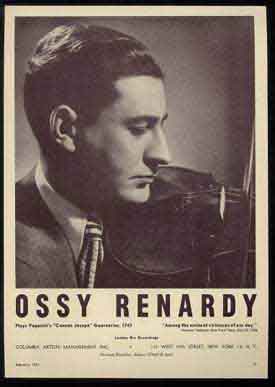 | | Ossy Renardy |
The violinist Ossy Renardy featured in one of Pristine's very first releases back in 2005 - his 1948 recording of the Brahms Violin Concerto with the Concertgebouw under Munch was his sole recording with an orchestra before his untimely death at the age of 33 in a motoring accident. Prior to this the young Renardy did make a number of recordings with piano accompaniment before the Second World War for Columbia in the years 1938-39, and Mark Obert-Thorn has, for the first time, brought all of these together in a single release. Charles Munch said of Renardy: "There is only one word to describe him: perfection. He has everything - style, technique and tone, combined in the most splendid manner". Take a listen to this collection, ranging widely from the Baroque stylings of Handel, Corelli and Platti to the later violin virtuoso output of the likes of Paganini, Sarasate and Vecsey via Schubert and Dvorák, and you'll discover yet another fabulous young musician whose life was cut short whilst on tour in the 1950s... Does this splodge actually help anyone? | | Here's my card... |
I'm sure you've seen them around, on advertising, billboards, product labels and so on. They look like the splodge of black and white above and they're called QR codes. I was reminded of them on Monday as I spent some time wandering around a local winery with a friend of ours (it's nice to have friends who run wineries) - she was showing a couple of guests the vast stainless steel vats, the oak barrels, the bottling line and, crucially for this story, the labelling machine. One of the joys of modern technology is that it increases your options and choice. One of the downsides is also that it increases your options and choice! In this case, it was the different labelling requirements for different countries, each requiring specific information, logos, bar-codes, importer names and the aforementioned XR codes. The days when you simply slapped an idealised etching of a chateau on the front alongside the name of your property and some indication of vintage and origin are in the past. Everything needs to be personalised, tailored to the individual market, and hugely complicated. Hence a big machine that allows the winemaker to customise her labels to please every importer around the world. To me, the QR-code is a wonderful example of technology for technology's sake, failing to deliver and making everything more unnecessarily opaque. The idea behind it is simple: point your phone's camera at the code and it'll turn it into a contact you can add to your address book. The code above gives you my name, address, business name, e-mail address, telephone number and website address, all in one computerised splodge. It's easy to use, and saves a lot of typing onto a small screen. So when did you ever use one? And when did you ever see anyone else pointing their phone's camera lens at one? No, me neither. It's far easier to reach me as a human by remembering the words "Pristine Classical dot com" (which I hope you can), typing them into a browser to visit our website, and then clicking on the contacts link. I suspect this is how a lot of people think about the current changes in recorded music distribution. What a lot of trouble getting your record collection onto a hard drive and then accessing it by computer, when all you need to do is pick a CD or record off the shelf and play it. To which I'd reply that this is only true until you've actually taken that leap of faith, spent the time, money and effort to make the changeover, and said goodbye to discs (should you wish to do so) for good.  | | Your music collection? |
I'll spend a little while later today finalising another of our PADMC disc drives, adding this week's latest releases before shipping it out to the wider world to someone who's decided to take that plunge. Once you do, and when you have such a system up and running, suddenly the whole world of downloads makes sense, and becomes so easy and simple that you begin to wonder what took you so long. But there's no real hurry here. Despite the continuing decline in sales I'm sure CDs will be around for a few years get. But unlike the QR code - ingenious in principle but largely ignored in practise - I think this is one step forward that few if any regret. Now, get your phone out and see if it'll make sense of the picture above - but if (like me until I researched it) you don't know, I really wouldn't worry about it. Your brain will do a better job of remembering the words... Andrew Rose
22 March 2013
|

|
Furtwängler's 1950 Ring Cycle starts here - Part 1: Das Rheingold
Bruno Walter's Bruckner 9: "a truly noble reading" (The Gramophone)
Walter's vision of Bruckner's final symphonic masterpiece - an unprecedented clarity of sound

Recorded 1959, stereo
Producer and Audio Restoration Engineer:
Andrew Rose
Columbia Symphony Orchestra
conductor Bruno Walter
Web page: PASC 384 Short Notes "So sensitive is Walter to the ebb-and-flow of Bruckner's tides of thought that even in such vast movements as the opening one here, or the Adagio which represents the apotheosis of his humble lifelong glorification of God , one forgets to become impatient with their length but is absorbed into the rich romantic texture slowly unfolded. The Columbia Symphony Orchestra plays admirably throughout, responsive to Walter's every direction; and the result is a truly noble reading."
- The Gramophone 1961
Bruno Walter recorded Bruckner's 4th, 7th, and 9th Symphonies at the end of his life for Columbia. This is the first - a fine stereo recording made in 1959 that's long been regarded as one of the greats.
Now it can be heard as never before - this new 32-bit XR remastering has lifted cobwebs you didn't know where there and revealed an unprecendented level of detail and clarity in a truly remarkable restoration of an all-time classic recording. Notes On this recording Bruno Walter made three studio recordings of music by Bruckner: the 4th, 7th and 9th Symphonies. Each was recorded during the very last years of his life, with the Columbia Symphony Orchestra (generally believed to consist largely of the Los Angeles Philharmonic) in stereo. As with the two Mahler recordings of the same provenance, released earlier this year as Pristine PASC376, these recordings were well made but - to modern ears at least - have something of a sonic veil over them. This may indeed not be apparent - until one compares the Sony/Columbia releases with these new 32-bit XR-remastered transfers. Suddenly one discovers an immediacy, a fullness of tone, the rasp of the brass, the rumble of the deep bass, the sheer vitality of Walter's orchestra and performance conveyed as never before. The recordings were of course taped, and I've managed to correct some minor pitch drifts throughout the recording, as well as reduce some of the hiss inherent in any analogue recording. But what will impact most on the listener here will be the massive, three-dimensional impact of the performance, the precise detail in Walter's direction, and an unprecedented clarity of sound.
Andrew Rose Review
Readers of the correspondence columns of The Listener will have noticed a recent set-to between anti- and pro-Brucknerites, hotly contesting whether or not Bruckner was tedious. What nobody thought to say was that, more than with most composers, his music depends on his interpreters: lack of sympathy with his leviathan scores, or misunderstanding or wilful disregard of their markings (always assuming they are the right scores to start with, and not "improvements" by well-meaning editors) can easily result in performances which stress the naivete, the vast leisureliness, the structural weaknesses to an intolerable degree. When, on the other hand, a Bruno Walter takes charge, the music can flow with an unruffled assurance, a sense of coherence and quiet purpose, a direct eloquence which utterly transforms the work. So sensitive is Walter to the ebb-and-flow of Bruckner's tides of thought that even in such vast movements as the opening one here, or the Adagio which represents the apotheosis of his humble lifelong glorification of God , one forgets to become impatient with their length but is absorbed into the rich romantic texture slowly unfolded. The Scherzo in this performance is taken at an unusually steady pace, which slightly lessens the contrast of tempi intended; but it is so meticulously played, and so lightly, that the effect comes to seem entirely convincing. The Columbia Symphony Orchestra plays admirably throughout, responsive to Walter's every direction; and the result is a truly noble reading. After this Adagio indeed any finale, had it ever been completed, might well have come as an anti-climax. The recording is outstandingly good, in mono as well as stereo; and the change-over which enables the symphony to be contained on only two sides, coming as it does at the da capo from the Trio back to the Scherzo, is at as unobtrusive a point as possible.
L.S., The Gramophone, June 1961
MP3 Sample Second movement
Listen
Download purchase links:
Stereo MP3
Stereo 16-bit FLAC
Stereo 24-bit FLAC
CD purchase links and all other information:
PASC 384 - webpage at Pristine Classical
|
Ossy Renardy's complete Columbia recordings together for the first time
Fabulous Obert-Thorn transfers of the young Renardy's pre-war gems

OSSY RENARDY
Complete Columbia Recordings
Recorded 1938-39
Producer and Audio Restoration Engineer:
Mark Obert-Thorn
Sonatas by Corelli, Platti and Paganini
Sonatinas by Schubert and Dvořák
Danzas Españolas by Sarasate
Encores by Handel, Burmester and Vecsey
Ossy Renardy violin
Walter Robert and Leo Taubman piano
Web page: PASC 383 Short Notes "Charles Munch was one of Ossy Renardy's greatest admirers, saying of him, "There is only one word to describe him: perfection. He has everything - style, technique and tone, combined in the most splendid manner""
- Wikipedia biography
Ossy Renardy is another of those incredibly talented musicians one has to list under the heading "if only", or "what if". Killed in a road accident between concerts at the age of just 33, he had begun a recording career interrupted by war that produced a number of 78s with piano accompaniment and a single recording with an orchestra, the Brahms Violin Concerto of 1948 (PASC013).
Here Mark Obert-Thorn has gathered together for the first time all of Renardy's Columbia studio recordings, made in 1938-39. They range from the Baroque to the late Romantics and spotlight a huge talent, still young and just emerging. Ossy Renardy is perhaps now a footnote in history - he could have been one of the all-time greats. Notes On this recording Ossy Renardy was born Oskar Reiss in Vienna on April 26, 1920. Except for some early training given by a neighbor, he was self-taught. He first played publicly at the age of eleven, and two years later toured Italy with a troupe of variety entertainers. His manager suggested that he adopt "Ossi Renardi" as a more Italian-sounding name, which the violinist later amended when he returned to Vienna. Victor de Sabata heard him perform in Milan in 1934, and invited him to play as soloist with the Vienna Philharmonic, which began his international career.
He made his American début at a Town Hall recital in New York in January, 1938. Two months later, a few weeks before his 18th birthday, he entered the Columbia studios to make his first recordings. (The Corelli Sonata from that session appears to have been his only Columbia disc to have also been released outside the USA.) In the fall, he returned to the studio with a new accompanist for a series of recordings which would conclude the following March.
In October of 1939, he caused a sensation at Carnegie Hall by performing all of the Paganini Caprices in the version with piano accompaniment arranged by Ferdinand David. Early in the following year he went over to the Victor label, where he made the première recording of the complete set of Caprices as well as several short encores (all reissued on Biddulph LAB 061-62, nla).
America's entry into World War II saw Renardy take up American citizenship and join the Army, where he played 490 USO concerts for servicemen. Restarting his career after the war, he signed with Decca in the UK in 1948, where his first recording (and his only one with orchestra) was the Brahms Concerto with Munch and the Concertgebouw (Pristine Audio PASC 013). He followed this up over the next two years with recordings of two unaccompanied Bach Sonatas and a selection of encores, most of which have been reissued on Testament SBT 1292.
Returning to America, he made his final recordings for Remington (the Franck and Ravel Sonatas and a new version of the Paganini Caprices, again with piano). He died in an automobile accident while leaving a recital in New Mexico on December 3, 1953.
The sources used for the transfers were all first edition "Full-Range" label Columbia shellacs except for the Dvořák items, which came from a pre-war "Gold" label set. While some sides have appeared on previous LP and CD issues, this is the first time the entire series has been reissued since its first appearance on 78s.
Mark Obert-Thorn
MP3 Sample Highlights: Dvorák & Sarasate
Listen
Download purchase links:
mono MP3
mono 16-bit FLAC
CD purchase links and all other information:
PASC 383 - webpage at Pristine Classical
|
Robert Mann plays Bartók
 | | Robert Mann |
PADA Exclusives
Streamed MP3s you can also download
Bartók
Contrasts for Violin, Clarinet and Piano, Sz. 111
Robert Mann violin
Stanley Drucker clarinet
Leonid Hambro piano
Recorded c. 1951
Issued as Bartok Records No. 916
This transfer by Dr. John Duffy
Over 500 PADA Exclusives recordings are available for high-quality streamed listening and free 224kbps MP3 download to all subscribers. PADA Exclusives are not available on CD and are additional to our main catalogue.  Subscriptions start from €1 per week for PADA Exclusives only listening and download access. A full subscription to PADA Premium gets you all this plus unlimited streamed listening access to all Pristine Classical recordings for just €10 per month, with a free 1 week introductory trial. Subscriptions start from €1 per week for PADA Exclusives only listening and download access. A full subscription to PADA Premium gets you all this plus unlimited streamed listening access to all Pristine Classical recordings for just €10 per month, with a free 1 week introductory trial.
|
|


