Kindle this, iPod that: the ongoing digital revolution
Winners and losers?
This Week's Preview
This week we return to Leopold Stokowski's 1962 concerts in Philadelphia that we began 2013 with, with the release of his 16th March concert as guest conductor of the Philadelphia Orchestra (
PASC372).
 |
| Stokowski |
Today's new release consists of the programme performed on 17th December, 1962, once again drawn from radio tapes specially prepared for Stokowski's private archive, and which passed, via his assistant Jack Baumgarten, to Edward Johnson at The Stokowski Society.
Edward sent us the ten-inch tape reels containing both concerts in the autumn of last year, and so impressed was I by the sound quality captured and preserved therein, I decided to make these our first ultra-high-resolution 24/96 releases.
This second concert has required a little extra remastering work by comparison to the first. For reasons unclear, the sound quality of the evening's centrepiece, Beethoven's Fifth Symphony, was somewhat inferior to that of the rest of the concert, with a rather muffled quality about it, and it's taken some considerable effort (and a lot of technology!) to bring it up to match the music which precedes and follows it in the programme. Happily we got there, and it'll take some very sharp ears indeed to notice any change in sound quality as the music passes from Wagner to Beethoven, and then from Beethoven to Ravel.
The full concert was actually a few minutes too long to squeeze onto a CD, and as such something had to give - even after trimming of announcements and commentary to a bare minimum. On reflection both Edward and I felt that the weakest
musical moment of the evening was perhaps the performance of
Sensemaya by the Mexican composer Silvestre Revueltas, and this has therefore unfortunately had to be excised from the CD and MP3 issue. However, thanks to the flexibility offered by the music download revolution, this performance of the piece, among the composer's most important output, is not lost for ever! It's been included as a "bonus" track in both our FLAC download versions, and can also be found on our website as a completely free 320kbps MP3 download.
The Beatles (again) |
Andrew Rose on Wednesday
|
The release on 4th January of our earlier 1962 Stokowski recording coincided with an ever-so-slightly tongue-in-cheek XR-remastered reissue of The Beatles' first single, 1962's
Love Me Do - it was given away as a free FLAC Download for all our newsletter readers.
The thinking behind this was to bring wider attention to changes in EU copyright laws due later this year, and my conviction that this is primarily being done in order to safeguard the revenues of probably the only 1960s act which can still sell its sixties recordings in significant quantities, The Beatles - despite the changes being sold to the European press as a measure to aid the incomes of hard-up 60s session musicians.
The timing seemed ripe: I'd had to hold off on the Stokowski concert until it too fell into the public domain on 1st January 2013. This lapse into public ownership is something that I believe highly unlikely ever to be repeated here; just as the Disney Corporation has successfully lobbied US politicians for extensions to American copyright legislation, ensuring that the image of a certain Mouse stays within their eternal control, so I imagine that within the next two decades we'll see a strong push to further extend the new 70 year period (up from 50 years, fortunately though not retrospectively applied) to 90 years as the year 2034 approaches.
 |
| The Beatles in the 1960s |
By then I'd wager there'll be few alive to remember many concerts given by Leopold Stokowski. And if the next extension passes, perhaps nobody will ever get to appreciate the recordings which followed those released today, but which took place in 1963 (and later) and sit silently on tape reels in the Johnson collection right now. The complexity of negotiation of rights to remaster and reissue these kinds of recordings (made under broadcast contracts which, in the UK at least, typically permitted just 2 transmissions) most likely renders them effectively locked away for good.
Well, it seems that the magic of The Beatles' name still works. The story of our "release" has slowly spread, thanks first to an article in the Philadelphia Inquirer, which was picked up by music trade press, and it has gradually worked its way around the world. A couple of weeks ago I took a call from one of the major TV channels here in France regarding the possibility of an interview on the subject, and this week we were featured in the regional newspaper for the area,
Sud Ouest (whose photo is reproduced above, and whose article, in French of course, can be read
here). Who's next?
Will your next music player look like this?
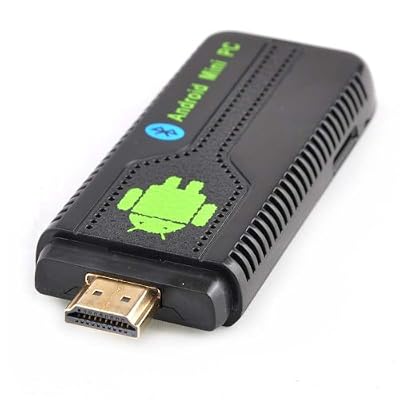 |
| Ug007 Android Mini-PC |
It's about the size of a memory stick, it
retails for $67.10 in the US on Amazon.com (that's around €50 or £44, but seems currently unavailable in Europe), and it's
almost ready to take control of your hi-fi system...
OK, so that's perhaps exaggerating the current state of play just a little, but this little chap is so close to being an ideal piece of kjit as to be more than worth some comment here. The tiny PC-on-a-dongle illustrated to the right, the
Ug007, has almost all you need to power your next digital music system.
There are some a few things you'll need to have in place: your music collection is (at least partially) shorted on a hard drive (such as a NAS server) accessible on your wi-fi network; you've some kind of Bluetooth digital-to-analogue converter (such as Arcam's nifty rBlink); you have a TV or monitor with an available HDMI socket (that's where you plug in the mini-PC - its HMDI connector is as shown in the picture); and you have some means of controlling the mini-PC - a Bluetooth keyboard and mouse or an Android smartphone running the free app that allows remote control operation from the phone's touch-screen,
That perhaps sounds like a lot of things to get started with, but you may have some or most of these already. This is the little fellow that brings them all together and makes it all work. And if you're happy to use your TV sound (or have a good set of amplified speakers attached in some way to your TV set) you won't need that Arcam converter right away - which is almost where I'm at right now: Music on hard drive? check. Wi-fi network? check. TV audio link to hi-fi? (sort of) check. Phone running Google's Android OS? check.
So why that caveat in the opening line,
almost ready? Well, for me there are currently a couple of things holding this particular mini-PC's revolution back. First up, its Bluetooth link is probably a standard one, which doesn't implement the advanced Apt-X encoding that makes Arcam's DAC a worthwhile investment. This new audio transmission standard is currently in place on, amongst others, new top-end Samsung smartphones and Apple Mac PCs and laptops (among other things), but isn't yet available on iPhone or iPad, or on many other phones. There are other hi-fi related devices which do use it, and when companies like Arcam, Sennheiser, Onkyo, Monster, Chord, Musical Fidelity and others start to incorporate it into their equipment, it's just possible it might take off more widely (there a list of products which are Apt-X compatible
here). What's important here is this: with Apt-X you get full CD-quality sound over a wireless Bluetooth link; without it you're looking at no more than reasonable-MP3-quality audio.
Secondly, the control software isn't quite finished yet, in my opinion, in its new Android incarnation. XBMC, my preferred media player, is up and running, but is still under heavy development for this operating system. If you want it to play high definition video, for example, you might find some of the Android hardware isn't up to this kind of power just yet. Getting that kind of performance out of a PC on a stick or in a phone is only just starting to become possible - but it will happen, and pretty soon I'm sure.
So it really can't be long before someone manages to pull all this together into a simple device you can slip into your shirt pocket, slot into your TV, that plays every music and video recording you own, transmits high quality sound without wires to your hi-fi amplifier and speakers, and does it all at a cost that's relatively negligible - certainly well under $100. If I was a hi-fi manufacturer I'd be seriously worried about this - their attempts to shoe-horn this kind of thing, audio only, into an inflexible amplifier-based format will date very rapidly indeed.
And of course, being a mini-PC (of sorts), unlike those amplifier-cum-wi-fi-receivers, one of these dongle devices can also be used for browsing the web, sending e-mails, and running almost any of the hundreds of thousands of apps available for the Android platform (though it might be a little useless as a sat-nav replacement!). Or maybe someone will make one to run Windows, or iOS, or OSX, or Linux.
If you can use wi-fi and Bluetooth to do away with the need for any major on-board storage, or stacks of assorted connector sockets, wires and plugs (bar a single video connector), what other possibilities might there be just around the next technological corner?
Andrew Rose
22 February 2013






