FREE ALBUM
| 
| |
A FREE 128k MP3
FURTWANGLER
Brahms
Symphony 1
Haydn Variations
Hungarian Dances
(Just in case Toscanini's Brahms isn't your up of tea this week...)
CLASSIC REVIEW
" We are so accustomed to analyzing the interpretive depth Wilhelm Furtwängler achieved that we often forget what a technically gifted conductor he was. As these remasterings by Andrew Rose reveal, Furtwängler could get the most gorgeous sounds out of an orchestra. His baton technique certainly was idiosyncratic, but he had no trouble attaining what he wanted. He also was an indefatigable rehearser. Georg Solti relates in his Memoirs Furtwängler's pleasure at Salzburg when Solti told him how much better the Vienna Philharmonic played for Furtwängler than for Karajan. Much of Furtwängler's sway over an orchestra derived from sheer force of personality. A member of the Berlin Philharmonic tells of how when rehearsing under another conductor, the orchestra's sound changed entirely after Furtwängler just walked into the hall. Thanks to Andrew Rose, we now can hear how central the concept of sound was to Furtwängler's interpretations of Brahms. There is much beauty of thought here certainly, but the sonic sybarite will derive much pleasure as well. Brahms was a great craftsman, and the importance to him of creating lovely sounds should not be underestimated.
As a composer, Furtwängler could take the occasionally disparate elements of Brahms's First Symphony and find inherent structure and drama. The introduction to the first movement is almost conversational, summarizing and prefiguring the subsequent drama like a Shakespeare prolog. The Allegro possesses weight and gravitas. It alternates between reverie-like fantasy and the onslaught of fate. The movement maintains a noble character, even when tragedy lurks around the corner. Nevertheless the movement never seems episodic-its transitions are finely judged. Furtwängler treats the slow movement as an intermezzo, with phrasing that is highly vocal and operatic. It acts both as a pause in the drama and an intensification of the feelings so far evoked. The third movement is a quasi scherzo. Its B section (like a trio) brings back life's rough and tumble, before fate in the brass and in pizzicato strings mark the return of the A section: an allusion to the brass in the third movement of Beethoven's Ninth. That symphony is even more eloquently drawn upon in the final movement. Its introduction portrays whole worlds passing before our eyes, then disappearing. Suddenly, the great string tune brings us to a place of peace and satisfaction. This is followed by excitement, even at times jubilation. An ominous shadow eventually falls over the music, which the coda pushes aside-leading to the triumph of the great brass chorale. Furtwängler resists the temptation to speed up from here, and the symphony ends on a majestic note.
Furtwängler's Haydn Variations are unusually somber, slower than his December 1943 Berlin recording. The statement of the theme offers lovely wind and horn choirs; the uniqueness of the instruments used by the VPO contributes a special glow. Furtwängler's tempos allow for the articulation of all the instrumental parts, including some often glossed over. The third variation contains a slight horn bobble. The fourth and seventh variations could stand alone as genre pieces, small elegies. The finale is alternately stately and tender, evincing an emotional vulnerability rare for any conductor. The three Hungarian Dances are hardly mere fillers. No. 1 features gorgeous, elegant string playing. In No. 2, Furtwängler creates a real gypsy feeling. He revels in the kaleidoscopic orchestration of No. 10. The Vienna recordings all were made in the Great Hall of the Musikverein, and are excellent monaural. Furtwängler, as usual, is indispensable to a fuller understanding of this music. These new remasterings heighten our appreciation of this conductor's feeling for Brahms's beauty and sensibility, and as such are warmly recommended."
DAVE SAEMANN
FANFARE NOV/DEC 2012
Download it now - for one week only - it's only free from our Cover Page! "UPGRADE" to full quality lossless 16-bit or 24-bit FLAC downloads with notes here: PASC 340 |
NEW REVIEW
| Classical CD Review
December 2012
Hanson Vol. 5
by S.G.S.
"I don't know why this piece should elude so many conductors, but as far as I'm concerned, Hanson's the only one truly to have nailed it"

|
American classics back in the catalogue, where they belong. Sometimes I think Pristine, the label which specializes in resurrecting old and out-of-print recordings and restoring them with state-of-the-art digital élan, has burrowed inside my head. They have worked so much on my wish list -- stuff I didn't believe I'd ever hear again -- I can't conceive of any other explanation for their catalogue. I've begun to feel the same way I do when I fall (all the time) for a stage magician's trick. I owned the original Mercury LPs of all the items on the program (in one case, its horrid electronic stereo equivalent), and because they were particular favorites, I've retained that original sound, or at least the sound that came out of my crummy record player.
Many view Howard Hanson as the standard bearer for Romantic music in the Modern era. I take a slightly different view, even from Hanson himself. To me, the music is too individual to become the basis of an artistic movement. Imitating Hanson is like imitating van Gogh: everybody knows that's your source, only you don't do it as well as the original. Also the "manifesto" work proposed, the Symphony No. 2, frankly isn't strong enough to bear the weight, as Le sacre, Moses und Aron, and Rhapsody in Blue surely are. Furthermore, Hanson's music changed at various points in his career. After World War II, the lushness of, say, the Symphony No. 2 or the opera Merry Mount gets pruned back for more concise and more dissonant work. The Symphonies 5 and 6 -- my favorites of the cycle -- don't really sound like the Hanson Everybody Knows.
Hanson subtitled the one-movement Fifth "Sinfonia sacra," because he was inspired by passages on the Resurrection in the Gospel of John, but you needn't know that to make sense of the work. It stands on its own. It begins with scalar lines heavily in the Phrygian mode, reminiscent of chant, but so does a lot of Hanson. However, its compression and its eschewal of song-like themes distinguish it from its older siblings. I've described the symphony in detail in a previous review of Gerard Schwarz's release on Naxos and won't repeat myself here. I will, however, speak to Hanson's performance. A very capable conductor, Hanson let his composer self down here in that he gives merely a good performance. Compared to Schwarz, however, the reading seems cramped and relatively undifferentiated -- a "wad" of music. A lot of this comes down to the playing of the Eastman-Rochester Orchestra, which simply does not reach the level of the Seattle Symphony. Furthermore, Schwarz had the benefit of Hanson's recording to guide him. I'm almost certain Schwarz knew Hanson's recorded legacy, since he reproduced so much of it.
Chorus and orchestra often drew Hanson to compose. The Lament for Beowulf (1925) is a flat-out masterpiece, while the Songs from Drum-Taps (1935) has more than its share of effective moments. The choral writing in the opera Merry Mount (1933) represents some of the most powerful parts of the score. The Cherubic Hymn for chorus and orchestra (1949) I've never warmed to, probably because I know it only in this performance. My dissatisfaction comes down to the singing of the Eastman School of Music Chorus, who puree the text into a slurry of pretty vowels. I have no idea of the text, and Pristine doesn't provide a copy or even a link to one -- a serious lapse, since Hanson wanted to write music that expressed its meaning. Consequently, the score comes over as another wad.
Although around in the earliest jazz as "the Spanish tinge," during the Thirties and Forties, American pop succumbed to a feverish mania for Latin-American music, especially rhumba, tango, and conga. Cole Porter wrote quite a few beguines (other than "When They Begin"). Latin dance bands like Xavier Cugat's influenced others, notably Duke Ellington, to incorporate Latin rhythms into numbers like "Caravan" and "Perdido." The craze hit even classical music with examples including George Gershwin's Cuban Overture and Aaron Copland's El Salón México. Morton Gould, who had two musical careers -- one in concert music, the other in pop -- composed a great deal to deadline for the radio program he hosted. I suspect this Latin-American Symphonette (Gould composed three more symphonettes) was written for that program. Why the term "symphonette" as opposed to the usual "sinfonietta?" Gould noted the suffix's popularity at the time and French as a Swing Era mark of class and sophistication, citing kitchenette and dinette as contemporary coinages. Nothing dates so quickly as the up-to-date.
The score stands perfectly poised between classical and pop. Its four movements take the form of dances: rhumba, tango, guaracha, and conga corresponding to opening allegro, slow movement, scherzo, and allegro finale. Each movement is both recognizably its dance and an extremely sophisticated concert work. Brilliantly and even poetically orchestrated, particularly the percussion, it appeals to popular taste without apology, and indeed has nothing to apologize for. The rhumba shakes booty. The tango goes from night phantoms to blazing sunlight and ends with spectral wisps. The guaracha, a favorite in Cuban brothels (like ragtime in American ones), sings a sly tune that I can't get out of my head. With the conga, a dance line sways and then snaps on the last beat.
For such a lively work, recordings have run rare on the ground. I dimly remember one from Felix Slatkin and the Hollywood Bowl Orchestra and one from Maurice Abravanel and the Utah Symphony, but they rose and sank. Gould himself led the best performance I've heard with the London Symphony Orchestra on Citadel, now out of print, of course. Gould also used to excerpt the tango and guaracha as album fillers, and those have shown up on a couple of releases. Hanson's account seems to have had the most staying power. It's very good, very peppy, but it's mono and the LSO swings more than Eastman.
Hanson's artistic aims and sympathies lay closer to Samuel Barber than to Gould. Although Barber gradually incorporated some of Stravinsky in his music, he never belonged to the American Neoclassical school. Like Hanson, his music is sui generis, despite his stylistic progression to Modernism. He had the gift for creating memorable melodies practically from the beginning, and nearly all of his works stand out from one another, simply because you can remember their tunes. Hanson performs three early works. The School for Scandal overture Barber wrote while still a student at the Curtis Institute in Philadelphia. Although a young composer with many masterpieces ahead, he came up with one of the great comic overtures. It bubbles like Strauss's Eulenspiegel, but it also, in its broad oboe theme, announces a new lyricism and an individual voice.
What can one say about the Adagio for Strings? Undoubtedly his greatest hit (especially after the movie Platoon), it has received so many rearrangements (two from Barber himself) that some label released all of them on one CD. Barber originally composed it as the second movement of his string quartet but almost immediately created a version for string orchestra. That version has consigned the rest of the quartet to relative oblivion and, ever since the death of FDR, has become our music of national mourning. Barber turns a very simple voice-leading technique into a masterpiece -- a giant arch of sound that builds from a whisper to a series of passionate outcries and then fades. It moves like a great sermon, with huge phrases and periods. It has reminded more than one writer of a stream widening on its way to the ocean. The composer grew to dislike the score and, when he had to attend a live performance, occupied himself by counting the mistakes the strings made. Apparently, its slow speed can mesmerize players so that they lose count.
The First Essay (known as the Essay until a second came along; later, he added a third) owes its title to Barber's scruples. He didn't produce a sonata movement or anything in Classical or Baroque forms, but something organic, exploring a few themes almost in the manner of writing an essay. He once claimed that the Essay was based on one idea, but that's pretty hard to sustain if you analyze the score. There's yet another big singing theme -- a lament -- a nervous scherzo, and a passage for brass that sounds like "Taps" blowing over a battlefield. The first two ideas combine to build to a climax. The brass passage briefly returns, dissolving into the main idea of the lament. But for those brass, one could analyze the work neatly. However, thematically they have nothing to do with either of the other two ideas. Nevertheless, the brass passages lift the piece from something well-made to something nearly profound, if you can describe music so. They add mystery. You ask yourself what they're doing there, isolated and yet rising spectrally from the music.
You can't say that any of Hanson's Barber wallows in sentiment or sonic gorgeousness. All the scores move crisply and clearly. In , I heard counterpoint that had previously eluded me. I normally like "crisp" and "clear," but not in the Adagio. I need to wallow. My favorite recording is Schippers and the New York Phil on Sony 770278 -- lush string textures and stereo, climaxes that go through you. However, Hanson's Essay No. 1 has been the best account on record for fifty years. I don't know why this piece should elude so many conductors, but as far as I'm concerned, Hanson's the only one truly to have nailed it. The usual errors include a too-slow scherzo and no idea how to integrate the "Taps" section into the rest of the work. Hanson takes us through the work with assurance, as if it were just one natural exhalation.
As I've said, I owned the LPs -- flat, boxy, and dull. Pristine has opened up and brightened the sound..
|

|
|
CONTENTS
| |
Editorial Want to buy a record? That'll be $480 please...
Toscanini First of two all-Brahms London concerts, 1952
PADA David Saperton plays himself, Ravel and Godowsky
|
Another year begins - welcome to 1962!
Possibly as late as we'll ever get in historic recordings...
This week I've been working on a couple of projects: we'll soon have Sir Malcolm Sargent conducting Beethoven's Eroica and Schubert's Unfinished symphonies with the Royal Philharmonic Orchestra in early-60s stereo, two composers remarkably rare in the conductor's discography.  But first it's the turn of Toscanini, and the first of a two-volume set documenting his two thrilling all-Brahms Festival Hall appearances in London in 1952 with the Philharmonia Orchestra. The concerts were recorded by EMI at the time, as well as being broadcast by the BBC, and I've endeavoured to bring both together for possibly the first time since an LP issue in the 1970s. They feature all four symphonies, plus the Tragic Overture (concert 1), the Haydn Variations (concert 2), and the British National Anthem (both concerts). The second volume will also include a short, live radio appreciation of Toscanini's performances given by Sir Adrian Boult during the interval of the second concert. The inclusion of the radio archive material has raised a few technical issues - the BBC sound has been sourced from AM broadcasts, with the limited frequency range that this implies, and I've had to use some pretty complex technical tricks to try and create the illusion of sonic continuity where we hear the announcer over a background of applause, general hubbub and orchestral tuning up. I don't have the announcer's name though he does sound at times like (a young) Richard Baker in the first concert - a plausible candidate? If anyone can confirm or correct me on this please get in touch - and if you're really good at this kind of thing, here's the announcer from the second concert - who is he? Happily the music recording was in good quality, and happily has responded brilliantly to the XR-remastering box of technical goodies - as usual, Ambient Stereo is strongly recommended here. 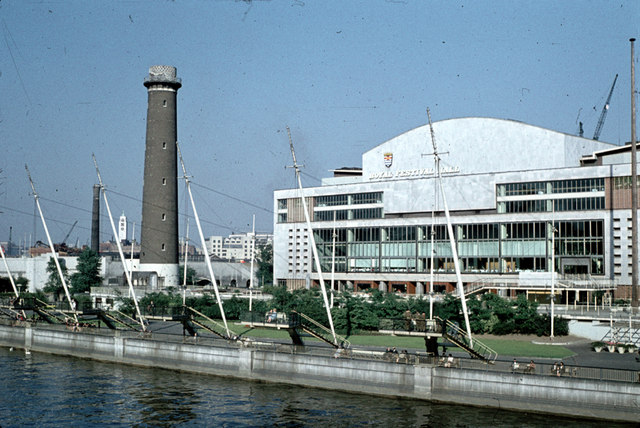 |
The Royal Festival Hall, London, in 1959 |
"Can I sell you a record, sir?...
 "In glorious mono, made using the finest 1950s technology, a limited edition release of just 300 copies, it contains a couple of Bach violin sonatas played by the Hungarian, Johanna Martzy (no, me neither, sir). It was issued in 1954 by EMI/Columbia - to you, sir, it's a snip at only £300 (that's about $480 or €380), plus postage of course. "In glorious mono, made using the finest 1950s technology, a limited edition release of just 300 copies, it contains a couple of Bach violin sonatas played by the Hungarian, Johanna Martzy (no, me neither, sir). It was issued in 1954 by EMI/Columbia - to you, sir, it's a snip at only £300 (that's about $480 or €380), plus postage of course.
"Only one small thing to note: it's a copy, it's not the real thing. I'm afraid an original would cost a lot more than this sir, as I'm sure you're aware. It's a modern reproduction, made by a company called The Electric Recording Co., recently set up in the UK, sir, and very fine it is too, so they tell me."Actually, sir, I'm sure you'll really want the box-set of all three LPs - at only £900 you will be saving over £3500 on a mint set of the original Columbia LPs, so it's a bargain, isn't it sir?
"(Then again, and please, whisper this very quietly, won't you sir, you could find the Testament double-CD of these recordings, transferred from the same EMI master tapes, at a more sane price of around £16.50...)"  It's certainly It's certainly a curious venture. Having licensed 80 recordings from the EMI archives, the Electric Recording Company has sourced and renovated (at enormous expense, we're told) a load of vintage equipment to play the tapes back on - as well as a 1950s-era mono disc cutter to create their new masters. They're releasing 5 albums a month; if you want one, you'll have to express an interest in them on the company's website (which, incidentally, doesn't appear to mention the cost or availability of the discs), and they'll get back to you. (Alternatively hit Google or eBay, where I've seen one of these discounted to a still eye-watering £240.) The company, it has to be said, has apparently gone to great lengths to recreate the best that fifties technology could manage, even down to the careful selection of reproduction packaging materials, the carefully-matched reproduction paper used for the letter-press printed reproduction booklets, even the type of plastic used for the reproduction inner sleeves. They've hired a retired Abbey Road engineer to rebuild their Ortofon mono disc cutter. They spent £100,000 on the purchase and renovation of their tape player. The website looks expensive, too...  Let's hope, for their sake, it pays off. I so, however, wonder just how many copies of their latest project, a reproduction of the Pathé 10-disc box set Mozart à Paris they'll sell - at £3000 a box (shown here). Would you pay $4800 for a box of reproduction records? with no remastering, no restoration, and every effort made to reproduce (the shortcomings of?) fifties pressings? That's a lot of money to pay for what might amount to little more than 5 or 6 hours of music in this day and age. There's no doubt this business is being hyped as a labour of love - this article from Classical Music Magazine is typical (and, as is typical, gets the science-y bit horribly muddied and muddled) - but to honest, it all seems a bit bonkers to me. Even at an affordable price, these records would be hard to sell - there's probably a good reason why some of them are rare in the first place. And surely the kind of collectors who do go after the rarest discs, and are prepared and able to pay the very highest prices asked, are interested in originals rather than reproductions and re-pressings. Certainly this is the case with any number of rare original 50s discs where later pressings (with different label designs or new master discs) sound immeasurably better yet command much lower prices - I'm thinking UK Decca LPs at this point, where Ace of Clubs reissues are much nicer-sounding than their LXT original counterparts. Why should these reproductions, however lovingly made, command such a price? Yet right now, in certain sections of the media, vinyl apparently holds a special place in the romantic hearts of journalists who are too young to remember the switch from vinyl to CD, who've swallowed the phoney "superior analogue sound quality" thing hook, line and sinker, and have discovered the joys of stylus on rotating plastic just long enough to rehash it into saleable copy, before moving onto the next young, well-heeled, urban-retro trend. I've no doubt the LPs will sound OK. Hopefully more OK than the originals they're reproductions of. But I've no doubt that they'd be much improved by good digitisation and modern remastering, preferably avoiding all the vintage valve (AKA tube) technology and ancient disc-cutting machinery being employed here, let alone suffering the well-documented shortcomings of vinyl that I spend so much time and effort trying to overcome: rumble, surface noise, end-of-side distortion and so on. About our free Beatles FLAC  Last week I offered a free Beatles download for all Pristine Classical newsletter readers: Love Me Do, in an XR-remastered version (as picked up and featured in The Philadelphia Inquirer on Tuesday - hello to David Patrick Stearns, the Philadelphia Inquirer's Music Critic!). Anyway, a few days later I received an e-mail from a reader, Chris Fox, who'd managed to write this onto a regular audio CD: "You state that 24-bit audio files cannot be transfered to normal CD. I downloaded the spectacular "Love me do" in 24-bit and after decoding the FLAC, successfully burned the resulting 24 bit wave file to CD. And it is spectacular on a high end stereo system. Have I found a new threshold?" Unfortunately for Chris he hadn't. I took a few moments to explain why this was the case, and thought it worth reproducing my response for the benefit of others who may be curious about this: Two things have come in to play here, conspiring to produce a 16-bit audio CD from a 24-bit source. First is the fact that the 24-bit file in question exists at the standard CD sampling rate of 44.1kHz, unlike the 24-bit files we release commercially, which have (until this week's 96kHz Stokowski issue) been 48kHz files, which in themselves are incompatible with CD.Now sample-rate conversion is a tricky thing to get right, and CD burning software that I know of doesn't attempt to do this. But it clearly is content to burn 44.1kHz files to CD, regardless of the higher bit depth. How does it do this? I imagine by a crude process of discarding the higher resolution data and simply using the "top" 16 bits of data in every 24-bit "word" of information.It clearly works, but it's a simple, brute-force method of getting a 16-bit file onto a CD. Much time, effort and research has gone into better ways of converting high bit-rate recordings down to lower bit rates. I remember being taught the somewhat confusing concept of dither whilst studying digital music technology at University in the 1980s, and it's a process that continues to be developed today, where an apparently illogical (at first sight) application of specially tailored noise at frequencies we're less sensitive to as human listeners allows us to achieve lower noise floors (simulating 19- or 20-bit reproduction) at frequencies we do particularly notice, giving far better overall performance at 16-bit audio levels than the method your CD writing software will almost certainly have employed.That said, to be brutally honest, in a loud, pop recording such as Love Me Do, it's unlikely to make any difference - the music, by its nature, already has a pretty limited dynamic range, and expanding the effective signal-to-noise ratio at frequencies below 15kHz probably won't make a jot of difference to what most listeners ever hear! But don't mislead yourself into thinking you've made a 24-bit audio CD. You haven't, and the length of time it's taken to outline why (and the complexity of further explanation) is one good reason to keep our 24-bit files a little harder to burn to audio CD - I don't wish to create false hope or impressions, or have people spending extra money on recordings they would do better to buy as properly-prepared, dithered 16-bit downloads for CD listening.No Bob Dylan here, though
 This was one of the sadder stories of the week. Sony Records, owner of the Columbia back-catalogue, this week issued a limited edition of 100 sets of previously unreleased Bob Dylan out-takes, home recordings and concert snippets from 1962 and 1963 to a handful of countries in Europe. Naturally these are already fetching high prices on eBay. A box-set of 4 CDs, cynically entitled "The Copyright Extension Collection, Vol. 1", Sony claims that they've released this material so that it can't fall into the public domain when changes in European Copyright law come into effect later this year. It's a line picked up and parroted by the press, including the New York Times, who, despite having an army of fact-checkers, seem not to have read the forthcoming Copyright Law any more closely than Sony's lawyers did. They refer to a "use it or lose it" clause which was present in the draft bill presented to the European Parliament a few years back as justification for Sony's actions. This would have allowed unissued recordings such as these to fall into the public domain if they were more than fifty years old if they remained unavailable to the public for a couple of years.  | | Bob Dylan, 1963 |
Some dastardly cynics suggested that all that this clause would lead to would be record companies making highly limited issues of material they wished to keep a hold on briefly available in a handful of EU states, to ensure that copyright didn't lapse. Oh, hang on a minute... Yet this "use it or lose it" clause was scrubbed from the final copyright act when it was ratified in November, 2011. It doesn't apply. The record company lobbyists made sure it was scrubbed out. This also means that you and I will never get to hear a wealth of golden-age live radio concerts, such as last week's 1962 Stokowski and this week's 1952 Toscanini, broadcast in the years following 1962, as these will now remain locked away until at least the mid-2030's (by which point in time I've no doubt the lobbying for copyright extensions will have taken place all over again). Ironically, all that this Dylan release has achieved is enough press coverage to expose Sony's ruse, and enough comment on newspaper websites from readers to ensure that anyone who wishes to find a pirate copy of these "new" old recordings (because they can't buy them) will quickly discover how and where to download them for nothing. I wish I could come up with a rational explanation for all this but I can't, beyond corporate paranoia and monumental stupidity.
Win Klemperer's Beethoven Symphonies
 As mentioned last week, we've partnered with the Audiophile Audition website to offer five copies of the complete Beethoven symphonies as conducted by Klemperer and issued over recent weeks in new XR remastered editions on the Pristine label. All you need to do is visit their extensive website at www.audaud.com and register there during the month of January 2013. At the end of the month the website's editor, broadcaster and reviewer John Sunier, will draw 5 names from the new subscribers and the winners will get to choose from CDs, FLACs or MP3s of the 6-CD set. You don't even need to answer any tricky questions! And while you're there, don't forget to check out the classical reissues pages, where Gary Lemco regularly contributes reviews of Pristine releases, some of which you're sure to have read here before now. Andrew Rose
11 January 2013
|

|
Toscanini's classic first 1952 London Brahms concert in stunning XR-remastered sound
"One of the very best (and most exciting) recordings of the work available"
- MusicWeb International

BRAHMS in London Vol. 1
British National Anthem
Brahms Tragic Overture
Brahms Symphony No. 1
Brahms Symphony No. 2
Recorded 29 September, 1952
Producer and Audio Restoration Engineer:
Andrew Rose
The Philharmonia Orchestra
Arturo Toscanini conductor
Web page: PASC 373 Short Notes "The First Symphony is a powerful performance... the care given to the woodwind is an example of this performance's individualism, and this is no more evident than in the finale with its horn and flute melodies, here played gorgeously by Dennis Brain and Gareth Morris... one of the very best (and most exciting) recordings of the work available... The great brass sonorities are here captured magnificently, strings arching ever higher upwards, horns and trombones radiant to the close. The cheers at the end say it all!" - MusicWeb International
The first of two all-Brahms concert recitals given by Toscanini in London in the autumn of 1952, this was his debut with the Philharmonia Orchestra and was, without doubt, one of the great triumphs of Toscanini's conducting career.
This newly XR-remastered release includes original BBC radio commentary to add even more atmosphere to a hugely charged event. Needless to say, the sound quality is spectacular! Notes On this recording Following our release last year of an XR-remastered edition of Toscanini's 1951 Carnegie Hall Brahms symphonies with the NBC Symphony Orchestra, I was repeatedly urged to tackle the London series he conducted in the Autumn of the following year. This is the first of two volumes, each dedicated to one of those two memorable concerts. The effect of Toscanini's return to the British capital for the first time since before the Second World War and the enthusiasm of the response of the music-lovers of Britain has been well-documented, as has the brilliance both of the Philharmonia Orchestra at this time, and the superb performances Toscanini elicited from it over two nights of Brahms.
These remasterings aim to bring the listener closer than ever to the magic of those nights, beginning and closing with excerpts of BBC radio commentary setting the stage, and the (edited!) rapturous applause reproduced. Much of this extra content was drawn from AM broadcast recordings which have taken some considerable effort to weave into the much high quality music recordings made by EMI. Happily the latter have responded brilliantly to Pristine's 32-bit XR remastering system, with a sound that's full, vibrant and very much alive - particularly do in our Ambient Stereo versions of this release. Andrew Rose Review Symphonies 1 & 2 The performances of the symphonies are compelling - and certainly much warmer and more lyrical than his recorded cycle with the NBC Symphony Orchestra. As interpretations, they rather contradict the impression that all Toscanini performances were somehow symmetrically constructed, with tempos often staggeringly similar from performance to performance. With the exceptions of the First and Fourth Symphonies, these Philharmonia accounts are often less expansive than the NBC cycle he recorded in late 1951/early 1952. The notable achievement in this cycle is the Third Symphony which here receives the most assured of all Toscanini's interpretations of this symphony - a performance of considerable sunniness with the most beautiful of cantabile ever-present. This contrasts with the NBC recording which is slow, lacks rhythmic tension and seems drawn downwards by an interminably long beat.
The First Symphony is a powerful performance, although as in all Toscanini's interpretations of this work he fails to conduct the opening bars of the work as they should be. These opening bars, with its unrelenting timpani strokes, are amongst the most grand and profoundly moving of all passages in the symphonic canon, yet Toscanini, like virtually most conductors, seems confused by Brahms' marking of sostenuto. Taken at almost quaver 100, the development of the opening timpani seems too fast - and he accelerates the timpani ruining the grand line that Brahm's intended (and for which you have to turn to Furtwängler or Celibidache to hear correctly played). This aside, however, the movement develops inexorably, with the contrapuntalism of Brahm's construction not only implied, but grandly developed. Dynamics, whilst not as scrupulously observed as Celibidache (the most inspired interpreter of this symphony) are actually more clearly heard in this Philharmonia account than in his NBC recording of the work. The opening drum rolls, even if tempi are wayward, do clearly distinguish between the opening f and the concluding ff, and in the first movement's main theme cellos, woodwind and horns play perfectly before the appearance of the crescendo. In fact, the care given to the woodwind is an example of this performance's individualism, and this is no more evident than in the finale with its horn and flute melodies, here played gorgeously by Dennis Brain and Gareth Morris. The playing here is certainly more distinctive than on the NBC recording, and recalls another Philharmonia recording of the First Symphony with Guido Cantelli (a performance remarkably similar to this one). The trombone's missed entry in the finale (and then his fluffed notes) do not noticeably ruin what is one of the very best (and most exciting) recordings of the work available.
Listening to the opening of the Second Symphony, with its low strings and horn and woodwind exchanges, I was amazed at how much presence exists in this Testament transfer. Toscanini was reputedly somewhat worried that string tone was somewhat undernourished, yet hearing the opening bars and then the entry of the string's first theme, one is aware of an extraordinary depth of tone. Tempi in this symphony are all swifter than in Toscanini's studio recording of the work, yet this is never at the expense of the string's beautifully phrased playing. The playing is at once lyrical as it is idyllic, with the tunes given a statuesque presence, the penumbral shading of Brahms' scoring spot-lit neatly against the borders of lighter melody. The second subject of the first movement is as song-like as one could ask for, the coda intense and evocative. If the middle movements are gracious, with felicitous woodwind playing, the finale, marked Allegro con spirito, is as grandiose and driven as any. The playing is wonderfully dynamic, the development to the coda remorselessly laid out before us but not overdriven in any way. When the triumphal coda appears, one of the most astonishing things Brahm's wrote (and as similarly transparent as the closing pages of Bruckner's Fifth symphony) the exuberance is infectious. The great brass sonorities are here captured magnificently, strings arching ever higher upwards, horns and trombones radiant to the close. The cheers at the end say it all! Marc Bridle, MusicWeb International, April 2000 (Review of Testament CD issue, excerpts)
MP3 Sample Tragic Overture Listen Download purchase links: Ambient Stereo MP3 Mono FLAC Ambient Stereo 16-bit FLAC Ambient Stereo 24-bit 96kHz FLAC CD purchase links and all other information: PASC 373 - webpage at Pristine Classical
|
David Saperton plays Godowsky, Ravel
 | | David Saperton |
PADA Exclusives
Streamed MP3s you can also download
WQXR-New York
7/14 November 1953
Saperton: Zephyr
Ravel: Gaspard de la Nuit
Short Spoken Interview
Godowaky:
Phonoramas 1, 4, 9, 10
Chopin Studies 13, 48
Alt-Wien
"Kunstlerleben Metamorphoses" v. 2
Triana
David Saperton piano
Recorded 1953
Remastered from low quality sources by Dr. John Duffy
Over 500 PADA Exclusives recordings are available for high-quality streamed listening and free 224kbps MP3 download to all subscribers. PADA Exclusives are not available on CD and are additional to our main catalogue.  Subscriptions start from €1 per week for PADA Exclusives only listening and download access. A full subscription to PADA Premium gets you all this plus unlimited streamed listening access to all Pristine Classical recordings for just €10 per month, with a free 1 week introductory trial. Subscriptions start from €1 per week for PADA Exclusives only listening and download access. A full subscription to PADA Premium gets you all this plus unlimited streamed listening access to all Pristine Classical recordings for just €10 per month, with a free 1 week introductory trial.
|
|



