 |
|
Welcome to February's Newsletter!
|
|
"...there is a fifth goal, which might be the trickiest of them all. This is learning how to hold both an ordinary reality, and non-ordinary reality consciousness at the same time".
Steve Serr, Ph.D., Shamanism 101
|
The Dream,
Raffaele T. Spano,
Shamanism 101, Instructor and Editor
Since we are an expression of the whole, it should be no surprise, nor should we even question for a moment, that we are both the microcosm and the macrocosm.
It is our nature and our right; a forgotten truth through which we can see many other truths that until then, had remained unnoticed.
From the spiraling galaxies suspended in the vastness of the cosmos, to the invisible atoms imprisoned in what we call matter, the same patterns are repeated constantly, if not eternally, throughout the universe.
There seems to be a spiritual order in everything; from the invisible to the visible, from the unreachable infinity of the cosmos, to the more known reality we live in.
Objects, people, animals, plants, rocks, pebbles... all carry within them the very same essence which makes everything and everyone part of a greater dream, something that we can access when we enter a shamanic state of consciousness.
And perhaps, it is when we go through moments of confusion in our lives, that we can have among these some of the most powerful realizations. The need for something acts as the fuel that gives power to the engine.
It is through the essence of all essences, by accessing the innate and primordial power of our dreams that we can return home, and in a sense, find again balance and harmony.
It is during the intense moments of our lives that we should, and perhaps must, return to the core of our beings: our hearts and souls.
The mind will not always provide all the answers. A chaotic mind is unable to find logic, because it has lost its compass.
It is our intimate relationship with Spirit that will realign our being to a more harmonious state of existence and as such provide a clearer and more powerful vision.
But we have to allow it.
It happens through our shamanic work, among many of the ways, through our hearts expanding and looking at the world with the eyes of a new-born.
It is something that we long for, and yet, we should be the ones that take care of the cosmic dream, since we are part of it.
But we have forgotten, often detaching and disconnecting ourselves from the beauty of who we really are: dreamers in the dream; or the dreamer's dream.
The lens through which we see the dream can only be one. I call it the great lens. However, as we move along our lives, more 'filters' are added, either by ourselves or by someone else, and the vision becomes distorted.
It is this distortion that needs to be addressed, ensuring that we purge from ourselves all limitations, all fears and all pre-conceived ideals. Shamanism does call us to fly freely, experiencing our wholeness, compassion and ultimately our true-selves.
And if we realign with the cosmic dream, then, we can only expect great things to happen.
|
The Unnoticed Aliveness of Our World,
Catherine Center, Shamanism 101, Instructor
From a shamanic perspective, everything is alive with its own spirit and consciousness, sharing the wisdom of the whole. Even things that would appear to be lifeless can still be communicated with, and so must contain spirit.
The awareness that everything has spirit and is part of oneness seems to come with us as we are born into the world. Many children know this and will talk to inanimate objects as if they were 'real'. Evidence of this occurred recently on a television show called 'Master Chef'.
On this show were a number of very young chefs, many of whom had been cooking since they were two. At this point in the show they were between the ages of eight and twelve, and their skills and knowledge about food and what to do with it were astounding. One of the children ran to get a blender and accidentally dropped it. His immediate response was to apologize to the blender..."Sorry blender", he sang out as he picked it up and ran back to his station.
How many of us remember doing that...apologizing to something when we bumped into it, dropped it, or somehow damaged it? We didn't even have to think about it; knowing that everything contained the life force was just part of who we were.
Accepting that everything has a spirit of its own, as well as being part of the greater whole, would mean that every physical thing we have, own, use, admire, see, hear, touch and need is worthy of our respect and gratitude for its role in our life. It is alive. It is conscious. Perhaps someone gets an idea to make something and that idea had to come from somewhere.
If that 'somewhere' is the spirit of the object itself, perhaps it works with the consciousness of the person and together an idea is formed. In order for it to be brought into form, Earth now comes into the picture since nothing can be made without her. Every single material thing we have has come from her body. She has given, and given, and given, even if it has meant the destruction of her physical being. The created form contains the spirit of the object, the spirit of Earth and the spirit of the human(s) that made it, all of which are part of the vast whole of all that is. How could it not be alive?
An example could be the switch on a lamp. That switch has been created from the body of Earth, giving form to a spirit through the human that designed it. It is alive because Earth is alive, and the spirit that it is, now in form, is alive and will stay that way for many long years, holding itself in form until it dissolves and returns to the whole. In this day and age of recycling, it may be given another form entirely, sharing its spirit with others to create something new. Out of spirit and into the earth through the body of Earth, the constant giver.
If one is to respect all life, all being, then showing gratitude for everything we have would be natural once we realized it was spirit made into a form. The light switch might enjoy being thanked for holding its form and making life easier; as might the piece of metal in the eyelet of a shoe, the sheets that surround one at night, the steering wheel of a car, the button on a shirt, the thread holding the button...
Everything we have is holding consciousness, holding spirit and might appreciate our gratitude and awareness of it as we walk together on the planet. We are constantly interrelating, in every waking and sleeping moment, with the whole through the everyday forms that surround us. There is an unlimited opportunity to express our gratitude for life!
|
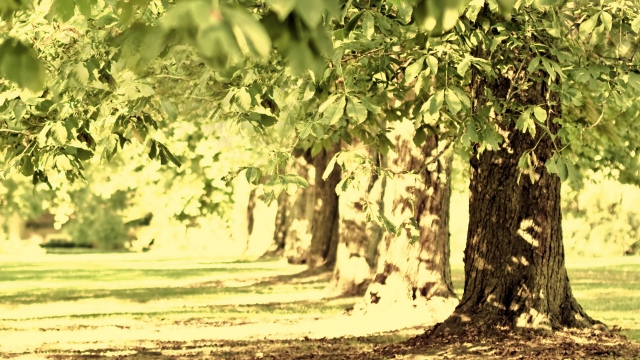
A message from Catherine's Chestnut Tree
"For many long years I have stood here, watching the sea, watching the humans, the bugs and the birds, feeling the wind through my leaves and caressing my trunk.
Many long years I have been granted access to the earth, the great provider. And for even longer have I yearned for the touch of an aware and intelligent human, remembering how it was when we were all first created. We knew each other well then, we were all part of the Great One. We knew only love.
You have been lost to us, humans. We have yearned for your touch, your caress, your song. We have waited patiently, hoping to hear the sound of your true voice, hoping to feel your touch of true love, of being one with all of us.
We are waiting for you, humans. Please respond. Please hear us, love us and know us as you once did. Please come to us with hearts rich in love and tenderness, without harshness, even if you must cut us down.
Ask us, respect us before you hack at us, damaging the whole when you take us. Let us be...find other ways...we plead with you now to know yourselves, understand what you are about.
Come to us. Listen to us. In this way, you can be healed. Be. With. Us. We can love you, care for you, and shelter you as we once did. Just ask us first, respecting and honoring us. Open your heart to us.
We feel soothed and cherished when you do, for we share the same open-hearted love of creation. We create together, and we love together. We are together. Please remember."
|
|
Shamanism: It Is You (Not Someone Else),
Steve Serr, Ph.D.
More and more of us within the cultures and regions of the world that have slipped away from our original, primal, indigenous relationship with our world have increasingly been driven by the consequential pain from this separation to try to recapture our ancient Earth-centered ways. Increasingly cerebral, dreaming our way through a brain-full of ideas rather than living in direct contact with the world, many are starting to realize that this separation is turning us into a species alienated from not just the Earth, but from each other and even from ourselves. The primordial and essentially human wisdom of shamanism offers hope to those who are seeking for reconnection.
Without one's own living shamanic culture to turn to, it would be natural to reach to those cultures and regions that somehow kept a better hold on their old ways than did our own. And, with world travel and the all the information available through books as well as the internet, opportunities to learn about the shamanic practices from different regions have multiplied: Hawaii, Korea, Mongolia, Africa, the Amazon... the list goes on and on. Where does one turn?
For better or worse, we do our best. We study what other cultures have been doing because we seek to know what we could be doing, even if the shamanism from another culture and region does not seem to accurately fit with our own. We look to what others in different parts of the world have to share as we strive to understand what we need to know in our part of the world.
In our quest for reconnection with ourselves and the Earth, we are understandingly tempted to try to duplicate the knowledge, practices, procedures and tools of other regions, cultures, and teachers, and try to make these our own. It makes all the sense in the world. If we avoided learning from the experiences of others, we would miss a wealth of understanding that may have taken lifetimes to gather.
I remember as a young boy having the unique opportunity to not just learn from, but feel real excellence through one of the most respected masters of her age - Billie Jean King - who was gifted not in shamanism, but tennis. One sunny summer afternoon and for a few precious minutes, this world-recognized expert guided my tennis stroke through the process of hitting a tennis ball.
Here was a true master of her craft, trying to share with a thin, young kid, her deep and hard-won expertise. As she guided my arm through the motions I was able to feel what it was like to be truly skilled. However, it wasn't until years later that I realized that she was showing me her skill. The way she struck the ball, though divinely perfect, was her arête, which is the ancient Greek word meaning 'excellence.' What she was passing on to me was her fantastic, over-the-top power, her unique way of being really good at what she was doing.
It wasn't mine.
Now just to be clear, I do not, nor did I ever, play any kind of tennis like Billie Jean King. Neither did I, beyond those prized moments, ever worked very hard to either duplicate her tennis excellence or develop my own.
However, through an unanticipated, curious and quite circuitous path I did end up becoming a shamanic practitioner, and later, a teacher. As a practitioner, reaching for my own excellence became hugely important to me, so I was initially baffled when my understanding of shamanism seemed to differ from those brilliant and capable people from whom I was learning and whose shamanism I strove to duplicate.
But perhaps it was because I was head-strong, that I persevered and kept trusting in what worked for me. However it wasn't until I started teaching and encouraging the development of my own students that it began to dawn on me: shamanic practitioners develop their own excellence. At first, this seems like an obvious no-brainer, but what this means is that a practitioner's shamanism is, necessarily, not that of someone else, some other culture, or some other region of the Earth.
Shamanism is necessarily a person, culture and region specific manifestation. It grows out of the person, place and time in which it arises, within whom and with which it is connected. It arises from the soil.
The last thing I would want to see is a practitioner trying to duplicate the shamanism of somewhere and someone else. Yes, practitioners do learn and grow by sharing each other's sometimes hard-won understandings, whether accessed through a particular teacher or an entire cultural lineage. However, there is no single, straight path to shamanic excellence. Moreover it is the nature of shamanism itself that each practitioner must find his or her own way, even when there are teachers and entire shamanic schools available to help point out previously discovered successful routes or pitfalls.
Ability in shamanic practice is always a consequence of an individual practitioner's ethics, relationship with their spirit helpers, sincerity of practice, and personal experience. Shamanism negates even the possibility of a single universally accepted reference book about itself. There is not even a single shared understanding of how or why shamanism's fascinating practices are effective. Unlike a religion, there is no shamanic Sutra, Bible, or Koran.
This situation is intellectually challenging to anyone who wants to get shamanism 'right'. But take, for example, the animal spirits. There are those that are culturally and regionally familiar in North America, yet these are not the same animal spirits that would be found in, say, South Africa. On the opposite side of the globe and in an opposite hemisphere, should a young, searching, South African shaman-to-be look for North American animal spirits during his or her initiatory journeys?
Of course not. Shamanism is a product of a particular time and place. This is one of the reasons why different shamanic practices around the world differ! The range of animal spirits found throughout the world is huge, each thriving naturally in their particular region.
Shamanism is, as I like to say, something that springs from the soil in which it manifests. Every region or shamanic culture arises within whatever it is amidst. Shamanism is an indigenous growth.
Moreover, Shamanism is very much a 'we do what works' sort of spirituality. In this sense, there is no particular form to shamanism about which a teacher or practitioner can say with any kind of credibility, "This, and only this, is shamanism." However, because humans develop familiarity and attachments to things and procedures, within certain cultures and even within particular shamanic lineages, there start to arise formally accepted tools, practices, or even specific spirits that become accepted as the ones to whom one should go.
Yet the underlying nature of shamanism is just the opposite of any kind of orthodoxy. People and cultures in different places develop different and sometimes unique shamanic understandings, tools and practices. Shamanism grows up and develops within a living world. It is an organic product of where it came to life.
This is the nature of shamanism: just as every culture and region of the world produces within itself its own unique shamanic development, every individual practitioner faces a personal course of growth. Everything a shaman comes to know develops from a combination of the form and nature of their personal experience and their living environment. Thus the excellence of a practitioner is necessarily a direct consequence of what is discovered inside one's own life, whether that be during a journey to a drumbeat or while stepping right outside one's front door.
What this means is that shamanic excellence is not realized by trying to duplicate the shamanism of someone or somewhere else. We do, however, benefit - sometimes enormously - from the experiences and skills that successful and ethical shamanic practitioners have gathered, no matter where they happen to live or what culture they happen to come from. We do listen closely to what others have learned from their experiences to help us navigate towards our own excellence. To ignore the experience of others, whether this be of an entire culture or that of a single person, would be to purposefully look away from perhaps thousands of years of accrued wisdom. It would be an exercise in intentional ignorance.
Certainly, the shamanism of others can provide clues that may help us discern our own path forward, yet each practitioner's path is always and necessarily, uniquely one's own. Just as it is for a human child growing in the physical world, no matter what that child is told, it is through their own discoveries, whether they be happy or sad, that they learn to find their own footing.
Shamanism is a spiritual practice that grows within a unique individual and within a unique culture and region of the world. Each practitioner's shamanism relies on their particular experiences within a particular culture and place.
The cultures that have lost much of their original indigenous wisdom have been looking to the distance to see what keeps the heartbeat of shamanism alive in different parts of the world. If you are from one of these floundering, searching cultures, by all means use the information you gather from afar, but use it wisely. Let the experiences of other shamanisms aid your exploration and discovery of what your shamanism is as it arises from your experience and within your culture, firmly planted in your own place on the Earth.
In shamanism, we are, just as our ancestors, part of the rich soil through which our natural, Earth-Centered spiritual practices and awareness spring. Once we accept ourselves as a living embodiment of this, our path is to let our shamanism arise within us.
Shamanism is not a conceptual exercise, nor can it be derived through the experiences of someone else. Plant yourself in your own living world. Dig your feet into your own soil, sand or snow that spreads out beyond your front door. Say 'hello' to the birds, fish, reptiles and mammals that fly, swim and walk around where you are. Acknowledge the sun that rises above your own head and call in the seasons that revolve in your hemisphere, not that of someone else.
This is shamanism. It is you.
|
|
Did you know that...
"Nature provides the finest example of true self; it is, and stays, true to its design, true to itself. A tree, a bird, a rock all stay constantly aligned and at one with the spirit that it is. Humans can remember to reconnect with true self through her portrayal of what that means."
Catherine Center
|
Thank you for joining us in February's newsletter!
|
|
|
|
Copyright © 2014. All Rights Reserved.
|
|
|
|
|