In many respects, the Brexit story has gone well beyond where it was when GBD held its first public Brexit event on July 7. The UK has a new Prime Minister now -
Theresa May, who has said that "Brexit means Brexit." And
Boris Johnson is Her Majesty's Principal Secretary of State for Foreign and Commonwealth Affairs. The pace of events shows no sign of slackening, and future developments are likely to be the source for most of our future comments on the UK's relationship to Europe etc.
Still, we wouldn't want to move on without highlighting at least one of the many excellent slides that
Bruce Stokes shared at the July 7 event and something from
Alan Wolff's comments.
Mr. Stokes is the Director, Global Economic Attitudes, at the Pew Research Center in Washington. The presentation he gave on July 7 was based on research on attitudes in EU countries this past spring, shortly before the British Brexit vote on June 23. At the outset, Mr. Stokes described the citizens of the EU as more inward looking than they have been in the past, and then he turned to slides that approached the issue of isolationist sentiment in different ways. One of those dealt with where a country's focus should be. Describing that slide Mr. Stokes said:
"The median right now is 56 percent ...[that is, averaging the different country responses, 56 percent] say that our country should deal with its own problems and let other countries, basically, fend for themselves."
Today's featured quote, however, was taken from his discussion of the very next slide, namely this one:
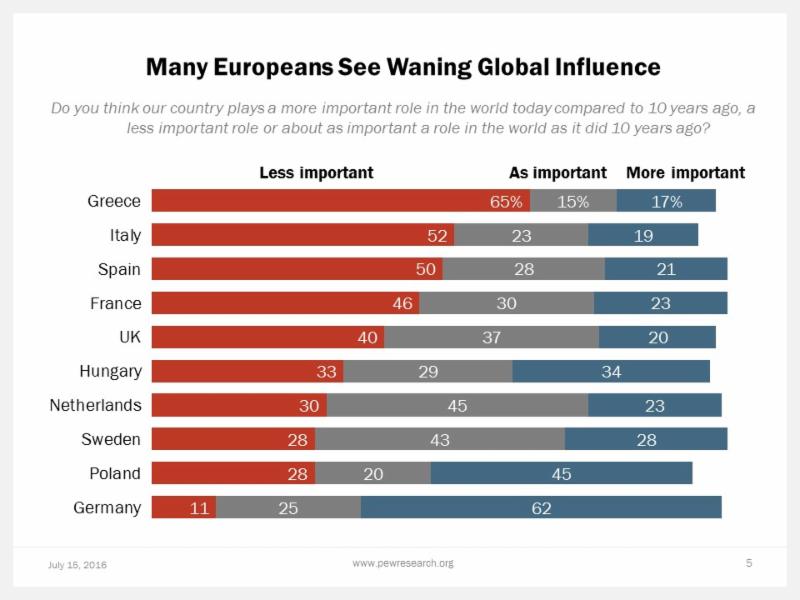
This is what he said:
"
One of the things that may be feeding this sense of 'we just have to deal with things at home and let the world fend for itself,' is that there is a widespread sense in a number of countries that our country is less important than it was ten years ago.
"And that includes 40 percent of people in the UK, who believe that their country is less important than it was ten years ago. It is up to you to objectively say whether they are or not.
"Notice that 62 percent of the Germans think they're more important than they were ten years ago. That's probably objectively true. And I can tell you, though, that somebody in the German foreign ministry said to me when I showed him this data, "Yeah, but you didn't ask the rest of Europe how they feel about it."
We won't try to summarize the other slides, but they are all on the GBD website and well worth a few minutes' consideration. Broadly speaking, if the research Mr. Stokes shared is any guide, the attitudes behind Brexit may be more pronounced in the UK than elsewhere, but they are hardly an anomaly. Much of Europe has been engaged for some time in a serious discussion about the EU and its relationship to the member states. It was astounding to learn, for example, that the
Germans would like to see trade negotiating authority - arguably the most basic EU function -
repatriated from Brussels back to Berlin. But that's what the polling suggests. In connecting the dots between the UK's referendum and concerns in other EU countries, Mr. Stokes said:
"Brexit, I think, has actually fueled the debate. But the tinder was there before the Brexit vote."
A Trade Proposal. As for the trade proposal that Alan Wolff put forward on July 7, that was really its second exposition. The first was in the article he published in Fortune's experts' series on June 24. At that time, it was about the only such thought out there. Now there is a lot of talk about a new US-UK trade initiative. And yet by the time of the July 7 event, Alan Wolff himself was raising questions about his post-Brexit proposal. You can read those for yourself, as a written version of his remarks is available on-line. This, however, was how he explained the essence of the proposal:
"On the day after the Brexit vote, I suggested that the U.S. government pull itself together (by the President reaching out to Congressional leaders) to offer to Britain and the EU together the mutual suspension of tariffs."