|
|
|
THE CAUCUS ENEWS


September 2016 |
The Episcopal Women's Caucus: Advocating for women since 1971,
theologically, spiritually and politically.
|
The EWC Board
Convener: Terri Pilarski;
Members: Amy Peden Haynie, Margo McMahon, Robin Woods Sumners, Kate Bradsen and Janet Waggoner; Consultant: L. Zoe Cole; Past Convener:Elizabeth Kaeton; Staff: Business Manager:Chris Mackey; ENews, Gigi Conner
|
The Episcopal Women's Caucus is a social justice wing of the Episcopal Church focused primarily on justice for women, but with justice for women comes justice for all people. This edition of the Caucus e-newsletter is dedicated to the BlackLivesMatter movement. We will include a number of essays by the board reflecting on our own stories. We will also include some book reviews and resources for people to use to study, to learn, and, to grow in self awareness and other awareness. It is our prayer that all people will be granted the full dignity and respect that every human being deserves. We are all made in God's image, loved by God, made good to do good.
|
|
CELEBRATE 40!
Dear Friends,
Today - September 16, 1976 - we mark the 40th anniversary of when the General Convention of the Episcopal Church passed a resolution in both the House of Deputies and House of Bishops to ordain women to all orders: deacons, priests, and bishops.
We thank you for over forty years of support for the Episcopal Women's Caucus and our
work to bring forth justice for women, and thereby justice for all people! The Caucus has been instrumental in shaping and advocating for justice issues in the Episcopal Church since 1971. Then we took on the huge challenge of ordination for women in all orders by organizing along all levels of church life. These efforts culminated in a resolution authorizing women's ordination presented and passed at the 1976 General Convention.
Since those early days the Caucus has continued to take on justice issues in the church including the advancement of ordained women holding positions in all areas of church life including as Bishop; working to advance equality for people of color, indigenous people, and LGBTQ laity and clergy in all arenas of church life and leadership; working for marriage equality; women's health care; violence against women and children' pay inequality; and standing with our sisters and brothers in The Consultation supporting the justice causes of our times.
It has been forty years since the General Convention resolution that authorized women's ordination in the Episcopal Church passed. Forty years in which much has been accomplished in the advancement of women in the church! And yet - there is much still to be done.
The Episcopal Church has earned a reputation as one of the most progressive Christian communities, thanks to vocal social justice groups such as ours. Our work must continue and you can make sure that it does, especially in today's political, social, and religious climate. Sadly, every day, more and more, the rights that have been hard won are threatened and the changes that need to be made for a more just world are stymied by fear mongering. The Episcopal Women's Caucus is one of those "reservoirs of hope needed for progressive change." In honor of the 40th anniversary of the General Convention resolution B-005 which amended Canon III.9 authorizing the ordination of men and women to all orders in the Episcopal Church, we invite you to renew your commitment to the Episcopal Women's Caucus and our efforts to continue advancing justice for all people. Your commitment can be in the form of a donation of any amount. We recommend joining the caucus or renewing your membership with a $50.00 donation. In honor of the 40th anniversary you may also donate $40 to the caucus. Your support enables the work of the Caucus to continue by providing the means for us to -
host the EWC breakfast at General Convention
-
honor women and men who promote justice issues in the church and the world
-
bring women to General Convention
-
support women at the United Nations Commission on the Status of Women
-
continue our role with The Consultation in the Episcopal Church
-
keep our website active and informative
-
maintain our social media presence so we can promote justice issues
-
provide our e-newsletter
The Caucus needs $16,000.00 to maintain our presence at General Convention, host the breakfast, bring women to General Convention, and support our work between conventions. We have an all volunteer board so that 100% of the proceeds raised supports the work of the Caucus and our efforts to transform the world. Please consider a generous donation to the Caucus by going to our website to make a credit card contribution http://www.ewc-ecusa.com/join-or-contribute. Look for the drop down menu to determine your donation. You may also send a check to EWC 1103 Magnolia St., South Pasadena, CA 91030, (626) 201-2363. Thank you! The EWC Board
|
|
Message from the Convener: Thankfulness
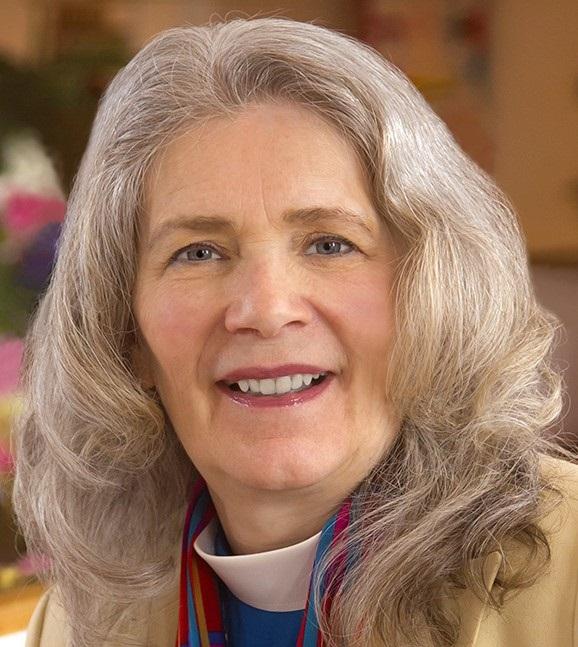
In the summer of 1976 I was nineteen years old, a college student trying to find her way in the world. My family had left the Mormon Church, the church of my ancestors and my childhood, when I was fifteen. I had no desire nor any intention of ever returning to an institutional church. Therefore I had no idea of what transpired in Minneapolis on September 16, 1976 when the General Convention of the Episcopal Church successfully passed a resolution in both the House of Bishops and the House of Deputies to ordain women to all orders, deacons, priests, and bishops. Then I had never even heard of the Episcopal Church, let alone ever considered what it would take to be ordained in the church.
In God's good humor and grace, by 1989 I was an active member of the Episcopal Church. My husband and I bought our first house in a little neighborhood on the Northwest side of Chicago. Nearby was a little stucco church with red doors and a lovely rose garden. My desire to return to church was strong enough that I had considered joining the Roman Catholic church, in which my husband had been raised. But I simply could not abide by their practices, polity, and requirements to join. After some conversation my husband and I decided to consider the Episcopal Church, recommended to us by the United Church of Christ minister who had married us a few years prior. That this lovely little neighborhood church was an Episcopal Church seemed fortuitous to me. My husband and I and our one year old daughter, were embraced by the church. To this day it remains our "home church," even though we have long since moved away.
My experience of church in this congregation was formative in ways I never anticipated. I found friends and community and good priests who answered my questions and helped me feel welcome. Before long my husband was on the Vestry and I was a reader and served on the altar guild. In time I began to discern a call to ordained ministry, but not to parish ministry. It was clear to me that being a female priest working in parish ministry was a path I did not want to travel. My beloved home parish had rejected a highly competent female candidate for rector, stating that she did not have enough experience. They spoke poorly of their experience with a female seminary student, calling her "strident." I was not interested in trail blazing a dominant male domain. I wanted a simple path. I thought hospital ministry was my calling and had solid female mentors already in hospital ministry to guide me along the way.
Then, my very first day at seminary a woman priest presided at the service and preached. She was the first woman I had ever seen in this role, the chaplain at Northwestern University in Evanston, affiliated with Seabury-Western Seminary when it was in Evanston, IL. I remember her confidence and presence and the power of her sermon. I wondered if I could ever be like her?
The last year of seminary I worked at an internship in a large urban church. Paradoxically the Rector was the same female priest my home parish had "rejected" for her "lack of experience." She and her male associate treated me like an equal, I was a respected part of a leadership team. There, I began to feel the pull of parish ministry, the gift of being with people through all stages of life and the rhythm of congregational leadership. The Rector was smart, mentored me well. She wore lipstick and had regular manicures, and loved to have a glass of wine with dinner, she was a woman, a wife, a mother, and a priest. A new vision of ministry opened up for me, and I began to see the potential for me to be a parish priest as well. Ten years after we joined that little neighborhood church I became the first person, in its 150 year history, to be ordained in the building.
I'd like to say that these sixteen years of serving as a parish priest have all been fabulous. (Don't laugh). We all know that when one works in ministry one works with real people and that means there will be times when work is messy. I have experienced the challenges of being a woman priest, challenges that come in many forms, subtle and sometimes blatant. I have also experienced the blessings of being a woman in ministry, an affirmation of what is possible for all women and girls.
My ordination came twenty-three years after the General Convention resolution. Due in large part to the work of the Episcopal Women's Caucus and the risk that women and men took to get that resolution passed, I have been able to serve three congregations as the first woman Rector. Each call has been a gift in its own right, teaching me about myself and deepening my relationship with God as I strive to be the kind of priest God is calling me to be.
Now, on this 40th anniversary of the passing of the General Convention resolution I give thanks for the true trailblazers. Their courage and conviction and willingness to take on this act of justice paved the way for so many of us who followed. I wish, all those years ago, in the summer when I was seventeen, that I had known of this event and that I could have celebrated it. Nonetheless I am grateful for their witness and for the women who followed, especially those who mentored me - Mollie Williams, Linda Packard, Jacqueline Schmitt, and Ruth Meyers - and offered me a vision of a life I could not have imagined when I was thirty-one and returned to church, let alone when I was nineteen.
|
|
UnSung Heroes: Past, Present, and Future
By the Rev. Canon Janet Waggoner, Episcopal Diocese of Fort Worth
Today, as we celebrate the 40th anniversary of General Convention authorizing the ordination of women, we give thanks for all of the women and men who have done valiant things to support the leadership of women in our church in quiet ways.
For every woman who has become a deacon or priest or bishop there are dozens of women and men who have helped them to succeed. People who knew in their hearts, before the woman knew it herself, that this woman had gifts for leadership and should be a priest. Members of parish discernment committees and Commissions on Ministry who have seen past patriarchal cultural norms and raised up women for ministry. Members of parish search committees who were the first in the history of their congregation to put forward a female candidate for election as rector. Lay and clergy delegates to diocesan conventions who were the first in the history of their diocese to elect a woman as their bishop. People who have surrounded with prayer and truth-telling and encouragement, bold women who were the first deacon/priest/bishop in their congregation/diocese.
Often, it is the woman who gets ordained or consecrated whom we lift up as an example of a great leader. And, indeed, many of these "first women" are amazing in more ways than people may ever know. However, it never would have been possible for these women to fulfill their callings as leaders without scores of Christian people fulfilling their roles to reshape a culture which had, for so long, overlooked them as heirs of the calling of Christ to be his apostles.
The work of transforming the culture of our Episcopal Church is not over. We are not yet place of full inclusion. We are not yet a people who see tremendous value in every person and esteem the unique gifts of each. We are not yet a people who are just as likely to raise up an Hispanic woman for ordination as we are to raise up a Caucasian man.
My prayer for myself and for all members of our Episcopal Church on this day of celebration is this: that each of us will be an unsung hero for someone who, without our help and support and truth-telling and encouragement and advocacy, will likely never be the leader, the bishop, the priest, the deacon, that God is calling them to be. Amen. Amen.
|
On September 16, 1976, I had just turned nine years old. I was a member of a Southern Baptist church and was still eight years away from baptism as a 17 yr. old high school student. After high school, I drifted away from the denomination that would not affirm my call to be a pastor (unless I was willing to live out that call as the Pastor's wife.) During my college
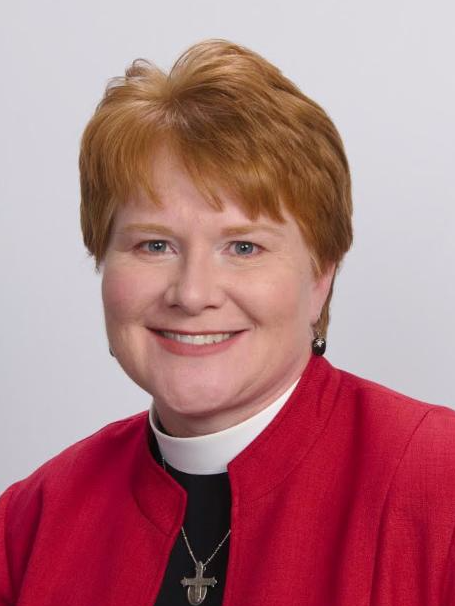 years, I visited other churches and briefly regularly attended a Roman Catholic church. years, I visited other churches and briefly regularly attended a Roman Catholic church.
The man I fell in love with and decided to make a life with, had been raised in the Episcopal Church all his life. He had grown up attending the neighborhood church, even bicycling himself to the early service to acolyte when his family would be attending the later service. Once we decided to entwine our lives, we started visiting different churches to see where we might land. We visited all of the other protestant denominations, but he was not quite comfortable in any of those. The last one we visited was our local Episcopal church. Neither of us had ever been there before, but he felt welcomed back and I felt welcomed home.h. After some exploration, I discovered that I could not become Roman Catholic for the same reasons I could not remain Southern Baptist.
After a few years of regular attendance, having and baptizing our children, and getting more involved, that familiar sense of call returned to me. In that church, the call could finally be explored and affirmed. That Episcopal church sent me (and others) off to seminary, knowing that our gender would not be an impediment to ministry. I changed dioceses during those years. By the time my ordination was scheduled, I was in a diocese that had never ordained women, and only two had been ordained before me there. Because I had re-started the ordination process, I get the distinction of being the first female who went from Aspirant to Priest in the continuing Episcopal Diocese of Fort Worth.
Today, there are fewer and fewer Episcopal churches that deny women ordination rites. It is important for us to remember that there are still a few out there. The women who are formed in those spaces need our support and advocacy. Even though it has been forty years already, support for clergy who are female is not an assumption we can make yet in every place. I am very thankful to God for the Episcopal Women's Caucus as the work still continues. I will be making my $40 contribution in thanksgiving - I hope you will join me.
|
How I Bonded With a T-Shirt Called God Is Not A Boy's Name 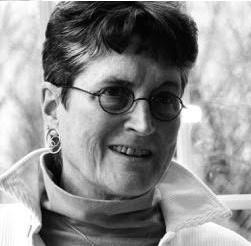
The Rev. Lyn G. Brakeman is an Episcopal priest, author of two books and a memoir and a blog. She serves as priest associate in a parish in Boston and lives in Cambridge.
When I was three and three-quarters exactly I met God for the first time under a table. My mother, who had three miscarriages before I was born with a splash in the middle of her winning bridge game and just weeks before a major hurricane blasted the northeast, told me I was a gift from God. I became curious about who God was.
One evening I tired of my parents' cocktail hour where the seemingly omnipotent martini glass presided, and huffed off seeking refuge under the dining table with a cloth to the floor. There I placed the Ritz crackers I'd snitched from the tray onto a cross beam and started a conversation with my three imaginary friends and a fourth friend called God. My friends were inattentive but God listened to my every word. I learned that I mattered and that God listened with no judgment or advice.
As the Exodus is for Jews and Jesus Christ for Christians, my dining room table experience was for me founding event. In Sunday School I memorized many big omni- words for God, but I knew that the only one with truth and staying power was Omnipresence. This God stayed with me even when my faith faltered radically through addiction, abuse, profound loss and grief, divorce, various sins beginning with "a"-and even the Church.
Right after the patriarchal Episcopal church voted in 1976 that women could be priests, I entered the ordination process in a diocese whose bishop had voted against the ordination of women priests. The environment was unfriendly at best. One woman on the screening committee told me she was against the ordination of women, but that she would be able to interview women fairly. I admired her pathology.
I was a forty-year-old institutional naif, suburban housewife, mother of four, and sliding toward divorce. It might have been easier had I been a man and not read Betty Friedan. I was tailor-made for rejection, which is exactly what happened. It took eleven years, two bishops, and plenty of grit and grace to be ordained priest finally in 1988.
My memoir, God Is Not A Boy's Name. Becoming Woman, Becoming Priest, published in 2016 by Cascade Books, imprint of Wipf and Stock, is not a sob story or a tragedy. Rather it is the story of my religious spirituality and my Omnipresent God who continued to listen, I had wanted to know about God and God taught me who I was. The thread of the voice of God within me held me together and keep me going. Once God, trying perhaps to find shelter from the torrent of my prayers, dared to tell me: "Lyn, I don't care if your'e ordained."
It took my a long time to learn that the Church I thought was practically equal to Christ was political as well as mystical. I consulted many women, especially those who had been irregularly ordained priests in 1974 and 1975, I received love, wisdom, support and encouragement from my sisters. I became an honest-to-god Christian feminist. I learned that there was this organization called The Episcopal Women's Caucus-a political watchdog to make sure women were fully included at leadership levels of the Church. EWC introduced me to my T-shirt,"God is not a boy's name" which I wore for courage throughout the worst of my ordination process and beyond.
At first the shirt was a logan, but soon its truth sunk deep into my flesh and my soul until I realized what I had known from the beginning: divinity has no gender and traditional theological language does not include me, or any female being, in the divine image, despite what is written in Genesis and lived by Jesus. The T-shirt message turned into my passion and my title.
Non-gendered language is not a new issue in the Church, but it is one which needs refurbishing. Words matter. They shape souls, human relations, and can cripple bodies with shame. Words about God are especially important. Recently, I gave a sworn testimony for someone and the familiar sentence was still there. There was no Bible but " . . .so help me God" remained. I don't think God is dead, even in the northeast. Who is the God people say they don't believe in? Religions have created a stereotype of almighty masculine transcendence. Is this not idolatry?
Jesus of course was a remarkable historical man, but the Christ we worship transcends gender, not to mention most all of our other dividing categories.
It is time for all religions to work together to create a just and loving language for humanity and divinity. English pronouns are pesky but they are not divine. Really. Many writers are already using non-gendered theological language, even if they have to repeat the name, God. The task is urgent. Someone might get brash enough to suggest God as a name choice in one of those books that list name choices for children.
God Is Not A Boy's Name is written in gratitude for a girl and a God under a table, the quirky wisdom of a T-shirt, and the Episcopal Church which is willing to tackle hard issues with political integrity and spiritual zest.
|
|
|
|
WE MIGHT ASK... At one time there was a 'women's desk and a Council of Women. Is this needed again? What kind of leadership training do we need to prepare women for leadership in our time? How can we best report on ministries to women around the world? Your input and suggestions are always welcome!
|
|
A Blessing for Meals
O God, like a mother tending her family, bless this food
and those who prepared it.
Like a father tending his family, give us a hunger to tend to the needs of this world.
As sisters and brothers in Christ, give us a hunger for justice, humility, and mercy.
From Words Matter Project
|
|
IF YOU ARE WONDERING ABOUT WHY OUR ELECTION THIS YEAR SEEMS TO BE FILLED WITH HARSH RHETORIC WATCH THIS
DOCUMENTARY
MISS REPRESENTATION
Mission statement: Using film as a catalyst for cultural transformation, The Representation Project inspires individuals and communities to challenge and overcome limiting stereotypes so that everyone, regardless of gender, race, class, age, sexual orientation, or circumstance, can fulfill their human potential. -
There is a double bind - a different standard that we hold women to who aspire toward leadership. We need more women, across the board, to stand for election for elected office, start companies,be judges and partners in law firms, and be leaders in the church as lay leaders, deacons, priests and bishops because women's voices haven't been equally represented for a long time across all industries.
Note: If you watch the trailer - some of the first images are shocking but these kind of images have shown up on campaign buttons this year (male candidate knocking female candidate to ground in boxing ring) and also when the first woman was elected as Presiding Bishop (white witch's head from Narnia placed on PB's head).
So sexism and other isms still alive and well today.
|
|
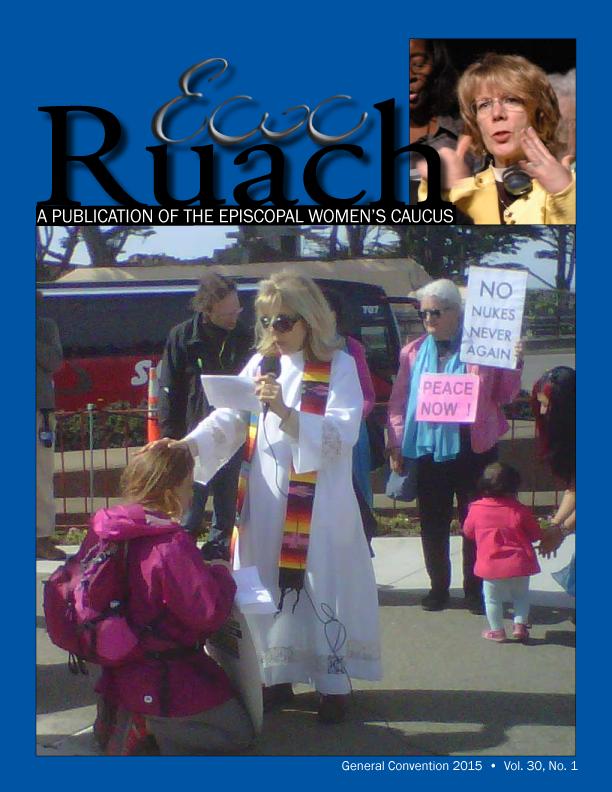
The Latest RUACHQuick Lin
|
|
Use this form to join the EWC, renew your membership, or make a donation. Make check out to EWC and mail to: Episcopal Women's Caucus, 1103 Magnolia St., South Pasadena, CA 91030
attn: Chris Mackey-Mason
Please indicate if this a:
___new application ___renewal ___donation to the EWC
Amount: $________
For new and renewing members, please select the appropriate membership level below. A contribution of any amount is sufficient for full membership in the Caucus.
|
|
|
 |
|
HISTORY
The 1976 General Convention of the Episcopal Church met that year from Sep. 11-Sep. 23 in Minneapolis, Minnesota and considered key resolutions regarding women and LGBTQ people in the church. Most notably, on September 16, 1976, resolution B-005 which amended Canon III.9 was passed by both the House of Deputies and the House of Bishops, authorizing the ordination of women to all orders, deacon, priest, and bishop. Similar resolutions had been narrowly defeated at the 1970 and 1973 General Conventions.
A 1967 General Convention resolution opened the diaconate to women and recognized that women currently serving as deaconesses were members of the diaconate and the term deaconesses was eliminated, making both women and men "deacons." Then, on July 29, 1974, three bishops, claiming that "obedience to the Spirit" justified their action, ordained eleven women deacons to the priesthood. These "irregular" ordinations caused a controversy in the church that led to both deeper conversation and divisiveness as dioceses and congregations sorted out the meaning of these ordinations for the wider church.
A Study Guide on the Ordination of Women was created by the Minnesota Committee for the Ordination of Women Now: Susan Salot Gumer, editor; Heather Huyck and Louis Schoen, conveyors; Paulette Briese, typist; Catherine Boyd Winter, Martha Winslow Snyder, Mary Lou Lockhart, Tricia Noble, Michael Olson, Shirley K. Johnson, members. The study guide was prepared to help deputies sort out the issues and facts from rumors and uninformed opinions on the matter of women's ordination. The guide was divided int two sections, a narrative introducing the issues and further articles that further explore them. These include essays on the theological, moral, and legal justifications for the ordination of women, the Philadelphia 11and Episcopal Women Priests, The Church's Dilemma, Healing the Church, The Case for Ordination of Women to the Priesthood, Jesus was a Feminist, Scriptural and Historical Perspectives on the Role of Women in the Church, church law and the regularization of the Philadelphia ordinations, and various articles on the ecumenical discussion between the Episcopal Church, Roman Catholic Church, and the Orthodox Church on women's ordination, among others. It is a small but dense publication, a terrific resource on the history and work that went into preparing deputies to finally pass a resolution approving the ordination of women, having failed at two previous general conventions.
A link to a scanned PDF of the guide can be read on the Episcopal Women's Caucus website:
|
Editor's Note: AND if it were not for the determined work and courage of many lay women - ECW - this history might not have come about. The History of the ECW Yet We Persist: A Historical Reflection on Episcopal Church Women by Katerina Katsarka Whitley is found here. It can be used at a gathering to 'act out' the history. Yet We Persist
When I went to seminary I went as a single parent with two daughters. My ex-husband stopped paying child support. Just when we had gotten to the end of our monthly money (thanks to student loans) a check arrived from the woman who had been president of ECW when I first joined the church. 'I had a good year with investments," she wrote, "and wanted to share my good fortune with you." And another woman, a banker, sent a check that arrive on one of those critical, pay bills, days. It was the love and strength of these women that kept me in seminary. --- Gigi Conner, Priest in Charge, St. Alban's, St. Pete Beach, Florida. |
|
|
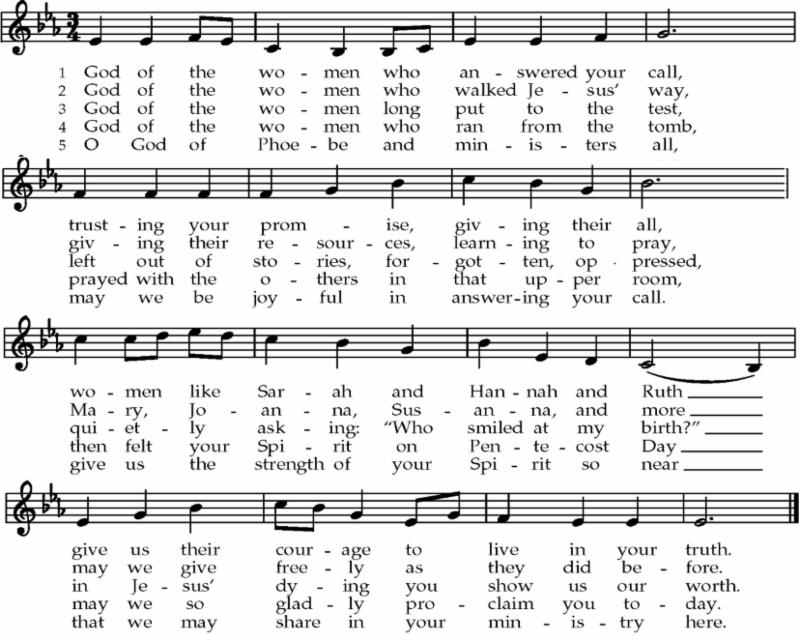
Words: Carolyn Winfrey Gillette (b.1961); Melody: Slane, Irish Traditional
|
|
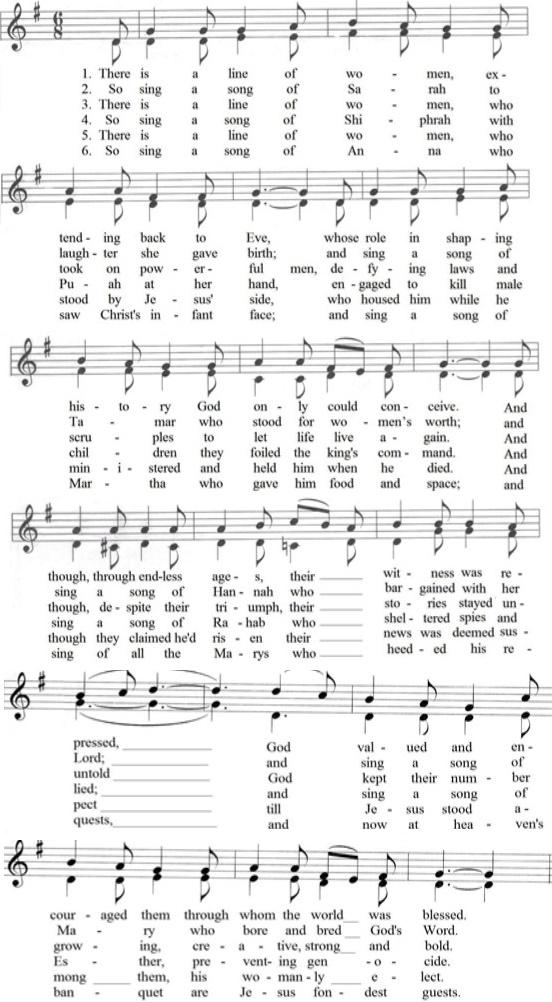
Words: John L. Bell(b.1949): Melody: The Seven Joys of Mary, English Carol melody.
|
|
|
|
|
|
|
|
|
|