|
Technology and Cargo Theft
In just a few months the Allen Lund Company will be celebrating its 40th anniversary. I have had the opportunity to observe the transition of our company and the produce industry evolving into a sophisticated distribution system. Regulations, de-regulations and technology have been a driving force behind the development of the efficient produce transportation systems we work with today. We continue to be amazed and bombarded with all of the new products that continue to be introduced to our industry. A visit to the PMA in Atlanta next month is a showcase of the creative ingenuity and products that are available for all of us to streamline our business.
As a result of new technology, we are able to provide live tracking of not only the truck location itself but also the temperature of the produce in the trailer. All of these bells and whistles are not without a price. As the cost of many of these devices continues to become more affordable the ability to insure the integrity of our produce shipments has become an affordable reality.
Technology has a downside too. Due to the internet and the capability of cell phones, our industry has seen identity and cargo theft grow into a 30 billion dollar a year challenge.
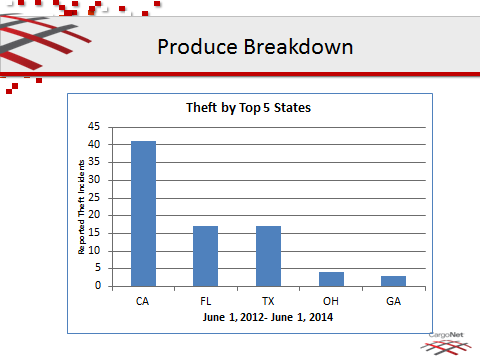
Cargo theft is a growing threat to our economy and the national security of the United States. Over the last few years produce loads have become targets for cargo theft. Food products, which includes produce, accounts for approximately 25% of cargo thefts that are reported. Three of the top five states that are "hot spots" for cargo theft are California, Florida and Texas. These are major produce shipping areas.
What can we as shippers, carriers and brokers do to put the brakes on this epidemic? The answer to this is complicated and challenging since the bad guys have used technology to their advantage just as we have. Thieves are getting more creative and sophisticated. As an industry we need to come together and make our systems more secure. It has to be a combined effort on every level for this to be a success. Shippers, packers, receivers, cold storage, carriers and brokers can make the task of produce cargo theft a challenge to the crooks and they will move on to easier targets. Cooperation at all of the various levels of the shipping process would increase security and reduce the likelihood of a successful cargo theft.
Cargo theft will continue to be a hot topic and it cannot be ignored. The time has come for the produce industry to develop procedures (best practices) that would become roadblocks for the bad guys. A successful program would require a minimal investment to insure the integrity and safety of our produce loads.
Bill Bess
Director Carrier Development
|
Bill Bess, Director of Carrier Development, was previously the manager of the Orlando, FL office, and has been with the Allen Lund Company for 31 years. With 43 years of experience in the transportation of perishable products, Bess' expertise includes perishable supply chain protocol.
|
About Allen Lund Company: Specializing as a national third-party transportation broker with nationwide offices, the Allen Lund Company works with shippers and carriers across the nation to transport dry, refrigerated (specializing in produce), and flatbed freight; additionally, the Allen Lund Company has an international division, which is licensed by the FMC as an OTI-NVOCC #019872NF, and a logistics and software division, ALC Logistics.
|
The content of this email is intended to provide information on the perishable commodities industry and is promotional in nature. Reliance should not occur on the content of this site other than to generally advise the reader as to such industry and no action should be taken in reliance on this site's information. With the exception of the Allen Lund Company website, ALC is not responsible for any contents linked or referred to from these pages. The copyright for any material created by ALC is expressly reserved but content on this site, in whole or in part, may be used, reproduced, or republished without ALC's prior written consent provided that ALC is identified as the source.
Privacy Policy: If the opportunity for the input of personal or business data (email addresses, name, and addresses) is given, input of these data takes place voluntarily and with no assurances of limited distribution, use, or restricted access by ALC.
|