| What's Growing This Week: | |
Basil (All)
Black Grapes (All)
Peppers (All)
Sweet Potatoes (All)
Green Beans (All)
Asian Pears (All)
Onions (All)
Spinach (S)
Collards (M,L)
Walnuts (M,L)
Eggplant (L) -- %
Pomegranates (L)
Arugula (L)
% -- Eggplant this week comes from our neighbor Free Spirit Farm.
Items may be substituted without notice.
|
|
|
Bulk Items
Sweet Peppers are available in bulk. Tomatoes are no longer available.
To sign up, log in to your account and go to the Web Store.
|
Contact Us:
| terrafirmafarm.com
csa@terrafirmafarm.com
|
|
| CSA Rates 2013 | Boxes are charged on Monday for the week's deliveries at:
$14 Small
$24 Medium
$32 Large
For a payment of $300, get a 3% bonus. Your account balance will be $309.
For a payment of$850, get a 5% bonus. Your account will be posted as $892.00
For a payment of $1,400, get a 7% bonus. Your payment will be posted as $1,498.
Vacations are charged weekly when notice is given as a fee, no charges occur during the vacation week.
$4 Small
$8 Medium
$11 Large
|
|
|
Pledge of Authenticity
Terra Firma is a real farm. We grow 99% of the produce that goes into our boxes on our 220 acres of certified organic land in Winters. If we do buy produce from other farms, it's almost always from a neighboring farm and we give them full credit in the box list.
The owners of Terra Firma are involved in every aspect of making your boxes a reality: walking the fields, planting the crops, selecting and checking what goes in the boxes and finally delivering them to you. We eat the crops from our fields every day, just like you do. Thanks for supporting our efforts and enjoying the food we grow.
Paul, Pablito, & Hector
|
Payments, Billing, and Changes
| Schedule vacations, change box sizes, make payments or sign up for autopay by logging in to your subscriber account at terrafirmafarm.com
|
|
|
|
News From Terra Firma Farm
Community Supported Agriculture |
|
Greetings!
On the largest farms in California and the rest of the U.S., harvest is completely mechanized. For commodity crops like corn and soybeans as well as canning tomatoes, almonds and walnuts, a handful of workers operating specialized machinery can harvest many hundreds of acres each. Even most winegrapes are harvested mechanically.
Walnut harvest is happening all around us as I write this: one machine shakes the nuts onto the ground, another sweeps them into rows, a third vacuums them up off the ground, and a fourth carries the nuts to trucks waiting outside the orchard.
Whatever the crop, the harvesting equipment is an enormous investment -- around $300,000 for walnuts, for example. It pays for itself through labor savings, of course. But only on a large scale. The cost of the equipment is a primary reason that there are ever fewer farms growing ever larger acreages of most commodities.
Harvesting fresh delicate and perishable vegetables with machines is even more complicated than harvesting commodities. The harvesters used by the large carrot producers, for example, cost half a million dollars. Same goes for the lettuce harvesters that are still in development. Only a handful of growers farm enough acreage to justify this investment.
Small scale mechanical harvesting aids are few and far between. And the ones that do exist are either old, or made in Europe (and thus hard to come by), where governments are more supportive of small scale farming. At Terra Firma, we have two harvesters: one to harvest green beans, and the other to dig potatoes and sweet potatoes. The vast majority of our crops are harvested by hand -- as they are on most fresh fruit and vegetable farms, even the largest ones.
But that doesn't mean we aren't highly mechanized: we are. In fact, with the exception of harvesting, most tasks on our farm are done with machines. Preparing the soil, fertilizing, planting, etc. Tractor cultivation takes care of the majority of weeds, although we almost always send humans through the field afterwards to catch what the machines miss.
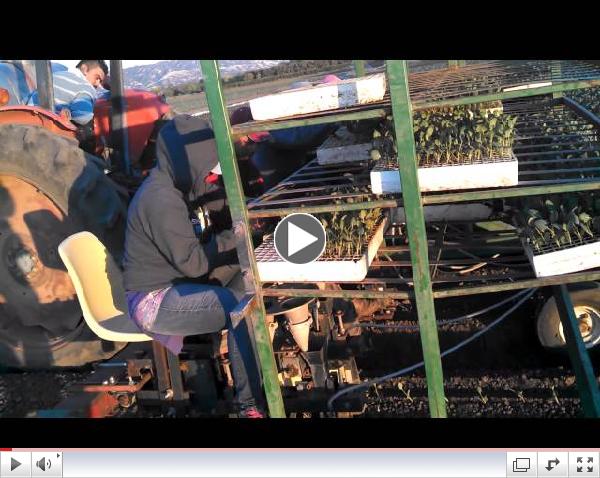
Here's a video of us planting broccoli using a machine that helps people do their jobs more quickly.
 | | Transplanting Broccoli |
This is a transplanter where people sitting upright pull plants from trays and drop them into a machine that sets them into the ground. It's not perfect -- we still need to have other people walking behind to check the plants. But it allows us to plant an acre of broccoli or onions quickly and easily -- in about an hour -- so we can get back to the work that we spend most of our time on: Harvesting by hand.
Thanks,
Pablito
|
|
Open Farm Day: October 19th
Tickets for Farm Day are still available at the webstore. Availability is limited due to space for parking, so get your tickets early to avoid disappointment. Activities will include pumpkins, berry picking, hayrides, a farm tour, and bouncy houses for the kids. You can bring a picnic but we will also have brick oven pizza for sale, made with TFF produce. There will be live music all day. As always, we will have a farmers market for anyone who wants to stock up on extra goodies from the farm. The raindate will be the following Saturday, October 27th. Tickets for the event are $5, and are exchangeable for pumpkins or produce. Kids under 12 get in free, but if you register them in advance they also get a free pumpkin. The event is not open to the public, but subscribers can buy tickets for friends and extended family. Lastly, we can always use extra help at the event. Anyone who is interested in volunteering in exchange for a ticket, email us to let us know. |
In Your Boxes
Our first cooking greens of the season are in your box today: Collards. Collards are essentially a cabbage that doesn't make a head, like Kale, and they are similar in flavor and nutrition to that currently super-trendy green. Collards grow more quickly than kale, though, which is why they are almost always ready to harvest first. We will have our first kale in two weeks. Wondering where are our almost-famously sweet TFF Carrots? While we normally start harvesting in late September, our first planting was literally fried by the mid-July heatwave. The second planting will be ready to harvest next week. Eggplant Note: The eggplants in the Large boxes today were grown at tiny Free Spirit farm just down the road from us. Toby Hastings grows organic produce for restaurants in the Bay Area and Sacramento; he called us because he had more eggplant than he could sell. Because of his small size, he is not required to be certified organic, but we are 100% confident in his growing practices.
|
Recipe: Sweet Potato Soup with Collards
This recipe returns to the tropical roots of these two vegetables. If you can't find coconut oil, you can substitute the coconut cream from a can of Thai coconut milk.
Heat 1 T. coconut oil in a heavy bottomed pot and add 1 peeled, mince onion and 2 cored, diced sweet peppers. Add crushed red (hot) pepper to your taste.
When the vegetables are soft, add 2 diced sweet potatoes (4 C.), 1/4 t. cumin powder and 1 t. smoked paprika. Cover the pot and cook until the sweet potatoes soften, about ten minutes. Pour in 2 quarts of your favorite stock.
Remove the leaves from 1 bunch of basil. Pull the tough stems from the middle of 1 bunch of collards, then chop the leaves roughly.
When the sweet potatoes are completely soft, puree the soup in batches with the basil leaves, reserving a few for garnish. Return to the pot to keep warm.
In a wok or cast iron skillet, heat 1 T. olive oil. Add the collard greens and saute on high heat until tender. And 1 minced clove of garlic and cook until it is translucent. Season with salt and pepper.
Serve the soup with a dollop of collards atop each bowl.
|
|
|
|
|

