The focus of most curation methods when applied to learning is in organizing, filtering, distilling, adding value, etc. to content. This is like serving food (content) in an improved way. There may be a risk in this trend. As trainers, designers and learning specialists, we continue to look at our role in curation as content servers, not learning facilitators. I propose, we focus on content co-creation as a process.
Simple Experiment
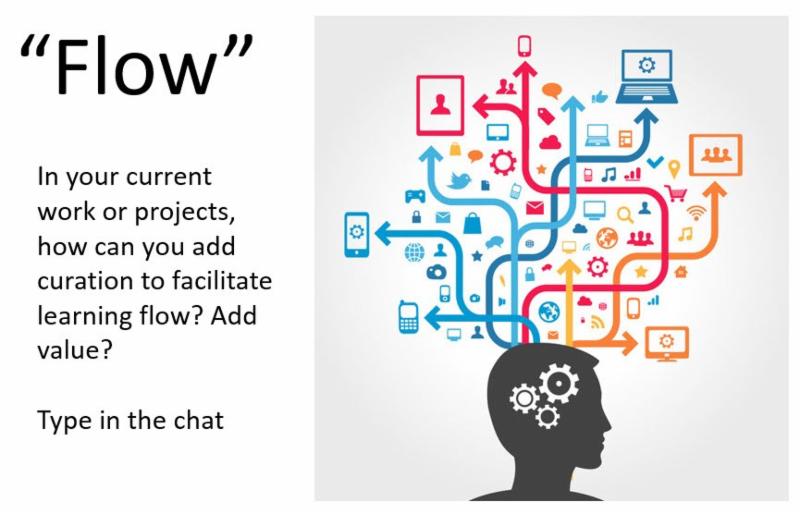
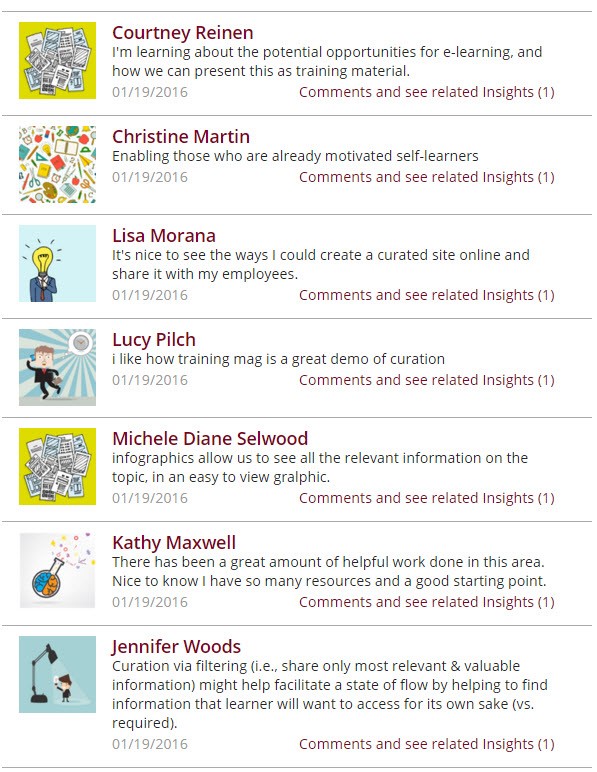
In the illustrations below, the first (Illustration 1) is a content from a webinar speaker and the second one (Illustration 2) shows added insights from participants. We asked participants to add their insights to the presentation. I ran a survey with twenty participants and asked them to review both sides and gauge their reactions.
Please review the illustrations below.
Presentation - Illustration 1Adding Insights - Illustration 2Respondent's Responses
These are samplings of responses.
On the Presentation: "Ideas provoked in me a thought."
"But I was passive to it."
"It was well organized and clearly stated, however, I wondered how this mattered to me."
"The presentation at times was a hit and miss - relevant and irrelevant."
On the Insights:"The insights made me smile about how others responded to the presentation."
"I saw how others interpreted the content and prompted me to respond to one of the ideas."
"I was inclined to respond and comment on the insights because it was personal."
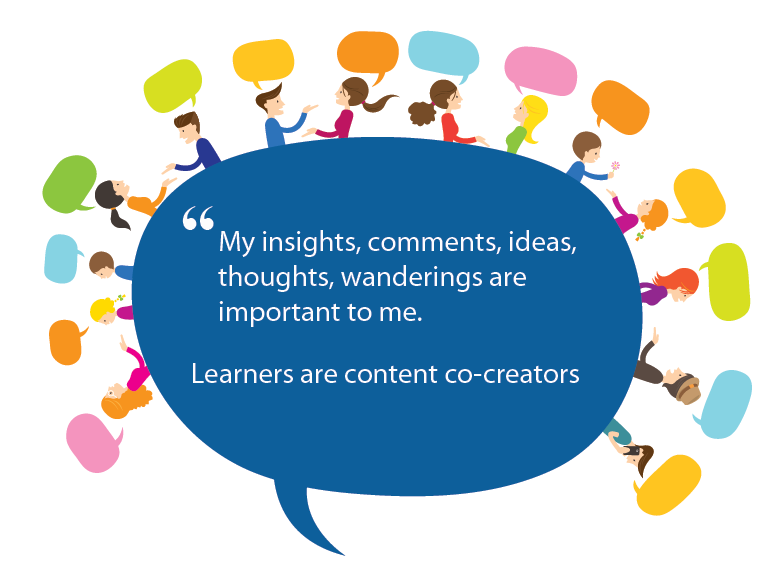
"Adding insights allowed me to create my own content, my own understanding of the presentation. "
Adding Insights is Co-Creating Content
Although it seemed obvious that adding one's insight is a better learning process since it is
recursive where learners interpret the presentation, adding their own meaning - it occurred to me that it is far more important that learners or our audiences add insights as a way to create their own content. Such content embodies their own understanding of the presentation. It bridges the presentation with that which is relevant to them. Therefore, this increases the value and contribution of the presentation in the real life of the learner.
I discovered that a simple insight - small, tiny, spur of the moment - is content from learners which becomes an even more important part of the presentation.
Practical Implications - Focus Our Eyes on Learners' Co-Created Content
Again, this seems commonsensical, but I missed it and now realize that this is the essence of curation - to draw out the small insights from the learners; not to serve better content.
In our rush to learn and implement curation methods in our learning environments, we overlook that our efforts ought to focus in as many ways as is possible, on getting the learners to co-create the content. This does not mean long, tedious demands for writing blogs or articles or journals. It simply means that every chance we have, we try to get learners to add an insight and allow others the facility to add more insights.