We're sending regular updates about film and media arts at the Smithsonian American Art Museum. In this post, I grabbed Michael Mansfield, associate curator of film and media art, and asked him about Nam June Paik's TV Crowns, which will be on display in our upcoming exhibition Nam June Paik: Global Visionary (opening December 13).
Below is an excerpt of my post, visit the blog for the full article.
-- Georgina
Meet the Social Media Team
|
Film & Media Arts
Nam June Paik: Television as Medium
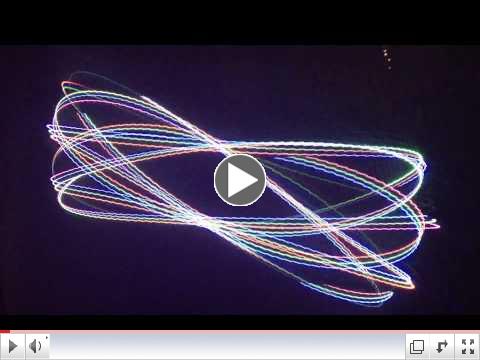 | | Nam June Paik's "TV Crown" |
Tell me about this installation.
Here we have an installation of three of Paik's TV Crowns. TV Crowns are pretty rare. They required Nam June Paik to disassemble television sets and reassemble them using components from multiple televisions. By investigating the inner workings of the televisions, he was able to manipulate the electronics to come up with these complex formal compositions appearing on the screen. This section of the exhibition demonstrates his deep understanding of the technology and his intimate understanding of the television set itself. Remember, this was conceived in 1964! This was groundbreaking work at the time and had not been explored by any other artist.
Nam June Paik is often described as the father of video art, but what we're looking at here is not actually video. Can you explain what we're seeing?
This is distinctly not a video piece. Paik was using a television set in a way that it had never been used before. A television set is intended to display an image fed to it by broadcast, a camera, or other video device. This is not what is happening here -there is no recording and there is no playback device. What Paik was doing is revealing the technology itself, and interrupting it. He used audio generators (which can be seen below each television set) to create an audio signal, which is fed through an amplifier to the cathode ray tube which generates the pattern. It's complicated, but you are essentially seeing an audio signal interpreted through the inner workings of the television set.
Why is this work important?
Think about how artists such as Jackson Pollock, Mark Rothko, and Morris Louis experimented with the material of paint in the 1940s and 1950s. They explored how it dripped and flowed, and how it interacted with different surfaces. This opened entirely new modes of expression, new ways of understanding ourselves and our relationship with the world around us. Exploring the medium itself, its tactile qualities, became really important to their work as artists. This is exactly what Nam June Paik was doing with televisions and technology in the 1960s. He was experimenting with technology itself as an artist's medium to see what it could bring to the global conversation.
Visit the museum's blog Eye Level for the full post, and mark your calendars to see Nam June Paik: Global Visionary, open December 13, 2012 -- August 11, 2013.
|
Photography, jazz, craft, media arts...
what's your pleasure?
to receive only the items you want! |
|
Smithsonian American Art Museum
P.O. Box 37012
Washington, D.C. 20013
|