|
Spiritual Gifts ~ The Gift of Tongues and the Gift of Interpretation of Tongues
1st Corinthian 12:7 But the manifestation of the Spirit is given to every man to profit withal. 8 For to one is given by the Spirit the word of wisdom; to another the word of knowledge by the same Spirit; 9 To another faith by the same Spirit; to another the gifts of healing by the same Spirit; 10 To another the working of miracles; to another prophecy; to another discerning of spirits; to another divers kinds of tongues; to another the interpretation of tongues:
There are many gifts of the Spirit, 1st Corinthians 12 is a only a partial list of them. There are many members in the Ekklesia but not every person has all of the gifts. Each member is given gifts as it pleases God so that the gifts may be used for the good of the whole body.
Of all of the various spiritual gifts, some people tend to focus on the "gift of tongues" which was one of the more obvious outward gifts of the Spirit as we see demonstrated in the early church. In our day this gift seems to be very rare in the Ekklesia.
Meanwhile in some segments of mainstream Christianity such as the Charismatic Pentecostal Movement, speaking in tongues is profoundly misunderstood and that misunderstanding is one of their most prominent doctrines, more so than obeying God and His Word. They believe that the ability to speak in "tongues" (according to their misunderstanding of it) is proof that one has God's Holy Spirit or that it is a sign that one has received the "Baptism of the Holy Spirit".
But how does the Bible define "speaking in tongues" and how was it demonstrated and used in the early church? What are the possible reasons that God would give this gift to His Ekklesia?
In Mark 16 Jesus prophesied that the gift of speaking in tongues would be granted to His disciples and would be a part of preaching the Gospel just as some other signs such as healing of diseases and the power to cast out demons. Jesus commissioned the disciples to go into all the world to preach the Gospel and at the same time He foretold that these signs would accompany that preaching. This is the only mention of the term "speaking in tongues" in all four books of the Gospels.
Mark 16:15 And he said unto them, Go ye into all the world, and preach the gospel to every creature. 16 He that believeth and is baptized shall be saved; but he that believeth not shall be damned.
17 And these signs shall follow them that believe; In my name shall they cast out devils; they shall speak with new tongues [languages]; 18 They shall take up serpents; and if they drink any deadly thing, it shall not hurt them; they shall lay hands on the sick, and they shall recover. 19 So then after the Lord had spoken unto them, he was received up into heaven, and sat on the right hand of God. 20 And they went forth, and preached everywhere, the Lord working with them, and confirming the word with signs following. Amen.
In Isaiah 28:11 Isaiah also foretold that tongues [various languages] would be used to preach the Gospel at a certain set time in the future. Paul quoted this verse when he was instructing the Corinthians in regard to the proper use of speaking in tongues.
Isaiah 28:11 For with stammering lips and another tongue [languages] will he speak to this people.
The rest of what the Bible has to say about the gift of speaking in tongues is in the book of Acts and in the letters to the Corinthians.
Pentecost 31 A.D.
It was on the Feast of Pentecost in 31 A.D. that the first recorded miracle of speaking in tongues took place.
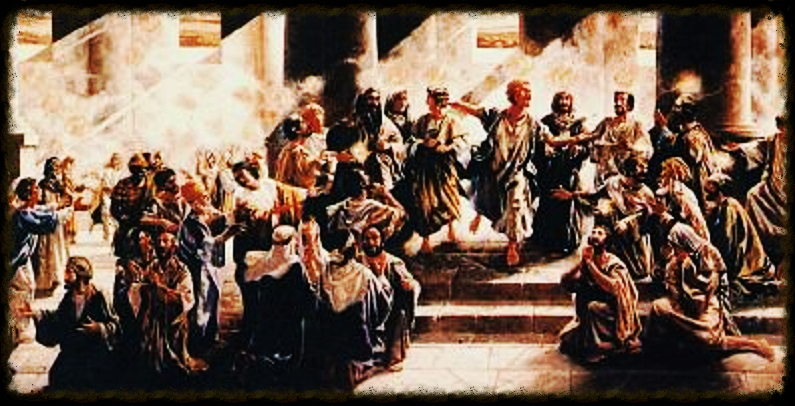
Acts 2:1 And when the day of Pentecost was fully come, they were all with one accord in one place. 2 And suddenly there came a sound from heaven as of a rushing mighty wind, and it filled all the house where they were sitting. 3 And there appeared unto them cloven tongues like as of fire, and it sat upon each of them. 4 And they were all filled with the Holy Ghost, and began to speak with other tongues, as the Spirit gave them utterance.
The Holy Spirit came in mighty power on that day and filled the whole house; it came with the sound of a rushing mighty wind and appeared as cloven tongues of fire that came upon each one that was sitting in the house. The passage says that all were filled with the Holy Spirit and they began to speak with other tongues.
The Greek word for tongues used in verse 4 is glóssa (Strong's #1100) and simply means: the tongue, a language, a nation (usually distinguished by their speech). (Strong's Concordance) From the clear context the apostles and the other disciples received the ability to speak in other languages after being filled with the Holy Spirit just as Jesus had prophesied that they would. The ability to instantly speak in a language different from our own by God's inspiration is the only meaning for speaking in tongues; and to add any other meaning is adding to Scripture something that is not there.The next few verses clarify even further that the other people outside this group heard the disciples speaking in their own native languages, not the normal Galilean dialect that the disciples would normally be speaking.
Acts 2:5 And there were dwelling at Jerusalem Jews, devout men, out of every nation under heaven. 6 Now when this was noised abroad, the multitude came together, and were confounded, because that every man heard them speak in his own language. 7 And they were all amazed and marvelled, saying one to another, Behold, are not all these which speak Galilaeans? 8 And how hear we every man in our own tongue, wherein we were born?Although there was an assortment of nationalities dispersed throughout the crowd that day, with people from a multitude of countries which were visiting Jerusalem for the Feast, they were all able to understand what was being said in their own native language.
Acts 2:9 Parthians, and Medes, and Elamites, and the dwellers in Mesopotamia, and in Judaea, and Cappadocia, in Pontus, and Asia, 10 Phrygia, and Pamphylia, in Egypt, and in the parts of Libya about Cyrene, and strangers of Rome, Jews and proselytes, 11 Cretes and Arabians, we do hear them speak in our tongues [language] the wonderful works of God. 12 And they were all amazed, and were in doubt, saying one to another, What meaneth this?
Acts 2:9-11 gives a list of the different countries that were represented by the men in attendance, who heard the message in their own native language. These people were in amazement for it was obvious that a miracle had occurred. They exclaimed "how hear we every man in our own tongue [language], wherein we were born?"
This was the official beginning of the New Covenant, when God's spirit left the physical Temple to dwell ONLY in the called out; and it was introduced to the people that heard and saw the disciples on that day with certain signs, such as the appearance of fire as cloven tongues and the miraculous hearing of the Gospel message by means of the gift of tongues in which they heard that message in their own languages.
God's Purposes For the Gift of Speaking in Tongues
This happened just as Jesus had said when He gave the disciples the commission to preach the Gospel to all the world and that they would speak with new tongues. Note that Jesus used the word "new" in combination with tongues (Mark 16:17) and Luke uses the word "other" in Acts 2:4. "New" means that the languages would be new to the ones that would speak them without having to learn them in the natural way. "Other" just means the languages would be "other" than the languages that they already knew but would be valid languages that those foreign to them spoke. This demonstration of the proper use of "tongues" is made very plain in the context of Acts 2:5-12.
The outside crowd of people knew that these men were from Galilee and therefore expected that when these Galileans began to speak that they would hear them speak in the Galilean dialect. "Behold, are not all these which speak Galileans?" When each of these men heard the disciples speak in the language that they had understood from birth in their own nations, proclaiming to them "the wonderful works of God" they knew it had to be a miracle and they asked "what does this mean?"
These men's hearing the disciples speak in their own distinct language was truly an "attention getter". When Peter stood up and explained that what they had witnessed was what Joel had foretold for the latter days, they knew exactly what he was talking about for they knew the Scriptures. This must have been incredible and marvelous news to them.
Peter than began to preach the Gospel message to them about Jesus Christ and how He came to save men and women from their sins and how they could receive the Holy Spirit. Realizing that they had just witnessed a miracle, they were eager to hear what he had to say. After hearing his message about Jesus, they then asked Peter what was it that they should do to be saved. Peter told them to repent and to be baptized in the name of Jesus Christ and that they too would receive the gift of the Holy Spirit just as they had witnessed the disciples receiving it earlier that day. After hearing Peter's message there were 3000 people who were convicted and were baptized on that day of Pentecost.
Acts 2:12 And they were all amazed, and were in doubt, saying one to another, What meaneth this?
13 Others mocking said, These men are full of new wine. 14 But Peter, standing up with the eleven, lifted up his voice, and said unto them, Ye men of Judaea, and all ye that dwell at Jerusalem, be this known unto you, and hearken to my words: 15 For these are not drunken, as ye suppose, seeing it is but the third hour of the day. 16 But this is that which was spoken by the prophet Joel; 17 And it shall come to pass in the last days, saith God, I will pour out of my Spirit upon all flesh: and your sons and your daughters shall prophesy, and your young men shall see visions, and your old men shall dream dreams: 18 And on my servants and on my handmaidens I will pour out in those days of my Spirit; and they shall prophesy:
The miracle of tongues that these people witnessed that day in combination with the Gospel message, no doubt had a lot to do with their conversion. Even though the people in the audience were of different lands and spoke different languages, God used this speaking in their native languages to draw 3,000 men and women to become convicted in their minds that what they had experienced was a sign that what the disciples spoke of was from God and that the promises of God were coming true.
Acts 2:31 He seeing this before spake of the resurrection of Christ, that his soul was not left in hell, neither his flesh did see corruption. 32 This Jesus hath God raised up, whereof we all are witnesses. 33 Therefore being by the right hand of God exalted, and having received of the Father the promise of the Holy Ghost, he hath shed forth this, which ye now see and hear.
34 For David is not ascended into the heavens: but he saith himself, The Lord said unto my Lord, Sit thou on my right hand, 35 Until I make thy foes thy footstool. 36 Therefore let all the house of Israel know assuredly, that God hath made the same Jesus, whom ye have crucified, both Lord and Christ.
37 Now when they heard this, they were pricked in their heart, and said unto Peter and to the rest of the apostles, Men and brethren, what shall we do?
38 Then Peter said unto them, Repent, and be Baptized every one of you in the name of Jesus Christ for the remission of sins, and ye shall receive the gift of the Holy Ghost. 39 For the promise is unto you, and to your children, and to all that are afar off, even as many as the Lord our God shall call.
40 And with many other words did he testify and exhort, saying, Save yourselves from this untoward generation. 41 Then they that gladly received his word were baptized: and the same day there were added unto them about three thousand souls.
God was calling many of the people in the crowd who had gathered because of the mighty wind, the fire and the speaking in many languages; to hear the apostles and they wholeheartedly believed the Gospel message. They then wanted to receive the promises of God that Peter offered to them if they would only repent and be baptized. 3000 of them accepted God's call, were convicted in their hearts of their sins, and repented. These people, both men and women, had the atoning sacrifice of Jesus applied to their PAST sins and made a baptismal commitment to live in obedience to God the rest of their lives. Thus the Ekklesia had a tremendous growth spurt in just one day with many new believers being added to it.
This chapter in Acts records the public outpouring of the Holy Spirit and after being filled with that Spirit, the disciples used the gift of speaking in tongues [various languages] to preach the Gospel to many people from distant lands showing us the correct meaning of the term "speaking in tongues".
This demonstration was a clear example of speaking in tongues to preach the Gospel so that men of other languages could understand what was being said so that they could learn about God, be convicted and baptized and have the opportunity to live forever in God's Kingdom if they remained faithful until death.
To further prove that the word for "tongues" [glossa] means "languages", we can turn to many other Scriptures where the same word is used and it clearly means just that: languages.
Revelation 5:9 And they sung a new song, saying, Thou art worthy to take the book, and to open the seals thereof: for thou wast slain, and hast redeemed us to God by thy blood out of every kindred, and tongue [language], and people, and nation; (Some of the other verses that speak of "tongues" that you may want to look up are in Revelation 7:9, 10:11, 11:9, 13:7, 14:6 and 17:15)
The Greek word used for "tongues" in these verses is associated with similar terms that depict different countries such as "races", "nationalities", and "kindred". In these verses, the Greek word for "tongues" always means "languages".
The gift of tongues is simply the ability to speak in a language of another person without any personal knowledge of that language or ever having learned a language not natural to the speaker. The gift is for the purpose of proclaiming the Gospel message and teaching God's word to a stranger or to foreigners as was done on this Feast of Pentecost in 31 A.D.
The gift of tongues [using various languages] to preach the Gospel was utilized mightily in the founding of the New Testament Church. This is truly a marvelous gift that God in His mercy gives to a few individuals to help those of foreign languages to hear and understand when they otherwise would not be able to.
The gift of speaking in tongues was given to those who were directly involved in preaching the gospel to those of foreign languages, and was not given to everyone. Indeed, since God is not the author of confusion in his revelations, and different people speaking in many languages at the same time in the same place would be confusion, as Paul himself tells us: The real miracle seems to be not in a confusion of speaking but that the hearers all heard in their native languages. James
Acts 2 shows two different kinds of miracles involving tongues. One is the miracle of speaking words in other languages, as Isaiah spoke of; and the other is the miracle of understanding the words in a different language of that being spoken.
How can this be? Apparently if there was one person speaking to many people from many different countries listening with many languages that people needed to hear and understand, then the message would have to be miraculously changed into many languages so each could hear it in his own native language. In this case, the miracle was in the hearing as much as it was in the speaking.
While various others may have been speaking personally to people of different languages, and the various languages being spoken were initially taken for confused drunken babble by bystanders: When Peter who spoke to them all in his one language each listener heard the same words of one man, Peter; in their own language. James
This was a special miracle that took place on the Day of Pentecost. It was the exercise of a gift whereby many people of many languages heard all of the speakers in their own native language regardless of who spoke and what language he may have spoken in. This chapter in Acts regarding the speaking in tongues was even more extraordinary as it gives the example of both manifestations of speaking and hearing that was made possible by the uniqueness of this gift of the Holy Spirit.
Just an aside, could it be that this kind of special phenomenon will occur once again on a future day of Pentecost; the day when the Holy Spirit is poured out on all flesh at the start of the Millennium? When Christ is officially coronated as King of kings and the theocratic Kingdom of God begins over all the earth; will all nations hear the Word of God proclaimed to them [through mass media] in their own languages?
Joel 2:28 And it shall come to pass afterward, that I will pour out my spirit upon all flesh; and your sons and your daughters shall prophesy, your old men shall dream dreams, your young men shall see visions: 29 And also upon the servants and upon the handmaids in those days will I pour out my spirit. (See whole chapter of Joel 2)
From Acts 2 we come to see that the speaking in tongues is given for the purpose of helping people of other languages understand the Gospel message and the Word of God . This is the correct understanding of "speaking in tongues" rather than some strange misinterpretation of certain Scriptures that some uninformed persons teach: that the gift of tongues is a type of incoherent, incomprehensible gibberish speaking that no one can understand.
The purpose of the gift of tongues is to make the message of God more clear and understandable for all language speakers. It is not for the purpose of some kind of emotional ecstatic unintelligible utterances as some wrongly think.
The Gift of Tongues As A Sign
1st Corinthians 14:21 In the law it is written, With men of other tongues and other lips will I speak unto this people; and yet for all that will they not hear me, saith the Lord. 22 Wherefore tongues are for a sign, not to them that believe, but to them that believe not: but prophesying serveth not for them that believe not, but for them which believe.
A secondary purpose of the gift of tongues is to make a visible and audible witness to those that are hearing that the message is from God. We saw an example of this in Acts 2 and we see it again in Acts 10. In Acts 10 the sign of speaking in tongues was an indicator to Peter that God had granted the Gentiles the gift of the Holy Spirit the same as to the Jewish people. It was also a special sign that God was showing all in attendance at Cornelia's house that God was now calling men of all nationalities and races to salvation along with the Jews.
Acts 10:44 While Peter yet spake these words, the Holy Ghost fell on all them which heard the word. 45 And they of the circumcision which believed were astonished, as many as came with Peter, because that on the Gentiles also was poured out the gift of the Holy Ghost. 46 For they heard them speak with tongues [hearing them speaking in Aramaic or Hebrew, and not in the Roman Latin], and magnify God. Then answered Peter, 47 Can any man forbid water, that these should not be baptized, which have received the Holy Ghost as well as we?
In 1st Corinthians 14:21 Paul quotes Isaiah 28:11 and applies it to the use of speaking in tongues. In Isaiah, the prophet is talking about tongues in a somewhat negative sense, saying that even though God uses speakers that make the meaning of His words plain to them by speaking the messages to them in their own language (through the gift of tongues) they still will not listen to Him. In 1st Corinthians 14, Paul uses this as an illustration that the gift of tongues serves as a sign to unbelievers.
We quoted earlier from Mark 16 where Jesus states that signs will be associated with the proclaiming of the Gospel message and He also implies that these signs will show evidence that the words and the messages of the speaker are divine and come from God, therefore confirming that what is being said is true. They are a type of second witness.
Mark 16:15 And he said unto them, Go ye into all the world, and preach the gospel to every creature. 16 He that believeth and is baptized shall be saved; but he that believeth not shall be damned. 17 And these signs shall follow them that believe; In my name shall they cast out devils; they shall speak with new tongues [new languages to preach the gospel to others in their native language]; 18 They shall take up serpents; and if they drink any deadly thing, it shall not hurt them; they shall lay hands on the sick, and they shall recover. 19 So then after the Lord had spoken unto them, he was received up into heaven, and sat on the right hand of God. 20 And they went forth, and preached every where, the Lord working with them, and confirming the word with signs following. Amen.
We read in the last two chapters in the Gospel of John where John records that Jesus did many signs, so many that they could not all be contained in John's Gospel. In chapter 20 John plainly gives the reason for the signs, "that ye might believe that Jesus is the Christ, the Son of God; and that believing ye might have life through his name."
John 20:30 And many other signs truly did Jesus in the presence of his disciples, which are not written in this book: 31 But these are written, that ye might believe that Jesus is the Christ, the Son of God; and that believing ye might have life through his name.
John 21:25 And there are also many other things which Jesus did, the which, if they should be written every one, I suppose that even the world itself could not contain the books that should be written. Amen.
The Greek word for signs is sémeion (Strong;s # 4592) and means: a sign, miracle, indication, mark, token. (Strong's Concordance)
We know that the English definition for "signs" means that they are for the purpose of pointing to something. Jesus while here on earth as a man, did many miraculous signs. They were miracles that pointed to the fact that He was sent from God the Father and that He came with a message that would bring people to the knowledge of the way of salvation and that they could live eternally with God if they believed and heeded His message, staying faithful until death. The signs were divine evidences that Jesus was who He said He was and that His message was absolutely true.
An example of a miracle used as a sign is the very first miracle that Jesus did in the presence of others when He of turned water into wine.
John 2:11 This beginning of miracles did Jesus in Cana of Galilee, and manifested forth his glory; and his disciples believed on him.
Why did He do this at the calling of his disciples and the very start of His ministry? John tells us in the verse that it was to manifest His glory to his disciples, that they would believe that He was who He said He was: the Messiah that was prophesied to come from the very first book of the Bible in Genesis 3:15 with many more prophecies throughout the pages of the Old Testament.
The main purpose of this first miracle was to reveal His glory to His disciples with the result being that they would believe on Him and have faith that He was indeed the Messiah which was to come. (It may have had other metaphorical inferences as well for the turning of water into wine could symbolize many things, but we want to concentrate on the main obvious reason: of convicting the disciples at the beginning of their time of being with Jesus so that they would believe.)
The Greek word sémeion used in John 2:11 is translated as "sign"; but in John 20:30 the same word is translated as "miracle". It is exactly the same Greek word used in both places. The Greek word sémeion which means "sign", also can be translated as "miracle". Both are proper translations. The changing of water into wine was a sign intended to increase the disciple's faith and was meant to give evidence of Jesus' Messiahship. This miracle was the first sign to them at the very beginning of the 3 ˝ years that they would spend with Jesus and being personally trained by Him. Jesus not only had power to perform signs and miracles, but He had the authority to grant his disciples power over demonic spirits, to cast them out, and to heal all manner of diseases.
Matthew 10:1 And when he had called unto him his twelve disciples, he gave them power against unclean spirits, to cast them out, and to heal all manner of sickness and all manner of disease.
When Paul and Barnabas entered the synagogue in Iconioum, they preached boldly about the Lord Jesus being the Messiah, about forgiveness of sins and the way of salvation; and the Lord backed them by doing miracles and signs through their hands as a witness that what they were teaching came from God.
Acts 14:1 And it came to pass in Iconium, that they went both together into the synagogue of the Jews, and so spake, that a great multitude both of the Jews and also of the Greeks believed. 2 But the unbelieving Jews stirred up the Gentiles, and made their minds evil affected against the brethren. 3 Long time therefore abode they speaking boldly in the Lord, which gave testimony unto the word of his grace, and granted signs and wonders to be done by their hands.
Paul stated that signs had been performed among the people of Corinth as evidence that he truly was an apostle sent by God to teach them and to show them how to live for Christ.
2nd Corinthians 12:12 Truly the signs of an apostle were wrought among you in all patience, in signs, and wonders, and mighty deeds.
And Paul had the gift of tongues more than anyone in the congregation at Corinth. "I thank my God, I speak with tongues more than ye all" (1st Corinthians 14:8).
Paul was not boasting about that fact, but rather was trying to make the point that even though he had this spiritual gift; the gift of "prophesying" [in the sense of inspired speaking] was far more important to use with each other, for in that way they were being edified and built up by using words that they could understand [prophesying meaning to teach, refute, reprove, admonish, comfort others]. He was emphasizing that the gift of tongues was to be used as a sign to unbelievers and not to be used amongst themselves when unbelievers were not present and/or the gift was not needed.
In this chapter Paul is trying to explain the difference between speaking in tongues [languages] as a sign to unbelievers; and the importance of prophesying [edifying and strengthening each other with inspired godly words] when in the presence of believers; for the Corinthian brethren were misusing their gift of languages by praying in the assembly in different languages that no one present knew, to show off just for the sake of personal vanity.
If I pray unnecessarily in Chinese when I know English, before an assembly of English speakers, my words may be known by God but will not be understood by the audience. I am just showing off in my personal vanity. In that case this is not the gift of speaking in tongues at all; it is merely personal vanity and trying to impress others.
1st Corinthians 14:2 For he that speaketh in an unknown tongue speaketh not unto men, but unto God: for no man understandeth him;
howbeit in the spirit he speaketh mysteries [his words are a mystery to the listeners]. 3 But he that prophesieth speaketh unto men to edification, and exhortation, and comfort. 4 He that speaketh in an unknown tongue edifieth himself; but he that prophesieth edifieth the church. 5 I would that ye all spake with tongues but rather that ye prophesied: for greater is he that prophesieth than he that speaketh with tongues, except he interpret, that the church may receive edifying.
In the following verse Paul very plainly says that the gift of tongues is for a sign to unbelievers and that the gift of prophesying was for believers.
1st Corinthians 14:22 Wherefore tongues are for a sign, not to them that believe, but to them that believe not: but prophesying serveth not for them that believe not, but for them which believe.
The gift of tongues was to be used to communicate a message to unbelievers who otherwise would not be able to understand what was being said. At the same time the miracle of how it was being done serves to point to the fact that the messenger represents God and that his message comes from God.
That is what signs do; physical signs point to the direction that one is to take or to follow and spiritual signs do the same thing. Signs and miracles are never performed without a purpose and in the case of tongues, the purpose is to direct unbelievers to God.
Paul's Rebuke to the Corinthians in Regard to Tongues
The reason that Paul went into such long detailed descriptions of this one gift of the Spirit is because the people in Corinth were not exercising their gift of tongues properly.
The main godly intended purpose of exercising this gift was to use it in the presence of unbelievers to preach and to witness to them.
Instead of doing this, the people were using the Gift of God in regards to languages, and misusing their language skills; to show off in a proud display of trying to represent that they were more godly than others, [as is done in this very time as well] during worship services when they were supposed to be edifying and building each other up.
They were letting pride in their skills take preeminence. We read in the later part of the chapter, that among other things, this kind of pride was also causing disorder and confusion in their assemblies. Paul wanted to correct them on the proper use of languages and also on the proper order of speaking and edifying during services. (Please see the whole chapter of 1st Corinthians 14)
The underlying problem that the people of Corinth had which Paul had to deal with in this lengthy chapter about tongues, was that they were taking pride in their natural skills and God's gifts; specifically the gift of tongues.
The people by their actions considered tongues to be one of the chief of the spiritual gifts and wrongly thought that having that gift gave them a sense of self-importance. So Paul had to remind them of the true purpose for gifts and told them that there are other gifts that are much more important than tongues.
The gift of tongues was being practiced within the congregation by those who were supposedly converted (showing off to other believers, instead of as a godly tool to reach unbelievers) using their gifts beyond the purpose for which they had been given.
It was really a matter of PRIDE and VANITY for they were using their gifts to show off and impress each other.
Spiritual gifts are given to profit others out of love for them, and not to bring self-importance and high esteem to the one exercising them; the Corinthians were doing the latter. That was the problem that Paul had to address, that the people in Corinth were using their gift of tongues to show off amongst themselves and were not using it for the purpose for which it had been given to them.
1st Corinthians 12:7 But the manifestation of the Spirit is given to every man to profit withal [for the benefit of the whole body].
The Corinthians were abusing and misusing the gift of tongues, using it for their own purposes and not for the purpose that God had intended. Paul had to strengthen them out. To abuse and misapply the gifts of God is to act like immature children and Paul was not afraid to tell the brethren that they were acting like children in their use of God's gifts.
1st Corinthians 14:20 Brethren, be not children in understanding: howbeit in malice be ye children, but in understanding be men.
Paul uses an illustration comparing men to children, as those who are lacking in spiritual maturity. He is saying to them that they were immature in understanding. Yes, they needed to be like little children who lack malice (evil intentions) but not like children in acting immaturely. He exhorts us to be like grown up men who are supposed to be mature in these things.
The people of Corinth had a lot of problems for we see many being addressed throughout Paul's two Corinthian Epistles. It was true that God had given them an abundance of spiritual gifts but in some cases they did not know how to use them properly and were acting like silly immature children in the use of their God-given gifts. They were showing off, taking pride in their gifting, comparing themselves with others who lacked the gifts that they had, and this was causing contentions, jealousies, confusion, and division in the Corinthian congregation.
That is why Paul had to say at the very beginning of the three chapters that have to do with the spiritual gifts that: "Now concerning spiritual gifts, brethren, I would not have you ignorant [uniformed]." (1st Corinthians 12:1)
Even though these were supposed to be converted people, and Paul indicates that they are, they were not yet perfected and Paul had to use stern correction with them. He tells them that they are still acting like spiritual babes.
1st Corinthians 3:1 And I, brethren, could not speak unto you as unto spiritual, but as unto carnal, even as unto babes in Christ. 2 I have fed you with milk, and not with meat: for hitherto ye were not able to bear it, neither yet now are ye able. 3 For ye are yet carnal: for whereas there is among you envying, and strife, and divisions, are ye not carnal, and walk as men?
And we see this kind of carnality when it came to using their spiritual gifts and specifically the gift of tongues. Paul addressed this kind of immaturity in another congregation, to the Hebrews who were also lacking in spiritual maturity and said that by this time these brethren should be teachers of others, rather than acting like babes that are unskilled in the Word.
This same warning needs to be heeded by all the members of the Ekklesia especially in our day. We all need to be more skilled in the Word of God and to be more knowledgeable about God's laws and precepts; and because we are not that skilled even after years of being in the Ekklesia, the same things could be said of us.
We, too, still have jealousies, contentions, strife, factions, and often a group mentality and many still look to blindly following carnal men to lead us. Our problems may not stem from the improper use of speaking in tongues but the same underlying problem of pride, showing off our gifts, refusing to let go of traditions that have been proved to be wrong, thinking that we know everything; and that no one can teach us anything still prevails in the COG assemblies to this day. And we are still unskilled in certain areas that could possibly allow false teachings to come into our midst including the misconceptions of what it means to speak in tongues and other Pentecostal practices unless we know these things and are on guard against them.
Hebrews 5:12 For when for the time ye ought to be teachers, ye have need that one teach you again which be the first principles of the oracles of God; and are become such as have need of milk, and not of strong meat. 13 For every one that useth milk is unskilful in the word of righteousness: for he is a babe. 14 But strong meat belongeth to them that are of full age, even those who by reason of use have their senses exercised to discern both good and evil.
Gift of Tongues As Practiced by the Pentecostal Movement
The Charismatic Pentecostal Movement people claim that speaking in an emotionally induced ecstatic gibberish is the "gift of tongues". Some also believe that it is evidence that one has the Holy Spirit or that one has received the "Baptism of the Holy Spirit". Some claim that to have deep meaningful prayer with God, the Holy Spirit will evoke one to to break out into this kind of emotional utterance that only God can understand.
Those that believe and teach these things tend to look mostly to Acts 2, Romans 8, and 1st Corinthians 14 for their beliefs in regard to tongues but they twist the meaning of the Scriptures and make it say what it does not say. They believe that the gift is about speaking in a garbled gibberish fashion that no one can understand including themselves, but somehow God knows what they are speaking. For those who believe and practice such things, they are very childish and do in fact show themselves to be carnal for they lack any kind of spiritual maturity not understanding the Scriptures.
One thing they believe is that speaking in tongues in a gibberish fashion is evidence that one genuinely has the Holy Spirit. They believe that unless you speak in tongues you do not have the Spirit of God. This is completely false! The Scriptures in no way support this.
The beliefs among these people can vary so others may believe that all believers have the Holy Spirit but speaking in tongues is a kind of badge of superior spirituality than others and that it shows that the ones that have this ability have an extra filling of the Holy Spirit and describe it as the "Baptism of the Holy Spirit".
The fact is that God says that the gift of tongues is a gift that He gives to certain individuals and that not all are given this particular gift. First of all, Paul says that he does not want the brethren to be ignorant [misguided] and he goes on to then inform them of the proper teaching for the gifts.
1st Corinthians 12:1 Now concerning spiritual gifts, brethren, I would not have you ignorant.
After explaining the various gifts he tells them that it is God that gives the gifts according to how it pleases Him.
1st Corinthians 12:8 But now hath God set the members every one of them in the body, as it hath pleased him.
Not all have all the same gifts but each member is given one or more gifts as God sees fit for them and as it pleases Him.
1st Corinthians 12:8 For to one is given by the Spirit the word of wisdom; to another the word of knowledge by the same Spirit; 9 To another faith by the same Spirit; to another the gifts of healing by the same Spirit; 10 To another the working of miracles; to another prophecy; to another discerning of spirits; to another divers kinds of tongues; to another the interpretation of tongues: 11 But all these worketh that one and the selfsame Spirit, dividing to every man severally as he will.
People who claim that ecstatic utterances are proof that one has the Holy Spirit or that emotional gibberish comes with the Baptism of the Holy Spirit are teaching what is completely contrary to what Scripture teaches.
Another false teaching is that tongues indicate a special filling of the Holy Spirit. They use and twist the following Scripture to mean this. But again what does the Bible say? Paul tells us that we are to be filled with the Spirit and in Ephesians where he says this there is no mention of speaking in tongues. Rather the filling of the Spirit is associated with speaking and singing about the things of God in psalms and hymns, singing to and about God, giving thanks, and submitting to God and one another in the Lord. These are the kind of things that provide evidence of being filled with God's Spirit.
Ephesians 5:17 Wherefore be ye not unwise, but understanding what the will of the Lord is. 18 And be not drunk with wine, wherein is excess; but be filled with the Spirit; 19 Speaking to yourselves in psalms and hymns and spiritual songs, singing and making melody in your heart to the Lord; 20 Giving thanks always for all things unto God and the Father in the name of our Lord Jesus Christ; 21 Submitting yourselves one to another in the fear of God.
Is it correct to assume that speaking confused gibberish is evidence of being filled with the Spirit?
The following verses show what kind of fruits one has if he is filled with God's Spirit. In Galatians 5 we are told to walk in the Spirit and therefore be filled with the fruit of the Spirit. Speaking in tongues is not listed as a fruit of the Spirit but rather love, peace, joy, ect.
Galatians 5:2 But the fruit of the Spirit is love, joy, peace, longsuffering, gentleness, goodness, faith, 3 Meekness, temperance: against such there is no law. 4 And they that are Christ's have crucified the flesh with the affections and lusts. 5 If we live in the Spirit, let us also walk in the Spirit.
If what the Pentecostal types teach is true, that uttering unintelligibly is a result of being filled with the Holy Spirit, then Jesus was not filled with the Spirit for there is no record that Jesus ever did any such thing.
But we absolutely know that Jesus was filled with the Holy Spirit, more so than anyone who has ever lived and yet there is no record that He spoke in unintelligible babbling. When one is filled with the Spirit, it means that that person will be living and conducting their lives in a Christ-like way. Just this little bit of evidence shows us that it is not necessary to spout spastic gibberish to be like Christ or to be Spirit-filled like He was.
Peter and the other apostles tell us that if we obey God, we will be filled with God's Holy Spirit. The evidence of being filled with the Spirit is that we understand the spiritual things of God and we are walking in obedience to all of God's laws. The more we obey, the more we grow in being filled with God's Spirit, but there is no mention whatsoever that speaking unintelligible gibberish is evidence to ourselves and/or to others that we are filled with the Holy Spirit.
Quite the contrary God's spirit is the spirit of a sound mind and is always subject to control, for even the spirits of the prophets are subject to the prophets. It is only demonic spirits which take control of the mind and body.
Acts 5:32 And we are his witnesses of these things; and so is also the Holy Ghost, whom God hath given to them that obey him.
The Pentecostal people that see the gift of tongues as ecstatic utterances also misinterpret what is said in 1st Corinthians 14. They use the phrase "unknown tongues" insisting that this means that the gift of tongues is to speak in languages (a gibberish kind of language) that are unknown to anyone including themselves, but that only God knows what is being said. But that is not what is being said here, rather that the language is known to the speaker, yet implying that what is spoken can be understood by the one hearing.
1st Corinthians 14:2 For he that speaketh in an unknown tongue speaketh not unto men, but unto God: for no man understandeth him; howbeit in the spirit he speaketh mysteries [speaks to God what is a mystery to the people because they do not understand].
1st Corinthians 14:14 For if I pray in an unknown tongue, my spirit prayeth, but my understanding is unfruitful. 1 Corinthians 14:3 But he that prophesieth speaketh unto men to edification, and exhortation, and comfort. 4 He that speaketh in an unknown tongue edifieth himself; but he that prophesieth edifieth the church.What Paul is saying is that if one prays in an unknown language that he, himself, cannot understand then it is pointless, doing so bears no fruit and does not edify himself or anybody else. This is not referring to praying in some kind of ecstatic gibberish that only God can understand.
Paul is pointing out that there is a time and place for speaking in other tongues to help others but that we are not to pray in words so that we ourselves do not understand what we are saying.
These two verses may be interpreted by the Pentecostals to mean things that are very much inconsistent with the gift of speaking in foreign languages mentioned in Acts 2:4-12.
The proponents of practicing ecstatic utterances tend to focus in on the word "unknown". The word "unknown" is what may cause stumbling to these people, yet they are reading things into these verses. The word "unknown" is not even in the original text; it is in italics indicating that the word has been inserted in the King James Version in order to clarify "tongues" according to the understanding of the translators. But in reality it only causes more confusion for modern day readers who have been indoctrinated with the biased ideas of the Pentecostals.
The word "unknown" was inserted because none of the Greek manuscripts have any descriptive word there so the translators put what they thought should go there to make the statement more plain. But these Pentecostals overlook that fact, and accordingly many argue that Paul is dealing with something different from speaking in known languages. Even if "unknown" were to be read into the verse, it would be referring to the fact that the speaker is speaking in a language that is unknown to him, rather than the speaker using a kind of unknown ecstatic speech used for intimate prayer.
For some reason they then will link this meaning to Romans 8 where Paul is talking about the operations and the helps of the Holy Spirit in a believer's life. They take these verses out of context (as they do the verses in 1st Corinthians 14) to mean ecstatic utterances used in prayer as the gift of tongues, when it means no such thing, for these verses in Romans 8 are not talking about tongues nor languages.
As we can see, this verse is not trying to teach us that tongues is for the purpose of strange gibberish utterance that no one understands and for the purpose of intimate communication with God.
Romans 8:26 Likewise the Spirit also helpeth our infirmities: for we know not what we should pray for as we ought: but the Spirit itself maketh intercession for us with groanings which cannot be uttered. 27 And he that searcheth the hearts knoweth what is the mind of the Spirit, because he maketh intercession for the saints according to the will of God. (Please see the whole chapter of Romans 8 to see what it is really teaching.)
The word translated "tongue" in 1st Corinthians 14:2 and 14 is the normal Greek term for "language"; same word that we quoted earlier in other verses that use the term "tongues". Second, Paul's use of the term "mysteries" in verse 2 "howbeit in the spirit he speaketh mysteries" is to indicate something not understood by the hearers; Third, the following verses in chapter 14 absolutely support the idea that even here Paul is speaking of human languages, and in fact the whole chapter supports this idea as well.
1st Corinthians 14:8 For if the trumpet give an uncertain sound, who shall prepare himself to the battle? 9 So likewise ye, except ye utter by the tongue words easy to be understood, how shall it be known what is spoken? for ye shall speak into the air. 10 There are, it may be, so many kinds of voices in the world, and none of them is without signification. 11 Therefore if I know not the meaning of the voice, I shall be unto him that speaketh a barbarian, and he that speaketh shall be a barbarian unto me.
To think that speaking in tongues in the Pentecostal way is a tool that God uses to lead His people to have a more intimate relationship with Him does not make any sense at all and is clearly a doctrine of demons. This kind of false speaking in tongues only causes confusion and God is not the author of confusion. He is a God of order and sound mindedness and power. To always be in control of our minds, to control our actions and our spirits is one of the fruits of the Spirit [temperance]. We are never to give up the control of our own minds, to do so only invites demonic spirits to influence us or even to take control of our minds. So this subject is of a very serious matter and we need to take warning to not ever let others deceive us when it comes to the gift of tongues or any of the other nonsensical things that the Pentecostal types teach and practice.
1st Corinthians 14:32 And the spirits of the prophets are subject to the prophets. 33 For God is not the author of confusion, but of peace, as in all churches of the saints.
2nd Timothy 1:6 Wherefore I put thee in remembrance that thou stir up the gift of God, which is in thee by the putting on of my hands. 7 For God hath not given us the spirit of fear; but of power, and of love, and of a sound mind.
The Pentecostal Movement's teaching on tongues is very much maligned and misleading and can be very seductive to those who are not familiar with the Scriptures. How do we stay close to God and not let this spirit seduce us? We can study Ephesians 6:10-17 and daily apply the kind of spiritual warfare that Paul outlines here in this passage:
Ephesians 6:10 Finally, my brethren, be strong in the Lord, and in the power of his might. 11 Put on the whole armour of God, that ye may be able to stand against the wiles of the devil. 12 For we wrestle not against flesh and blood, but against principalities, against powers, against the rulers of the darkness of this world, against spiritual wickedness in high places. 13 Wherefore take unto you the whole armour of God, that ye may be able to withstand in the evil day, and having done all, to stand. 14 Stand therefore, having your loins girt about with truth, and having on the breastplate of righteousness; 15 And your feet shod with the preparation of the gospel of peace; 16 Above all, taking the shield of faith, wherewith ye shall be able to quench all the fiery darts of the wicked. 17 And take the helmet of salvation, and the sword of the Spirit, which is the word of God:
In Summary
What many mainstream Pentecostal type churches call "speaking in tongues" today is different than what the Bible records in regards to this practice in the books of Acts and in Paul's letter to the Corinthians.
The miracle that occurred on the Day of Pentecost in A.D. 31 in which strangers from other lands, each hearing the disciples speaking in his own native language, was one of communication and not vain babbling or unintelligible speaking.
It was actually two miracles, for various disciples spoke different languages than their own; but when Peter stood to speak he could only have spoken in one language, but many different languages were heard by the ones that spoke in those languages all at the same time; so the miracles were in the speaking and in the hearing.
The Greek word translated "tongues" is glossa and simply means "languages." When the miracle of speaking in tongues occurs it simply means that the speaker speaks in a language that is unknown to him and which he has never learned by natural means. It can also mean that each person in the audience can hear and understand the words spoken by the speaker in his or her native language. Also, some in the early Church particularly in Corinth, had the natural ability to speak in several languages. In that case, it seems that people were showing off their abilities, speaking every language they could at every opportunity, regardless of whether the people who heard them could understand. And they were exercising their gifts out of pride and vanity to impress others; not for the purpose intended by God.
The brethren in Corinth were caught up in their vanity, having lost sight of the fact that members of the body are to always use spiritual gifts to benefit others; and not for the purpose of bringing honor and attention to themselves. Paul wrote 1st Corinthians 14 to specifically address this problem.
Paul tried to set them straight by teaching them that the proper use of the gift of languages would be to speak the language or languages that the congregation could understand; that the gift of tongues had its proper place but it was of little value if they were just exercising their gift of speaking in other languages just to hear themselves speak in tongues that were unknown to anyone else.
They were using various languages for the purpose of impressing each other with no one really understanding what was being said. Paul admonished them to focus on speaking in words there were understandable in order to teach God's Word more fully, so that they could edify each other and thereby grow in the understanding of spiritual things. That was the most important thing rather than impressing each other with their gift of speaking in other languages.
All the biblical examples of speaking in tongues in Isaiah 28, Mark 16, Acts, and in 1st Corinthians 12, 13, 14 demonstrate the correct biblical purpose for "tongues," and are in direct contrast to the type of "speaking in tongues" practiced in some false churches in our modern times where the people make strange utterances that sound like nonsensical gibberish sounds which are unintelligible to the speaker and to the listener; which is the direct opposite of what true speaking in tongues is about.
Both the apostles Paul and John warn in their letters not to be deceived and taken in by spiritual counterfeits and warn that demonic spirits can appear to be angels of light, and that such spirits seek to infuse their brand of anti-Christ evil spirituality into the Ekklesia if we are not alert and on guard against them.
2nd Corinthians 2:11 Lest Satan should get an advantage of us: for we are not ignorant of his devices.
2nd Corinthians 11:14 And no marvel; for Satan himself is transformed into an angel of light.
The purpose of these studies is to inform us on the proper use of God's spiritual gifts but also to make us aware and alert to the possible deceptions that can creep into our own assemblies.
We are hearing that some ministers at the highest levels are trying to bring a Pentecostal influenced type of worship services and other types of gatherings. Many of us experienced this kind of infiltration when WCG changed many of the truths that they did have, to incorporate the many false teachings of the worldly churches.
As we know deception began very subtly with the top leaders and some of the ministers and eventually changed what sound doctrine we did have, and replaced the teachings of God with the false traditions of men. Let us be vigilant, Brethren, for deception is the most powerful tool of Satan that he uses against the Ekklesia and he knows that his time is short.
1st Timothy 4:1 Now the Spirit speaketh expressly, that in the latter times some shall depart from the faith, giving heed to seducing spirits, and doctrines of devils;
2nd Timothy 3:13 But evil men and seducers shall wax worse and worse, deceiving, and being deceived.
1st John 4:1 Beloved, believe not every spirit, but try the spirits whether they are of God: because many false prophets are gone out into the world.
Speaking in tongues in some kind of gibberish is an attempt to counterfeit God's Spirit. Living any other way than as God reveals, is a counterfeit of the genuine spiritual gift that God gives to his people. There really is no mystery involved. The Greek word that is translated "tongues" simply means language, that is all it is, a language known by hearers but not native to the one that God uses to speak in the language of the listener.
The gift given is so that all can hear the Wonderful Word of God and have the opportunity to believe, repent, be baptized and receive the gift of the Holy Spirit.
We are to have nothing to do with the unfruitful works of darkness including the kind of profane practice of modern day counterfeit "speaking in tongues" that the Pentecostal Movement teaches. Their teaching is totally contradictory to what Scripture teaches and leads people away from the truth of God, not toward it.
The kind of "gibberish speaking" that is so prevalent and is being practiced today by false religions, is inspired by Satan and is a doctrine of demons. That kind of "gift" is not of God. It is a counterfeit which only brings about pride, deception and confusion and it behooves us to run from such nonsense.
Ephesians 5:6 Let no man deceive you with vain words: for because of these things cometh the wrath of God upon the children of disobedience. 7 Be not ye therefore partakers with them. 8 For ye were sometimes darkness, but now are ye light in the Lord: walk as children of light: 9 (For the fruit of the Spirit is in all goodness and righteousness and truth;) 10 Proving what is acceptable unto the Lord.
11 And have no fellowship with the unfruitful works of darkness, but rather reprove them.12 For it is a shame even to speak of those things which are done of them in secret. 13 But all things that are reproved are made manifest by the light: for whatsoever doth make manifest is light. 14 Wherefore he saith, Awake thou that sleepest, and arise from the dead, and Christ shall give thee light. 15 See then that ye walk circumspectly, not as fools, but as wise, 16 Redeeming the time, because the days are evil.
If we want to know what the correct application is for this gift we must look to all of the Scriptures and put them together to give us what it really means to speak in tongues and not look to other religions to give us our understanding.
2nd Timothy 3:16 All scripture is given by inspiration of God, and is profitable for doctrine, for reproof, for correction, for instruction in righteousness:
Jude 1:3 Beloved, when I gave all diligence to write unto you of the common salvation, it was needful for me to write unto you, and exhort you that ye should earnestly contend for the faith which was once delivered unto the saints. 4 For there are certain men crept in unawares, who were before of old ordained to this condemnation, ungodly men, turning the grace of our God into lasciviousness, and denying the only Lord God, and our Lord Jesus Christ.
Revelation 3:11 Behold, I come quickly: hold that fast which thou hast, that no man take thy crown.
When it comes to the teachings about the gift of tongues, let us be sure that what we believe lines up with Scripture, can be verified by Scripture and is not just something that men came up with out of the imaginations of their own hearts.
The Spiritual Gift of the Interpretation of Tongues
The next gift mentioned after the gift of "divers kinds of tongues" in the list found in 1st Corinthians 12:10 is the gift of interpreting tongues.
1st Corinthians 12:10 To another the working of miracles; to another prophecy; to another discerning of spirits; to another divers kinds of tongues [languages] ; to another the interpretation of tongues [languages] :
To some individuals God gives the gift of supernaturally speaking in different languages, or speaking in one language that all listeners may understand in their own language, and to others He gives the gift of interpretation of languages.
The gift of interpreting tongues is the ability to translate a foreign language into the language of others. This gift is always alongside the gift of speaking in tongues. It is a separate gift, but the individuals who have the separate gifts work together, one to speak and the other to interpret what is being said.
Interpretation is needed where a speaker in a language different from the listeners does not have the gift of speaking to be understood in the language of the listeners.
Interpretation can also be different from speaking, in the case of writing and reading, where an interpretation of written material may be needed.
1st Corinthians 14:27 If any man speak in an unknown tongue, let it be by two, or at the most by three, and that by course; and let one interpret. 28 But if there be no interpreter, let him keep silence in the church; and let him speak to himself, and to God.
1st Corinthians 14:5 I would that ye all spake with tongues but rather that ye prophesied [spoke under inspiration]: for greater is he that prophesieth than he that speaketh with tongues, except he interpret, that the church may receive edifying.
1st Corinthians 14:12 Even so ye, forasmuch as ye are zealous of spiritual gifts, seek that ye may excel to the edifying of the church.
At the conclusion to Paul's instruction regarding the subject of tongues and edification he emphatically stated that he would rather have a few words that could be understood by all than to give long oratories in an unknown tongue that no one could understand what he was saying.
1st Corinthians 14:19 Yet in the church I had rather speak five words with my understanding, that by my voice I might teach others also, than ten thousand words in an unknown tongue.
There is no benefit to others in hearing something they cannot understand. More importantly, when the gifts are not applied properly or abused in the congregations it can cause a lot of spiritual harm to the brethren.
It appears from Paul's writings that it required a lot of wisdom when using these gifts among the people, for he goes into great detail about when to use them and when not to use them and from there goes on to exhort them in regard to having order when they came together to worship.
His concern was that everything, including the speaking in tongues and the interpreting of those tongues, is done for the edification of the church.
He explains to the brethren that there should only be two or three speaking in a foreign language and if necessary should be interpreted. If there is no interpreter present, then one should hold his peace or be quiet (1st Corinthians 14:26-28). The gifts were to be used in a concerted effort by humble individuals who only want to benefit the people (the body of Christ) and also glorify God with the gifts He had given to them. He did not want the gifts abused or misused by those who were puffed up with pride because they had these gifts and abilities.
Jesus, too, exhorted His disciples, which would include all those that would come after, of this very principle; that we are always to keep our priorities in order. The seventy that were sent out discovered that they had been given miraculous abilities and they marveled [were amazed] at them, we would do the same thing, but Jesus redirected their thinking and told them to set their hearts on eternal life and on the Kingdom of God. That is what we are to ultimately celebrate as our top priority above and beyond having certain gifts as wonderful and spectacular as they might be. The gifts are really only tools to do God's work here on earth, but to have our names written in heaven is something we can really rejoice in.
Luke 10:17 And the seventy returned again with joy, saying, Lord, even the devils are subject unto us through thy name. 18 And he said unto them, I beheld Satan as lightning fall from heaven.
19 Behold, I give unto you power to tread on serpents and scorpions, and over all the power of the enemy: and nothing shall by any means hurt you. 20 Notwithstanding in this rejoice not, that the spirits are subject unto you; but rather rejoice, because your names are written in heaven.
If the gift of speaking in tongues was a part of the Ekklesia in our time, it would be practiced in agreement with what the Bible teaches and exemplifies. The speakers would speak-forth genuine languages of different countries (1st Corinthians 14:10). It would be for the purpose of communicating God's Word to other people of another language not known by the speaker (Acts 2:6-12), and the practice would also be in accordance with 1st Corinthians 14:33, "For God is not the author of confusion, but of peace, as in all churches of the saints", being of a sound mind under God's inspiration (2nd Timothy 3:16).
1st Corinthians 14:26 How is it then, brethren? when ye come together, every one of you hath a psalm, hath a doctrine, hath a tongue, hath a revelation, hath an interpretation. Let all things be done unto edifying. 27 If any man speak in an unknown tongue, let it be by two, or at the most by three, and that by course; and let one interpret. 28 But if there be no interpreter, let him keep silence in the church; and let him speak to himself, and to God. 29 Let the prophets speak two or three, and let the other judge. 30 If any thing be revealed to another that sitteth by, let the first hold his peace. 31 For ye may all prophesy one by one, that all may learn, and all may be comforted. 32 And the spirits of the prophets are subject to the prophets.
33 For God is not the author of confusion, but of peace, as in all churches of the saints. 34 Let your women keep silence in the churches: for it is not permitted unto them to speak; but they are commanded to be under obedience as also saith the law. 35 And if they will learn any thing, let them ask their husbands at home: for it is a shame for women to speak in the church. 36 What? came the word of God out from you? or came it unto you only? 37 If any man think himself to be a prophet, or spiritual, let him acknowledge that the things that I write unto you are the commandments of the Lord. 38 But if any man be ignorant, let him be ignorant. 39 Wherefore, brethren, covet to prophesy, and forbid not to speak with tongues. 40 Let all things be done decently and in order.
Paul cared about his congregations and just as he prayed for the people in Ephesus he would have prayed for those in Corinth. He wanted them to come to have a spirit of wisdom and knowledge in all the things of God and that they would have a walk [life] worthy of their high calling. Paul prayed that God's people would understand and be enlightened in the ways of God and that we would be wise stewards of all that God gives to us including having the proper knowledge regarding spiritual gifts that He bestows upon us.
Ephesians 1:15 Wherefore I also, after I heard of your faith in the Lord Jesus, and love unto all the saints, 16 Cease not to give thanks for you, making mention of you in my prayers;
17 That the God of our Lord Jesus Christ, the Father of glory, may give unto you the spirit of wisdom and revelation in the knowledge of him: 18 The eyes of your understanding being enlightened; that ye may know what is the hope of his calling, and what the riches of the glory of his inheritance in the saints, 19 And what is the exceeding greatness of his power to us-ward who believe, according to the working of his mighty power,
Where Are these Gifts Today?
I have been associated with the Ekklesia since 1975 and I have never seen or heard of these gifts being properly exercised locally or in other countries; either the speaking of tongues [languages] nor the interpretation of tongues. Is God still using these gifts in the modern church of our day? Perhaps He does in rare cases and we are just not hearing about it, but it does not appear that He is granting these gifts on a grand scale at all at this time.
When we study 1st Corinthians 12 through 14, we see that Paul is instructing us on the proper use of and the purposes for the spiritual gifts. He does not want us to be ignorant about those things. (1st Corinthians 12:1) Further he addresses the kinds of abuse of God-given gifts
In Corinthians 12:30 Paul ends with talking about tongues and then begins with tongues in the next chapter with 1st Corinthians 13:1 saying "Though I speak with the tongues of men and of angels, and have not charity [godly agape love as taught in the Word of God] I am become as sounding brass, or a tinkling cymbal."
We know that 1st Corinthians 13 is the Love Chapter, so why is the subject of tongues at the very beginning in Paul's instruction of how to have agape [godly] love? Why is the chapter with the subject of agape love placed in the middle of the discussion of the gifts of the Spirit? It seems almost like an in-set chapter. It is because the application of charity [godly love] was the overall solution to the problems the Corinthians were having. Likewise loving and keeping the whole Word of God is the solution to the problems we have in the Ekklesia today. The abuse of tongues was occurring because they were full of pride and they lacked love for God and for each other.
What does this lead up to within the same chapter? For this we go to verse 8.
1st Corinthians 13:8 Charity never faileth: but whether there be prophecies, they shall fail; whether there be tongues, they shall cease; whether there be knowledge, it shall vanish away.
Paul is emphasizing the fact that there will always be a need for godly love within the Ekklesia but the need for the gift of tongues will end at some point. He is showing us what God's perspective is when it comes to the gifts. We must realize that at the time of Acts, the New Testament was not yet written; the church had only the Old Testament at that time. The compilation of the Books of the Gospels and later the apostles' Epistles were added to Holy Scripture later. The people in the early church did not have what we have today. The gift of tongues was a definite help in establishing the growth of the church in those early years and among many peoples from many lands. Also, they did not have the benefits of our modern day technology that can translate and interpret different languages instantly. What was the purpose for tongues? It was to preach the message and to confirm it with signs.
1st Corinthians 13:9 For we know in part, and we prophesy in part.
Paul recognized in his day that they only knew in part, or imperfectly, which also means incompletely.
When the Bible was finally completed, we then had the completed Word of God.
1st Corinthians 13:10 But when that which is perfect [complete] is come, then that which is in part shall be done away. 11 When I was a child, I spake as a child, I understood as a child, I thought as a child: but when I became a man, I put away childish things. 12 For now we see through a glass, darkly; but then face to face: now I know in part; but then shall I know even as also I am known. 13 And now abideth faith, hope, charity, these three; but the greatest of these is charity.
After the New Testament books were compiled and added to the Old Testament and then the Book of Revelation was added, the church then had the complete Word of God. The apostle John wrote in Revelation:
Revelation 22:18 For I testify unto every man that heareth the words of the prophecy of this book, If any man shall add unto these things, God shall add unto him the plagues that are written in this book:
19 And if any man shall take away from the words of the book of this prophecy, God shall take away his part out of the book of life, and out of the holy city, and from the things which are written in this book.
John is stating that the Bible is complete and that we are not to add anything more or subtract anything. The Bible has the whole Word of God which also testifies of the Messiahship of Jesus Christ and the way of salvation and how to have eternal life. It also gives record of the many miracles that God performed for His people. Many, many peoples of the world now have access to the Bible.
"The Bible has been translated into many languages from the biblical languages of Hebrew, Aramaic and Greek. As of November 2014 the full Bible has been translated into 531 languages, and 2,883 languages have at least some portion of the Bible." (Wikipedia)
It could be that the gift of tongues is no longer really needed in our present day culture and at this time. Most modern day Israelites and vast numbers of others around the world, either own or have access to God's Word contained in the Bible.
The Bible was completely written by the time the original apostles had died with all of its various parts collected together and canonized. It was to be used by the Ekklesia to teach God's Word and to preach the Gospel to all men. It may be that there will be a need for tongues in future times, perhaps even during the tribulation when Bibles may not be available in some places or because God's people will be in captivity and dispersed in various places in the world. God may then again grant this gift so that others of different languages and from many other countries can receive the Gospel message. Only God knows. In the meantime we can be studying, learning, meditating on and incorporating as much of God's Word into our hearts and minds while we still can, and be ready always to be used as God determines and to use whatever gifts He should give to us for His glory only.
In the book of Zephaniah is a wonderful promise that tells us that someday there will be no need forever of speaking in different languages for there will be only one language and it will be PURE; we will be united with God and also with each other, all who are in complete harmony with the Father and His Son.
Zephaniah 3:9 For then will I turn to the people a pure language, that they may all call upon the name of the Lord, to serve him with one consent.
Constance
| 

 And they were all filled with the Holy Ghost, and began to speak with other tongues, as the Spirit gave them utterance. And there were dwelling at Jerusalem Jews, devout men, out of every nation under heaven.



