|
 For exceptional benefits to help you in the garden- Join Today! If you are a Mass Hort member- please recommend membership to a friend! Forward this newsletter. CLICK HERE TO JOIN |
|

SPREAD THE WORD,
HELP US GROW!
Refer a new member to Mass Hort and receive a coupon to attend a Thursday Night at the Hort lecture for free!
|
|

You Shop - Amazon gives to Massachusetts Horticultural Society!
Amazon will donate 0.5% of the price of your eligible AmazonSmile purchases to Massachusetts Horticultural Society whenever you shop on AmazonSmile.
AmazonSmile is the same Amazon you know. Same products, same prices, same service.
Begin shopping at www.smile.amazon.com |
|
| November 15, 2015
NEHLDA Fall Reception | |
Ikenobo Ikebana
Saturday, November 14, 2015 First Parish Church, 50 Church Street, Waltham MA 9:30 am - 2:30 pm
|
|
|
|
|
Letter from the President

Dear Friends,
Supporting teachers and learning in the gardens are our priorities. Helping the next generation of young gardeners connect with the environment through visits to the gardens is one way to inspire children to discover the wonderful world of plants and gardens.
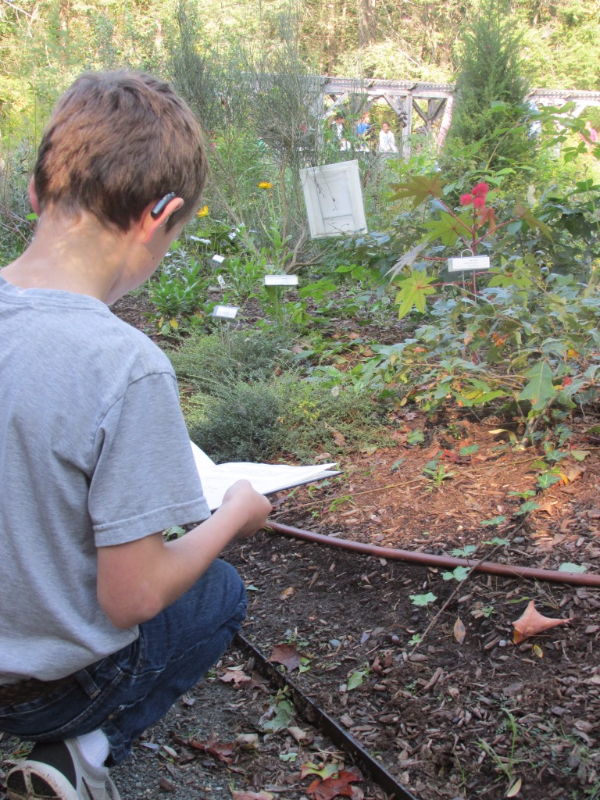
Last Friday was a busy day at Mass Hort with over 280 students from the Weston Country Schools working on their environmental science projects in every corner of the property! Collecting pockets full of acorns due to this year's abundance. Drawing flowers and leaves. What fun!
In February 2015 Mass Hort held a school gardens conference to help connect teachers, administrators, and volunteers to each other, and resources, such as Mass Hort, to help with garden programming. We will host another school garden conference this February, building on last year's successes.
Although our summer season has officially ended, the fall is a wonderful time to visit our gardens.
Please join us!
Kathy
|
|
Honorary Medals Dinner

On Thursday, October 15, at 6:30 p.m., the Massachusetts Horticultural Society will hold its 116th Honorary Medals Dinner. This has been an annual event since 1909, when the Society began conferring honorary medals on those individuals and institutions regarded as important contributors to the art and science of horticulture.
This year, Mass Hort will present Kris S. Jarantoski, Executive Vice President and Director of of the Chicago Botanic Garden, with its greatest honor, the George Robert White Medal. This award is given to a person who has done the most in the past year to advance interest in horticulture. He has exemplified the leadership, vision, and dedication to the field of horticulture that this award was designated for when George Robert White, a great benefactor of Boston, established a permanent fund to award a gold medal "to the man or woman, commercial firm or institution in the United States that has done the most during the year to advance the interest in horticulture in its broadest sense." The 2015 honoree develops and directs the horticulture, plant collections, and facilities and planning of the Chicago Botanic Garden. Since joining the Garden in 1977, Jarantoski has played a major part in the creation of each of the 26 distinct gardens and four natural areas on the Garden's 385-acre campus. In 1929, Mass Hort presented the first Thomas Roland Medal to honor men and women who have shown exceptional horticultural skill. Incised on the front of the medal is a cypripedium orchid, his favorite flower. Mr. Roland, himself, in fact, was lucky enough to receive the first medal named after him. The 2015 Thomas Roland Medal will be presented to Joann Vieira, Director of Horticulture at the Tower Hill Botanic Garden. First made in 1927, The Jackson Dawson Award honors individuals who have shown exceptional skill in the science of hybridization or propagation of woody plants. The 2015 awardee is The American Chestnut Foundation.The American chestnut was a keystone species throughout its range in the eastern United States. By the 1950s, virtually nothing remained of the species other than occasional seedlings and small sprouts. In 1983, a committed group of scientists formed TACF to initiate a complex breeding program to transfer genes containing disease resistance from Asian chestnut species to the American chestnut. In just 20 years, these talented scientists and volunteers began to produce the first generation of trees that are 96% American chestnut but contain Asiatic genes for blight resistance. With the aid of many partner organizations, TACF is leading the restoration of an iconic species once on the brink of extinction. The Gold Medal was issued for the first time in 1924. Like the silver medal, it was a replica of the George N. Mitchell 1847 design. This year we honor: Roger Cook - for his expertise on This Old House and his promotion of the public's understanding and appreciation of horticulture and gardening. As landscape contractor for the Emmy® Award-winning television series, This Old House and appearing on its sister show, Ask This Old House, Roger Cook motivates aspiring green thumbs and inspires stumped professionals with expert advice learned over the course of a lifetime in landscaping. Mrs. Dorrance H. Hamilton - for her support of excellence in horticulture through the Preservation Society of Newport County, Flower Show. From 1994 to 1995 Mrs. Hamilton, with other founders, planned the first Newport Flower Show, to be held in 1996, and she chaired it until 2002. Several awards at the Flower Show have been named in Mrs. Hamilton's honor including the Whimsey Award in Horticulture awarded to the most original and creative presentation of plant material in an outdoor container. Mrs. Maureen Ruettgers - for her support of excellence in horticulture at the Isabella Stewart Gardner Museum and her beautiful "Gardens at the Clock Barn" in Carlisle, MA. The Silver Medal was first awarded in 1901. This medal is a replica of a large gold medal designed by George N. Mitchell in 1847 for the Society. The 2015 silver medals will be award to: The Preservation Society of Newport County, Flower Show - for promoting the appreciation and understanding of horticulture to the general public, and to Suzanne Thatcher - for noteworthy service in horticulture.
Suzanne is a Senior Buyer and Perennial Specialist at Russell's Garden Center, Wayland where she has worked for 23 years. At Russell's she is primarily responsible for the Perennial and Rose areas which is a significant portion of sales at one of New England's largest retail Garden Centers.
Suzanne is a member of the Perennial Plant Association and has served twice on the local site committee for the Boston Symposia. She has assisted in the sourcing of plant material for many notable projects including PBS's, This Old House, Adrian Bloom's Boston area creations and more recently The Blue Garden in Newport R.I.
The Honorary Medals Dinner will take place at Elm Bank in The Hunnewell Carriage House, 900 Washington Street, Wellesley, MA. Tickets are $130 for refreshment and dinner. Proceeds from this special event benefit excellence in horticulture at the Massachusetts Horticultural Society. Please call 617-933-4945 for tickets or visit http://www.masshort.org/honorary-medals. |
Festival of Trees and Snow Village
Plans for the 2015 Festival of Trees are in full swing. This annual event takes place in the Hunnewell Building (trees) and in the Education Building (Snow Village) at Mass Hort's headquarters at The Gardens at Elm Bank. Opening day is the day after Thanksgiving, November 27. The trees are donated by individuals, organizations and businesses and the trees are usually decorated following a theme of the donor's choosing. Visitors 'vote' with raffle tickets for the tree(s) they wish to win. Many families divide their tickets among their children and it is fun to watch the kids try to select the tree they want the most. At the end of the event, the lucky ones take home their trees and decorations. We invite our readers to participate as well. Full information about how to donate (or sponsor) a tree is available at www.MassHort.org/Festival-of-Trees. You can also call (617) 933-4988.  The Snow Village became an enchanting addition to the Festival of Trees in 2014 when it was generously donated by Bill Meagher of Needham. This year it has been moved to a larger space, and Bill and other volunteers are busy building it. Model trains wind their way through villages and vignettes. Fenway Park is featured as well as a ski mountain, lots of skaters, Santa in the sky and other locations, an amusement park, New England and Dickensian villages and much, much more. Thomas the Tank Engine is also featured. This wonderful display has something of interest for all ages and cannot be missed! |
Mass Hort's Wish List
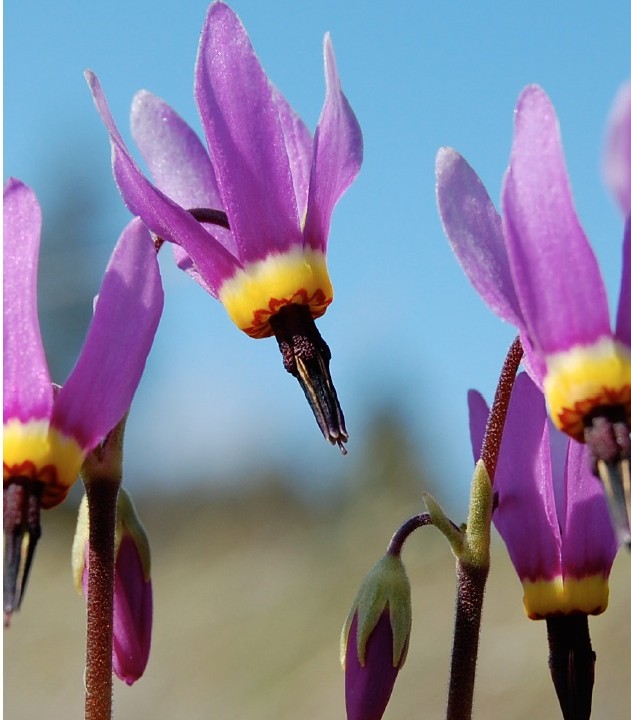
I wish, I wish upon a star... please be our star!
Since opening on May 1, thousands of people have visited us at The Gardens at Elm Bank. So many have come to learn and relax... including Master Gardeners, friends, picnickers, and families playing in the newly renovated Weezie's Garden for Children!
Our staff and volunteers work diligently to maintain this magical place. Please review our Wish List on Amazon.com and help us keep The Gardens at Elm Bank growing. The Gardens at Elm Bank Wish List You can spend $10 or $1,000 - every purchase helps. Thank you! |
 October Hort Hints October Hort Hints
By Betty Sanders
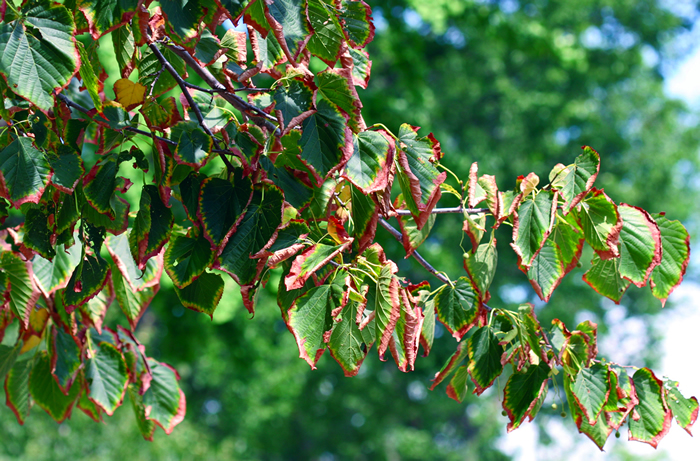
The heavy rains at the beginning of October gave us a respite from the drought. But one soaking rainstorm isn't sufficient to undo a summer's worth of dry weather. Remember to water trees and shrubs until the ground freezes if the rains do not continue regularly.
How dry I am... is probably what most of your trees and shrubs, and perhaps your perennials are saying. For most of us it has been a dry spring, summer and fall. The plentiful snows of last winter disappeared quickly in the spring and little rain has fallen since (Eastern Massachusetts' precipitation is 24% below average through the end of September). Many trees show damage particularly at the top where the leaves are dropping prematurely. Shrubs are similarly distressed. 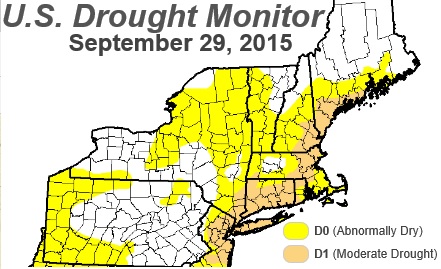
Use your water (particularly if you are in a town with watering restrictions) to help your trees and shrubs. Winter is a desert for plants. Once the ground is frozen there will be no water available to take up. If your trees and shrubs cannot fill their roots and limbs with water during the autumn, they will suffer damage or die. Lawns naturally shut down when dry and recover quickly once the rains begin. Keep watering the woody plants until the ground freezes in December if we don't get lots of rain through October and November. |
| | These leaves indicate the tree is stressed by lack of water |
Cleaning up the vegetable garden. You may not have started harvesting winter squash and you may still have lots of greens and leaf vegetables growing, but it's time to start cleaning up the vegetable garden. Because a disease called 'late blight' was a problem this year, pull up and bag tomato plants (once they have stopped producing) and then pick up all the dropped fruit. Like the plant, the fallen tomatoes can harbor disease and get your garden off to a bad start next year. These go to the trash, not the compost heap. Be aware that corn borers can overwinter in corn stalks. If they were a problem this year, don't compost the stalks
Healthy plants should be pulled and placed in your compost bin or heap. If you take a few minutes to cut up larger plants, you will speed the composting process. After you have cleaned the garden, turn the compost heap. This puts the new material into the heart of the pile where the bacteria can get to work. It also supplies the oxygen that the microbes need to do their work.
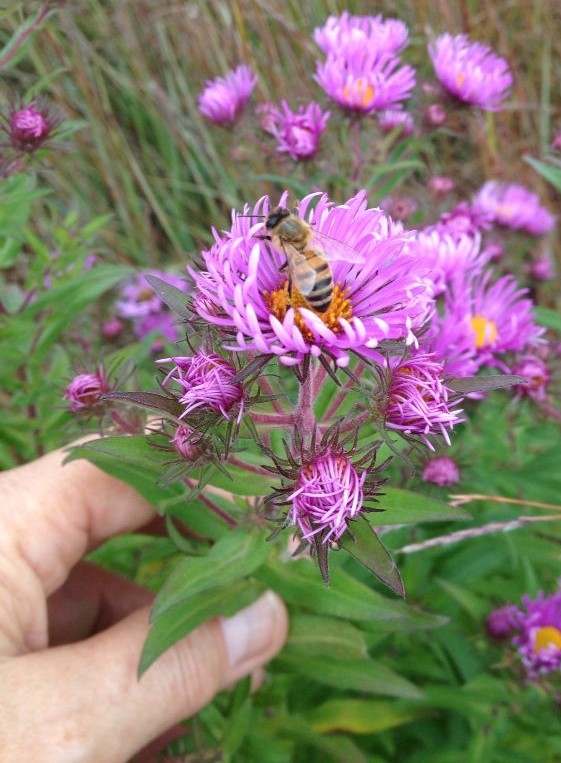
Careful out there! Early autumn is when many wasp, bee
|
| | Bees have less food in autumn - like these asters - and can be more aggressive |
and hornet populations are at their peak. And, with less food available, they are more likely to come in contact with humans. Bees, particularly the American native bees, have suffered huge population losses in recent years. Do not use any herbicides or pesticides that are not absolutely necessary in your garden. While no one chemical is the culprit, many scientists now believe exposure to multiple chemicals is behind this population collapse.
And one out of every three bites of food you take is there because it was visited by a pollinator.
Pruning rule of thumb. Do not cut back plants that are still green and growing until the leaves begin to change color-they are still putting food in the roots for winter. And no pruning trees and shrubs until after they have gone dormant for the winter. Any cuts now might encourage growth which will not have time to harden off and will die during the freezing temperatures. Unless they have been damaged, never prune spring bloomers until they have bloomed in the spring.
|
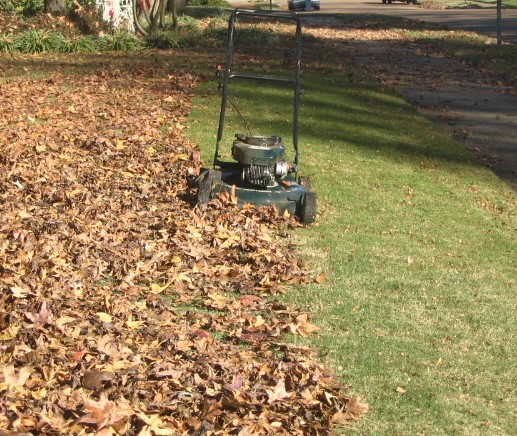
| | Help your lawn by mulch-mowing autumn leaves directly back into your lawn |
Button up your overcoat. After you have cleaned up your gardens, spread an inch of compost or a layer of fresh organic mulch over them. The compost will work its way into the soil, revitalizing it for the spring growing season by adding nutrients and organic matter to the soil. Most plants that die in the winter do so not from the cold but from having their roots exposed as the soil freezes and thaws. One to two inches of compost or mulch can help keep them warmer until the soil freezes and then help keep those plants safely frozen until spring arrives.
Lawn Care for Spring It's not too late to do a world of good for your lawn. Go to https://soiltest.umass.edu/ for information on how to send in a sample for testing. Based on the numbers UMass Ext provides to tell you what the soil needs, add lime and fertilizer now. Fertilizer will strengthen the roots and lime is vital to keep the pH of the soil in an optimum range for the growth of grass. Mowing fallen leaves instead of raking or blowing, adds nutrients and organic material to the soil at no cost and no extra work for you. ------------------------------------------------------------------------------ You can see more of Betty's horticultural advice at www.BettyOnGardening.com. Betty is also the 2015-2017 President of the 11,000+ member Garden Club Federation of Massachusetts.
|
|
Princess visits the Gardens
Princess Giorgiana Lectures on Italian Renaissance Gardens
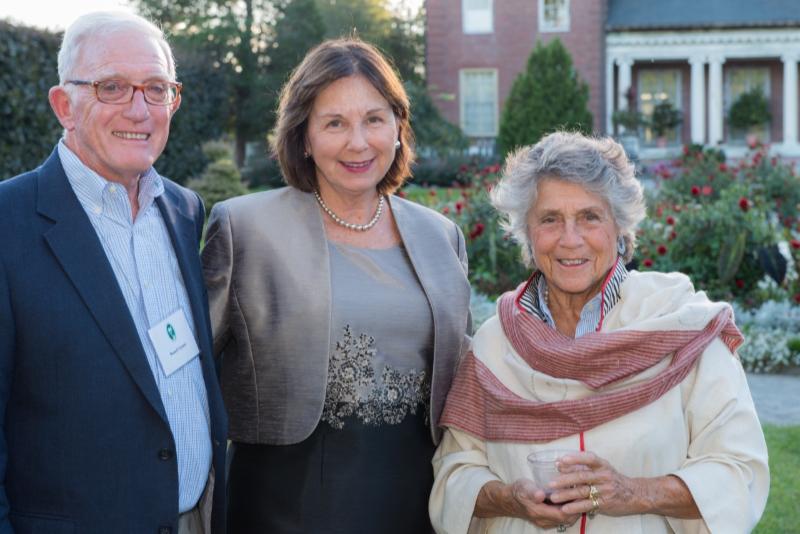 On September 27 Mass Hort held a reception for the Princess Giorgiana Corsini in the Italianate Garden followed by a lecture in the Hunnewell Carriage House.
Over 130 guests attended, enjoying a lovely evening in the garden with wine from the Princess' vineyards, followed by an interesting lecture.
Pictured, left to right, Russ Corsini, Mass Hort member from Wellesley who was instrumental in planning this event, Kathy Macdonald, and Princess Giorgiana Corsini from Florence, Italy.
Photo Credit: John Harmon, Wellesley Weston Magazine |
Book Review
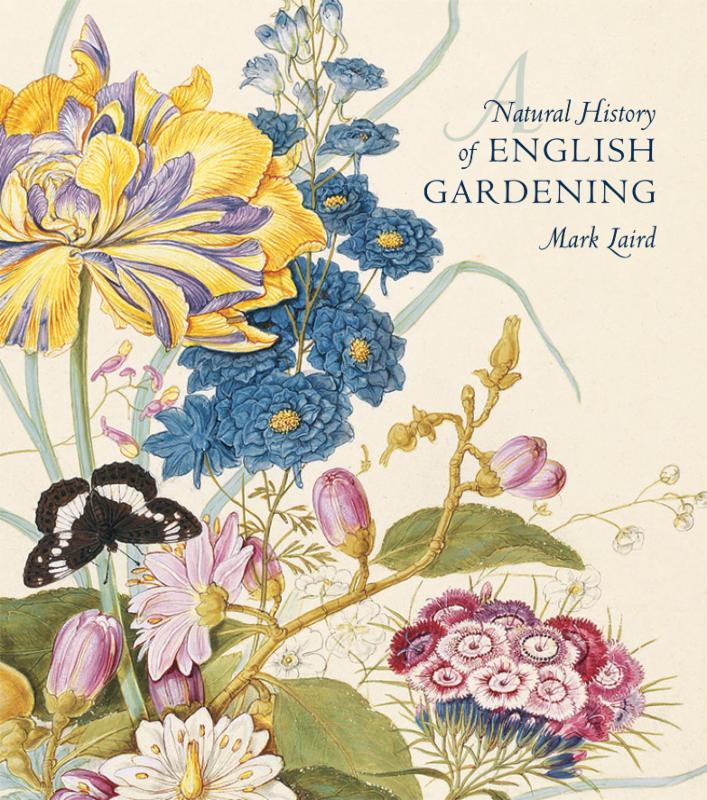
A Natural History of English Gardening
By Mark Laird
New Haven: Yale University Press, 2015
Reviewed by Patrice Todisco
As every gardener is well aware, despite careful and deliberate planning, their success lies beyond their control, held hostage to the complex realities of natural forces and the multiple dimensions of time and space. In his magnum opus, A Natural History of English Gardening, historic landscape consultant, garden conservator and historian Mark Laird explores this dichotomy, placing the history of the garden at the intersection of ecology and culture: a vibrant, messy place at the nexus of control and chaos,
|
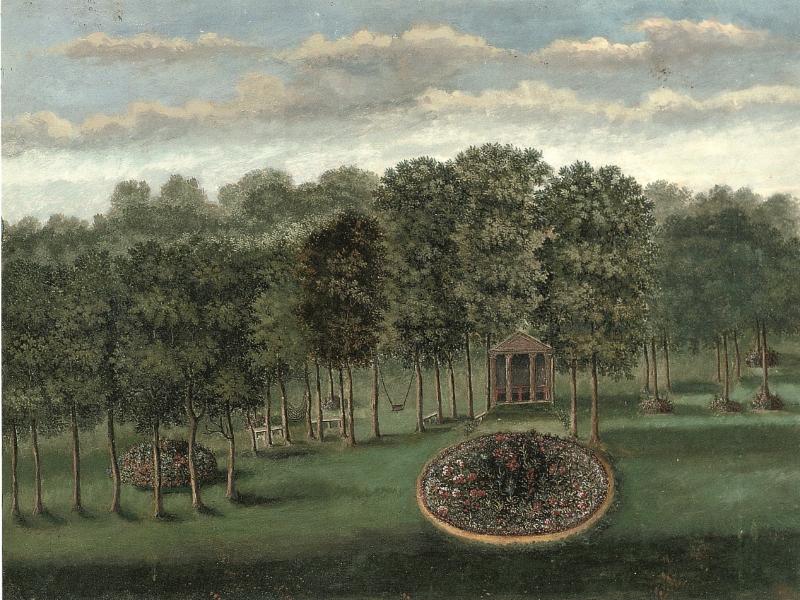
| | An illustration shows the Temple Flower Garden of Richard Bateman's Grove House, Old Windsor, Berkshire, in the 1730s. Private Collection. |
Laird's inspiration derives from the writings of Gilbert White, the pioneering naturalist whose 1789 natural history of Selborne intimately records both the natural and cultural forces of a singular English village. In contrast he cites Horace Walpole, owner of the Gothic Revival estate Strawberry Hill, whose popular book The History of the Modern Taste in Gardening, published in 1780, informed the literary genre for many years with its singular focus on taste and heroic designers at the exclusion of "life forms that inhabit the garden." It's an imbalance that Laird seeks to ameliorate.
|
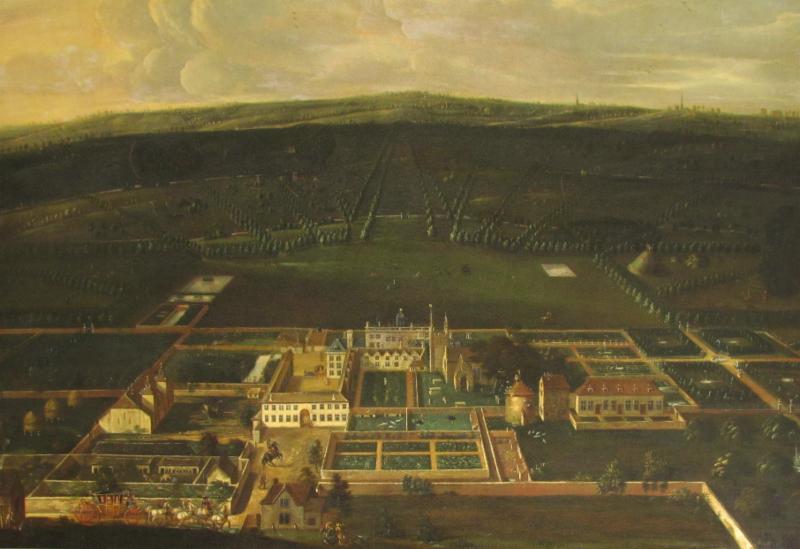
| | Badminton from the south, attribued to Thomas Smith. Photograph courtesy the Duke of Beaufort |
To do so, A Natural History of English Gardening travels outside the realm of the country house, with its rigidly defined coda of design elements, to explore both the city and court where innovations and explorations in natural history were transforming garden concepts. From the coffee house to the tea room, these are the places where what Laird describes as a "horticultural culture"flourished, shaped by informal groups of plant collectors, nurserymen and botanical scientists.
Laird devotes a chapter to a new world vision of the garden in which plants
|
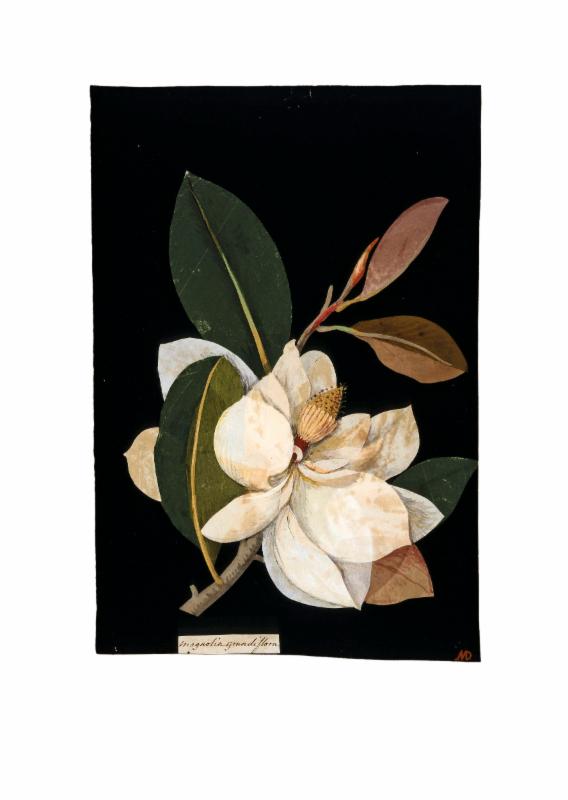
| | Mary Delany, 'Magnolia grandiflora' (detail) 26 August 1776, collage of coloured papers, with bodycolour and watercolor. British Museum. |
and animals, both exotic and indigenous, were integrated within the garden, with varying degrees of success. One is reminded of Linnaeus, who famously housed his pet raccoon, Sjupp, at his botanical garden in Uppsala. The 2nd Duke of Richmond's menagerie, where animals "partnered"with concepts evoking the "American Grove"and Princess Augusta's Aviary at Kew offer "comparative vignettes of feeling vying with sensibilities."
Although Laird suggests that A Natural History of English Gardening"inclines to the fragmentary", he identifies three key themes that inform his approach. These are the contribution of women to natural history and gardening, the role of amateurs, both women and men, to the increasingly professionalized, male dominated, sciences and the split sensibilities innate to gardening which Gilbert observed and recorded at Selborne.
|
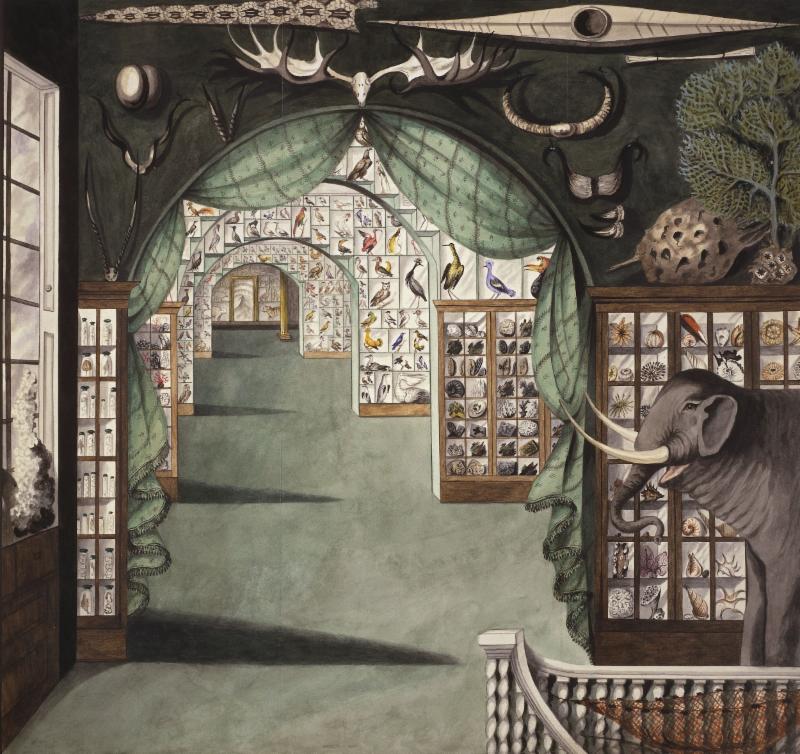
| | Sarah Stone, Interior of Leverian Museum: View as It Appeared in the 1780's, as copied in 1835 watercolour. British Museum. |
Laird's focus on women, whom he describes as "engaged patrons of an innovative Eden,"is extensive and much appreciated. While the work of artist Mary Delany is well known, her circle of influence is less so, including her close association with Mary Cavendish Bentinck, wife of the 2nd duke of Portland. The importance of the domestic arts and the contributions of women naturalists to horticultural innovation provide a new lens in which to view the garden.
A Natural History of English Gardening is a carefully crafted and well-researched, replete with extensive full color illustrations, plans, paintings, journal entries, correspondence and notations. Its seven chapters are preceded by a series of illustrative watercolor, pencil and crayon plates beautifully rendered by the author. At 450 pages in length it is both large and heavy and might possibly be mistaken for a coffee table embellishment belying its depth as a work of scholarship.
This is an important book that provides new insights into the discipline of garden history, a field which is long due for an overhaul. By viewing the cultivated landscape as both a natural and cultural phenomenon, Laird links the past with current concerns including biodiversity, climate change and habitat loss, reinforcing the interconnected nature of all life forms, a concept that is as relevant today as ever.
Patrice Todisco writes about parks, gardens and the public realm at landscapenotes.com.
|
Watering with an Eyedropper

By Neal Sanders
Leaflet Contributor
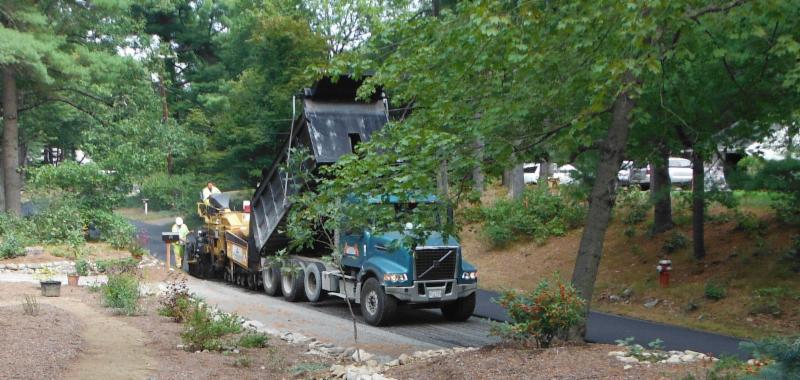
My street got a long-awaited repaving last week. In three days, town crews efficiently took off the top two inches of asphalt and laid down a like amount of new blacktop along a three-mile course. I was impressed with both the speed and attention to environmental conservation, with the old macadam bring instantly whisked away for reprocessing.
|
| | We got less than half the normal rainfall in September |
Like many of my neighbors, I came out to watch as the paving crew went by. As they worked in front of my house, Highway Department Foreman Bobby
Kennedy paused to look over our still-abuilding landscape.
"Neal," he said. "I don't think I want to know how you're keeping all those plants so green."
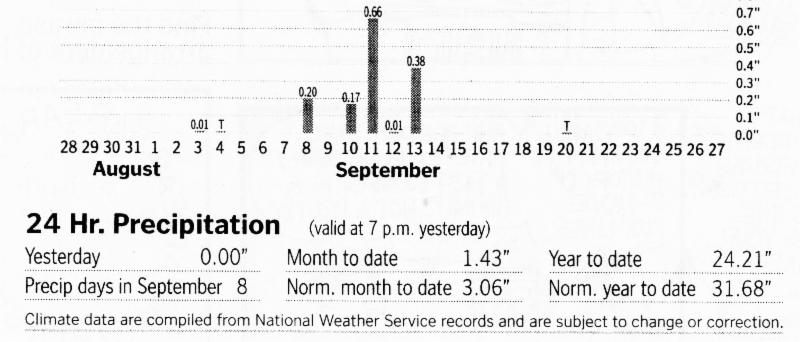
Medfield, like virtually every town in eastern Massachusetts, is under tight water restrictions this year. Even including that mountain of snow that fell between January and March, the region has had less than 25 inches of precipitation so far this year against an average of nearly 33 in the first nine months. It just didn't rain this summer. We are in a drought.
We thought we had our watering needs taken care of when we installed four
|
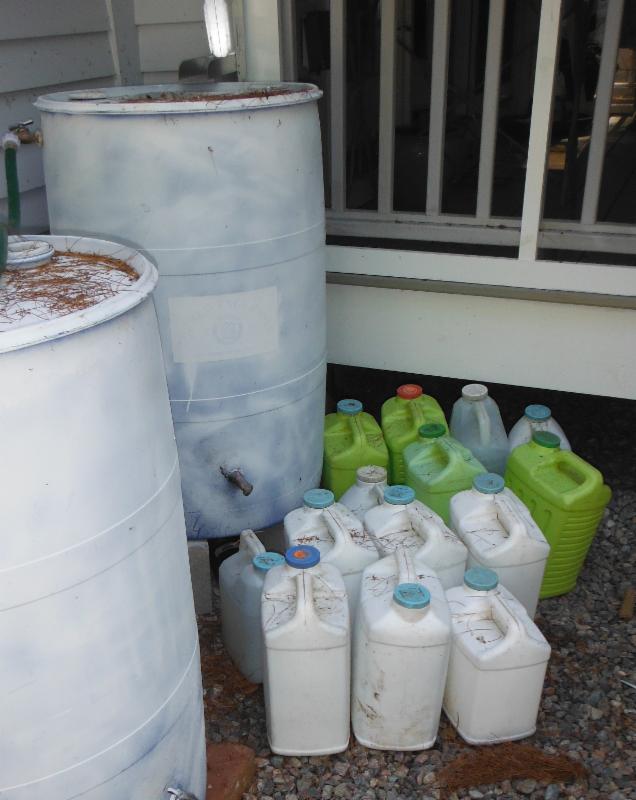
| | Part of our cat litter container collection with two of our rain barrels |
55-gallon rain barrels across the back of our house. As little as a quarter of an inch of rainfall will fill those four barrels to overflowing. The trick to a rain barrel, however, is to first get the rain and, second, to get the rain to fall evenly over time. As the chart nearby shows so starkly, September produced less than half the normal amount of rainfall and it all fell in a six day period in the middle of the month.
And so, to keep our new plants alive and growing while adhering to both the letter and spirit of water bans, we have resorted to an eyedropper approach to watering. Or, to be more accurate, we employ a flotilla of cat litter containers.
Here's a statistic: if you have a 3,000 square-foot lawn - that's 100 feet by 30 feet - and you turn on your sprinkler system long enough to put a half an inch of water on that lawn, you will use a thousand gallons of water.
We don't have a lawn and, if we did, we wouldn't water it. Lawns godormant in the heat of summer and recover nicely when cooler weather returns. But we have eight newly planted trees, roughly 60 shrubs, and nearly 200 perennials, all in the ground three months or less. If the roots of those trees and plants don't have access to water, they die.
We also have a massive number of three-gallon containers that originally held cat litter. Today, they have been re-purposed to hold water. Our original plan was to use the containers as 'overflow' for all the water being produced by our rain barrels; the equivalent of a fifth or sixth barrel. But in the absence of rainfall, the water in those containers comes out of a faucet.
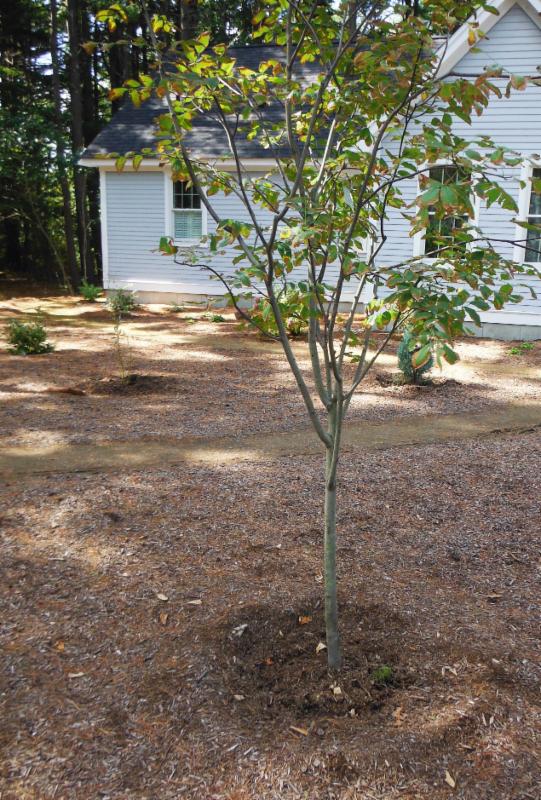
When we water, each tree gets two containers, or six gallons, of water. Each shrub gets between one and 1.5 gallons of water. Depending on size, each perennial gets from a quart and half to a gallon of water. The water is applied directly to the base of the plant, where we wisely created a mulch berm.
So, how much water do we use? I started counting the number of times I re-filled those containers. Amazingly, we are watering our entire garden using less than 180 gallons.
There's just one minor downside to this otherwise ingenious, water-efficient method of keeping our plants properly hydrated... someone has to carry that water from plant to plant and fill those jugs.
|
| | Every tree and shrub in our garden has been planted with a mulch berm to hold water |
Betty and I share that activity, which we typically perform just after dawn on those days we water. I fill twenty or so jugs and then pre-position them where experience says they will do the most good. Betty does the actual watering and leaves the empty containers where I can collect them. I re-fill the jugs and return them to where I think they'll be needed. All this is done at breakneck speed with jugs being placed and collected up to 150 feet from where I fill them. A physician would say I'm getting a good upper cardio workout. The neighbors have concluded we're nuts.
You may ask yourself, 'why not just use a hose?' That's a good question, and a sign of a nimble mind at work.
The answer is twofold: first, we can water with containers in a fraction of the time it takes to do so with a hose. Our watering record is 20 minutes. I can fill a three-gallon container in ten seconds. Try pushing that much water through a hose without blasting the soil off the roots of a plant in the process. Also, hose watering is, at minimum, a two-person process. One person points the hose. The others performs a continuous mambo to keep the trailing part of the hose - and we're talking a hundred feet of hose here - from crushing or being dragged over unsuspecting plants. I might also add that dragged hoses have a way of 'reconfiguring' bark mulch beds and gravel paths and disassembling stone walls.
The second answer is that there is no waste with containers: every drop gets on the plants that need it. Moreover, those containers are continually being filled not only with water drawn specifically for watering, but for other household activities as well. We collect the water other people let flow down their drains - shower water awaiting that perfect temperature, for example, or water used to wash vegetables. Trust me, the plants don't mind.
The downside is the abandonment of any attempt at dignity. At 6:30 a.m., our neighbors can look out their windows and see the Sanders flying around the garden carrying those dumb containers. I cannot help but notice that we are now getting a contingent of dog walkers who have adjusted their schedules to better enjoy the spectacle. I know we're good for a laugh.
But in a few weeks the quarterly water bills will go out. My plan is to take mine straight to the Highway Department and show it to Mr. Kennedy. Then I get to watch him scratch his head and wonder how we kept our garden green using so little water.
----------------------------------------------
Neal Sanders is the author of nine mysteries. His tenth, 'How to Murder Your Contractor' will be published in early 2016. You can find Neal's books at Amazon.com and in bookstores.
|
|
Mass Hort's Botanical Prints Available Online
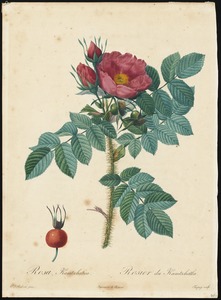
Thanks to three months of collaboration between the Massachusetts Horticultural Society, the Boston Public Library, and Digital Commonwealth, more than 1,000 rare images from the oldest horticultural library in the nation are now available at the click of a button.
With prints dating from 1620 to 1969, Mass Hort's Botanical Print Collection captures more than three centuries in the evolution of botanical illustration, offering an invaluable resource for students, researchers, and authors in the field of horticultural. The digital portal will also create opportunities for the public to explore images that until now have been seen only by experts and aficionados, and to cultivate an appreciation for the art and science of horticulture from the comfort of their own homes. Tom Blake, Digital Projects Manager, Boston Public Library, commented that "Digital Commonwealth enables Massachusetts cultural institutions to develop a virtual presence, enhancing education and research by creating a community of support, offering professional advice, and facilitating collaboration. The Digital Commonwealth portal facilitates worldwide access to the cultural heritage of Massachusetts. Our repository provides an affordable option to organizations that are unable to host one locally." The Horticultural Library at Massachusetts Horticultural Society was the first in the United States. It was established soon after the Society was founded in 1829 to share horticulture knowledge and beauty through its prints, books, extensive collection of seed catalogs, and other rare materials. Its horticultural holdings provide invaluable resources to our members, scholars, historians and general public Noticing that interest in botanical prints had grown during the intervening 140 years, the Society mounted its first major exhibit in 1968. It continued in 1969, when a group of lily prints was shown to the North American Lily Society at its annual meeting Digitization and online access to special collections is an important strategy for any cultural heritage organization as it allows us to reach our users beyond our buildings and business hours. Today, with the help of Digital Commonwealth, Mass Hort's Library will meet the 21st Century digital needs of students, researchers, authors and the public. Check out the Botanical Prints! Massachusetts Horticultural Society's botanical prints are available online at the Digital Commonwealth repository at These images are available for the purposes of viewing and studying and not for commercial use. Digital Commonwealth is a non-profit collaborative organization that provides resources and services to support the creation, management, and dissemination of cultural heritage materials held by Massachusetts libraries, museums, historical societies, and archives. Digital Commonwealth currently has over 130 member institutions from across the state. The Massachusetts Horticultural Society Library at 900 Washington Street, Wellesley, MA is supported by members and donors. Please help us maintain our library collection with a tax deductible donation or by calling Elaine Lawrence, Director of Development at 617-933-4945.
|
Catching Up with the Last Half Century Maureen Horn, Librarian
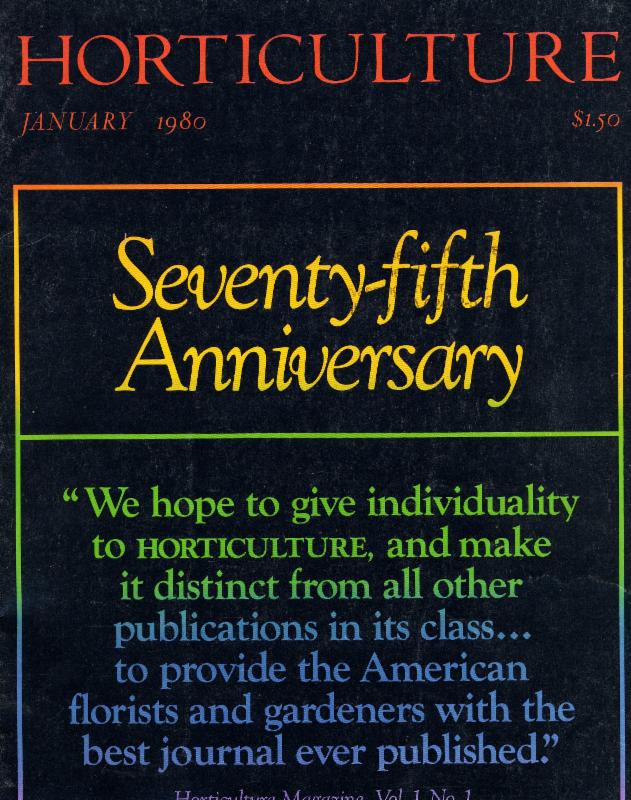 Part 9 Part 9
The End of the Seventies : The Big Celebration
A recurring theme in conversations and reports in the waning days of the 1970's was anticipation of the activities for 1979 to celebrate the 150th anniversary of the founding of the Massachusetts Horticultural Society. The talking began in December 1977, when the Executive Committee announced that it was seeking fundraisers for the celebration. At time, they laid out an agenda that would highlight the special occasion. On the list were
- An exhibit in the Boston Public Library that would last for several months.
- A dinner party in the Great Hall
- Attendance of past medal winners
- A horticultural symposium
- A lecture on solar greenhouses
- Visits to the Arnold Arboretum and Mount Auburn Cemetery
The celebration would begin with the upcoming 1978 Flower Show.
Blizzard Confronted
Several gatherings had to be cancelled because of the famous Blizzard of 1978. For example, the Camellia Show did not take place because of water damage to the loggia in Horticultural Hall. On the other hand, international tours - to Monaco, Toronto, Spain and Scotland - were organized and well-received, perhaps because of the threatening Boston weather. As one would expect, the receipts from the Flower Show, held during the aftermath of the great storm and in the shadow of another storm, were disappointing.
The Exhibitions Committee, though, was undaunted, and Stephen Crosby announced that he would talk to every indoor plant society about the impending 150th anniversary. President Patricia Storey would head up a committee to select prints for a calendar and for posters to emphasize the celebration. They should be ready at the beginning of 1980. In June, she announced that the lease with the Boston Shakespeare Company was accepted by the Executive Committee and one could expect theatrical performances in Horticultural Hall.
The educational offerings continued to be the star attractions for M. H. S. members, and out of 20 courses offered, only one was run at a loss. More ambitious projects were also undertaken; for example, Executive Director Clifford de Baun planned a symposium on horticultural therapy to take place in June. After a summer hiatus, the Trustees were looking forward to the September meeting, when they were promised the "Flora of Shakespeare" exhibit on loan from the Arnold Arboretum and the Shakespeare Company's production of Hamlet.
A Decade Predicted
The Anniversary Year was finally completed, and it was deemed a great success. It was also seen as a time for making decisions about the most important assets of the Society. The benefits and costs of publishing Horticulture magazine were endlessly debated, with no resolution in sight. The magazine would celebrate its 75th anniversary in 1980 with an issue looking at gardening methods, both past and future and would contrast the past 75 years with the next 75. The Society's other publication, The Nasturtium, would appear as The Leaflet in January 1980.
President Robert Mill commented on the importance of the Library and asked the Library Committee to advise the board on how it could become a more valuable asset. He noted that during the celebration, the attendance and the enthusiasm of volunteers reflected the spirit of the 1829 founders. It seemed that the celebration, undertaken to look back at past deeds, revealed the Society of the future as an organization of volunteers.
|
School Field Trips at Mass Hort
Mass Hort welcomed the Weston Country School on Friday, October 9 to The Gardens at Elm Bank. Over 280 students enjoyed an environmental field trip in our garden classroom!
Want to bring your school field trip? Contact: Katie Folts at 617-933-4973 or kfolts@masshort.org.
|
Notes from the Vegetable Garden
By Susan Hammond
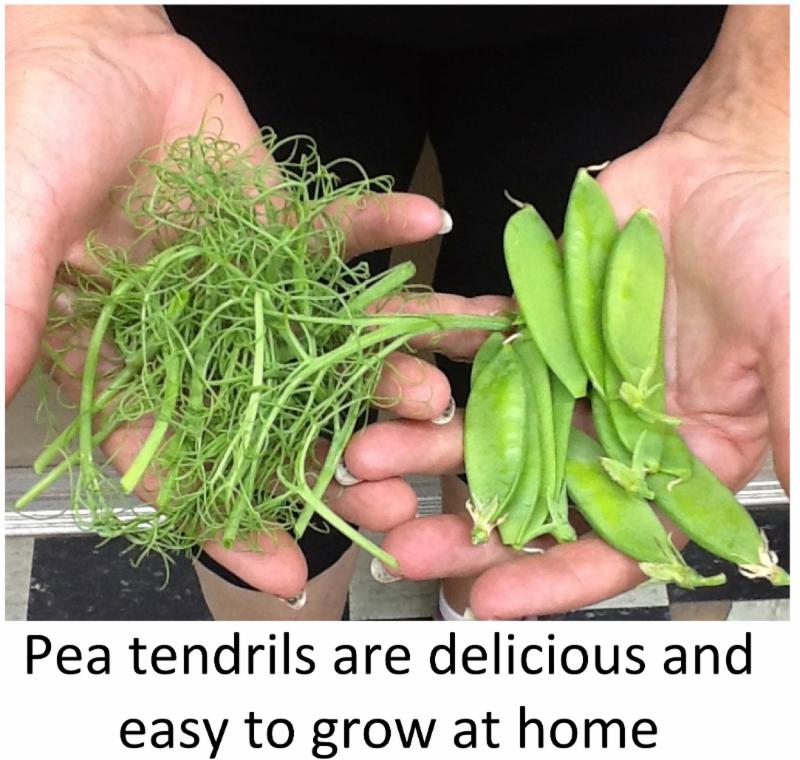 The harvest year in the Garden to Table Vegetable Garden begins with the early, cold-tolerant crops like peas and lettuce and greens. As the cycle of the garden year progresses and we have cooler weather and shorter days, we're back to harvesting those crops again. We're especially fond of the "Feisty" peas from Johnny's Selected Seeds, since they can be eaten at all stages of growth - from shoots through tendrils to mature peas. This will let us get a crop from them even if our remaining garden season is shorter than we expect.
When we got to the garden on September 28 th, we were greeted with signs 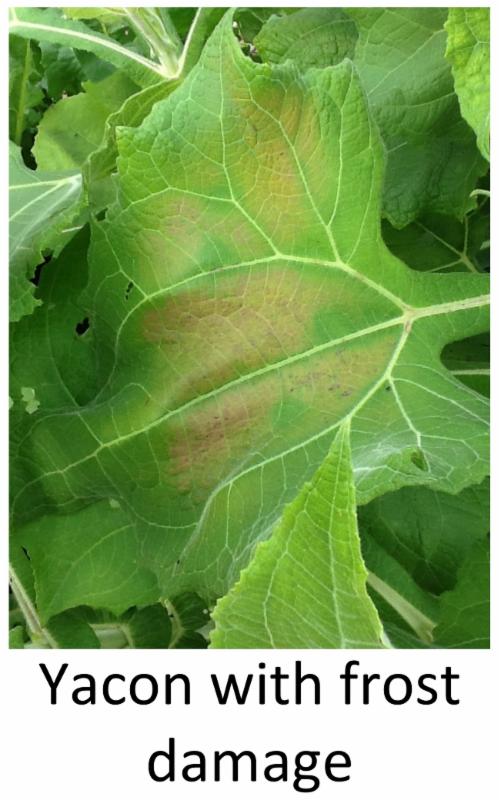 of frost on some of the plants - even though there hadn't been a frost warning. Why did we find frost damage in the garden when the reported nighttime temperatures didn't get below freezing? And why in the vegetable garden, but not in other MHS gardens? There are several reasons. One is that we generally measure temperature four to six feet up off the ground, and the air temperature at that height might be 36 degrees, but a few inches off the ground it can be much colder. The dry weather also played a part: wet ground can retain heat better than dry ground can. Also, on a dry (dew point below low 30's), clear, and windless night, plants can lose substantial heat through radiational cooling, which can cause the temperature around them to go below 32. The vegetable garden is in a wide-open area of Elm Bank, and the weather conditions were just right for it to get nipped a bit by frost.
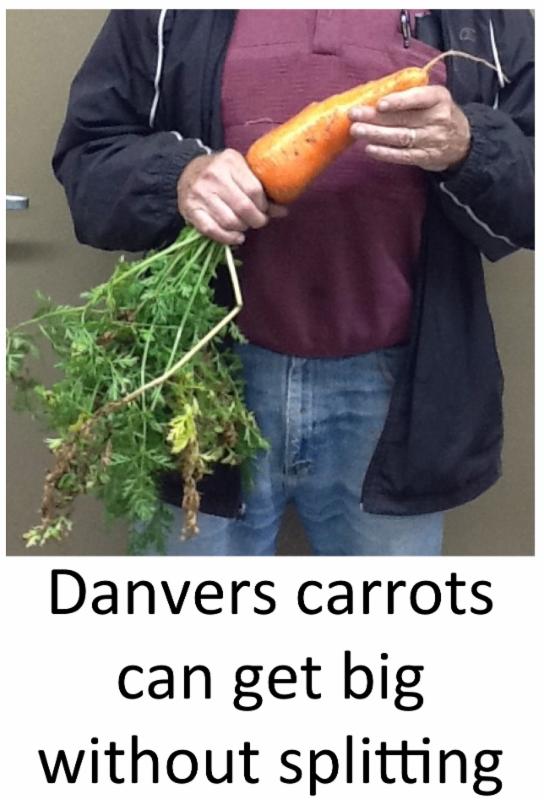 Frost isn't all bad - some of our crops this year, such as parsnips, are actually tastier after frost. And some things were planned to mature late in the garden season, including leeks and our heirloom "Danvers" carrots.
We have lots of harvesting yet to do and expect to keep the garden going until one to two weeks after true frost . We won't be in the garden on Columbus Day, but stop by and see us on non-holiday Mondays and Thursdays from 9:00 a.m. - 1:00 p.m.
|
What a Summer in Weezie's!
By Katie Folts, Education Coordinator
|
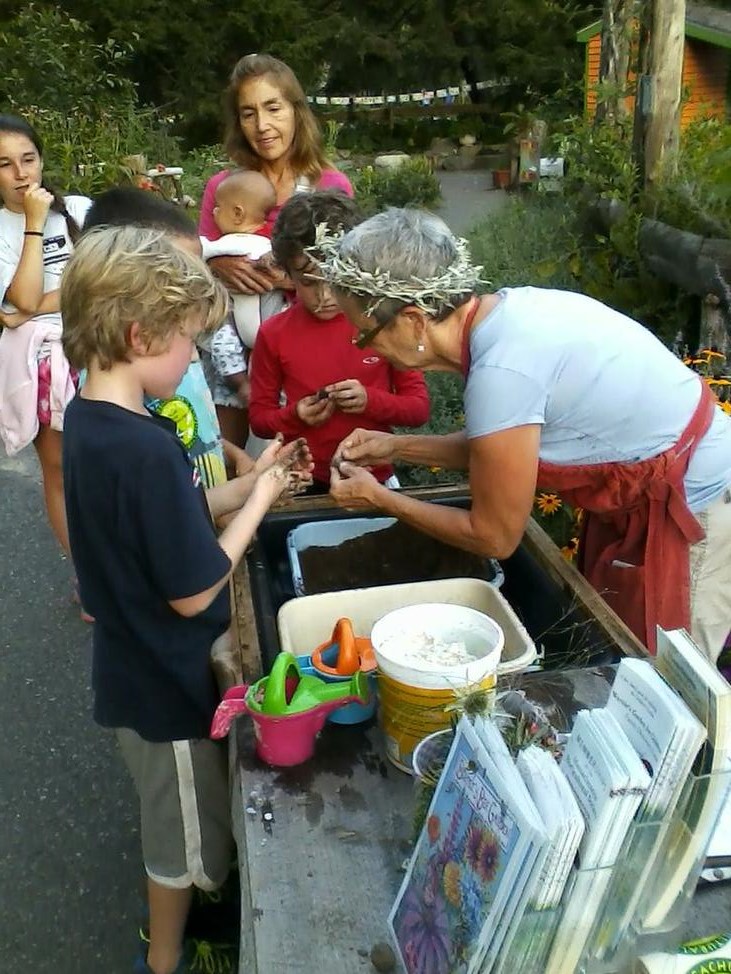
| | Garden Educator Molly shows kids how to make a 'pollinator pods' |
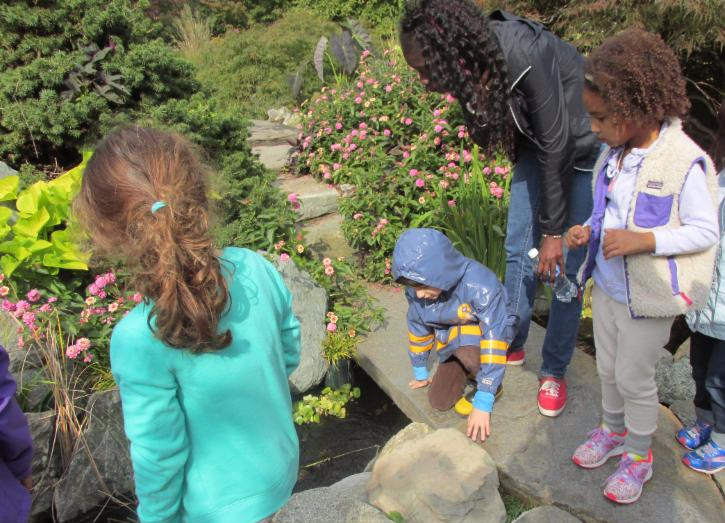
It is hard to believe that the summer has come and gone. It has been quite a summer for the education staff. In addition to Plantmobile visits to community events, schools and camps, we hosted daily children's programs in Weezie's Garden for Children all summer long.
This was a new undertaking for Mass Hort, expanding our garden programs from twice a week to six days a week. We reached thousands with horticulture activities such as pressing flowers and learning about herbaria and planting seeds and propagating cuttings. To reach so many children and families, we added two new educator positions. The educators were in the garden to offer activities and interpret the garden for visitors. We also used new features in the renovated Weezie's Garden for Children as the backdrop for our activities. Children connected with the natural landscape as they built fairy houses in the "Enchanted Woodland" and they learned about the history of plants in our "Dinosaur Garden", a garden of petrified wood, ginkgo, palms and dawn redwood. Many children tasted, smelled and experienced fun heirloom vegetables in the Seed to Table garden. On Wednesdays, we again welcomed the Dover Town Library and their Super Awesome Fun Time-the story hour which is so much more! In September and October we welcomed school visits and used our newly constructed outdoor classroom space. If you haven't been to Weezie's yet, you still have a little time! We'll be coming back next season with even more renovations! Please contact the education team if you would like to learn more about how you can support the connections we make between kids and their natural environment. |
Bringing the Garden to your Table: Brewing fine Ale, Goddess style!
By Hannah Traggis, Garden to Table Educator
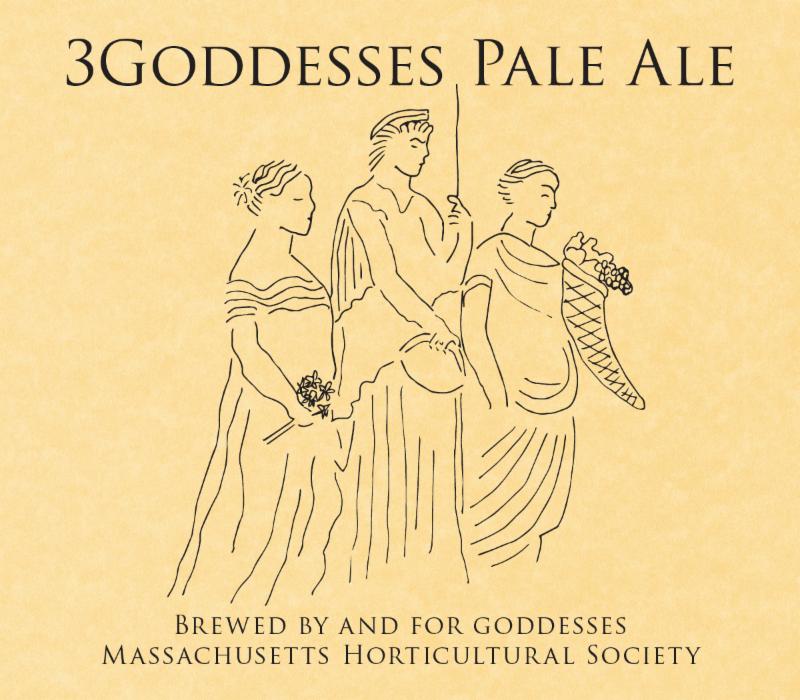
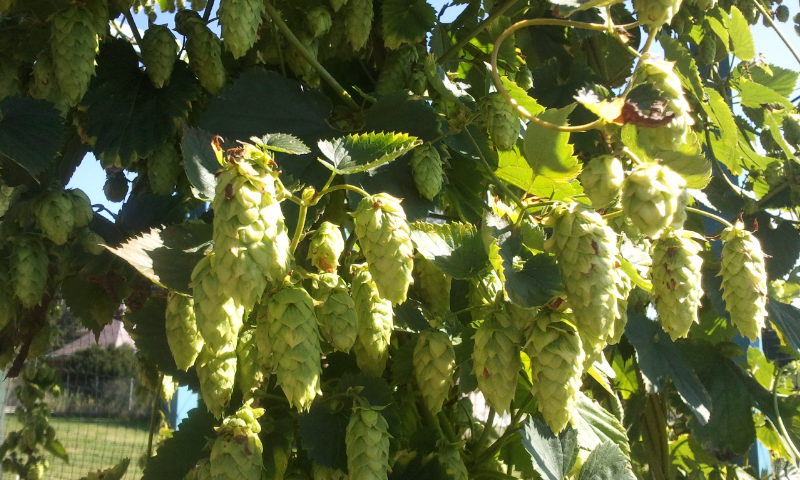
When the garden yields forth a bountiful crop of hops, what else should you do besides brew a tasty batch of ale?! Late this summer, that is exactly what we did! Female Hops vines, Humulus lupulus, produce aromatic cones that have been used to impart flavor to beer for centuries, their first documented cultivation dating back to 736 AD. Here, in the Gardens at Elm Bank, we have been cultivating our own hops, 'Cascade', for several years and the vigorous vines gave us over 7 pounds of fresh hops! Wanting to capture the essence these beauties had to offer, we teamed up with Dan Eng at his do-it-yourself brewery, Barleycorns in Natick MA, to create our very own 3Goddesses Pale Ale! A custom original recipe designed by Dan to specifically utilize the most of our fresh hops, the brew debuted to rave reviews at this year's Garden to Table Program Fall Harvest Dinner and Fundraiser!
Brewed by and for the goddesses of Mass Hort, and guided carefully by Dan, we enjoyed every step of the fascinating process. We began by hand milling together five types of malted barley, including two that would add depth in color and a subtle, nutty, fresh-baked bread taste. Next was the mashing, a hot-water process that activates enzymes within the grain that break starches into simpler sugar molecules, providing food for the yeast to digest during fermentation. We wanted to optimize this part! The liquid left after the grains are removed is called the wort. This passed through a carefully controlled boiling process during which we added fresh hops several times.
The earlier hops additions lend bitterness, while the later hops additions lend flavor and aroma. At this point, our incredible wort was ready for yeast and 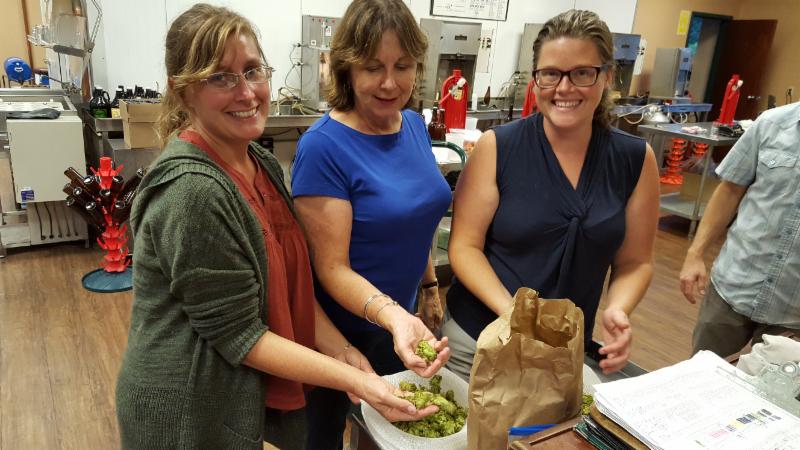 fermentation. A quick check of specific gravity to see how densely packed the sugars were, Dan tucked our keg safely away to ferment. After a few weeks, our delicious Pale Ale was ready to bottle and received our executive director's 'seal of approval' and label of her own special artwork and design! Thanks to Katie Folts, Katherine Macdonald and Penni Jenkins for the collective effort in true goddess style! Join us and learn to brew your own Craft Beer with Dan Eng on October 29th! |
|
|
|
|
|
|