Join the ACP for a
"Taste of Philly"
Networking Event
Join Frank Leonetti, ACP National Treasurer, along with other Corporate Board members in celebrating an incredible 30 years of the Association of Contingency Planners (ACP)! The celebration takes place during DRI2013, making it convenient to attend both exciting events! The evening will feature visionaries in business continuity, partners in disaster recovery, and practitioners in emergency preparedness, and industry experts in crisis management as they gather to network and socialize. It's a great chance to mingle with other ACP members while enjoying enjoy casual fare, hot hors d'œuvre, libations, and refreshments. Register today! Door prizes include:
- Two (2) National ACP memberships for one year (New members Only)
- One (1) Apple iPad mini
- Two (2) $100 Amazon Gift cards
The reception is absolutely free, and is sponsored by StrategicBCP; it will, however, will be limited to the first 100 registrants. So, register for the ACP reception by clicking here, and click here to register for DRI2013. Ask about special ACP discounts for DRI2013 and the one-day pass option. Event Specifics: Date: Wednesday, June 5 Time: 5:30 p.m. Location: Philadelphia Convention Center - Suite 126A
| |
Clyde's Corner: A Visit with DRI Instanbul
DRI International is truly an international organization. BCP issues and concerns are, in fact, global, and many of you are a part of a global business continuity/resiliency program. Day-to-day challenges and the resulting solutions more often require a world view. The interconnectedness of multiple moving international parts is inescapable. This makes our job very difficult...and very interesting. Last week, I was privileged to teach a DRI course in Istanbul, Turkey. This four-day class was the first ever class held in Turkey. The students were the very first to take the qualifying exam in Turkey and will be part of a very, very small (but growing!) number of certified business continuity professionals in their country. It was an honor for me to teach these motivated students who work for top tier companies in Istanbul. Their daily work challenges and BCP/security responsibilities represent the variety of issues and perplexing challenges that we may all face in our daily roles.  What made this class special was the fact that we were conducting the class entirely in English for native Turkish speakers who also are fluent in English. As an instructor I was often challenged to dig deep into my vocabulary bag to find multiple words to help define words like caveat, concurrent, or reciprocal. Clearly a wonderful experience for me; I think the students also enjoyed the class, the camaraderie, and the opportunity to meet others in their profession. While sharing the classroom experience, lunches, and a few laughs, we were able to share work stories, life stories, and our collective interest in this business continuity profession. My week in Istanbul provided me with the opportunity to make new friends and learn a little about Turkey, taste traditional Turkish foods, and spend a little time in this dynamic, bustling city at the confluence of Asia and Europe. Jerome Ryan, CEO GRM Solutions LLC and DRI board member, who organized and sponsored this course, had the following to say at its conclusion: "I am very pleased with the successful completion of our first DRI Istanbul course held in Istanbul, Turkey at the beginning of May. We had many wonderful students from the largest Turkish and international companies attend. DRI Istanbul now stands as a regional hub for BCM professionals in Europe, Middle East, and North Africa. With the overwhelming success of this course, we are proud to announce that we will be scheduling another BCLE-2000 course in Istanbul early this Fall - more details to follow." A profound thank you to my students in Turkey for making my time there very special, and I wish you all luck in all you do. It is my hope that we keep in touch and that next year you will be able to attend our DRI2014 conference. Clyde Berger cberger@driif.orgVice President and Director of Volunteerism DRI International Foundation
| |
DRI Foundation
Charity Auction:
New Items Added!
Good news! We've added new items to our auction including an autographed Green Bay Packers football, cardio kickboxing classes, and even a private movie screening of the upcoming DreamWorks movie Turbo along with a tour of the animation studio! All that and more is up for grabs in the Disaster Recovery International Foundation online charity auction. With lots of new items to choose from, we figured you'll need more time to make up your mind. Bidding will now run until May 24. Click here to view items and bid. The annual online auction is being held as a fundraiser to support the DRI Foundation. There are many great items, ranging from restaurant gift cards, to sports memorabilia, to electronics, to spas, to vacation packages, to theater and philharmonic tickets, and much more. Some items will continue past the online auction and be present at our silent auction at DRI2013 on June 6. Don't worry if you can't be present, as absentee bidding will be in place for these items.
| |
|
|
 |
|
Greetings!
 See that picture? That's PSY, the Gangnam Style guy. And in that photograph, he's doing his signature "choreography" at a Los Angeles Dodgers baseball game. See that older gentleman sitting near PSY? That's Tommy Lasorda. He's old school baseball, a former player, coach, and your basic baseball legend. Now take a close look at Tommy Lasorda's face (which remained like that throughout PSY's entire performance). While I won't be putting words in his mouth, I think Tommy's expression says it all. And I think that's the expression that's been on my face most of the week too. I certainly looked like that when I caught Molly, the disaster dog, spraying that Kong doggie Cheez Whiz stuff directly into her mouth. She stole the can, removed the lid, and figured out how to bite the stem so she was on the receiving end of much bacon cheddar goodness. That's what I get for putting her on a diet. And I certainly looked incredulous as teenager after teenager arrived at my door yesterday with bags of clothing to donate. I didn't know that my daughter had decided to act upon her activist genes and spearhead a "Fitch the homeless" drive from our home. (If you haven't heard about "Fitch the homeless," google it. Talk about a potential disruption and brand disaster in the making!). And just now, as I carefully (actually, reverently) opened the teeny tiny Blue Bunny chocolate covered chocolate ice cream in a wee chocolate cone and watched it leap bunny-like straight from the wrapper to the floor (yes, Molly ate it), I certainly had Lasorda face. We all have those days, weeks, months, minutes at home and at work (I'm smart enough to leave the work stuff under wraps!). And when your work is basically dealing with that Allstate mayhem guy all day every day, you must have more than your fair share of "those days." So, in the spirit of those top ten lists I talked about last week, here's one we all can use: 15 Things You Should Give Up To Be Happy (you get five extras!). It's the best thing I've read recently (it would make my top 10 for sure) because no matter what personal or professional struggles you face, these 15 gems will help you get through them with intelligence, grace, and humor.
Buffy Rojas
|
How Are Cities Preparing for Potential Disasters?
|
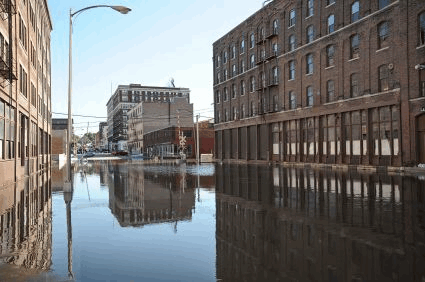 Good question. On Wednesday, we got some answers when PBS NewsHour hosted Judith Rodin of the Rockefeller Foundation and Tomas Regalado, mayor of Miami to "discuss how major cities are preparing for future disasters -- not just hurricanes, but floods, earthquakes, tornadoes, snowstorms, droughts and even blackouts." Click here for that interview. Recently the Rockefeller Foundation announced a $35 million grant program to help cities develop disaster preparedness plans and to ensure resilient cities that can bounce back. NewsHour has been following disaster-stricken cities and has complied those stories here. Cities featured include New York and Chicago, among others. |
Say Goodbye to This Symbol of Sandy
|
 | |
Work Begins to Remove
Jet Star Roller Coaster from Ocean
|
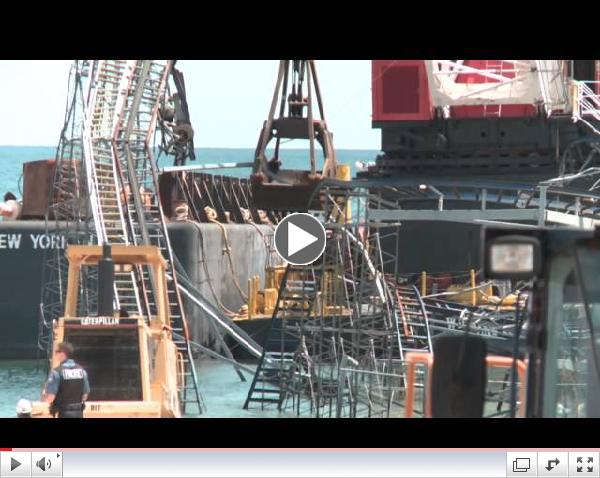
It was a bittersweet farewell this week to the Jersey shore Jet Star rollercoaster that had become a symbol of Superstorm Sandy. The rollercoaster partly submerged in the sea sure was a sight to see. So much so that a local official quoted in this video clip reports that it brought sightseers to Seaside Heights. There was some discussion of leaving the rollercoaster where it fell, as a tourist attraction. But those plans were ultimately scrapped in favor of the safety of beachgoers and the environment. News rumors about the iconic coaster? The next one might be named "Superstorm."
|
Register Now for DRI2013!
| 
Click here to register, and click here for more information about DRI2013 to be held June 4-7, at the Pennsylvania Convention Center in Philadelphia, PA. |
|
U.N. Warns of Escalating Economic Losses from Disasters, And DRI Is Taking Action to Help!
| 
The United Nations Office for Disaster Risk announced yesterday that the Global Assessment Report on Disaster Risk Reduction - the UN flagship publication on global disaster risk and disaster risk management - has been launched. Economic losses from disasters since 2000 are in the range of $2.5 trillion, a figure at least 50 percent higher than previous international estimates, according to the report.
The third edition of this biennial publication, titled "From Shared Risk to Shared Value: the Business Case for Disaster Risk Reduction," highlights how the transformation of the global economy over the last 40 years has led to rapid increases in disaster risk in low, medium and high income countries, affecting businesses and societies. The U.N. Office for Disaster Risk Reduction warned in the 246-page report that economic losses from floods, earthquakes and drought will continue to escalate unless businesses take action to reduce their exposure to disaster risks.
U.N. Secretary-General Ban Ki-moon said "economic losses from disasters are out of control" and can only be reduced in partnership with the private sector. "Our startling finding is that direct losses from floods, earthquakes and drought have been underestimated by at least 50 percent," Ban said. "So far this century, direct losses from disasters are in the range of $2.5 trillion. This is unacceptable when we have the knowledge to reduce the losses and benefit from the gains."
"As an international organization that deals with preparedness on a daily basis, DRI International is heavily invested in global preparedness. DRI International's mission statement is 'to make the world more prepared,'" said DRI President Al Berman. "It's really important, and it's a long-term project. There needs to be some means by which a regional process is created so that the haves can help the have nots. We're working with a number of Asian and Latin American countries and governments on standards right now. As we learned in the Great Eastern Earthquake on 3/11 in Japan, these incidents can and did have a real negative effect on businesses in other countries, including the U.S. We're also working in the Gulf region on a standard there so that they have a unified approach to dealing with disasters. We're working toward something that eventually all countries in the region will buy into. And we're working in Latin America, where natural disasters, like mud slides in Brazil, are a huge issue."
"Incidents are inevitable. Disasters are man-made. Both the public and private sector have a duty to provide a reasonable standard of care to prevent disasters from occurring. I applaud the U.N. Office for Disaster Risk Reduction for their effort to lead at the international level," added DRI Director of Global Operations Chloe Demrovsky.
"In the years ahead, trillions of dollars will be invested in hazard-exposed regions," Ban said. "If that money fails to account for natural hazards and vulnerabilities, risk will increase. Where such spending does address underlying risk factors, risk will go down."
According to the AP, the report said recent major disasters such as Hurricane Sandy in 2012, the 2011 floods in Thailand and the 2011 Japanese earthquake and tsunami put a spotlight on the growing impact of disasters on the private sector. The report says increasing globalization, the search for lower costs and higher productivity, and quick delivery "are driving business into hazard-prone locations with little or no consideration of the consequences on global supply chains."
For example, it said Toyota lost $1.2 billion in product revenue from the Japanese quake due to parts shortages that caused 150,000 fewer cars to be manufactured in the United States and a 70 percent reduction in production in India and a 50 percent reduction in China.
On the other hand, Orion, which owns and operates one of the largest electricity distribution networks in New Zealand, invested $6 million in seismic protection that saved the company $65 million in the 2010 and 2011 earthquakes, the report said. And preventive investments by fishermen in Mexico saved each individual entrepreneur US$35,000 during Hurricane Wilma in 2005, it said.
To read the report, listen to interviews, and access other informative and interesting supporting material, click here.
|
|
Sneak Peak: FDNY Tunnel Training!
| 
A recent NBC 4 New York feature gave viewers a rare look inside the FDNY's training facility on Randall's Island, which is an exact copy of a subway tunnel. Click here for the video. The tunnel is used for disaster training exercises and is very detailed - down to the tiles on the walls, smoke machines, recorded screams, and mannequins standing in for injured subway riders.
"The more realistic you can make your training, the better people are going to do when they're at the real scene," FDNY Chief Tom Robson told NBC.
The tunnel is designed to teach FDNY firefighters underground rescue skills and is a relatively new addition - just added in the last few months. It also will be used by federal agencies and the military for training exercises. New York has the nation's largest subway system, which is used by more than five million riders a day and sees dozens of emergencies each year.
|
|
|
|
|






