March 2015      
Line up with the Mustang Band!
Memberships dues and donations from alumni, friends, and fans like you pay for uniforms, game-day meals, transportation, instruments, and scholarships.

Support your band and show your spirit.

Take your spot in the Diamond M today.

Learn more and pledge your donation here.

In this Issue
1. Board Members Wanted
2. Spring Meeting and Picnic May 2
3. Mustang Band Photo Contest
4. Social Media Update

5. SMU Going to the Dance
6. Twirler Retrospective
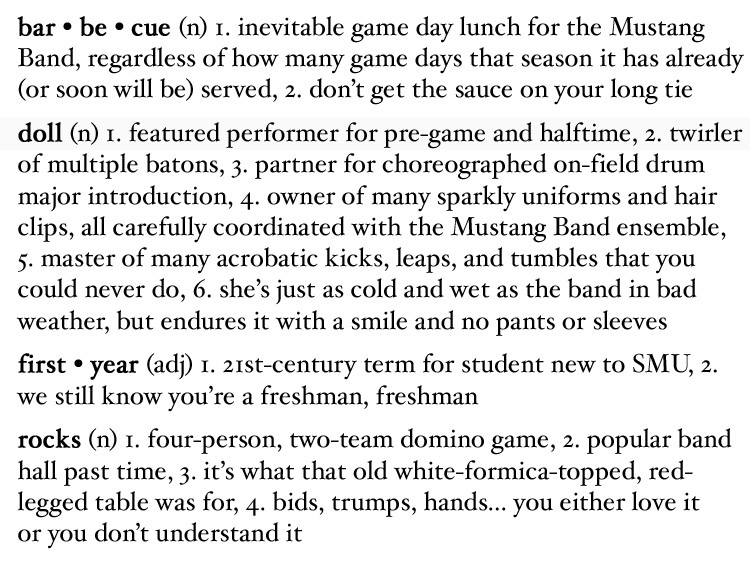
7. Monthly Lexicon
8. Nostalgic Photos

Read the Board!
Upcoming events!

Saturday, May 2
Diamond M Club meeting
Band hall
10:00am

Family picnic
SMU campus TBD
11:30am

Keep in touch
Comments? Questions? Article suggestions? Nostalgic photos?

Email us:
diamondMclub@gmail.com

Follow us on Twitter:
@DiamondMClub

Follow us on Instagram:
@DiamondMClub

Check out our YouTube channel:
@SMUdiamondmclub

Like our Facebook page


Share the Newsletter
Know someone who's a Mustang Band supporter but who may not be getting this e-mail?

Send this newsletter to them and let them know what they're missing!  Click the button below.


Board Members Wanted


April is the time of year when the Diamond M Club conducts it annual election.  We have five seats available for the 2015-16 board of directors. 

The Diamond M Club board meets once a month and provides year-round support to the Mustang Band through a variety of fundraising and community-building events (things like the Boulevard tailgates, the post-Pigskin Revue cocktail hour, the senior reception, the spring picnic).  

It's perhaps a thankless job in some ways, but it's without question a very rewarding job.  There is surely no better way to rekindle your own fond memories of SMU than by immersing yourself in the Mustang Band.

Board members serve a two-year term.  Those elected this April will serve until May 2017. 

You need not be a Mustang Band alum.  Anyone with an interest in helping the Mustang Band succeed can sit on the board.

If you are interested in running for these seats, e-mail us at diamondmclub@gmail.com.  We need to finalize ballots by Saturday, April 4.

Winners will be announced at the May 2 general meeting.


Spring Picnic and Meeting: May 2


Listen up, people.  The 2015 Diamond M Club spring meeting will again be hosted in conjunction with a family picnic.

You are invited!

Mark your calendars for Saturday, May 2.  The meeting will start at 10:00am in the new band hall.  We'll do the family picnic immediately preceding the meeting, probably starting at about 11:30am.  Lunch will be served, plus we'll have plenty of fun activities from dominoes and cornhole to bounce houses and face painting.  All ages are welcome.  More picnic details soon.

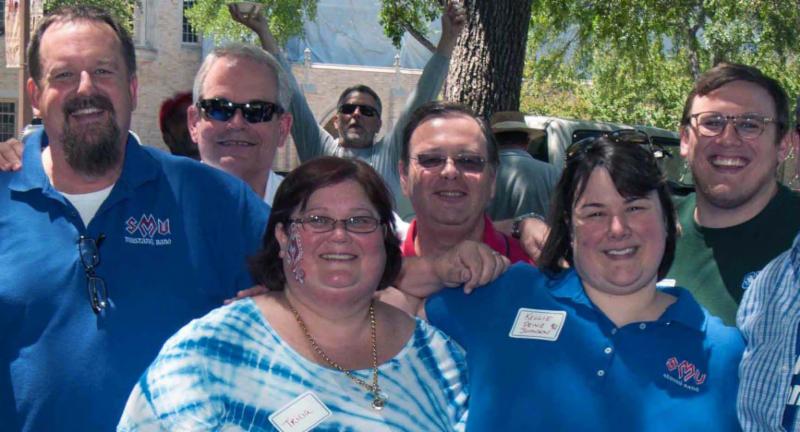
Look at that picture up above.  See how much fun everyone had last year?  Don't miss out.

Use our Facebook event page to let us know if you're planning on attending.
 

Mustang Band Photo Contest
  
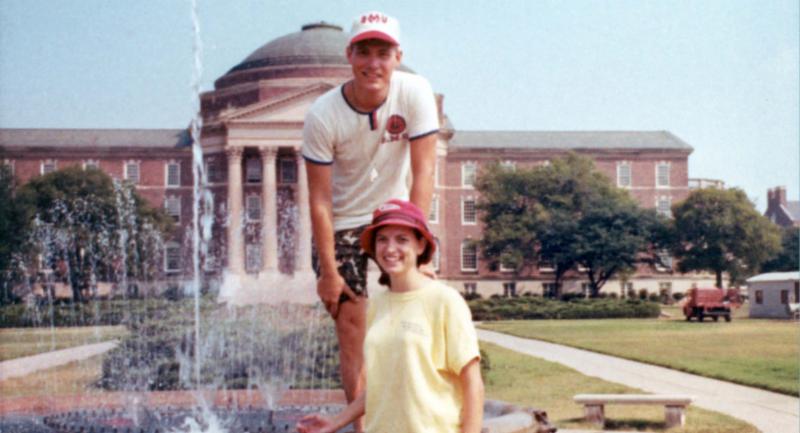
Fountain ceremony 1963

Cool photo, right?  The freshman orientation at the SMU fountain, circa 1963.  We love posting photos like this, and many of you love seeing them, but we're running out of new ones.  And our efforts to ask nicely for SMU alums to dig through old photo albums and shoeboxes haven't worked very well.

So we're going to try a new approach and appeal to everyone's sense of competition.

Thus, we are launching the 2015 Mustang Band photo contest.  

Entries are due by Saturday, May 30, 2015.

Any and all photos (from any decade) are welcome.  You can email them to diamondmclub@gmail.com or direct us to an online account (Facebook, Snapfish, etc) where we can grab them.  You're also welcome to mail us prints - we can scan a handful and return them.  We ask only that you write to us in advance to let us know your plans so we can work out the logistics.

Small prizes will be available in each of the following seven categories:

1. Most "spirited" (any year)
2. Most "esprit de corps" (any year)
3. Most "musical" (any year)
4. Best 1960s-70s photo
5. Best 1980s-90s photo
6. Best 2000s-2010s photo
7. Best contemporary band photo

You don't have to worry about submitting to a specific category - send us the photo and we'll slot you.  Though you are also welcome to let us know which one you want to enter.

There's really just one cardinal rule: we're looking for photos that we haven't seen before.  The intent here is to motivate all of you to help us find new images, not recycle the same ones again.

The decision of our panel of VIP judges (whose names we will announce soon) will be final.

If you have any questions, let us know.
 

Social Media Update
  
In addition the Diamond M Club's awesome Twitter feed, YouTube channel, and Instagram account, we've just launched our own Facebook page.  Please take a moment to bookmark (and like!) us.

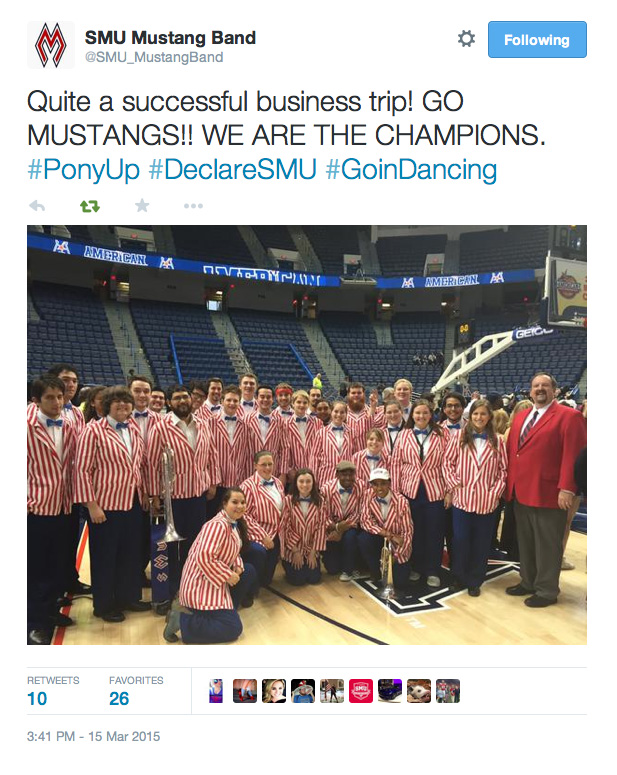
Please also note that the Mustang Band (who already has a pretty cool Twitter feed - see below) has now joined the Instagram family.

With all of these fancy digital platforms, there's no reason to not feel connected to us!


SMU Going to the Dance


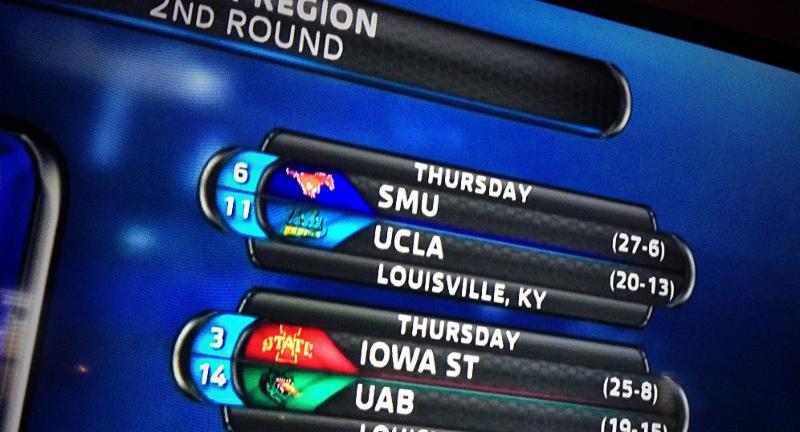
Yes, it's true.  After a drought of 20+ years (and a rather shameful snub last year), the SMU men's basketball team is going back to the NCAA tournament.  The team won the American title tournament on Sunday and will face UCLA Thursday afternoon as a 6 seed.

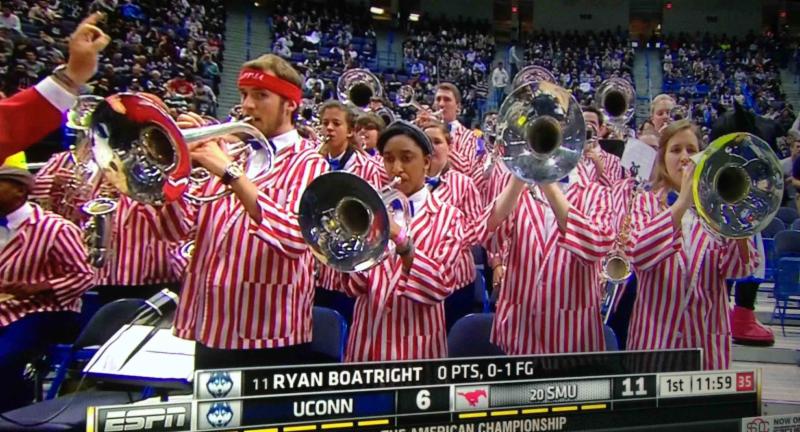
SMU's record made it a virtually NCAA lock going into the AAC tournament last week, but Sunday's win sealed the deal.  And, of course, the Mustang Band was there.  Viewers at home could hear a number of Mustang Band classics coming through loud and clear on the ESPN broadcast, from "Pony Battle Cry" to the "Blue Brothers Theme."

These are historic times for the Mustang Band.  In the last 40 years, SMU has gone to the NCAAs just four times (1993*, 1988, 1985, 1984).  Our informal research among alums and directors tells us that the Mustang Band attended none of those games.  Which means when the band blasts "Peruna" and heckles the UCLA opponents in Louisville this week, they will be the first to do so in an NCAA tournament setting.


BTHOOucla.


* If you want to hear a sad story of bitterness and regret, talk to someone who was in the band in 1993 and ask about the NCAA tournament. 


Twirler Retrospective


We did a retrospective of 50+ years of Mustang Band drum majors a few newsletters back, so it's only fitting to do a similar celebration of the Mustang Band twirler, sometimes known as "the doll." She always provides that essential visual flourish on the field, both in the razzle-dazzle of her uniform and the impressive skill juggling and tossing batons. The Rotunda tells us the band had majorettes and twirlers prior to the Dr. Irving Dreibrodt's arrival in 1958, but it seems like it was after his arrival that the position became was it is today. 

Until the 1970s, the twirler was the only girl in the Mustang Band, but that didn't make her an outsider.  From the very beginning, we're told that the doll was a part of the band, receiving a beanie and participating in the orientation process.


With the help of Facebook and some resourceful alums - especially drum major emeritus Randy West - we were able to track down several twirlers to ask them what it was like to perform on the 50-yard line with the band playing behind them.  A big "hubba" to them all for taking them time to answer our questions, share their insights, and pass along some great photos. 


Some of their responses had to be edited for space. Our apologies. (Bird-dog.) 


Sharon Humble, 1989.


What years did you twirl for the Mustang Band?

Camille Mayfield Cooper Brotze: Years as featured twirler: 1960-61 understudy/featured twirler: 1961-1963.

Sandy Smith: In late summer of 1964, Irving Dreibrodt, the iconic director of SMU's Mustang Band (96 Guys and a Doll), came to my hometown of San Antonio to recruit me to be the "doll" for his band.  He also offered me a partial scholarship, which he said was the first time he had given a twirling scholarship.  He had gotten my name from his friend Pat Arsers Sr. who was the band director for Alamo Heights and from Betty Arsers with whom I had had some early lessons. I had graduated from Robert E. Lee High, a rival school of Alamo Heights, so I was particularly appreciative of their recommendation.  At the time, there was a hard-fast rule that the twirler had to understudy for a year before becoming the featured performer.  This rule allowed the directors to see how the twirler fit in with a group of all guys - It was very important that the guys liked, respected, and got along with the doll.  Consequently, my freshman year, I was an understudy for Dottie Wilson who was in her last year.  I was with the band from fall of 1964-spring of 1968; I was the doll from 1965-1968. I did not have an understudy during my senior year.  In the spring of 1968, Mr. Dreibrodt (Coach) asked me to extend my tenure and offered me a graduate scholarship.  Unfortunately, I had already committed to other plans.  I often wish I had stayed on - I really missed my band "brothers."

Curby Conoley: 1969-70

Cordelia Kincaid Light: I was the doll with the Mustang Band 1970-71-72 (married 1973).

Elizabeth Fordham: 1979 - 1983 (freshman thru senior years)

Sharon Humble: Fall 1987 through Spring 1990.

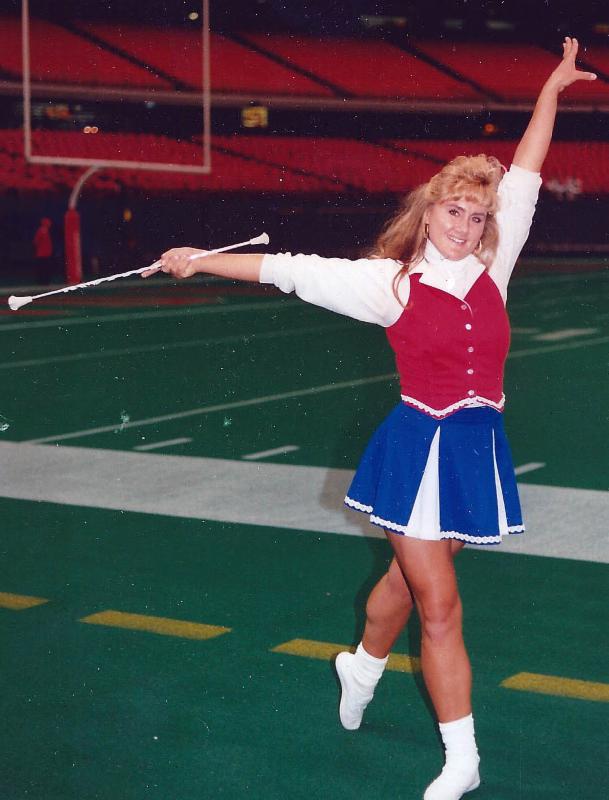
Kathy Vines: 1991-1995, featured twirler all 4 yrs.

Becky Hardin Maner: I was at SMU from 1995 to 1999.

Jenni Wright: 1996-2000, then I stayed on and continued to be a big sister and sponsor the twirlers who followed.  

Kelli Montgomery Park: From 2003-2007

Carly Bender: My first game to perform with the Mustang Band was at Rice on August 29, 2008, and my last game was the BBVA Compass Bowl Game on January 7, 2012. (2008-2012).

Megan McKinnon: 2014-Present. I started twirling for the Mustang Band last year.  I am really excited and looking forward to another year with the band. 


What's your hometown?

Brotze: Carlinville, Illinois

Smith: San Antonio, Texas.  I always liked hearing the introduction of the band, drum major and twirler over the stadium intercom - my first drum major, Pat Arsers Jr., the lead trumpet player, David Alley, and I were all from the same city - it made me proud for San Antonio.  And I liked the alliteration of "Miss Sandy Smith from San Antonio." 

Light: I am from Uvalde Texas, graduated from Uvalde High School 1970.

Fordham: Gonzales, Texas and Houston, Texas

Humble: San Antonio, Texas, but now I live in the Philadelphia area, near Valley Forge National Park.

Vines: Richardson, Texas - moved away to Houston for a year (and hosted a game after party after the SMU/UofH game for the band).  Moved back to Dallas and have lived in Richardson again the last 15 years with my husband. We have 2 boys, Blake and Tyler who are 11 and 9.

Maner: I grew up in a Wills Point, TX

Wright: I was born in Colorado, then grew up in San Antonio, Texas prior to attending SMU. 

Park: San Antonio, Texas

Bender: University Park, Texas

McKinnon: Round Rock, Texas


How long had you been twirling when you arrived at SMU?

Brotze: Began twirling at age 5, was the Mascot with the Carlinville High School Band.

Smith: I believe I started twirling the summer after eighth grade.  So, I had been twirling around four years.  Even though I came late to twirling, my dance and acrobatic background of eight years gave me a helpful foundation that allowed me to take naturally to the skill and art of twirling.  Plus, I practiced every school day from four o'clock until the sun went down, and on weekends, I practiced three to five hours a day.  I particularly enjoyed aerial work and combining acrobatics with traditional twirling.  I truly had found my passion in twirling.

Conoley: Picking up a baton during my early childhood in Taylor, Texas began a long-time love of twirling. Twirling was not an unusual skill back in the 50s and 60s. Girls did not have the opportunity to play sports and the twirlers at the local football games were so glamorous. By the time I was thirteen I was taking professional lessons and enjoying statewide competitions. Long hours of practice paid off when I became the "Doll."

Light: I competitively twirled for seven years prior to becoming SMU's doll.

Fordham: I had been "twirling" most of my life, although it was just something fun today until I got serious about it in middle school. 

Humble: Three years.  I was a quick study and a very hard worker.  I averaged about 3 hours a day of twirling practice in high school. I picked up twirling easily due to a strong athletic background in basketball, volleyball, and track and field (high jump, hurdles, and running) before I started twirling.

Vines: I started twirling at age 6 to help rehab from a surgery.  I began competing right away and competed on the national level until my junior year in college.  I twirled for my high school band, too, and once I got to SMU, twirling for the band was my first love.

Maner: I started twirling when I was six, so it had been 12 years by the time I arrived at SMU.

Park: I had been around it my entire life because my mom had a twirling studio but I did not start competing until I was 8 years old. So I had been twirling for almost 11 years when I arrived at SMU.

Bender: 11 years.

McKinnon: I started twirling in the 4th grade (age 9), so I have been twirling for 15 years.


Sandy Smith.


How were you selected for the Mustang Band?  Were you recruited or did you try out?

Light: It was a privilege to have received a letter from Dr. Irving Dreibrodt asking me to try out the spring of 1970.  I had already committed to going to SMU so my dad encouraged me to try out.  I did it for him!  He had always been my biggest fan, and he mine.  So I didn't want to disappoint him.  I contacted Margaret Mann, my twirling instructor, and she and I worked out a suitable routine which I performed one rainy Saturday in April at Ownby Stadium.  I was judged by Dr. Dreibrodt and Betty Arsers.  Then, I was to perform for the Red and Blue spring game at Ownby Stadium that afternoon.  It was rained out!  Each year I tried out for the position of feature performer.  I just thought I was going to SMU to be a college girl, footloose and fancy free, instead I went to SMU with my batons in hand ready to perform with the Best Dressed Band In the Land, and had a blast.  A wonderful experience that I am so fortunate to have had.  An experience of a lifetime that I am forever grateful.  

Fordham: Tryouts.

Humble: Short answer:  I had to try out.  The long answer is a more interesting story.  I believe I have had to try out more times than anyone else ever has to be in the Mustang Band.  I tried out for twirler in Spring 1986, my senior year in high school.  I wasn't chosen that year; Tammy Taylor was chosen to be the doll for 1986-87.  I started at SMU as a freshman in Fall 1986.  However, I wasn't in the band because I thought I wasn't good enough playing French horn, my instrument from middle school through high school, to march with the band.  At that time, I didn't realize how inviting the band actually was to musicians who wanted to be in it.  I kept up with my twirling, because I planned to try out again the next year.  At that time, a twirler had to win the position two times in a row in order to keep the position without having to try out again.  I stayed in shape by running, weight-training in Dedman Center, and taking ice skating as a P.E. class at SMU.  The guys who worked at Dedman Center were really good about giving me half a basketball court to practice in or opening up the gymnastics room for me, since it was fully mirrored and had mats for practicing my aerial tricks.  After SMU lost football to the NCAA Death Penalty, I heard from one of my best friends from high school, Todd Shingler, who was in the Mustang Band, that Tammy planned to leave SMU since there wouldn't be football games to twirl at.  However, she didn't tell the band directors she wasn't returning.  With all the confusion created by the Death Penalty about how the band would continue into the 1987-88 season, no Spring try-outs were held for twirler in 1987.  I continued practicing over the summer with my twirling coach and checking periodically with Bob Brandenberger about try-outs.  In August 1987, Bob confirmed to me that Tammy wasn't returning to SMU and said I could try-out when the band returned to campus for the Fall.  I tried out, and was selected as the twirler for the 1987-88 season.  I tried out again in Spring 1988--my third time to audition to be in the band.  The band voted for me, but the directors and the former twirler brought back for judging try-outs voted for someone else, "Beth," whose last name I don't remember.  That loss was heart-breaking.  When Bob asked me how I thought the results turned out, I told him they made a mistake--they chose the wrong girl.  I had so many great friends in the band now, having spent an entire year with the band, earning my beanie, learning all the traditions, going on the "Bridging the Gap" road tours with the band, working on the stage crew for Pigskin Revue, and being roommates with fellow bandmember, Christine Woodward, I could not imagine having to go back to not being in the band at all.  Thus, I asked Bob if I could stay in the band and march playing French horn.  I think Bob was surprised, but he agreed to it.  I borrowed a French horn from my high school over the summer to practice and be ready for Fall marching season.  When I returned to SMU in August 1988 for band camp, two fellow bandsmen, Larry Lawyer and David Pearson, drove up while I was unloading my car to move back into the dorms and said Bob Brandenberger wanted to speak to me as soon as possible.  My heart sunk - I thought Bob was going to tell me he changed his mind and that I couldn't march with the band that year after all.  I went to the band hall to see Bob.  He told me that the twirler they had selected,"Beth," wasn't going to be coming to SMU for about three weeks after school started because she wanted to go on a twirling exhibition to Peru.  She wanted the band to hold the twirling spot for her.  Bob declined to do so--I think he realized SMU wasn't her priority.  He offered me the twirler position again for the 1988-89 season.  I told him I wanted the position, but only if I didn't have to try out for it again for the 1989-90 season.  I wanted the band to honor my two years in a row of service as the twirler just like it did with other past twirlers and drum majors and not require me to try out again for the position. Bob agreed that was only fair, and he kept his word. 

Vines: Yes, I tried out at Moody on a Saturday morning in the spring of 1991.  First, I had a sit down interview with Bob and Lou in Bob's office.  Then we headed over to Moody.  Many of the band members were there and voted on the performances.  I remember three of us tried out that day.  Eric (Edwards, the drum major) and Bob-O did most of the talking and introductions.  We customized and performed two different numbers to try out.  Once we were finished and Bob announced the winner, he asked me for a verbal commitment for the fall and then invited the band to come down out of the stands and meet me.  It was awesome!!  I didn't know it at the time but half the crowd probably was hung over from the night before as it was 9am on a Saturday.  I think there would have been two if (the prior year's twirler) stayed but that's a guess.  We did not hold tryouts after I arrived until I was graduating.  I do know girls who wanted to try out but we didn't hold them, lucky for me.  I always felt 100% support.

Maner: My freshman year was the year after Kathy (Vines) graduated.  Kathy and I took lessons from the same teacher.  She was the one that encouraged me to tryout at SMU.

Wright: I was actually accepted to go to the University of Arizona to twirl when I was a junior in high school.  Due to my brother's illness my senior year of high school, I decided to stay closer to home.  In that situation I choose to try out at several universities in Texas my senior year and was chosen to twirl for SMU. 

Park: I started to look at schools my freshmen year of high school and when I walked on to the SMU campus I fell in love. Then we started to take to the band director, David Kehler at the time, and in order for me to be able to attend SMU I needed a scholarship. So that's when Kehler started to talk to President Turner saying they needed to offer a bigger scholarship for twirling to get a better caliber of twirlers to try out.  So my senior year of high school SMU did not have a twirler (2002-2003). That is when president  Turner put the twirling scholarship in place for a half ride. 

Bender: I was 8 years old when I started twirling at a few SMU basketball game halftime shows. The announcer introduced me, "Please welcome to the floor the daughter of 1981 alumni Carolyn and Gary Bender and future Mustang twirler, Carly Bender."  In high school I became the first twirler at Highland Park so I was able to participate in the SMU Homecoming parades.  In a way I was always encouraged to twirl for SMU by my parents, high school band directors, and SMU alumni. I officially tried out and was selected in the Spring of 2008.   

McKinnon: I tried out to be the feature twirler for the Mustang Band in February 2014. 


What got you started in such an unusual skill?

Brotze: Student of ballet and loved watching Purdue University's  "Golden Girl" twirl  at football games.

Smith: My mom was discussing with my older sister Wanda and me what activities to take up in high school.  Mom wanted us to learn to play an instrument and to read music, and Wanda and I had always enjoyed watching the twirlers at the halftimes of football games.  So, we decided to join the band and become twirlers.  That summer there was a twirling camp at Trinity University in San Antonio, so we signed up for it.  At the end of the camp, there was a contest that included three portions: talent, strutting, and twirling.  Despite being new to the field, I fortunately won the Junior Miss Skyline Majorette award, which served to further motivate and inspire me to pursue my new-found passion.  We learned a lot at the camp and met several local teachers, including the aforementioned Betty Arsers with whom we took our first private lessons

Light: I started taking twirling lessons in Uvalde when I was about 11 years old.  I competitively twirled in state and national competitions.  Margaret Mann, came to Uvalde and formed the twirling group "The Uvalde Honeybees," which I was a part of.  We were recognized as national champions and performed in New York on The Ted Mack Amateur Hour.  Also, we were performers for the San Antonio professional football team, the Toros.  

Fordham: My mom was a twirler and drum major of the band when she was in high school, and she taught me the basics when I was young. I took lessons on and off through elementary school and became a competitive twirler In middle school.

Humble: My mother started me in twirling lessons when I was five years old, but I stopped taking lessons while still young when I had to have surgery on my left arm.  I resumed twirling lessons again at age 15, my sophomore year of high school, when I and a friend decided to work with two other girls in the band to form a twirling line for the following year.  I had an excellent twirling coach, Pat Montgomery, who I trained with twice a week besides practicing on my own.  I also had the good fortune that my school's featured twirler, who was a senior and a powerhouse twirling athlete who also took lessons from Pat Montgomery, took me under her wing and spent time working with and mentoring me.  By the time the next year rolled around, none of the other three girls were selected for twirler and I was the only one--the featured twirler.  

Maner: I wanted to sign up for tap and ballet, but they didn't have a class for six year olds so I ended up in twirling instead.

Wright: I was a gymnast first.  During grade school a classmate was sharing what she had done over the weekend.  A twirling contest.  I found myself asking more questions, then running home and asking (begging) my mom to let me twirl! From the age of 7 through college I continued to practice and gain new skills to compete at state, regionals, and nationals.  Though performing on the field is what I enjoyed the most, because you could have a lot more fun and not be so serious!

Park: My mom did it when she was in school and was a high school and college majorette and opened a twirling studio and I was brought up around it. I would play around with baton when I was a little one but did not take it serious. I was into gymnastics at the time.  But around the age of 7 I told my mom I wanted to start twirling. She waited for me to say I wanted to do it, she never wanted to pressure me so she knew when I felt ready to twirl I would tell her I wanted to start taking lessons. 

Bender: Because both my parents were SMU alumni, I started attending SMU football games when I was about 7. I remember watching the feature twirler on the field and telling my mother that I wanted to be her when I grew up. One game my mother and I went to the Mustang Band section after halftime and asked the twirler who we could contact to get involved with lessons, and after 11 years of lessons, competitions, and plenty of practice I was able to eventually accomplish my goal and became SMU feature twirler. 

McKinnon:  My mom was the feature twirler for the University of Texas in the 1970's, so she helped me to get started!


What was the biggest challenge being the twirler? 

Brotze: Finding a place to change my outfits in an all-male facility.

Smith: It is hard to think of my time as the doll as a challenge - it was such a humbling honor and fairy-tale thrill to be the only twirler for such a unique and talented band.  I suppose the hardest adjustment was not having as much practice time as I had been accustomed to in high school.  As an avid student, I had to learn to budget my time between twirling and studying. Luckily, I did find a good balance.   The responsibility of creating new weekly routines could have been a challenge but, on the contrary, was easy and fun due to our band's upbeat, brassy jazz sound.  It was hard to stay still when the guys played - my head got moving with ideas while my feet tapped the beat.

One aspect of our halftime performances did give me butterflies:  the opening fanfare.  No one except the drum major and I were moving during the "Big D Fanfare."  It was my first high aerial of the show, and I knew all eyes were on the baton as it soared above the stadium lights.  I always felt better after I caught that one - it allowed me to continue the program with much more ease and unfettered joy.

Conoley: The biggest challenge for me being a twirler was learning how to budget my time between band, school work, and social life. There was also no real area on campus that I could go to practice privately. 

Light: The only challenge that I had while being the twirler, was working my classes around 1:00 practice.  I was the official roll taker, so I knew all the guys by name.  I really got to know them.  They were so nice, funny, and joked with me.  Each made me feel special and treated me with kid gloves.  They were very protective of me and polite.  They were gentleman and I loved them all.  Then, I would head across Central Express way, have lunch at the Hilton, then go to Neimans.  Pretty much fun!  Studies, social, all fell into place, I pledged Theta that spring.

Fordham: Not taking it personally when the band sang "Thunder Thighs." 

Humble:  Besides having to try out for the position so many times? Twirling in a skirt!  While visually striking as a historic and traditional look of the Mustang Band doll, the skirt was physically limiting in terms of tricks that could be executed out on the field.  The skirt created a lot of drag and slowed me down in spins, plus we were on Astroturf, so I could never do more than a two-spin on the field.  The skirt also interfered with certain under-leg catches, with my batons getting snagged by the fabric, so I had to eliminate some tricks from my performances.

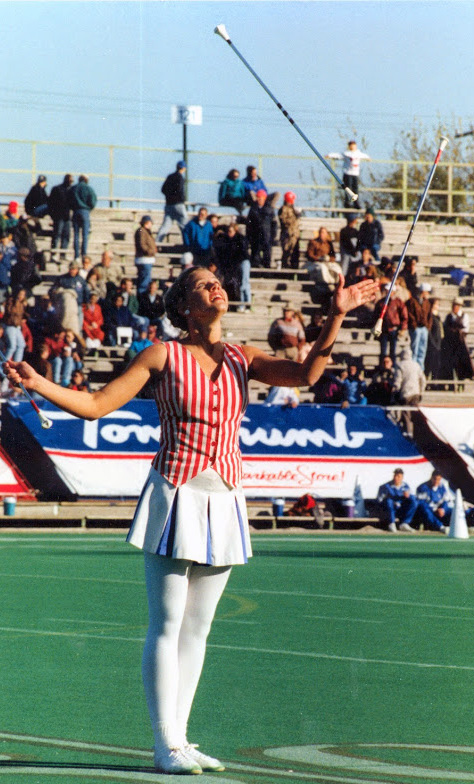
Vines: Initially, I thought I might be a bit different because I didn't have an instrument group to team with daily, as I was getting to know new friends, but with our process of initiation and earning our beanies, I felt integrated immediately and felt right at home.  I was an only child, and found dozens of new friends in my new band home so the challenge of going "away" to school was never a real concern either.  Perhaps the greatest challenge was a wearing a short pleated skirt during a COLD game (see the photo in our Nostalgic Photos section below).  My nerves the first half of the game always made me feel even cooler, but there were only  a couple of times that even with adrenaline running - that I felt cold during a performance.

Maner: The hardest part for me was overcoming my shyness in order to be a part of the band and perform at halftime.

Wright: Twirling in the cold!  Man your fingers can really get hurt when they are ice cold and the baton lands in them!

Park: Given that twirling is such a unique sport, a big challenge was always have gym space to practice. Not a lot of people would understand that the time and dedication it took to twirl at the level I was at or even the scholarship opportunities that were given to me for twirling.

Bender: While pursing a honors business degree with a minor in mathematics, I was involved in many other SMU organizations and extra curriculars, therefore time management and prioritizing were my greatest challenges. One time I had a mock trial competition in St. Louis, Missouri on the same day as a SMU football game. I left the competition early, but was able to finish my cross-examination portion. I then got on a plane and flew to Dallas, and arrived just in time for the 2nd quarter of the game.

McKinnon: As a second year law student, my biggest challenge is balancing the time commitments for both school and twirling.


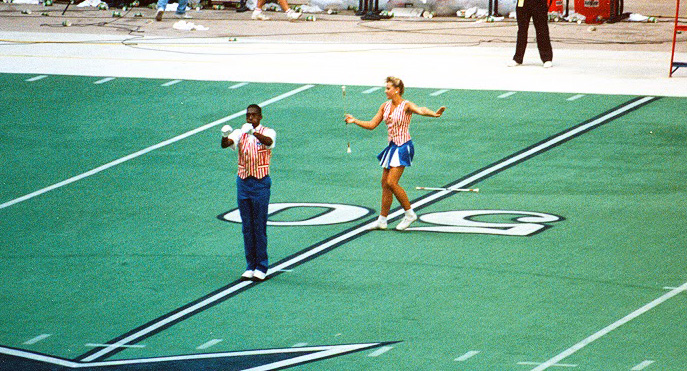
Kathy Vines with Eric Edwards at Texas Stadium.


What was the best part about being the twirler?

Brotze: All the band members (all Guys) being like BIG Brothers.

Smith: That's easy - the camaraderie of my 96+ Guys and being such an integral part of the "Hub of SMU Spirit!"  Our band truly was the hub of campus spirit, and I felt so proud to be a part of it.  Even though SMU was then a big Greek school, I never was part of a sorority.  Yet I never felt that I had missed out, because I had my own band fraternity - the best "club" on campus!  We were such a tight group - like family.  While I have not been able to stay in touch with every band member, I know that should I meet any one of them now, there would be that same bond between us.  Our own freshman class bonded over initiation activities like "meeting" Peruna and wearing beanies.  We wore those little caps with pride, and I became close with my fellow class members.  I remember especially Wayne (Buddy) Mitchell and John Lennox with whom I ate dinner every night of our first year and shared in raucous laughter as we shut the cafeteria down.  John has since passed away, and I miss him. He was so funny and talented.  Buddy and I have remained close friends over all these years.  In fact, he is the source of the photographs I submitted for this article.  As an attorney and a feminist, I know it is more politically correct and fair to have women in the band.  But I must say that there was something very special about being part of this group of guys that functioned as a sports team while playing jazz music with such talent and flair.  I feel very, very lucky to have been their doll.  

Having an understudy was also great, because Lynda Gilmore (Daniel) became one of my two best friends.  I met Lynda our freshman year, because she, too, was an understudy and a competitor for the twirling position.  To her credit, after I became the twirler, she became my biggest supporter and stayed with the band for most of her years at SMU.  Having her in the stands was like having a sister who had my best interest at heart.  I am happy to say that she and I remain the closest of lifelong friends.

Of course, one of the best parts of being the twirler was that I got to continue pursuing my passion.  I loved twirling and to continue it with such an elite college band was a dream come true.   I never take that for granted.  It changed my life's direction in so many ways and afforded me a rich, rewarding education.  Coming of age in the time of civil rights and the Vietnam War gave me a global sense of life's interconnections, and the students and faculty at SMU were engaged and compassionate in these movements.

During my time as the doll, we had a fantastic football team (the Jerry Levias years) that got us to the Cotton Bowl game my junior year.  It was my first time to twirl on national television, which was rare back then and quite the big deal - they even still showed the half-time back then!  My family and friends back home were excited to watch for me during our halftime performance - needless to say, I was more nervous than usual that day!  The next year, my senior year and Randy's first year as drum major, we were again on national television in the opening game with Texas A&M.  Rain was predicted, so the Dallas Morning News came to campus and took photos of Randy and me under an umbrella.  One of the pictures was on the front page of the newspaper the next day.  Interestingly, neither Randy nor I remember if it actually rained or not.  I do recall that every time we played A&M (which was still an all-male school then) all the guys in the band encircled me as soon as I stepped off the bus.  No Aggie was going to bother their doll.  I felt like I had 96 brothers looking out for me.

Mr. D did a smart thing - he had me do roll call as an understudy and as the doll.  By meandering through the different instrument sections, I got to know every single guy in the band in a short time.  It was always a pleasure and made me feel part of their world.  I felt I had a connection to each guy, and it greatly enriched my band experience.   

In life, it is our connections and friendships that are the richest part of our experiences.  So, when I look back on my SMU days, it is my friends and my "guys" I remember most.  They remain dear to me and live in my heart's memory with respect and deep affection.  I send out hugs and heartfelt appreciation to each and all of them.  Hubba, Hubba!

Light: The very best part of being the doll was meeting so many nice people, especially Dr. Dreibrodt, Randy West, Cathy Fair, and Jack Rohr.  The opportunities I had as the doll opened so many doors.  I am still introduced, to this day, by some people as "the doll with 96 guys from SMU."  Now that is amazing!  The recognition I received is so humbling. 

Fordham: The obvious answer is that I loved to twirl, particularly two and three batons, and performing was fun.  Looking back, the best part is the great friends I made along the way. 

Humble: The best part about being the twirler was making all the life-long friends I met in the Mustang Band, but I realize everyone else who was in the band also had that same opportunity for strong friendships.  I loved showing off all the high-toss tricks and stunts I could do, which I knew very few other people could do.  I also got a big kick out of how Bill Melton, the voice of the Mustang Band, always introduced me over the loudspeakers as "the lovely Miss Sharon Humble" as the band was leaving the field after half-time shows.

Vines: Easy - the friends!  I was very involved in campus activities in addition to the band, but my first/primary affiliation and the reason I even attended SMU was to twirl and be a part of the Mustang Band.  It was too bad we didn't have a band dorm or campus house.  The Mustang Band was all I hoped and dreamed it would be - to influence me during college and after - and I loved the team spirit, even the early and late practices.  It was hard not to smile sometimes even when Bob-O wasn't pleased with our practice on a particular day.  I was so damn glad to be there.  And when the crowds cheered for us during half-time - who isn't motivated by that?!

Wright: Being able to be unique and having fun doing what I have done all my life.  Twirling was the one thing that kept me grounded throughout my life.  I still use the lessons from my twirling career to my adult life.  Thanks to my coach, Margaret Mann, for giving me the opportunities to grow and become a better person!

Park: I loved competing and traveling around the world. I went to France and competed in the world championship and received the bronze medal in two baton.  But the best part was twirling in college and representing my university on the fields and at competitions. Twirling in college is the final payoff for all the hard work you put into the sport. And to become a feature twirler at a university is just icing on the cake.

Bender: The best part of being the twirler was that I was able to travel with the band to many of the away games and participate in other events. We went to New Orleans and Florida, and even performed at a Dallas Cowboys halftime show. In addition it was very exciting to participate at the SMU Centennial Celebration. 

McKinnon: My favorite part about being the twirler is the feeling that comes with performing on the field and the environment on game days. I love interacting with the fans, and I love being able to work with the band to put on fantastic halftime shows.


Where did your uniform come from?

Brotze: All my outfits were made by SMU and I co-ordinated pre-game  and halftime  with the theme of the game day.  Always to be the Best Dressed Band in the Land.

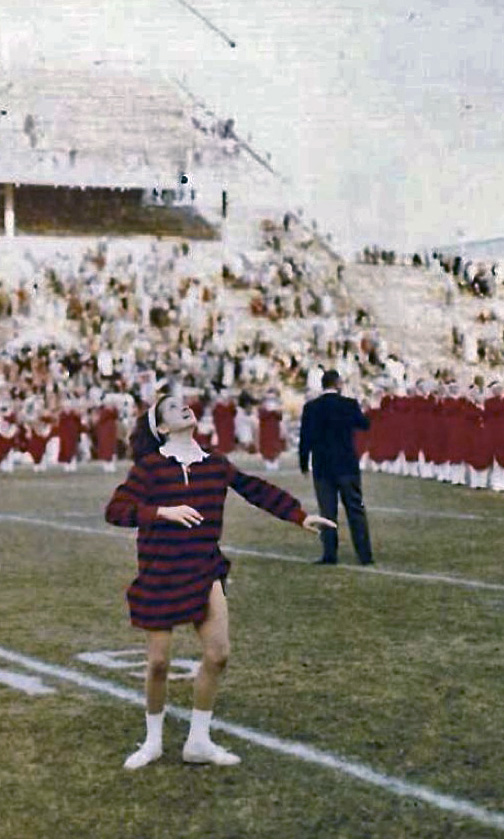
Smith: When Coach (Mr. Dreibrodt) recruited me, he said he wanted the doll to be the girl next door: wholesome, innocent, and approachable.  He said there would be no glittering, sequined, tight-fitting costumes.  Nor would I be in a military uniform.  My outfits matched exactly those of the bandsmen - except I wore a short skirt instead of trousers.  I even had a nightshirt!  Coach designed them and had a local seamstress make all my outfits. However, the ponytail of my first two years was mine already.

Conoley: My uniforms were handmade by a seamstress in Taylor. Another very memorable tradition is the command to a freshman at any given moment to "Bird Dog." Miniskirts were in fashion then. I can remember walking from class in my miniskirt and hearing the loud command from behind "Bird Dog, Freshman!"

Light: My uniforms were designed by Vera Barnhart exactly to match the guys' uniforms.  She got the same fabric from Dr. Dreibrodt and she made my uniforms to fit perfectly and designed to complement the "best dressed band in the land"... and they were!  Then Bobby Roloff personalized my garment bag that I carried to the Cotton Bowl for games by painting my name "SMU's Doll," that was so very special.  I still have it hanging in my closet with all my different uniforms, I didn't simply have a vest, blouse, and skirt.  My uniforms were designed so that the pregame uniform transitioned very easily into half time uniform.  My skirts easily zipped onto the different vests that Randy required that we wear that week.  I had candy-striped, red and blue exactly like the guys with a Diamond M sewn over the heart.  

Fordham: My uniform was made to follow the traditional skirt/vest style that had been in place before I arrived at SMU. I grew 4 inches between my junior and senior year in college, so I had to have a second set made. 

Humble: My costumes were made by the mother of fellow bandsman Jeff Blackburn.  Back in the 80s, the SMU twirler had to wear the traditional costume of a short skirt with a vest, even though in high school and in competition all twirlers wore the sparkly one-piece costumes that the SMU twirlers have gotten to wear for about the last 13 years.  Since I was selected for twirler in August 1987, I didn't have much time to have the skirt and vest costumes made--only two weeks before the first performance.  Bob Brandenberger introduced me to Jeff Blackburn, who was from Grand Prairie and whose mother was a seamstress.  Jeff took me out to his home--maybe on my third day in the band--and I had dinner with his family.  After dinner, his mom and I collaborated on style and design, she took my measurements, told me what kind of fabric she would use, and told me where to order my bloomers for under the skirt.  Jeff drove me back to campus that night, and in about a week, his mother had three vests and three skirts for the costumes made.  I still had to buy the sequin trim and I sewed it onto all the costumes by hand in my dorm room.  My head still spins to think about how fast it all came together.

Vines: Colleen Morales was the twirler for (I think) 1 year before me and we had competed with each other for years.  She gave me three uniforms which I wore all four years.  My mom remade one uniform for me senior year as I wanted a bold blue skirt.  My favorite one was the candystriped vest with a blue skirt.  I would try to coordinate with the band uniforms each week.

Maner: My uniforms were made by a lady in Mesquite. She had converted a room in our house into a sewing room and made costume for several twirlers in the area as well as dresses for Miss Texas.

Wright: My Mom!!  Thanks to her, I always well dressed.  My first two years, we only wore the traditional SMU doll vest and skirt.  I will be the first to admit that it wasn't the easiest thing to twirl in.  My junior and senior year, for the pregame show I wore the traditional SMU doll vest ad skirt, but for half-time out came my "traditional" twirler costumes.  It was very interesting being the one who was able to wear the first twirling costume for SMU!  After that, all the dolls went for the "traditional" twirler costumes, never to see the SMU doll vest and skirt again.

Park: We had a very talented seamstress in Austin, Texas who would make all of my costumes and my mom and twirling coach would come up with all of the designs. Also a part of my scholarship would go to the new costumes we had made. I loved the SMU tradition for the band, there was a pre-game uniform and a halftime uniform. So if the band was changing, I had to change costumes too. By the time I left SMU I had a total of ten twirling costumes.

Bender: I had 13 uniforms for SMU that my mom and I designed. 

McKinnon: I have a uniform seamstress in California who has helped with my costumes. My main costume is just like one that I had in the past, but with SMU colors.


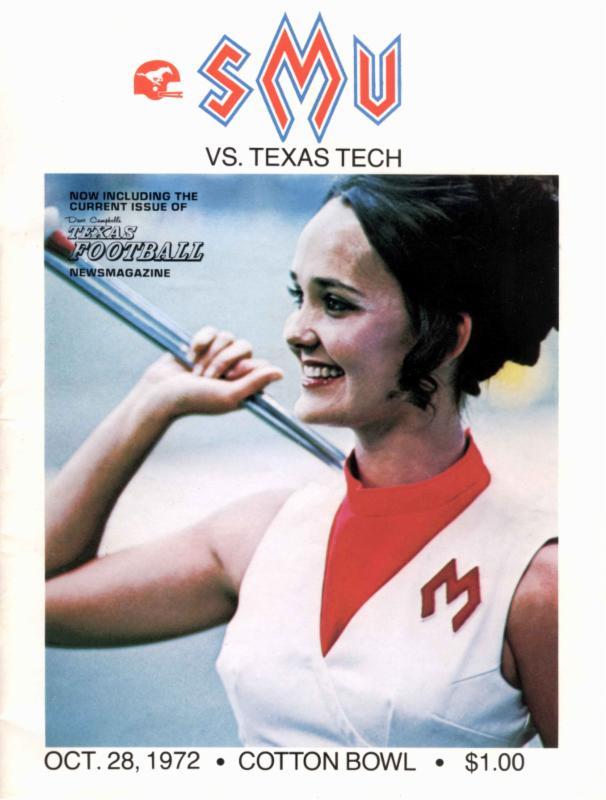
Delia Light on the cover of a football program - we're told it may be the only time the twirler was so honored.


What was your relationship like with the drum major?

Brotze: My years as featured twirler were shared with Drum Major Stan Mayfield and I was Camille  Mayfield Cooper (no relation) but we did have a very close relationship and did do some routines together.

Smith: I worked with two drum majors while I was the doll.  My first one was Pat Arsers, Jr.   It was his parents who had given my name to Mr. Dreibrodt, and I always had a special bond with him.  He was older, but accepted me right away as a peer.  Because of our mutual respect, we worked very harmoniously together, and there was sincere warmth between us and a steadfast support of one another.  I felt lucky to have such a kind, easy going drum major with whom to collaborate.

My second drum major, Randy West, was a sophomore when he took over from Pat during my senior year.  Randy had been responsible for planning shows for his high school band, so once he became drum major, Mr. Dreibrodt turned a lot of the planning and teaching of the formations over to Randy.  From 1967-1972, Randy was both drum major and assistant director.  He was young but very capable and creative.  Like Pat, Randy was easy to work with.  He looked out for me as well as for the guys in the band.  He was very generous of spirit and liked to showcase the talents of the doll and the soloists.  Despite having only one year together as a team, we became great friends. Unfortunately, in my moving around the states to teach or go to law school, we lost contact.  In fact, when he was planning the Old Guys Rule (OGR) reunion, he looked all over for me - and I had been under his nose in Dallas all that time.  I really regret missing the OGR reunion and look forward to the next one to catch up with my guys and to meet the other twirlers and dolls.  Randy again was assistant director from 1975-1977.  His commitment to the all the guys and to the band continues, and our own friendship picked up right where we left off.  We see each other frequently now and still have our signature long, candid conversations.  The bond of trust and friendship we shared as college students at SMU is still as strong as ever.

Pat and Randy had different personalities and styles, but they both were wonderful to me.  I always felt supported by their good will and friendship.  Having a drum major on my side made the job of being the doll easier and all the more fun.  Thank you, Pat and Randy - I really appreciate you both.

Light: Randy.  He was the best!  He was the most organized and knew exactly what he wanted.  He worked hard to make the Mustang Band so amazing.  A born leader!  I thought of him as my boss.  He was so kind and respectful all the time.  The ultimate gentleman.  Love him!!!  

Fordham:  We had a great drum major during the four years I was the doll.  He did his thing and I did mine. 

Humble: Excellent.  I had two drum majors, who I considered my "squad leader" each year: Chris Dyer in 1987-88 and Larry Lawyer in 1988-89 and 1989-90.  Chris taught me a lot about how the band's show's were organized, where I needed to be, etc.  I had a great deal of respect for him.  Larry and I had a very good friendship.  We were in the same class at SMU, so I ultimately knew him better and longer than I did Chris.  They are both really great guys.

Vines:  Always fantastic.  Eric was a great big brother to me and really helped me understand the style we were looking for during the pre-game "dance" with the drum major.  That continued with Nate Duermeyer - we had so much fun with our "dance."  We practiced and practiced and would end up laughing at some point every week during our performance.  I always followed our drum majors conducting to ensure my routines and movements aligned with the sounds of the band to try to enhance the performance.  I had great respect for our drum majors and was blessed with our strong friendships too.

Maner: There was a different drum major each year I was there but I got along with all of them.

Wright: We were always having fun!  Freshman year was Shawn Storer - how to describe Shawn??  Wild and crazy!  Brent Johnson was the drum major my sophomore year.  Becky and I had fun performing duet stunts around Brent.  But I'm not sure he always enjoyed the baton exchanges over his head!  My junior and senior year was Bob Sine.  Bob and I knew each other from high school so we already had a good relationship to build upon.  We enjoyed coming up with stunts to dthough I am not as much as a dare devil as Kayli Mickey! 

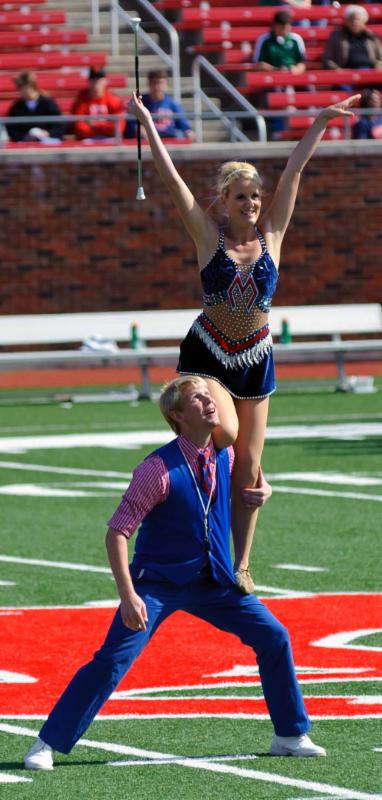
Park: We were very close. We started a new little tradition which is still going on today. He would lift my up at the beginning of pregame and we would do a little dip then continue into the show. It was always fun to be creative and see what we could come up with.

Bender: I loved all my drum majors, and think I was incredibly lucky to have great friendships with each of them. My freshman year it was Bryan Melton, who was a sweet southern gentleman. Then I got to work with the first female drum major, Amanda Weise. And finally there was Nick Morris, who I still keep up with today. He has been like a brother to me. I had so much fun performing with him because he had so much enthusiasm and love for the band! 

McKinnon: Nick Morris was the drum major last year. I had a great relationship with Nick! He was very helpful and encouraging, and he definitely made my first year so much easier. 


What was the hardest "trick" in your repertoire?

Brotze: The ground bounce and one rotation catch of baton.

Smith: I did a lot of high aerial work and acrobatic twirling.  Both required exquisite timing, so that the baton came down at exactly the right time and in exactly the right place.  Just learning to get the baton to go to the heights I wanted without veering off took a lot of practice.  Of course, wind was not a friend.  In windy weather, I had to adapt the release point to insure the baton went straight up.  Another "trick" involved throwing the baton up and forward perfectly, so that I could do a front walkover and have the baton come down just as I came up to catch it.  Again, that move is hard, because of the timing and placement of the baton's descent.  Too high, and I would have to wait for it to come down; too low, and it would hit me in the face.  I had another move that required me to toss the baton either vertically or horizontally in the air, and when it came down, to kick it up again with my foot high into the air before catching it.  I sometimes twirled fire, flag, or two batons, but mostly I stuck to my two staples of aerial work and acrobatic sequences.

Conoley: My favorite trick was a tour jete and aerial lift with the baton.  Turn and catch the baton. 

Light: I had already done difficult tricks at competitions, I viewed the Mustang Band as a jazz band with a lot of style and pizazz!  My job was to complement the band and its style of music with routines that I choreographed to the Mustang Band style.  Of course, I did high tosses and regular twirling but with much more dancing.  I was a dance major and performer.

Fordham: Juggling three batons was my "thing."

Humble: Juggling three batons at the same time.  

Vines: Either tossing the baton and doing a front walkover and a spin before catching it OR doing back neck rolls (baton spinning on the back of my neck) with two other batons spinning in my hands at the same time I was walking and standing, then kneeling on both knees, and then standing back up again.  It's a smooth trick but everyone always tries to figure it out.  Jugging three was always my favorite.

Maner: I don't know if it was the hardest, but I always enjoyed using three batons.

Wright: Double illusion under two batons.

Park: I would have to say it was either the high toss front walkover or juggling three batons.  I would always play around at practice and try four batons but I never had to guts to do it at a game.  I would worry about the wind or the lights.

Bender: I had a four-baton skill that I always loved. In fact, it was Kayli Mickey (My SMU duet partner) who taught me how to perform it.  The first baton is a high toss, then then-baton pendulums, one-spin, catch in reverse-illusion. 

McKinnon: I think my hardest trick is the "toss backflip." I throw the baton in the air, do a backflip, and catch the baton when it comes down. This trick can be challenging, especially on windy days, but I enjoy doing it because it is fun, and I think it makes me unique as a twirler.


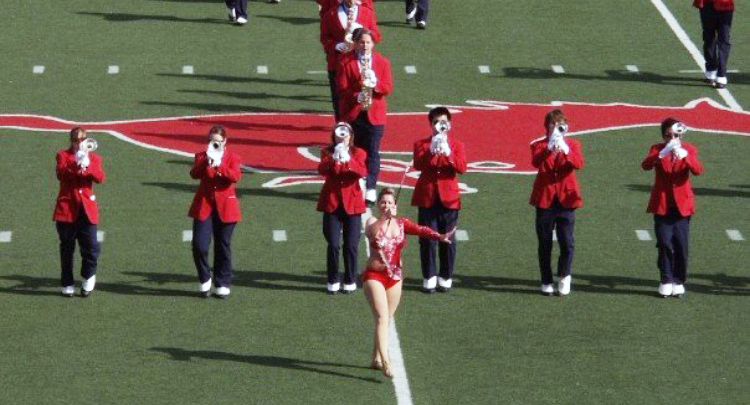
Kelli Montgomery Park on the field.


What was your favorite Mustang Band tradition?

Brotze: Formation of the Diamond M.

Smith: I liked all our traditions, but I remember most fondly the freshman initiation rites - they were valuable in cementing our sense of belonging to our freshman class and to the band as a whole.  I loved going to the ranch to "meet" Peruna.  As freshmen, we also had to wear beanies, which was really a badge of honor.  We were very proud to be part of the Mustang Band!  Even though the female understudies didn't have to endure everything the guys did, Lynda and I eagerly helped our freshman brothers play mild pranks on the upper classmen in charge of our "hazing."  I believe we got dunked in the Dallas Hall fountain a time or two.

I also loved Pigskin Revue.  I remember dancing in one of them, and it was tremendous fun.  A lot of my non-band friends were in the number, too, and I felt great having them get to be part of our band.  We wore brightly colored pant suits - representing rival schools.  Mine was orange!  Everyone at SMU looked forward to this show, and many fraternities and sororities participated.  Different band members played solos or in ensembles -- it was a great showcase for the hidden talents of band members and other students on campus.  The seats were always filled with an enthusiastic audience prepared to love the show.  Pigskin truly was a highlight of the year's events on campus. 

I always enjoyed the use of "hubba hubba" to show appreciation and enthusiasm.  It made the recipient feel quite special.  I know, because Mr. D would have the band "hubba" me often when I came in from practice.  We used that special recognition of approval and excitement to honor Bob Hope who came to SMU more than once during my time as twirler.  He was a gem of a guy and was pleased to be an honorary Mustang Band member.

Another great tradition was the White Helmet Awards given for outstanding performances in the halftime.  Mr. Dreibrodt said it had never been given to a twirler, so I was floored and deeply honored to get my first one my sophomore year.   The "hubbas" from the guys made me feel so supported and valued as one of them.  As it turned out, I got one each for the next two years, as well, and I remain so proud to this day that Mr. D thought I deserved them.  It is a rewarding feeling to be recognized for hard, devoted work and for contributing to the success of a show.  I know the guys who received them were also super proud and motivated to go the extra mile. 

I think a lot of the guys probably liked the tradition of the freshman "hell bus."  The twirler was not allowed on that bus, but I did enjoy riding with the upper classmen and getting to know them on the "elite bus."  Apparently, the hell bus served up some interesting times and stories.

As a twirler, I loved the formation of the Diamond M as we grouped for a soloist or marched off the field to "Peruna."  I always felt like we were extending and creating a long tradition that united us not only with present band members but with our musical predecessors and the entire student body.  It is so inspiring to be part of something that is bigger than yourself or one halftime - to be part of a living history.

Conoley: I admit that changing of the uniforms is really my favorite tradition. It sets us apart from other college bands, as well as the fabulous jazz music. 

Light: Band traditions - the song "Peruna" played every time SMU made a touchdown or good play, the spirit everyone had, especially the guys' "Hubba," and wearing the freshman beanie.  The initiation at Cullwell Farms was great fun.  I remember walking through the stalls to meet Peruna and David Hensley sprayed shaving cream all over me, all the guys were so upset with him that my introduction to kiss Peruna never happened.  Everyone was in such a stew.  Anyway it resulted in David bringing me a bottle of Joy perfume and a silk red white and blue scarf as an apology.  It certainly was not expected but more appreciated than he ever knew.  What a nice guy, truly a gentleman, from Tyler, Texas.

Fordham: The "buzz" when we first came out on the field. 

Humble: Singing "Shanty, Varsity, Home" at the end of performances.  More than anything else, it brings together the Mustang Band community in a most positive way.

Vines: Too many to count:  Beanies for sure - I still keep mine in my bedside table.  Bus songs memories always make me think of freshman brothers and sisters, Waddle, and Jennifer Henry.  A fave was yelling down the ramp, up the ramp, painting the square, initiation, running across the field after pre-game, timekeeper (Batson), Pigskin.  Even fountain activities....I mean if there are fountain activities that we claim.  I cannot leave out singing "Varsity" anywhere anytime and "Shantytown" after the game.  And somehow I have a blue Diamond M tattooed on my right ankle with a red baton.  The baton has faded over the years but the Diamond M still glows...

Maner: My favorite tradition is the uniforms the band wears. It makes them unique and standout from others.

Wright: By far, the beanie ceremony.  I will never take for granted my freshman brothers and sisters.  They were always there for me no matter what.  I am also very thankful to my upper classmen for showing us the ropes.  These are friendships that still mean a lot to me though I am thousands of miles away.  Know that when football season rolls around, I miss my time with the Mustang Band and spending time coaching the twirlers.

Park: My favorite tradition would be when we received our beanies. I thought I was going to be the only person to ever fail and not get one. I was so worried about learning everyone's name I was walking around with a piece of paper and writing their names down and who they looked like to me so I could go back to my dorm and study.  Now that I look back on it I just laugh but its moments like that make it unforgettable.  

Bender: The Dallas Hall fountain beanie-dipping ceremony was my favorite Mustang Band tradition. As a freshman, watching the ceremony, it was that moment that I knew I was a part of a special and important organization at SMU, and that the Hub of SMU Spirit is the Mustang Band. 

McKinnon: My favorite tradition was going through initiation during band camp. I really enjoyed getting to know unique things about everyone in the band. 


What was your favorite Mustang Band song?

Brotze: "Shantytown"

Smith: It is hard to say what my favorite was - obviously "Peruna," "Shantytown" (I loved hearing the guys sing), "Varsity," and "Pony Battle Cry" are perennial favorites, because of the emotions of pride, solidarity, and loyalty they evoke and the energy they engender.  But, others stand out because of the creative jazz treatments they received (usually arranged by the immensely talented Jack Rohr) or because they were so upbeat -- inspiring creativity and energy in my twirling routines.  I remember liking "And the Angels Sing," "San Antonio Rose," "Two O'Clock Jump," and "When the Saints Come Marching In."  Really, any song played by our Dixieland Jazz Band became original and stirring - I loved them all.

Conoley: My favorite Mustang Band song would have to be "Peruna."  I also love "South of the Border (Down Mexico Way)."

Light: Jack Rohr's arrangements of all the SMU songs were great.  I love "Shantytown" and "Nights In White Satin."  Jack was a kick, so much fun and such a talent.  I loved visiting with him and Cathy in that old hot office.  Both of them made me laugh.  Of course, I loved Dr. Driebrodt and his gruffness. 

Fordham: I liked all of the songs, although the slower ones weren't particularly geared for twirling. 

Humble: "Malaguena."

Vines: No contest: "Shantytown."

Maner: It may be generic, but I love "Pony Battle Cry." Instead of lullabies I sang "Pony Battle Cry" and "Shantytown" to my kids when they were babies.

Wright: Any of the Earth, Wind and Fire songs!! It is always fun performing to Tommy Tucker's arrangements and the band had a way of ensuring a lively performance.

Park: "Shantytown."  It was always fun to wrap our hand around each other and start singing.

Bender: "Shantytown!"  It was the one time where the majority of the band got to take a break from playing and we could all sing and dance together. 

McKinnon: My favorite song so far has been "Malaguena." This song is special to me because the band played it during my first halftime performance as the SMU feature twirler. I think the band also does a fantastic job with it!


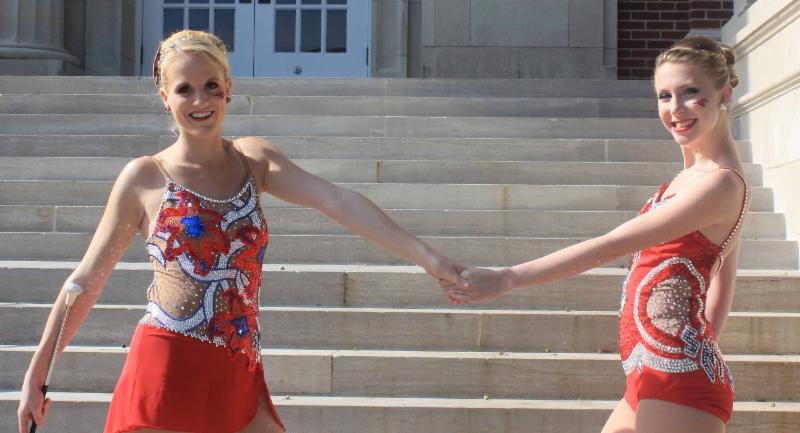
Carly Bender (l) and Kayli Mickey.


Where is your beanie today?

Smith: My precious beanie is sitting on a shelf of honor in my house.  I treasure it as I do the gold bowl given to me by the band members when I graduated, which is inscribed "From 96 Guys to Their Doll."  I also still have all my batons in my closet (I threw some aerials last December at my family's annual Christmas touch football game), my band sweater, my white helmet caps, and my Diamond M necklace (a gift from Randy West).  Along with these valuable keepsakes, I cherish my memories and an album of photographs given to me by my friend and outstanding photographer, Buddy Mitchell.

Light: Today my beanie is in my sparkly red baton case with all my batons. 

Fordham: I keep my beanie, my batons and a picture from the Cotton Bowl in my office.  They remind me of one of the most fun times in my life. They're also a reminder that time flies and you have to make your time count. 

Humble: In a frame in the basement of my house.

Vines: Bedside table - I would grab it in a fire.  "Run up dI sCorE" is what we painted on ours.  How that liquid paper lasted all these years, I don't know.

Maner: It is currently packed away along with several other mementos from my twirling years.

Wright: Being a world traveler, my beanie often travels with me for sentimental reasons.  Currently, I live in Bangkok, Thailand and so does my beanie and my batons!

Park: It is in my baton bag.

Bender: My beanie still remains in my baton case so that I may have it when I come back for the SMU Homecoming game every year. 

McKinnon: My beanie is currently sitting on my desk at home!


We also gave the twirlers a chance to share any additional memories they didn't get a chance to address with our questions...


Brotze: Best memory - my wedding in 1963.  Marrying the Bass sax player  and having seven Mustang Band members in  our wedding party!  Still have reunions with four of them.  Hope this gives you some insight into my wonderful  experience.  Also,  one of our sons,  Matthew,  is an alumni of the Mustang Band.  Our other son, Todd, was drum  captain of Northwestern University Band  and performed  at the Rose Bowl  during his years. Mr.  D.  was so awesome  also - he  and his family were very much a part of my life while at SMU.  Thanks for letting me share these thoughts.

Conoley:  How I remember my first halftime performance, SMU vs. Ohio State.  It was in the Cotton Bowl and televised on National TV!  Drum Major Randy West and I still reminisce about how nervous I was.  The exhilaration of performing with the Mustang Band and the tricky timing of costume changes in the men's locker room are great memories. The 96 guys went to the locker room first and were given a certain amount of time to change. Then I was allowed in.  More times than not, the clock ran out on the second quarter and here came the team!  I scrambled for cover when I heard them coming and somehow made a quick exit.  Football coach Hayden Frye got a big kick out of it.  Always, Dr. Dreibrodt, Jack Rohr, and Randy West were so supportive and fun.  Through Facebook I am grateful to still keep in touch with many of the great guys and their lives. It's amazing how one year can be such an indelible moment in your life. Hubba!

Light: Each bus trip to the Cotton Bowl for the games was special to me.  Every day practice was so different and so neat.  Practicing under the tree outside the old band hall, listening to the music, choreographing, and practicing to the SMU band was the best experience for me which helped in my later years of teaching dance.  I owned and operated two dance studios for 35 years.  As a matter of fact, one of my dance students, Cindy Ward, of Pearsall later became one of the four dolls in the late 1970s.  Also, outside that old band hall, I met so many nice and interesting students that passed by as I practiced.  Again, I say Cotton Bowl experience and Texas Stadium were amazing.  My life as SMU's 96 Guys and a Doll is truly one that sets my college experience apart from anyone else's.  I loved it, and am so humbled.  I am proud that I had such an amazing opportunity

Humble: My twirling coach, Pat Montgomery, is the mother of Kelli Montgomery, who was the twirler with the Mustang Band from Fall 2002 through Spring 2007.  I visited Pat and Kelli in the hospital the day after Kelli was born in 1985!  I taught Pat's other twirling students while she was out on maternity leave, and I'm very close to the Montgomery family.  I remember Kelli twirling from about the time she could walk, so I was thrilled when Kelli also went to SMU and twirled with the Mustang Band.

Vines: Some of my fave memories were traveling to Houston and San Antonio over the years.  Certainly, our trip to perform in the Rose Bowl stadium when we played (and came close to beating) UCLA was a favorite memory too.  Those were always epic trips!  I'm so thankful for the initial four years of friendships and memories.  My college experience would have paled in comparison without our program.  I wouldn't trade it for the world. Love and Hubba Hubba!

Wright: I enjoyed having the opportunity to work with several of the dolls after my time.  I remember "KEG" (Katherine Elizabeth Gilbert) (Kathy Vines) helping out my first year I was the doll.  It was nice to have someone around who could answer questions and get a feel for the expectations in a university setting.  I wanted to do the same for the upcoming twirlers.  While I was the sponsor, I was at the summer rehearsals and then the evening rehearsals as well during the week in addition to attending all of the games on campus or out of town.  Depending on circumstance, I generally helped give feedback on routines that were being developed for the field, watching to ensure precision and accuracy of timing, and facilitating working with the drum major and the directors.  It was especially important to help with routines and being consistent when there were two or more dolls. 


The dolls at the 2007 "Old Guys Rule" reunion.  
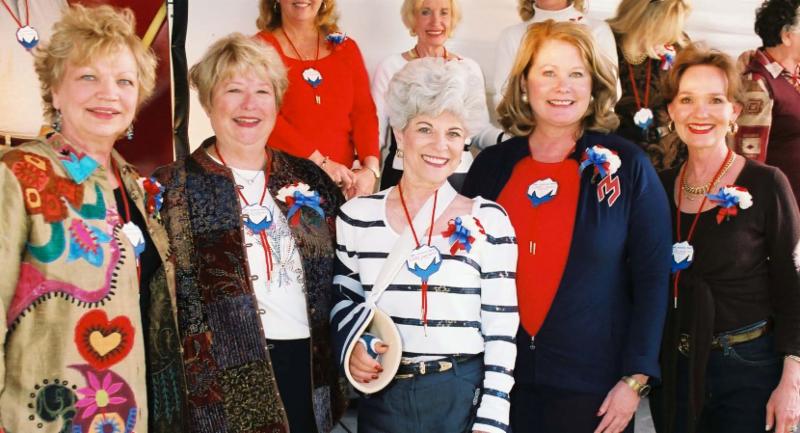
From left: Judi-Pat Evers, Camille Brotze, Deanna Mayfield, Curby Conoley, Delia Light.


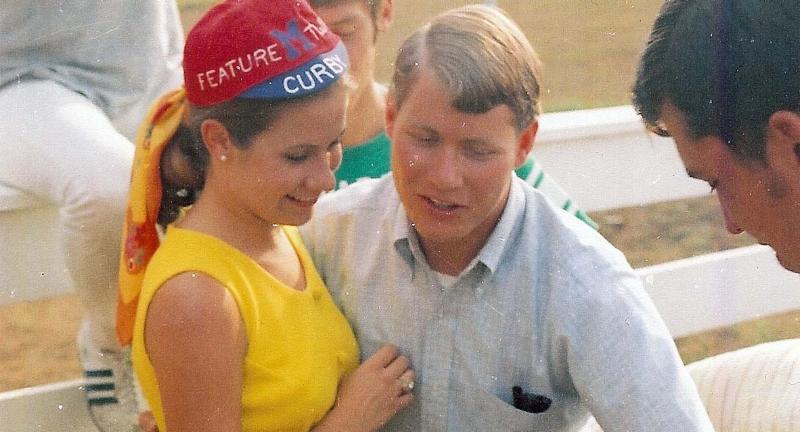
Curby Conoley also shared the photo below.  We've long heard of the traditional "meeting" of Peruna that concluded freshman orientation, but had never seen a photo.  This one is priceless.


Conoley: In the spring of 1970, I went with all the guys to a wonderful ranch for a band retreat and the rite of passage for the frosh. We were officially going to become members of the Mustang Band! In the photo you can see my trepidation as my dear friend Randy West coaxes me while Bob Brandenburg holds Peruna.


A big "hubba!" to all Mustang Band twirlers, past, present, and future.


Monthly Lexicon
 

Nostalgic Photos: "Doll" edition

Sandy Smith on the field.  Nightshirt uniforms!

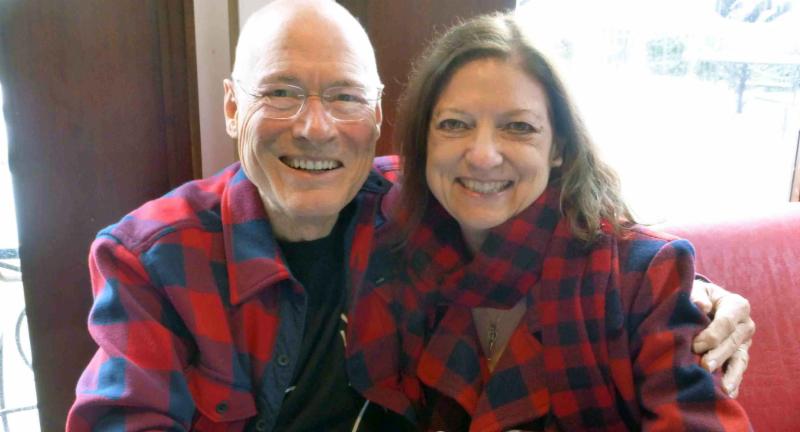
Sandy Smith and Randy West, freshman orientation - 1967.

Sandy Smith and Randy West, still coordinating clothing - 2015.

Kathy Vines at Ownby in the cold.


Diamond M Club / Southern Methodist University / Dallas, Texas 75275 /