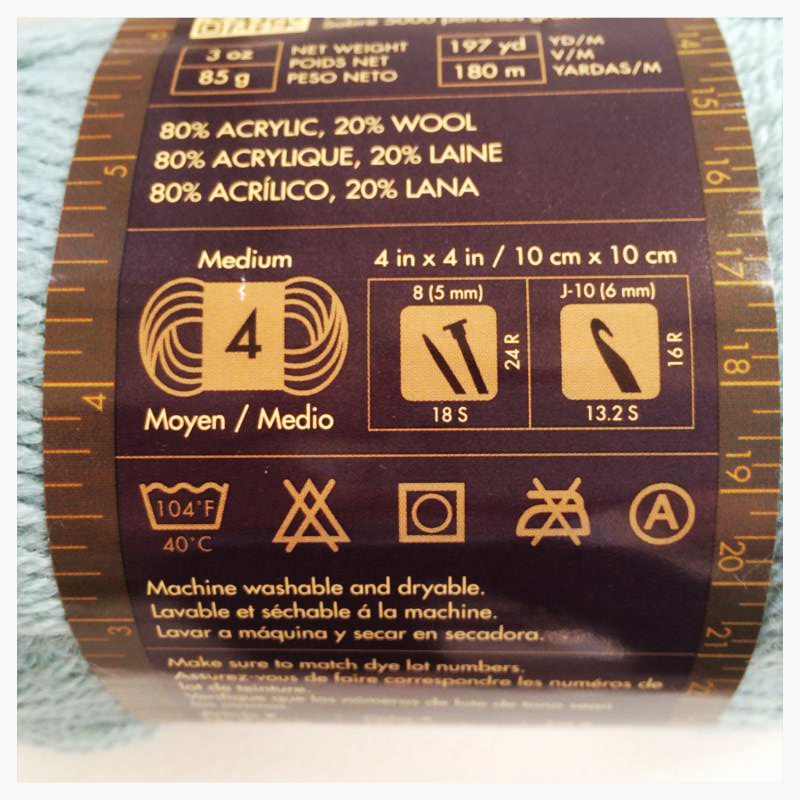
Take a look at the icon that looks like knitting needles and/or crochet hooks inside of a box on the label. On our label, it's just to the right of the icon of a skein of yarn.
Look at the square with the knitting needles, right above them it says 8 (5 mm). This indicates that the appropriate size needle to use for this yarn is US 8.
On the top of the box is 4 in x 4 in, which means that the other numbers refer to a swatch of 4".
Below the box it says 18 S. This stands for 18 stitches.
On the right side of the box it says 24R which means 24 Rows.
So, the approximate gauge of this yarn is 18 stitches and 24 rows over 4" using number 8 needles.
This tells you that the AVERAGE (not tight, not loose) knitter could expect to have 18 stitches over 4", which is the same as 4.5 stitches over 1" (18 stitches ÷ 4 inches = 4.5 stitches per inch).
If you want to make a scarf approximately 8 inches wide, then multiply 8 (inches of total width) x 4.5 (stitches per inch) = 36 (stitches). This means that you would cast on 36 stitches to make a scarf approximately 8" wide.
Remember, if you are a loose knitter, then your scarf may end up being a little wider than that. If you are a tight knitter, your scarf will end up being a little narrower than that. But it's a scarf, so it doesn't matter.
When you're ready to make a project that needs to fit appropriately (hat, gloves/mitts, sweater), you will want to do a gauge swatch to make sure that you get the same gauge as the pattern so that your project will fit as expected.
A Few More Notes About Needle Size
Many yarn manufacturers will give a needle range (for instance, #4 weight yarns may say US 6-9). There is no hard and fast rule when it comes to what needle size to use. Because when you do end up doing a gauge swatch for a project, it's most important that you find the needle that will get you the correct gauge (number of stitches per inch).
It's Not Just Needle Size
Obtaining the correct gauge in your knitting project is not just based on needle size. If you knit tightly, you'll have more stitches per inch than the pattern requires. And if you don't have enough of them to match the pattern's gauge, you're knitting loosely.
So if the pattern calls for 20 stitches over 4 inches, and you are only coming up with 18 stitches over 4 inches, that means you need 2 more stitches to match the pattern's gauge. To do this, you need to use a smaller needle, which will make smaller stitches and create more stitches per inch.
On the other hand, if you are coming up with 24 stitches instead of 20 stitches every 4 inches, you'll need 4 fewer
stitches to match the pattern's gauge. Try a bigger needle to make your stitches bigger, and get fewer stitches per inch.
Gauge Rule of Thumb:
Need more stitches? Use a smaller needle.
Need fewer stitches? Use a bigger needle.
Now you know how to calculate gauge for your knitting project!
Next time, we'll talk about calculating pattern repeats.