|
New Bioprospecting Activity: Students Can Collect and Share Data with GLBRC Scientists
Check out a new, simple version of our bioprospecting lab. Students can test a variety of environmental microbial samples for the ability to break down cellulose. In this lab, the presence of cellulase enzyme activity in samples is detected by observing whether or not microbial samples can degrade cellulose filter paper in a test tube. The methods used by students in this lab are nearly identical to those used by GLBRC scientists. Student results can be shared with GLBRC and could help biofuels researchers discover enzymes to make better biofuels.
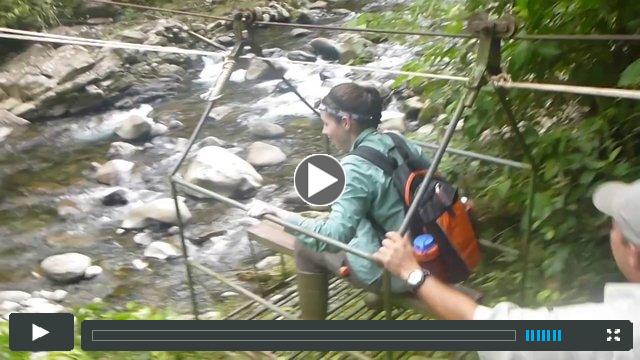 | |
Gina Lewin, GLBRC microbiologist, describes how this bioprospecting activity connects students with biofuels research.
|
This lab activity was developed with Research Experience for Teachers program participant Craig Kohn. Craig also worked with TED-Ed animators to make a cool animated video and flip classroom lesson introducing students to the bioprospecting for biofuels lab.
|
|
Recap: Bioenergy Institute for Educators 2013
During the week of June 24-29, GLBRC Education and Outreach held the annual summer Bioenergy Institute for Educators (BIE) program in UW-Madison's new Wisconsin Energy Institute building. A total of 18 middle and high school science educators representing schools and institutions from Wisconsin, Michigan, California and Oregon spent six days learning about GLBRC bioenergy research and opportunities to teach bioenergy-related topics in their classes.
 | |
Class of 2013 still smiling after six days!
|
View photo highlights in this slideshow.
|
|
Recap: Research Experience for Undergraduates
For the past 10 weeks, six students participated in the Center's Research Experience for Undergraduates (REU) program at UW-Madison. They came from as far away as Puerto Rico, and all were low income, minority, and/or first in family to college. Each student was embedded in a bioenergy research team and had a graduate student, or similar, as a day-to-day mentor.
 | | REU students celebrate with John Greenler after final presentations. |
Their order was a tall one. In this short period of time they worked with their mentor to come up with a project proposal (presented as a poster), ran a series of experiments, analyzed their results, and then presented their work during a final research symposium. In addition, they all attended regular programming developed by the Integrated Biological Sciences - Summer Research Program (IBS-SRP), and weekly seminars on bioenergy.
|
|
Recap: Research Experience for Teachers
Three high school teachers spent seven weeks working with GLBRC research mentors at UW-Madison and Kellogg Biological Station
as participants in the Research Experience for Teachers program. Teachers gained first-hand experience conducting current biofuels research and developed related education materials to bring back to classes during the 2013-14 school year.
 | | Marin Dobson, high school biology teacher, analyzed the chemical composition and energy potential of various bioenergy crops. |
Learn more about the 2013 RET projects in this slideshow.
|
|
|
Upcoming Events & Professional Development Opportunities
For details on the events below, please visit our website calendar.
September 26-29 |
Related News and Resources
Growing Energy the Holistic Way
Here is a great short story and video about UW-Madison ecologist Claudio Gratton's research on balancing bioenergy crop production and biodiversity services such as pollination and insect pest suppression. This could be used as a nice supplement to GLBRC sustainability classroom activities, especially Field Investigations: Bug Biodiversity and Ecosystem Services.
PD Provider Institute on Next Generation Science Standards
BSCS is offering a series of Professional Development (PD) Provider Institutes to support PD providers by deepening their knowledge, increasing confidence, and enhancing abilities to support the implementation of the Next Generation Science Standards and the recommendations put forth in A Framework for K-12 Science Education. The registration deadline for the fall Institute is Sept. 9.
Florida Project Produces Nation's First Commercial-Scale Cellulosic Ethanol
The Energy Department on August 1 recognized the nation's first commercial-scale cellulosic ethanol production at INEOS Bio's Indian River BioEnergy Center in Vero Beach, Florida. The project uses a unique hybrid of gasification and fermentation technology -originally developed with Energy Department support starting in the 1990s - to convert wood scraps, grass clippings, and other waste materials into transportation fuels as well as energy for heat and power. See the Energy Department press release.
|

|
|
|



