|
Tech Corner: Translating research into revolutionary technologies
|
|
|
UW-Madison Researchers Lift the Hood on Biofuels Testing
The flight of stairs between the ground floor and the basement of the University of Wisconsin-Madison's Engineering Research Building separates a tranquil academic hallway from what looks-and smells-like a busy mechanic's garage. But instead of fixing cars, researchers are studying the internal combustion process itself to reduce the pollution, greenhouse gas emissions, and fuel consumption associated with modern transportation.
This summer, wielding pipettes rather than wrenches and lab coats rather than coveralls, engineers in UW-Madison's Engine Research Center (ERC) are testing 'green' hydrocarbon fuels produced in the lab of James Dumesic, a professor of chemical and biological engineering and a researcher with the Great Lakes Bioenergy Research Center (GLBRC).
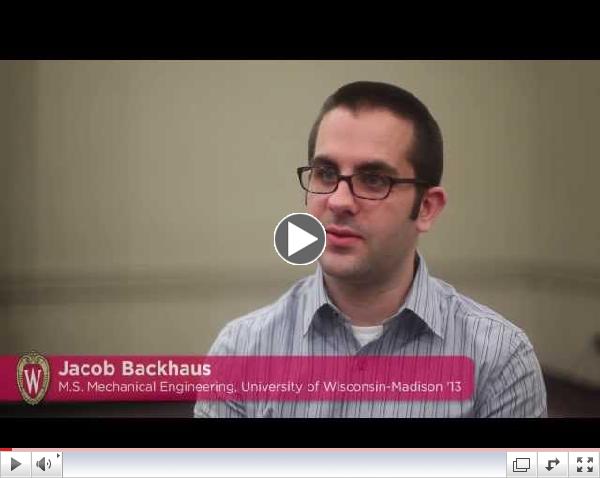
In the video below, Jacob Backhaus of the University of Wisconsin-Madison talks about what researchers are looking for in an ideal renewable fuel that could replace fossil fuels without any perceivable difference to the consumer.
 | |
Designing the Perfect Drop-In Biofuel
|
|
|
Biofuels Beat: An inside look at the latest GLBRC science
|
|
|
Researchers Unearth Bioenergy Potential in Leaf-cutter Ant Communities
 | | Illustration of the leaf-cutter ant Atta cephalotes. The variation in texture between the top and bottom represents different stages of biomass degradation in each layer of the fungus garden. Image credit: Cara Gibson. |
As spring warms up Wisconsin, humans aren't the only ones tending their gardens.In the University of Wisconsin-Madison Department of Bacteriology, colonies of leaf-cutter ants cultivate thriving communities of fungi and bacteria using freshly cut plant material.
These fungus gardens are a source of food and shelter for the ants, but for researchers, they are potential models for better biofuel production.
"We are interested in the whole fungus garden community, because a lot of plant biomass goes in and is converted to energy for the ants," says Frank Aylward, a graduate student in the Currie Lab and a researcher with the Great Lakes Bioenergy Research Center.
Aylward is the lead author of Applied and Environmental Microbiology's June 15 cover article, which identifies new fungal enzymes that could help break down cellulosic--or non-food--biomass for processing to fuel.
|
|
Education and Outreach Update
|
|
|
Introducing CB2E: GLBRC Activity to Convert Cellulosic Biomass to Ethanol in the Classroom
In this flexible lab sequence published by GLBRC's Education and Outreach team, students convert cellulosic biomass sources like sawdust and straw into sugars and then ethanol. As biomass samples are pretreated, enzymatically digested and fermented, students use glucose meters and ethanol probes to measure the key products of this chemical conversion. In the process, students test predictions about which biomass sources and treatments will be most effective for producing ethanol.
This activity was developed with Madison Memorial High School chemistry teacher Travis Tangen, who worked with WEI researcher Troy Runge in the 2012 GLBRC Research Experience for Teachers Program. Special thanks to GLBRC researchers Rebecca Garlock Ong, Jonathan Walton and Yaoping Zhang for their contributions.
|





