|
|
|
Office of Human Resources August 2015
|
|
|
HR REVIEW
Your Source for University Human Resources News and Information
|
|
|
|
|
|
Payroll/FASIS
| |
FY15 Mobile Allowance Deadline
To ensure processing for the September 2015 paycheck, Additional Pay forms to renew or to set up new mobile allowances for FY 2015 must be submitted to the Payroll Office by 09/15/15. Forms that are received after 9/15/15 will not be processed retroactively.
The policy and forms can be found in the Mobile Guidelines document.
For more information, please contact:
Evanston: Eileen Sandalow, e-sandalow@northwestern.edu
Chicago: Ro Torres r-torres@northwestern.edu
I-9 Training
I-9 compliance is an important part of the hiring process. New employees must complete Section 1 of the I-9 no later than the end of their first day of employment. In order to complete Section 2 of the 1-9, employees must show their work eligibility documents to an authorized Northwestern representative no later than their third day of employment.
To become a Section 2 Processor for I-9s, or to refresh your knowledge on the I-9 process, please sign up for an upcoming training session in FASIS Self Service. The next sessions will be held:
Evanston Campus
September 15, 2015
10:00 am - 12:00 noon
Rebecca Crown Center
Training Class Room
| Chicago Campus
August 20, 2015
10:00 am - 12:00 noon
Tary Research Education
Weinberg Lab 1-730
|
FASIS Open Lab Assistance for Financial and HR Administrators
Do you have FASIS, Kronos, or payroll questions? Do you have problems filling out forms or determining how to set up your fall appointments? FASIS offers weekly open lab sessions on the Chicago and Evanston campuses, including a virtual online option for those who cannot make it out of the office.
For added convenience, Chicago open labs are combined with FFRA, providing additional assistance on financials systems. The first lab of each month is attended by staff from Effort Reporting on both Chicago and Evanston campuses.
For more information on open lab times, please visit:
http://www.northwestern.edu/hr/managers-administrators/fasis-administrator-tools/fasis-open-labs.html
|
|
 |
|
|
| Benefits | |
Staff Incidental Sick Time (IST)
The allotment of Incidental Sick Time (IST) will remain at 15 days for fiscal year 2016 (September 1, 2015 through August 31, 2016) rather than the previously announced reduction to 12 days. The University will continue to monitor the data around incidental sick time. The IST allowance is intended for the occasional staff employee illness or care during a family member's illness. In addition, the IST allowance covers the first 5 business days of an Extended Sick Time (EST) absence.
New Healthy Family App Helps Members Keep Track of Important Preventive Services

Healthy Family is a new app from Blue Cross and Blue Shield of Illinois that provides information on which wellness screenings and immunizations are recommended for you and your family. The app helps you take charge of your health so that you can have informed conversations with your doctors.
Healthy Family app features include:
- Recommendations for you and your family based on age and gender
- Ability to store past test information
- Ability to set reminders for upcoming tests and add notes
- Bilingual capabilities (The app is currently available in English and Spanish)
Preventive services are designed to prevent or detect health problems. Some examples of preventive services include, annual health checkups, wellness screenings and immunizations. With some serious illnesses, there may not be any obvious symptoms in the early stages. For this reason, it is important to have regular wellness screenings in order to limit risks. Immunizations can help stop illnesses before they have a chance to start.
To get the Healthy Family app, text* FAMILY to 33633, or download it on the App Store or Google Play.
Employee Tuition Benefits Information Sessions
Northwestern University School of Professional Studies (SPS) and the Northwestern Human Resources Benefits Division will host Information Sessions for benefits eligible NU employees on Wednesday, August 5 and Wednesday, August 12.
These Sessions will explain how to take advantage of your employee tuition benefits through the part-time, evening, and weekend undergraduate, post-baccalaureate, professional development, graduate and advanced graduate programs available through the School of Professional Studies.
Academic, admissions and student service representatives from SPS and the Human Resources Benefits Division will be available to answer your questions. Lunch will be provided. Click here to register online.
We hope to see you on campus.
|
Chicago Campus
Wednesday, August 5, 2015
12:00 noon - 1:00 p.m.
Wieboldt Hall - Room 408
339 East Chicago Avenue
|
Evanston Campus
Wednesday, August 12, 2015
12:00 noon - 1:00 p.m.
Donald P. Jacobs Center - Room 2245
2001 Sheridan Road
|
|
| Conflict of Interest | |
While the formal conflict of interest disclosure (COI) process for staff occurs on an annual basis each February, staff and managers can proactively engage and consult with Northwestern's Conflict of Interest Office (NUCOI) at any time with respect to questions or concerns around outside interests, activities, and relationships that could relate to or impact Northwestern responsibilities. For example:
- I would like to hire a family member as a temporary employee - is this problematic?
- Am I allowed to perform paid consulting for another department at the University?
- How should I handle a gift or event invitation from a University vendor?
Feel free to contact NUCOI to discuss these or similar questions at any time:
|
|
Work/Life Resources
|
Caregiving Corner -
info for parents and caregivers
"Tips for Easy Back-to-School Transitions"
The summer is just about over. No more going to bed late, sleeping in every morning, or playing outside until dark. Now the routine has to change. Beginning kindergarten, going back to primary school, or a child care program usually means two things to a young child: 1) a stricter time schedule; and 2) adapting to a different caregiver, classroom, teacher, school, friends, or academic challenges. These new experiences can bring on stress or cause children to resist necessary adjustments. Read more (login: northwestern, password: eap)
Elder Care Tip of the Month from NU Senior Care Connections
August Tip of the Month: "Mom Fell - Now What?"
By Jennifer Gibbons, LCSW, Adult & Senior Care Advisor
http://blog.care.com/elder-advice/
When my mom fell one summer, she was standing on a ladder painting the columns in front of her home. She hadn't told anyone she was planning to do this, and couldn't imagine any trouble would come from it. When she lost her balance she fell six feet to the ground along with a full bucket of oil-based paint. So not only was she lying on the ground with a broken arm and without anyone in sight to assist her, but she was covered head to toe in paint-- six hours from where I live and work.
NU Life Matters
LifeNotes
"360 Degrees of Wellness"
When people think of health, they often first think about exercise, diet, and catching colds. But being "well" means much more than just physical health. In recognition of total well-being, this month we provide tips on promoting:
- Emotional well-being
- Financial fitness
- Physical health
- Sense of belonging and purpose
Read more (login: northwestern, password: eap)
Upcoming Workshops
Did you know October is National Work/Family Month?
Pre-register for National Work/Family Month Programming, and stay tuned for the announcement of Northwestern's National Work/Family Month Keynote Speaker.
NU Senior Care Connections: "Taking the Car Keys Away from Dad: When is it time?"
|
Evanston Campus
Wednesday, October 14, 2015
12:00 noon - 1:30 pm
Norris Center
Wildcat Room (101 A)
Click to RSVP
|
Chicago Campus
Thursday, October 15, 2015
12:00 noon - 1:30 pm
Rubloff Building
9th Floor Lake Shore Conference Room
|
NU Life Matters: Financial Wellness "It's Never Too Early to Start Planning for the Future"
|
Evanston Campus
Tuesday, October 27, 2015
12:00 noon -1:30 pm
Norris Center
Wildcat Room (101 B)
|
Chicago Campus
Wednesday, October 28, 2015
12:00 noon - 1:30 pm
Rubloff Building
9th Floor Lake Shore Conference Room
|
Visit our Work/Life Resources Workshop web page
For information, to RSVP to any upcoming Work/Life workshops, or to request a workshop for your school or department, please visit the Workshops web page.
Workshops: We want to hear from you!
What's on your mind? We are always interested to hear what Work/Life workshop topics you'd like to see offered. Please share your ideas for our upcoming calendar of workshops by email or by phone at (847) 467-1460.
Twitter
Follow the Office of Work/Life Resources on Twitter @NUWorkLife for the latest in work/life news, workshops and more!
|
|
Staffing
| |
Writing an Effective Cover Letter
While you may be tempted to submit your application and resume without a cover letter when applying for a staff position, a cover letter provides an opportunity to differentiate yourself from other candidates as well as showcase your unique strengths and capabilities that might not be easily explained within your resume. This article provides tips on how to construct this all-important document.
First, and perhaps most importantly, cover letters should be tailored to the position for which you are applying. The qualifications and skills you highlight should be matched to the requirements of the position. For example, consider an individual with an extensive administrative background who also has volunteer experience in publishing and a degree in English. The cover letter submitted when applying for an administrative assistant position may look very different from one submitted when applying for an editorial position.
4 General Components
While cover letters should be tailored to the position for which you are applying, there are 4 general components that should be included in any cover letter:
- An introduction that indicates why you are writing and to which position you are applying.
- One to two paragraphs outlining your relevant skills and qualifications. This is your opportunity to demonstrate what uniquely qualifies you for the position compared to other candidates and to explain any gaps in your resume or questions others may have when reading it. Rather than simply listing your past accomplishments and titles, position them in terms of how they benefit the organization. Your cover letter needs to address the question, "What's in it for the organization?"
- A brief final paragraph that indicates what action will come next. Use this as an opportunity to make your desire and availability for an interview known.
- A closing statement that thanks the reader for their time and consideration.
5 Basic Rules
- Keep your cover letter brief and simple. A half-page cover letter is ideal.
- Use a font and font size that is simple and clear.
- Always use spellcheck.
- Have someone review your letter for proper spelling, grammar, and overall readability.
- Steer away from using buzzwords, acronyms, jargon, and overly personal language. Don't assume the reader will know what you are referencing, spell it out.
For additional resources on career development and conducting a job search, visit the Careers and Workplace Learning sections of the Office of Human Resources website.
Maintaining the Highest Standards of Conduct
As members of the Northwestern University community, it is our responsibility to conduct our activities with the highest standards of conduct in mind. This requires our personal commitment to becoming familiar and complying with relevant University policies and to following laws and regulations. The University's Standards for Business Conduct provides a framework for administering University resources and establishes guidelines for appropriate standards of behavior.
No set of policies can address every decision or transaction we will face in our daily University activities. If you have a question about the right course of action, there are several resources available for you to consult. You may want to review the Standards for Business Conduct and other relevant University policies at http://policies.northwestern.edu/. You may also contact your supervisor or identify other knowledgeable University officials with whom to consult by visiting www.northwestern.edu/ethics/. Finally, you may report your question or concern to EthicsPoint®, Northwestern University's hotline, at www.ethicspoint.com or 866-294-3545.
 |
|
Compensation
| |
Annual Merit Planning Concludes: Online Notification
As this year's performance excellence and merit review process draws to a close, every staff member should be aware of important next steps and key dates associated with them.
Performance and Merit Increase Conversations
Each staff member should be scheduling time with his/her manager to discuss the results of this annual process. These conversations are intended to be a candid and open exchange, in which both parties:
- Review the staff member's goals for the past year, the degree to which those goals were met, and the resulting linkage to pay
- Identify opportunities for performance improvement as well as overall professional growth.
While these types of discussions are strongly encouraged, there are circumstances which may delay or even prevent them from occurring in a timely manner. Factors such as scheduling conflicts or extended absences may present challenges to the recommended process and timeline. However, the desired outcome is that each staff member has an annual performance and merit review with his or her manager.
Key Dates for Online Notification
|
September 1, 2015
|
Merit increases for all non-exempt staff, exempt staff and faculty are effective. Staff members will be able to view merit increase information via the FASIS self-service portal.
|
|
| September 18, 2015
| First pay date for non-exempt staff to receive their FY15 salary with the merit increase applied.
|
|
| September 30, 2015
| First pay date for exempt staff and faculty to receive their FY15 salary with the merit increase applied.
|
If you have questions regarding the information in the FASIS portal, please notify your manager or contact the Compensation Consultant responsible for your area.
Minimum Wage
President Obama's signing of Executive Order 13658, results in the minimum wage for employees working under federal contracts (including certain types of grants) being increased to $10.10 per hour on January 1, 2015. This minimum wage rate applies to new federal contracts and replacements for expiring contracts. The minimum wage rate will be increased annually based upon the annual percentage increase in the Consumer Price Index. Northwestern's minimum hiring rate is above $10.10 per hour so we are in full compliance with this Executive Order and there is no immediate impact to employees.
Chicago's New Minimum Wage Rate
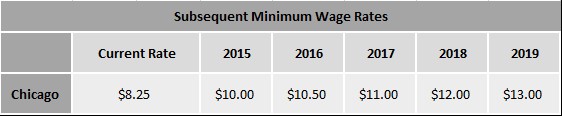
The Chicago City Council voted to raise the minimum wage rate to $10.00 per hour effective July 1, 2015. Subsequent increases will bring the minimum wage to $13.00 per hour by 2019. The 2015 increase to the minimum wage rate will have no immediate impact to Northwestern employees.
Independent Contractors
On July 15, 2015, the U.S. Department of Labor's Wage and Hour Division issued Administrator's Interpretation 2015-1: The Application of the Fair Labor Standards Act's "Suffer or Permit" Standard in the Identification of Employees Who Are Misclassified as Independent Contractors, which analyzes how the Fair Labor Standards Act's definition of "employ" guides the determination of whether workers are employees or independent contractors under the law. It discusses the breadth of the FLSA's definition of "employ," as well as provides guidance on the "Economic Realities" factors applied by courts in determining if a worker is indeed an employee. Proper classification of individuals is critical to appropriately process and make payments for services. http://www.dol.gov/whd/workers/Misclassification/AI-2015_1.htm
Economic Realities
Independent contractors are workers with economic independence who are in business for themselves. The following "economic realities" may help resolve the Common Law Rules above and assist in determining whether a worker is truly in business for himself or herself. If, like most, the worker is economically dependent on an employer who can require (or allow) the employee to work - and who can prevent the employee from working - an employer-employee relationship is indicated.
- The extent to which the work performed is an integral part of the employer's business.
If the work performed by a worker is integral to the employer's business, it is more likely that the worker is economically dependent on the employer and less likely that the worker is in business for himself or herself.
- Whether the worker's managerial skills affect his or her opportunity for profit and loss.
Managerial skill may be indicated by the hiring and supervision of workers or by investment in equipment. Analysis of this factor should focus on whether the worker exercises such managerial skills and, if so, whether those skills affect that worker's opportunity for both profit and loss.
- The relative investments in facilities and equipment by the worker and the employer.
The worker must make some investment compared to the employer's investment (and bear some risk for a loss) in order for there to be an indication that he/she is an independent contractor. A worker's investment in tools and equipment to perform the work does not necessarily indicate independent contractor status, because such tools and equipment may be required for the work. If a worker's business investment compares favorably enough to the employer's that they appear to be sharing risk of loss, this factor indicates that the worker may be an independent contractor.
- The worker's skill and initiative.
Both an employee and an independent contractor may be a skilled worker. To indicate possible independent contractor status, the worker's skills should demonstrate that he or she exercises independent business judgment. Further, the fact that a worker is in open market competition with others would suggest independent contractor status.
- The permanency of the worker's relationship with the employer.
Permanency or indefiniteness in the worker's relationship with the employer suggests that the worker is an employee, as opposed to an independent contractor. However, a worker's lack of a permanent relationship with the employer does not necessarily suggest independent contractor status because the impermanent relationship may be due to industry-specific factors, or the fact that an employer routinely uses staffing agencies.
- The nature and degree of control by the employer.
Analysis of this factor includes who sets pay amounts and work hours and who determines how the work is performed, as well as whether the worker is free to work for others and hire helpers. An independent contractor generally works free from control by the employer (or anyone else, including the employer's clients).
The process in place at Northwestern aids in determining whether an individual is an independent contractor or whether an employer-employee relationship exists and to ensure that payment is handled appropriately. Independent contractor payments must be tracked for taxable income reporting on Form 1099, and employee payments are subject to employment taxes and are reportable on Form W-2. Errors in employee/non-employee classification may lead to significant fines and penalties due to lack of appropriate income reporting, tax withholding, or provision of benefits.
To request a review of an individual, please go to http://www.northwestern.edu/hr/policies-forms/forms/payroll-administration/IndependentContractorQuestionnaire.pdf
|
| Learning & Organization Development | |
The Northwestern University Learning & Organization Development (L&OD) team collaborates with faculty and staff who want to develop their talent and advance their workplace outcomes, processes, and engagement. L&OD provides consulting, coaching, workshops, retreats, and tools for individuals, groups, and organizations.
Registration and Catalog News
Registration is still open for August workshops!
To see what is coming up, view the Summer 2015 catalog online.
Fall 2015 Catalog
In an effort to increase efficiency and awareness, our Fall 2015 catalog will be available online-only as a downloadable PDF for easy and quick desktop and mobile access. To view, download, or print the most up-to-date catalog, please visit the Workplace Learning website and click the current season's catalog under "Quick Links."
Please note: While our upcoming catalog contains sessions taking place during Fall 2015, L&OD offers a wide variety of workshops and additional opportunities throughout the year to help improve workplace performance. For our complete list of courses Click here.
Follow our Twitter feed to get L&OD's best picks of upcoming events and learning resources.
Questions? Comments? Contact the L&OD team at workplace-learning@northwestern.edu or 847-467-5081
|
|
|
|
|
|
|
|