|
|
"As poets, we have so much potential to change people's lives for the better by giving people poetry instead of advertising, instead of chit chat, instead of the same ten words used in the same ten ways on the same ten television shows... We can give people the real, which is what poetry is, and make them excited to go live their complicated lives instead of making them feel dead because they're surrounded by dead language on the street, on the train, on television, at the movies. Well, the internet is everywhere and nowhere at once. Which is a place poetry is very comfortable with."
|
|

Zapruder's new collection, Sun Bear (Copper Canyon Press, 2014), is personal and beautiful. At times resembling the nervy lines and syntax of Frank O'Hara's "I do this, I do that" poems, this new collection has an extraordinary sense of music and timing. The persona behind these poems is looking outward and self-consciously considering the boundaries of the world he inhabits as a human, an American and a poet, while recognizing what is exerting its pressure from the outside. It's one of my favorite books this Spring.

Like all good poetry must, Saskia Hamilton's newest collection,
Corridor (Graywolf Press, 2014), escapes easy categorization, despite the fact that it seems to be the most formally traditional collection in this poetry review. Whether or not a reader follows the lyrical or narrative threads that are brushed throughout with the lightest touch, the tight language and clarity of exposition makes it difficult to be left behind. Her work is not unlike a donkey ready to pull: an economical use of bone, fur, muscle and stubbornness--a specimen onto which an unassuming amount of weight is yoked.
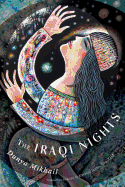
Iraqi Nights (New Directions, 2014) , the third volume by acclaimed Iraqi poet Dunya Mikhail is a retelling of The One Thousand and One Nights. Mikhail takes on the role of Scheherazade, telling herself rather ordinary stories of children who go to school / and come home again, in order to endure and illuminate the conflict between the U.S. and Iraq. Dramatic and intimate, historical and accurate.
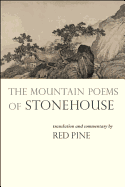
Any reader interested in the long, rich history of Eastern Asian poetry--and its translation into English--must, if they haven't already, read Red Pine; and any reader interested in the long, rich history of Eastern Asian poetry--and its translation into English--must, if they haven't already, read Stonehouse. Luckily, The Mountain Poems of Stonehouse (Coppyer Canyon Press, 2014) brings these two poets together, and is, in fact, one of few collections to feature Stonehouse's poetry. With cultural contextualization supplied by Red Pine, Stonehouse's poems skirt anti-poetry, being as direct, unadorned and knowing as any poetry this day and age isn't.

Like most post-modern poetry, Arthur Sze's poems have always seemed to challenge the notion that a reliable interlocutor is central to the lyric poem. But unlike most post-modern poetry, Sze seems to find this challenge housed in perspective more than identity. In Compass Rose (Copper Canyon Press, 2014), he continues this exploration in a collection that is full of disparate images linked together to cause a satisfyingly dizzying experience. Sze's mashup of images--with varying profundity, scale and chronology--often cohere around loose and fast resemblances and a perspective that is seemingly illusory and undeniably ardent.
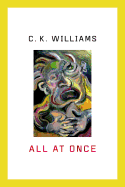
Distracting oneself while awaiting a doctor's call with a diagnosis, lingering on the image of two smiles received on the subway, relishing the way a wife with a French accent pronounces his name: all are lyric moments to the poet C.K. Williams, whose import is convincing due to the effort Williams puts into trying to locate the feelings they draw out of him. Though Williams' poetry has always resembled prose, he somehow loosens up in All At Once (Farrar, Straus and Giroux, 2014) and lets the lines run margin to margin, reading more like short essays. Despite the looseness in form, Williams' poetic touch still comes through with beautiful sentences, which are maximal and meandering at times, but rhythmic and full of movement.
Reviews by Jevin (jevin[at]commongoodbooks.com)
|
"Saskia Hamilton" by Ben Folds and Nick Hornby. From Lonely Avenue (Nonesuch Records, 2010).
|
|
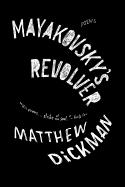
A collection as tight as it is capricious, Mayakovsky's Revolver (Norton, 2012) brims with anger and enchantment, basking in the light of the moon in August and the memory of a brother's suicide. Matthew Dickman--hailed by many as our "next public poet"--has composed a veritable suite of abrupt and boisterous poems, unmatched in their enthusiasm, vigor and despair. This book is what love would say if it could talk, and lust if it could stop.

Frank Bidart is many a poet in Metaphysical Dog (Farrar, Straus and Giroux, 2013), winner of the National Book Critics Circle Award. He is Ava Gardner at the height of her beauty; a 65-year-old grandson chastised for having eaten at the house / of his new black friend; he is Frank looking back on Frank who wrote the poem "Ellen West," the year after his mother's death. He is, in other words, the poem itself, less concerned with making an impression than, as Lyn Hejinian writes, "renew[ing]" his "engagement with the world... with every sentence," and its many mini-events, only implicitly recorded in a / poem.
 A book by A. Van Jordan is always an event. M-A-C-N-O-L-I-A portrayed the life of MacNolia Cox, the first black finalist in the National Spelling Bee Competition. Quantum Lyrics, too, personified the likes of Albert Einstein and the Atom, hybridizing poetry and physics in one cinematic sweep. Which brings us to The Cineaste (Norton, 2013), Jordan's fourth and most focused work to date, whose subject is the very nature of depiction. From star to screen and script to script, this uncharacteristically thematic poet brings to life the movies and the mysteries of sitting in the dark, waiting for our stories to be told. Jordan has employed use of the screenplay in the past, but to no greater effect than in these paced and three-dimensional attestations to the power of film. Called by Laura Kasischke "the announcement of the birth of an entirely new poetics," The Cineaste is a must see.
Reviews by Colin (colin[at]commongoodbooks.com)
|
 "White space percolates this lyric, while the current lull in American military actions forms the occasion of this book, Gillian Conoley's seventh poetry collection. With poems titled 'late democracy,' '[Peace] contrary to history,' and 'Trying to Write a Poem about Gandhi,' the work pulls one way and then pushes back another, testing the inner ground for breath." --A. Anupama
 "City Poet has everything: poetry, art, sex, gossip, and glamour. Brad Gooch is a marvelous chronicler of the fifties, when the Cedar Tavern was booming, and the Poets Theatre flourished. Greenwich Village, literary Cambridge, the Hamptons when real artists lived there: it's all in The Life and Times of Frank O'Hara, a book that is a 'life and times.'" --James Atlas
|
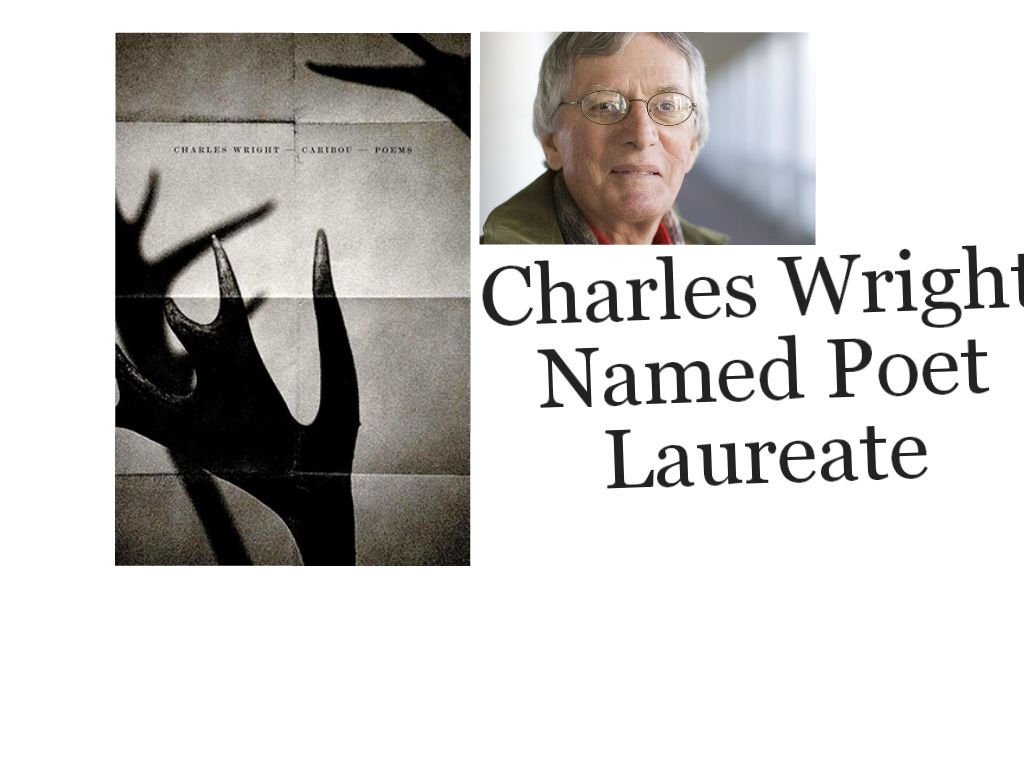 "I really don't know what I'm supposed to do... But as soon as I find out, I'll do it."
|
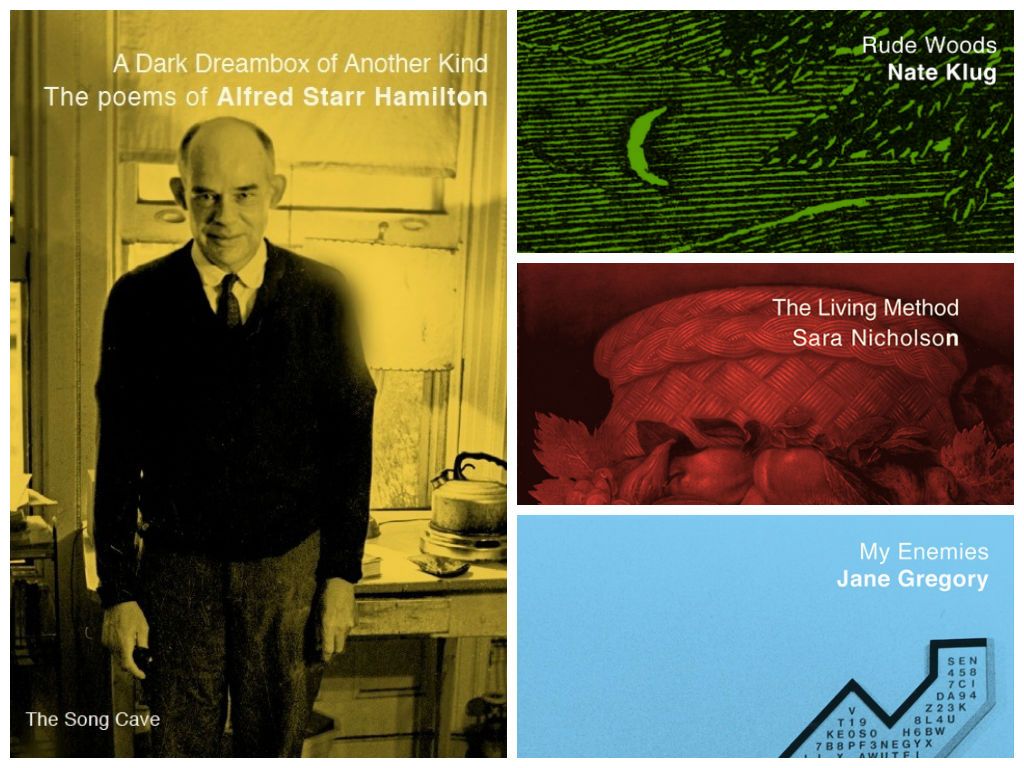 The Song Cave
 is edited by Ben Estes and Alan Felsenthal and dedicated to recovering a lost sensibility and creating a new one by publishing books of poetry, translations, art criticism, and making art prints and other related materials. You can listen to an interview with Estes, Felsenthal and poet Amanda Nadelberg, discussing A Dark Dreambox of Another Kind by Alfred Starr Hamilton, on KCRW's Bookworm. For more information, including links to freely download limited edition chapbooks by Peter Gizzi, Ben Lerner, C. D. Wright and many others, visit thesongcave.com Print the coupon below or mention the words "Song Cave" at the register for 20% off your purchase of any Song Cave book (currently displayed in our poetry section) while supplies last. |
|
|
|
|
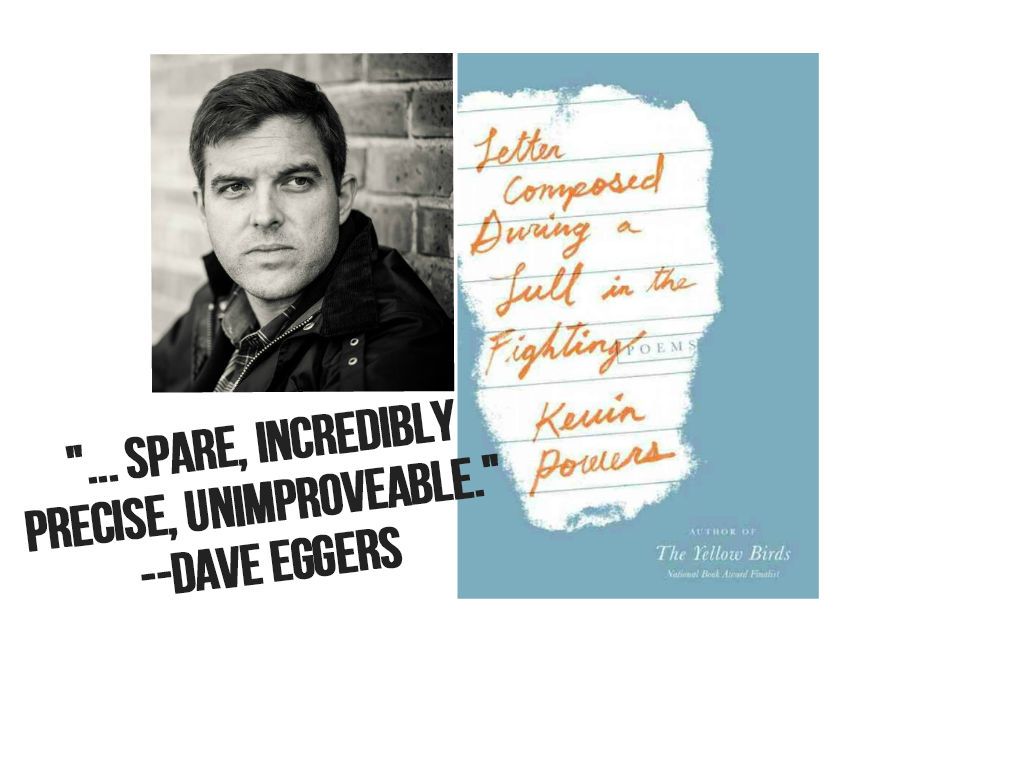
Military Veteran and National Book Award Finalist Kevin Powers' First Poetry Collection,
|
|
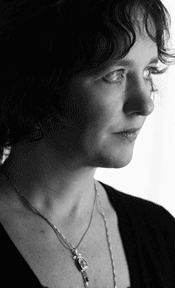
"I'm not sure, honestly, that I'm ever writing for anyone other than myself, except perhaps when I'm revising (which I don't actually consider to be 'writing'). I feel like I'm composing the poems mostly with music in mind--the sound of the words, and trying to make whatever needs to happen to link events or images in a poem sound as natural as possible."
Laura Kasischke, National Book Critics Circle Award Winning Author of Space, In Chains and The Infinitesimals (07.2014), In Conversation with Common Good Books. Coming Soon.
|
| |
Save 20% on any in-stock book published by The Song Cave, while supplies last.
One time use only. Not applicable to special orders.
|
|
|
|
|
For past reviews and interviews, event updates and more, follow us on tumblr  and on facebook and on facebook 
|
-----------------------------------------------------------------------------------------------------------------------------------------------------------------
Common Good Books 38 Snelling Ave S, St Paul, Minnesota 55105
phone 651.225.8989 www.commongoodbooks.com hours Monday-Saturday, 9 - 9 / Sunday, 10 - 7
----------------------------------------------------------------------------------------------------------------------------------------------------------------
|
|
|