The Parable of the Good Samaritan
 25 And behold, a lawyer stood up to put him to the test, saying, "Teacher, what shall I do to inherit eternal life?" 26 He said to him, "What is written in the Law? How do you read it?" 27 And he answered, "You shall love the Lord your God with all your heart and with all your soul and with all your strength and with all your mind, and your neighbor as yourself." 28 And he said to him, "You have answered correctly; do this, and you will live." 25 And behold, a lawyer stood up to put him to the test, saying, "Teacher, what shall I do to inherit eternal life?" 26 He said to him, "What is written in the Law? How do you read it?" 27 And he answered, "You shall love the Lord your God with all your heart and with all your soul and with all your strength and with all your mind, and your neighbor as yourself." 28 And he said to him, "You have answered correctly; do this, and you will live."
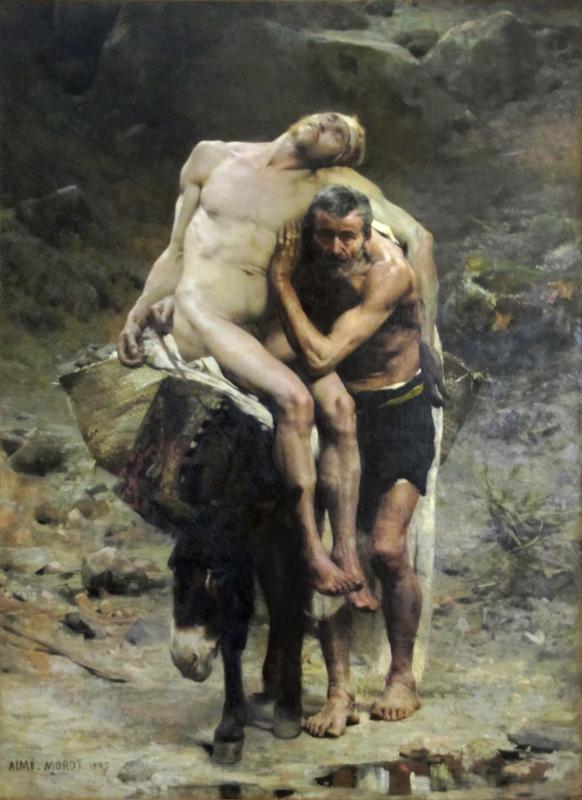
29 But he, desiring to justify himself, said to Jesus, "And who is my neighbor?" 30 Jesus replied, "A man was going down from Jerusalem to Jericho, and he fell among robbers, who stripped him and beat him and departed, leaving him half dead. 31 Now by chance a priest was going down that road, and when he saw him he passed by on the other side.32 So likewise a Levite, when he came to the place and saw him, passed by on the other side. 33 But a Samaritan, as he journeyed, came to where he was, and when he saw him, he had compassion. 34 He went to him and bound up his wounds, pouring on oil and wine. Then he set him on his own animal and brought him to an inn and took care of him.35 And the next day he took out two denarii[a] and gave them to the innkeeper, saying, 'Take care of him, and whatever more you spend, I will repay you when I come back.' 36 Which of these three, do you think, proved to be a neighbor to the man who fell among the robbers?" 37 He said, "The one who showed him mercy." And Jesus said to him, "You go, and do likewise."
|
MUSINGS
My 7-year old daughter has a friend who lives just one street over. Walking on the street we will pass four houses to get to hers. My daughter mentioned to her one time that they are neighbors. The friend stated that they are not as the she believes one must live directly to the right or left to be neighbors. With this definition, the poor child must think she has only two neighbors.
In the Gospel lesson today, the lawyer asks Jesus for some clarification with that all-important Greatest Commandment. The lawyer wants to know who is considered his neighbor. The way the text is framed and presented, it gives the impression that the lawyer is trying to narrow down the list of people he must love in order to inherit eternal life. Jesus then tells the lawyer the parable of the Good Samaritan. In the parable Jesus mentions the type of "upstanding" men who have neglected the traveler half-dead on the road to Jericho. He throws in that the one who ultimately helped was a Samaritan; which is so unusual that he had to use the additional label of "Good" when describing the Samaritan, though his actions alone would certainly indicate his generous and kind heart. Like a half-hour sit-com, by the end of the telling of the parable, the lawyer realizes that the neighbor is the one who showed the man mercy and Jesus tells him to "go and do likewise." How often do we look at this lesson? How often do we still consider who our neighbor is? Depending on the context, we can substitute "Samaritan" with any number of other groups commonly considered to be "less desirable." And the particular "less desirable" group just changes as our tolerance changes. Today, we could make a point of saying that we should love our Muslim neighbors. Hopefully in the future, we will be more accepting and we won't be classifying our Muslim brothers and sisters in such a way. There won't be a need to tell other that we need to love them - they just will. Why do we have a tendency to do this - to define who our neighbor is in terms of ethnic or cultural groups as a substitute for the Samaritans? I suppose we are providing a modern context for the listener of our sermon - making the point clearer and more accessible and relevant. Or maybe we are subconsciously substituting a group of people we don't know very well, and have little day-to-day contact with, because it is the easy thing to do. It is easy to say, "I love my Muslim neighbor" when you don't have any Muslims living in your town. But hundreds of years later we still have this prevailing issue of defining our neighbor. I think in order to break the cycle we need to look closer to home. "I want you to be concerned about your next-door neighbor. Do you know your next door neighbor?" This quote from Mother Teresa is one I think about whenever I consider this scripture. It hits close to home for me, since I have lived in my house for 9 years and still don't know half of the people on my street, and I confess, I haven't really tried. Do you know your next door neighbor? Your next door neighbor is the woman watering her immaculate lawn and never greets you when you walk by. Your next door neighbor has a political sign in his front yard that is different from yours and looking at that sign makes you uncomfortable. Your next door neighbor is the teenager you only see when he comes home from school and disappears into his house across the street to play his drums so loudly your dishes rattle in your cupboards. Do you know your next door neighbor?
|
|