And yet our friend, Luke will not let us stand with eyes turned heavenward for very long. Luke keeps forcing our gaze back to earth. Our dear friend Luke will just not allow anyone in this text to keep looking to heaven, no matter what the circumstances.
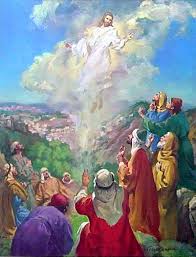
On this day those disciples of the Easter narrative-the women from the empty tomb, Peter who ran to see for himself, the two who were accompanied by Jesus to Emmaus, all the others who celebrated, questioned, lived the resurrection--found themselves no longer looking heavenward, but at the one who dwells among us. They who had asked, "How can this be?" Those who found "Christ is risen" to be an idle tale. All of them were blessed as Jesus withdrew and was carried to heaven.
I imagine they watched his ascension. I imagine they longed for him to stay with them for the day had been much too short. But then they did the most incredible thing. They turned from looking to the heavens to dwelling in the world and they returned to Jerusalem with great joy and were in the temple continually blessing God.
The book of Acts adds a pair of angels to the story who direct the disciples back to earth by the question, "Why are you standing looking up toward heaven?" Barbara Rossing notes that "the ascension is not about Jesus' absence but about his presence in the world in a new way. Rather than turning our gaze to heaven to await Christ's return on the Mount of Olives, these earthly minded angels turn our gaze out into the world."
There is way too much work to do to spend our time gazing to the stars, speculating the time of Christ's return.
I serve a congregation with a huge, slopping roof that reaches to the heavens. If I were able-and not so terrified of heights-to sit at the pinnacle of that roof, I would be able to see three low income apartment complexes, a few schools, the building that houses the Greece Food Shelf, places where need is great. I would also be able to see a good number of churches-Catholic, Episcopal, Missouri Synod Lutheran, Baptist, Non-Denominational, Methodist, Presbyterian, places where witness is given to the risen Christ and needs are met and partnerships are formed.
Last Sunday a good number of us from these churches donned sneakers and raingear to walk in our local CROP walk. We, who are drawn together by the risen and ascended Christ, walked this earth together in hope to feed God's hungry children wherever they may be found. We made new friends, we laughed and commented on the beautiful spring flowers emerging from deep within the earth. The children counted the number of drivers who smiled and waved to them. Despite the rain, it was a glorious day to witness to our faith in the one who calls us to be witnesses to the grace and mercy of Jesus.
What of us? What witness do we bear? As we sit in the places on earth where our churches are planted how do we offer a witness to our community? Is it in our feeding the hungry or providing shelter to the homeless, or hope to the poor, or a word of life to one another in the midst of tragedy? Do we walk beside the least of our society, meeting their needs? For Christ walked among his followers and directed them to a mission beyond themselves, just as Christ calls us to a mission beyond ourselves.
As Barbara Rossing also notes, "If Jesus ascension is to have meaning, it must be by way of underscoring Jesus' presence still on earth. And that is through us. The ascension unexpectedly turns our gaze earthward [ ] to every place on earth where God's people work as agents of hope and healing in the midst of struggle."





 [Jesus said to the eleven and those with them,] "These are my words that I spoke to you while I was still with you-that everything written about me in the law of Moses, the prophets, and the psalms must be fulfilled."Then he opened their minds to understand the scriptures, and he said to them, "Thus it is written, that the Messiah is to suffer and to rise from the dead on the third day, and that repentance and forgiveness of sins is to be proclaimed in his name to all nations, beginning from Jerusalem. You are witnesses of these things. And see, I am sending upon you what my Father promised; so stay here in the city until you have been clothed with power from on high."