With 2015 being the 50th Anniversary of Princess Cruise line, we thought you might enjoy a little history as to how it all began. We personally found the story interesting.
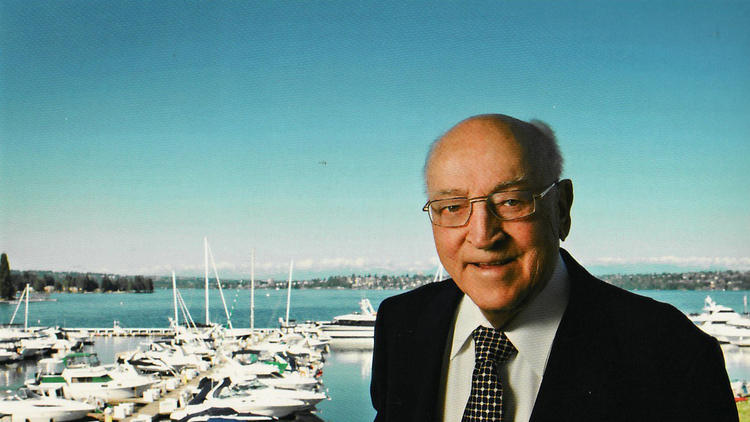
Much of the following is from an interview in 2005 with Stanley B. McDonald (pictured), the founder of Princess Cruises who passed away in November 2014. McDonald's comments are in italics.
During planning for the 1962 World's Fair in Seattle, we determined that there weren't enough hotel rooms for people coming to the fair. So we decided to bring in several ships to operate as a hotel while people attended the fair. We bought a ship and brought it out to the west coast from the Caribbean and it sailed from San Francisco to Victoria B.C. then down to the Seattle World's Fair for a 10-day cruise. For four days of the cruise the ship was used as a hotel while our people onboard visited the fair. This was a howling success and it continued operation during the entire fair.
From that we got the idea of a cruise ship. I saw that people loved to cruise. So we searched around and came up with a ship that we could operate as a cruise ship.
Up to now ships were only thought of as a means of transportation (think Old World to New World across the Atlantic) or for moving cargo from points A to B. Now, people could think of them as a new way to vacation!
Although there were some limited cruises offered in the Caribbean, McDonald's idea was to offer cruises from Los Angeles to Mexico during the winter months for those wanting a warm tropical destination. He chartered a 318-passenger converted ferryboat named Princess Patricia owned by the Canadian Pacific Railway. It was only used in Alaska during the summer months and just sat idle during the winter months.
Q: Why the name Princess Cruises? Where did that come from?
Princess Cruises came from the name of the first vessel we chartered from Canada, Princess Patricia owned by the Canadian Pacific Railroad. I liked it very much and I got permission to use the name Princess. We had to have something that would be well liked, that had quality in it -- and this is what we determined using the name Princess would be.
In November 1965, the Princess Patricia left Los Angeles for Mexico minus the shipboard swimming pools, glitzy nightclubs, casinos, spas and round-the-clock eateries that have since become associated with taking a cruise.
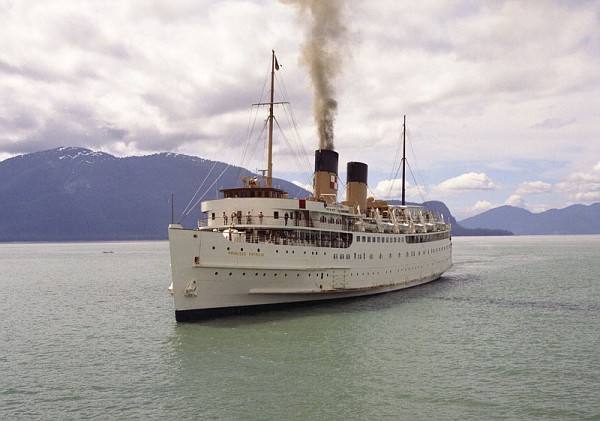
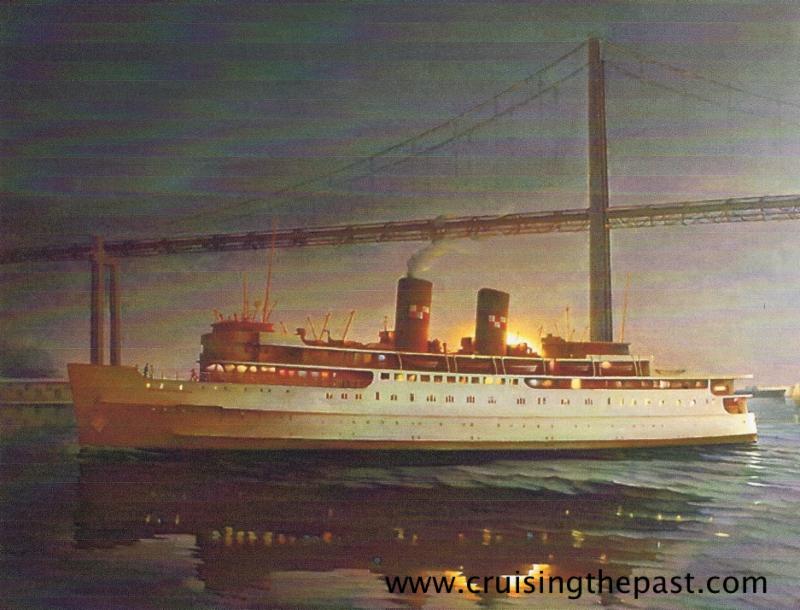
The Princess Patricia under steam. How she appeared when making her first Princess Line Cruise.
Princess was one of the first lines to popularize cruises to the west coast of Mexico--which they dubbed the "Mexican Riviera." In the summer of 1966, the ship returned to its tasks for the railroad in Alaska and Canada.
However, Princess Pat, as she was fondly called, had never been designed for tropical cruising, lacking air-conditioning.
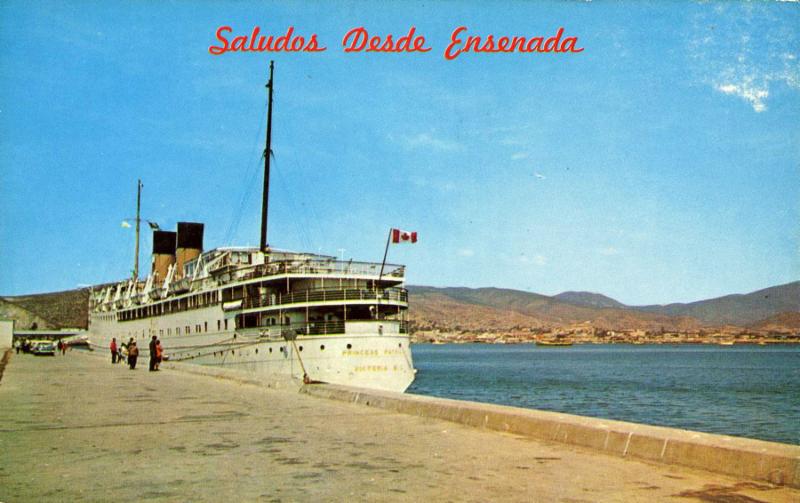
Princess Patricia First Port Call in Ensenada, MX
Following a second successful season shepherding snowbirds seaward, McDonald chartered an Italian-made ship named Italia.
The Italia had originally been ordered in 1963 by another company and was one of the first to implement modern design elements, such as lifeboats mounted lower on the ship, allowing for uncluttered upperdecks, and engines placed far in the rear, allowing for spacious public rooms amidship.
Construction proceeded slowly, and accordingly, the Italia was not launched until the spring of 1965, and during the fitting out, both the owners and the builder were declared bankrupt. The Italia was passed onto a bank who created a company to charter or sell the ship, and consequently, the company chartered the Italia to Princess.
Princess, marketed the ship as Princess Italia but never officially renamed her. She did not even receive the Princess logo on her funnel until 1967.
Continued high demand for berths led to the charter of the Princess Carla for the 1968 season. In 1969, the Princess Italia was used on Alaskan cruises from San Francisco. In 1971 MacDonald leased the Norwegian vessel Island Venture and renamed it the Island Princess.
McDonald did not stay in the cruise business for long. In 1974 he sold Princess Cruises to Great Britain's Peninsular and Oriental Steam Navigation Company (P&O), one of the world's oldest and largest diversified shipping firms but agreed to stay on as the CEO. With the financial backing of this industry giant, the California-based cruise line purchased the Island Princess as well as its sister ship, the Sea Venture. A retrofit transformed the Sea Venture into the Pacific Princess, a 20,000-ton vessel with room for 640 passengers.
P&O also transferred its Spirit of London to the Princess line, which renamed it the Sun Princess and the line also canceled its leases on the Italia and Carla.
Within a year of its adoption into the P&O family, Princess had become one of the world's largest passenger cruise lines!
Q: What was your original logo and how was the current logo created?
Originally, because we were going to Mexico, we had a character painted on the stack. But it was a little too Mexico-focused if we were going to more places like Alaska and the Panama Canal.
So, an artist came up with this concept and did the head of the princess that we now know, the colors and all. I looked at several different designs and said 'this is the one'-- and it's been that ever since.

The old logo was used for two years and the Seawitch came in on the third year. The current logo has been very telegraphic for people; they recognize it right away and it's gotten a lot of publicity. I think we paid $50,000 for the designer to do it and I would say now it's worth millions of dollars.
*****Talk about memories!*****
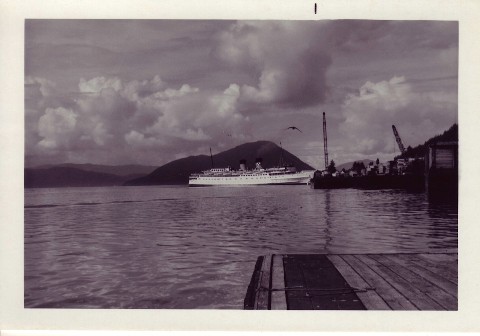
Thank you Dave for sharing this photo
*****
Q: What do you think of today's cruise ships compared to those when you were starting Princess?
I'm very proud of the fact that cruise ships are now the destination for the guest. They want to go see foreign countries and ports, but the ship really becomes the destination. It's entirely different than in the days when cruising was transportation. It makes me feel proud; these ships with 3,000 guests are tremendous and wonderful. The quality of the ships has increased so much that the general public has just embraced it and enjoyed it.
The Italia was the first modern built ship for cruising only -- probably one of the first, if not the first one. It was a modern, sleek ship that carried about 460 people and a lot of new amenities and entertainment.
My daughter came up with the idea of having a gym on board, now every ship has one.
Q: What are some of your early memories about this new vacation experience you had created?
I remember one of the biggest things was that people wanted to gamble while onboard. So we got some slot machines. The first time we put them on the ship we were coming out of Florida on the way to Los Angeles.
The first night out everybody was up there gambling, I thought to myself, "This is a big success." The second and third night, same thing -- then I found out the machines were put together wrong and they were all paying off a tremendous amount.
Matter of fact, I had to put up thousands of dollars myself in order to pay the people using the machines. So that was our introduction to gambling!
Q: Were there other funny incidents as you started cruising?
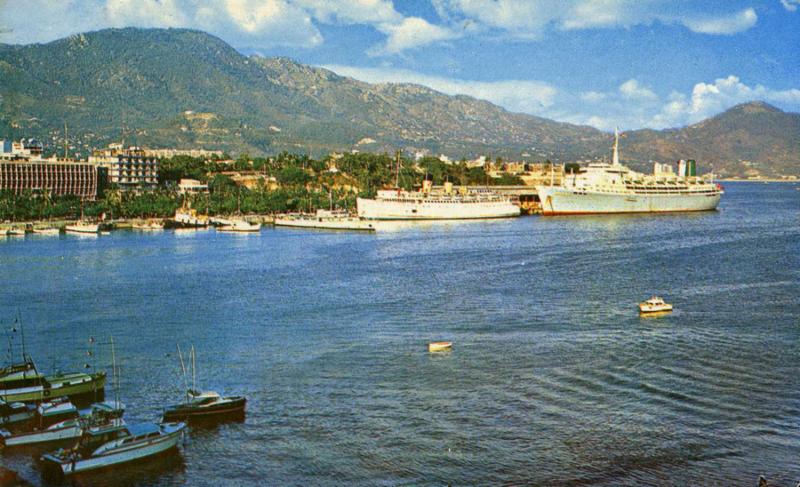
On our inaugural season on Princess Patricia, we'd go down to Acapulco and back. The Princess Patricia didn't have a laundry onboard because it wasn't a big enough ship. So we told guests they could have their laundry done in Acapulco. We got down to Acapulco and all the laundry was sent out and we were going to sail the next morning.
But the laundry came back as one owner: "Princess Patricia" with hundreds of people's laundry all mixed together. So we had to set up tables in the lobby and take out the clean laundry so people could come down and identify their clothes.
|
|
| Princess Patricia (the small ship) in Acapulco, MX. |
The Secret Word for March is laundry.
Q: What about shore excursions?
The main thing we did first was to recognize that people wanted to see the port and the people there. We had to plan for that through shore excursions that were interesting.
So we did do that and we were very proud of our tours. As a matter of fact, Princess Tours started entirely because of this and today it's a big company.
Q: Who were your early competitors and what was that like?
The only competitor starting out that we had was the Matson Line. They had ships that went to Hawaii and back. They were nice ships and they were under an American flag so they could operate between any ports in the U.S. They were very successful at that time but costs were rising and they started to have trouble.
There were also some ships that would be en route to, for example, Australia or London, and they would come into Los Angeles. We did have to compete with them, but basically we didn't have any true competitors until Sitmar Cruises came in. Sitmar was a west coast operator with good ships. They were still around when I left.
Q: How did "The Love Boat" come about?
"The Love Boat" is kind of an interesting story. Looking back, it was a very difficult decision to make.
Before "The Love Boat" we had various movie companies using our ship from time to time. Remember Columbo? We had various ones like that. It was fine, but they took up guest cabins which was bad because we were sold out. It gave us exposure, but they were somewhat of a nuisance, from the viewpoint of the guests who could be irritated because they were out on the deck. It didn't turn out to be too big of a problem but it was costly.
But during this time one of our cruise directors was writing a book. And she gave it the name "The Love Boats." It was submitted to us as a movie, onboard Island Princess. But it required 106 cast and crew, I believe, who we had to carry at our cost. We debated this quite a while because it was a huge commitment for us and certainly for the studio. Subsequently it was at Spelling that they decided to make a T.V. show of it.
Q: Is it true that Princess nearly said "no" to the Love Boat opportunity?
I will never forget the time when an executive came in to tell me: "I got rid of this person who wanted to make a deal with us on putting a T.V. show aboard the ship." He told me a little bit about what it was, and that night I left the office and came back the next morning and said, "Hey, I've been thinking about this more -- let's put this back on the front burner."
It was a big commitment for us, the small company that we were. And carrying this 100-some crew was costly. It turned out that it was "The Love Boat" that we nearly threw out -- but it was an incredible success. And the show made the cruise industry jump way ahead, years and years with that one program.
Q: How did the purchase by P&O come about?
When we sold to P&O it was my feeling that there was an opportunity to grow. They had the ability to build the new ships that were necessary to support growth for cruising in the U.S. And they were willing to do that. Under the agreement, I would stay and manage the company and be president of P&O North America for five years. I enjoyed very much working with them to build the company so it would be attractive to people in the U.S. And that was exactly what happened -- we did it the way Americans wanted and it worked.
Q: Explain what it was like to create ports of call in the early days.
When we first started cruising to Mexico it was unknown what was going to happen. The one port that no ship had ever gone to was Puerto Vallarta -- a beautiful place. I traveled down there from Mexico City and it took me more than a day on an airplane. Because the airplane had to stop at this little town, then that one, and we changed engines -- it was unbelievable. And here was this quaint little town with people doing their washing out at the creek and so on. Well, this was going to be an interesting port of call!
But we didn't have pier there, so we decided to drop anchor. But we didn't even have a small pier to get the people off the launch. So we talked to the local community and they said they would build a pier -- we were going to pay for it but they wanted to help. We began to build the pier, and then a storm came in and wiped out what had been built so far.
For the first cruise -- remember no ship had ever been in there -- we had to get something to get people off, because we couldn't get in close enough to shore with the launches. So, they got a barge and sank it on the beach, so the people could get off, walk up and across the barge and back down to the sand on the beach. Well, that solved our problem and saved our first cruise to Puerto Vallarta. The whole city got out there and finished the pier that is still there today.