Want to make a
Difference?
|
|
How about reducing your mowing by just ten percent? And getting your neighbours to do the same. How about your employer? Little steps by many add up to huge progress for our planet.
|
Princeton Retail:
763-631-9458
Scandia Retail:
651-433-1437
Customer Service:
800-837-5986
|
|
|
|
Greetings!
 
Last Sunday (March 13th) the New York Times printed an article by Edward O. Wilson entitled "The Global Solution to Extinction." This interesting article is well worth reading as it defines in quantitative terms the ecological condition of our planet and the related need for preservation and restoration. Although it ends on an optimistic note, it also identifies at least some of the immense challenges faced by humankind to maintain the diversity, stability and ecological health of the planet. Needless to say, all of us working to restore native plants or plant communities are attempting to help solve this challenge.
So, how are we doing so far? Well, in the past century we have gotten started but certainly not kept up with the loses. I think all would be shocked if we could travel back to 1916 to view the quantity and diversity of life as compared to what we see today. And going back 200 years would probably make even the most optimistic of us quite nervous (Bison, P. Pigeons, I. Billed Woodpeckers, the vast tall grass prairies, etc., etc.,). But if you are reading this you already get it. You are working to become part of the solution and all of us appreciate the effort. It is just that we need to do more and do it better. We need to embrace and restore diversity with all of our collective might. In small spaces and large, in the urban core and out in the open country, in the forests, wetlands, and ag lands across the planet. At PRI we are committed to this effort and will do all that we can to help you contribute as well.
So keep up the fight, be optimistic and enjoy the spring. We can and must prevail.
Ron Bowen
PRI President
|
|
|
 Retail Stores: Opening for the Season Retail Stores: Opening for the Season 
Now that spring has officially arrived, the PRI retail stores will soon be opening for the season! Regular store hours will begin April 4th for our Princeton and Scandia retail stores. Stop by and see what's new in our stores; browse our wide variety of books, gift items, works from local artists, bird houses, bird seed and, of course, our wonderful selection of native seed and plant materials. April Store Hours:Monday - Saturday 9:00-5:00Sundays: Closed
Boreal Natives will also have regular store hours beginning May 6th and running through July 2nd. Although not a source for books and other gift items, you can find the same high quality seed and plant materials you've come to expect from us. Boreal Natives: May 6 thru July 2 Friday: 9-5 Saturday: 9-1 *Other days and times available by appointment* For a complete breakdown of store hours, phone numbers, and directions, visit the Retail page on our website. Also be on the lookout for our monthly Retail E-Update which highlights special deals and promotions in our stores throughout the year.
|
|
|
Employee Profile: Jacob Anderson
 Jacob Anderson is our Director of Products and works mainly out of the main office in Princeton, Minnesota. Jacob has recently joined our company and is excited to grow with PRI in the coming years. He received his Master's in Animal and Range Science from Montana State University in 2013 and a Bachelors in Biology with a focus on Ecology from Augustana College in 2011.
As the Director of Products, Jacob is responsible for overseeing the production of plants and seed at our three production facilities in Minnesota. He works with the knowledgeable managers at each site to produce the high quality, origin specific native plant materials that PRI is known for. Although it may seem like he spends most of his time in the office, Jacob really enjoys driving the tractors on the farm, walking through the prairie, and getting his hands dirty in the greenhouse.
Jacob grew up near Sioux Falls, South Dakota and moved to western Montana after he graduated from college. In Montana, he was an ecological consultant and enjoyed exploring the scenery of the West. Jacob and his wife, Kristi, decided to move back to the Midwest to be closer to family and the prairie. They currently do not have any kids, but enjoy playing with their two year old Lab named Murphy. Outside of work, Jacob enjoys hunting, woodworking, tinkering with his pickup, playing his violin, and anything outdoors.
|
|
|
Project News: Hartley Park - City of Duluth Parks & Recreation
 A buckthorn and Asian honeysuckle removal project is currently underway at Hartley Park in Duluth, MN. This project is a collaboration between the City of Duluth Parks and Recreation, Prairie Restorations, Inc., and Hartley Nature Center. The first phase of the project, currently underway, is focused on the Old Hartley Road Trail which meanders for nearly a mile through the heart of the park. This trail is the most widely used and largest multi-use trail within the park. The heavy use of this trail by humans, wildlife, and birds, has resulted in this trail having some of the largest colonies of buckthorn spanning its length. As a result, this trail corridor has been designated as an area of utmost importance for removal because it serves as one of the most major seed sources for buckthorn throughout the entirety of the park. Given that the Old Hartley Road Trail is one of the most common paths for visitors to the park, this removal corridor provides the public with an up close and personal opportunity to observe the buckthorn and Asian honeysuckle removal process first hand.
Once this phase of the project is completed, a few other techniques and strategies will be implemented in other areas of the park. This includes work in three overgrown pine plantations that have an understory dominated glossy buckthorn. A selective harvest of the pines themselves will be taking place as well to increase the overall health of these areas. Also, as the city budget allows, areas with low infestations of buckthorn will be cut, slashed, stump treated, and left lay to decompose naturally. This process of removal will be primarily focused near Hartley Nature Center's main building.
The progress of this removal project is already starting to show a vast improvement to the park's natural areas and public support and approval has been overwhelming! PRI looks forward to developing a long range management plan for Hartley Park targeting other terrestrial invasive plants as well as buckthorn as we move into the coming years. With this project, raising public awareness of invasive terrestrial plants and helping the Hartley Nature Center to form volunteer action groups has been of the utmost importance. At PRI we are excited to provide the City of Duluth with technical support and educational awareness well into the future.
|
|
|
Save the Date - Prairie Day 2016!
In case you haven't heard, we have set a date for Prairie Day 2016! The event will be held at our Princeton Farm on August 13th from 9-4. Planning is well underway and details are being worked out, but it promises to be a great day of learning and enjoyment for the entire family.
One of the highlights of the day will include the opportunity to observe monarch butterflies visiting our blazing star flower plots. Envision literally hundreds and hundreds of monarchs fluttering about - it is an amazing sight!
More info will soon be available on our website. We are looking forward to a great event and we hope that you can join us!
|
|
|
Scientific Name Changes
 At PRI, the scientific (Latin) names for individual plant species are a very important aspect of how we maintain accuracy and authenticity in our restoration work. We organize our plant and seed inventories using scientific names, and they are a huge part of our internal dialogue. The system of binomial nomenclature is indeed important throughout the natural sciences because it gives us an accurate, clear way to distinguish species, whereas common names can vary regionally and tell us nothing about how species are related to each other.
This system however, is not static or written in stone, and many changes have occurred over time, as our knowledge base expands. Scientific names can switch back and forth, and sometimes more than one name is recognized.
In recent years, new genetic information about individual plants species and plant families has shed new light on how we classify them, and many familiar native plants are now recognized as belonging to a new genus, species and/or family. It seems that most of these recent changes are based on good scientific information and are likely here to stay.
In 2016, PRI has decided to update many of the scientific names that we use, to reflect changes that have occurred in scientific literature. These new names are found in our new 2016 brochure and on our website. Some of the most significant changes include species that were found in the Aster, Eupatorium, Petalostemum, Senecio, Smilacena and Scirpus genera. The previous scientific names that we used are still included in the plant descriptions within our brochure for reference purposes, so we encourage you to take a look and familiarize yourself with the changes.
|
|
|
Spotlighting: Wood anemone
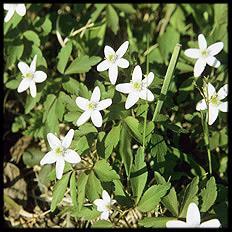 How great is it to live in a place like Minnesota where we can experience the changing seasons! For many of us, one of spring's greatest pleasures is a mid-day hike in the woods and getting reacquainted with our old friends, the woodland spring ephemeral wildflowers. Ephemeral, meaning short-lived or fleeting, makes these plants even more precious and after a cold winter nothing warms the soul more. Wood anemone (Anemone quinquefolia) is often found in deciduous woods growing near the base of trees even while piles of snow are still melting nearby. Although the flowers are solitary, the plants grow in clusters, perhaps to facilitate pollination. Wood anemone depends largely on wind instead of insects for pollination. The breezes jar loose the pollen and carry it to nearby blossoms for pollination, instead of insects who are few in number so early in the spring. Even for the few insects that are around, they don't find the blossoms particularly attractive due to their lack of nectar and lack of scent. On cloudy or rainy days the flowers will droop in order to protect the pollen from being washed away. Wood anemone is often found growing with Pennsylvania sedge, blue wood aster, columbine, early meadow rue and rue anemone.
|
|
|
 Resource Library Resource Library
Interested in the concept of landscaping with  native plants but wondering just where to begin? A visit to our Resource Library may be the answer. Packed with pages of useful information, this library can help you get acquainted with all things native. And remember, an on-site consultation with one of our restoration ecologists is only a phone call away! "Get a life in which you are generous. Look around at the azaleas making fuchsia star bursts in spring; look at a full moon hanging silver in a black sky on a cold night. And realize that life is glorious, and that you have no business taking it for granted."
|
|
|
|
|