|
|
|
Serving tribes in Kansas, Oklahoma, Nebraska, and Texas.
|
March 31, 2015
|
|
|
LINKS

Contact:
Jim Self, Manager
jim.self@okstate.edu
or
Karla Sisco, TTAP Specialist
karla.sisco@okstate.edu
|
|
|
|
|
| |
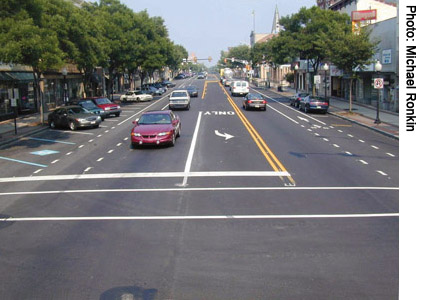
Every Oklahoma main street falls below 20,000 cars per day, and may be a candidate for a road diet. Road diets can improve safety for all users of the street, reduce crashes, and lower the speed of traffic on the street. (OU Institute for Quality Communities
|
Attention Safety Engineers, Transportation Planners, Pedestrian and Bicycle Coordinators, Safe Routes to School Coordinators, Local Public Agency Coordinators, and Transportation Alternatives Program Managers!
Road Diets is coming to Stillwater~Thursday, April 9, 2015
11:00 am to 3:00 pm
Road Diet live training and webinar
AGENDA
Please join FHWA, the Oklahoma LTAP, Southern Plains TTAP, City of Stillwater and the Oklahoma Department of Transportation for a presentation on "ROAD DIETS".
Four-lane undivided highways experience relatively high crash frequencies - especially between high-speed through traffic, left-turning vehicles and other road users. One option for addressing this safety concern is a Road Diet, which typically involves converting an existing four-lane undivided roadway segment to a three-lane segment consisting of two through lanes and a center two-way left turn lane. This reconfiguration has many benefits. As part of the safety focus area of the Every Day County (EDC) Initiative, the Federal Highway Administration (FHWA) is promoting Road Diets. This EDC Exchange will highlight how local agencies are using this low cost safety countermeasure to improve safety, operations, and livability in their communities. This Exchange will be of interest to Safety Engineers, Transportation Planners, Pedestrian and Bicycle Coordinators, Safe Routes to School Coordinators, Local Public Agency Coordinators, and Transportation Alternatives Program Managers.
________________________________________________________________________________________________
|
Asset Management training in Stillwater on Tuesday, April 7
Asset management
(Tribal RoadStar Program - Course 3) - This one day session is intended for tribal and local government employees responsible for managing transportation infrastructure. It will cover the core principles of asset management and introduce the basic steps to implementing a transportation asset management program.
Developing an Asset Management process will help your agency make the best decisions about tribal transportation infrastructure given the resources available. The method uses asset information to help tribal leaders make better maintenance and improvement decisions about the tribal transportation system to extend the usefulness of transportation assets with available funding.
SIGN UP!
________________________________________________________________________________________________
|
 Spring TTAP Training Schedule Spring TTAP Training Schedule
____________________________________________________________________
|
|
| |
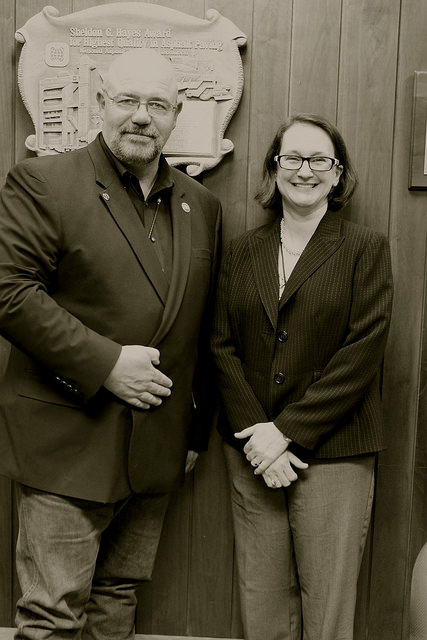
Jay Adams, outgoing Director-Tribal Coordination, OKDOT, was honored at the
March 10 OTTC meeting, and Dr. Rhonda Fair, OKDOT, was introduced as the new Tribal Coordinator.
|
Dr. Rhonda Fair introduced as new Director-Tribal Coordination at OKDOT
The Oklahoma Tribal Transportation Council recognized Jay Adams, Director-Tribal Coordination, Oklahoma Department of Transportation (OKDOT), for his years of service and dedication to tribal transportation at their regular meeting on March 10. Appreciation for Adams' service was also expressed by each board member at the Tribal Advisory Board Meeting (TAB) held earlier that day. At the TAB meeting, Adams also introduced the new tribal coordinator at OKDOT, Dr. Rhonda Fair. Fair currently serves as OKDOT's Tribal Liaison for the Cultural Resources Program. She will continue in that role along with her new responsibilities as Director-Tribal Coordination.
"Jay has truly been an asset to the Tribes in Oklahoma by allowing us to have firsthand knowledge and insight to ODOT. By collaborating and working together, Oklahoma Tribes have been able to get projects accomplished faster and more efficiently," noted Michael Lynn, OTTC Vice President.
"As I look back on the years I have worked in Indian country with many tribal program personnel, in State and Federal offices, I cannot think of many that have made and put forth the efforts to help our Native American people and our communities more than my friend Mr. Jay Adams. I truly believe he has helped the State of Oklahoma, the Tribal Governments and our County Commissioners come together as a team with the Federal Highways Agencies to improve our Oklahoma roads and bridges for our families to travel." added Milton Sovo, OTTC President.
PHOTOS
___________________________________________________________________________
|
SAVE THE DATE! National Tribal Transportation Conference, September 21-24
Hotel Information
Sheraton Myrtle Beach Convention Center & Hotel
2101 North Oak Street
Myrtle Beach, South Carolina 29577
| Room Rate: | $83 + tax | | Cut-off date: | August 21, 2015 | | Room Block Name: | NTTC | | Reservations: | 888-627-8203 |
Call for Presentations:
If you would like to present, or have suggestions for topics, please contact the Eastern TTAP at Michigan Tech at conference@ttapnttc.com. More information, along with a formal Call for Presentations, will be available on the conference website http://www.ttapnttc.com shortly.
Questions?
If you have questions, please contact the Eastern TTAP at Michigan Tech at 888-230-0688 or
ttap@mtu.edu.
More information can also be found on the conference website at:
http://www.ttapnttc.com
________________________________________________________________________________________
|
 Tribal Transportation Program Safety Funding FY2014 Awards have been announced!
The FY14 Tribal Transportation Program Safety Fund Award list is now available at:
http://flh.fhwa.dot.gov/programs/ttp/safety/ttpsf.htm.
WASHINGTON - U.S. Transportation Secretary Anthony Foxx announced today that 82 tribes will receive more than $8.5 million for 94 projects from the Federal Highway Administration (FHWA)'s Tribal Transportation Program Safety Fund (TTPSF) to improve transportation safety on tribal lands.
"Our nation's tribal communities deserve roads and bridges that are just as safe as any others, regardless of where they live," said Secretary Foxx. "By improving safety for drivers and their passengers on tribal lands, these important funds will enhance the quality of life for their communities."
________________________________________________________________________
|
Road Inventory Field Data Systems (RIFDS) training scheduled for April
April 29-30 in Rothschild, WI (Stoney Creek Hotel and Conference Center. Room Block: Eastern TTAP 800-659-2220.
Registration for Wisconsin event:
Phone at 1-888-230-0688, fax at 906-487-1834, or email to alkerttu@mtu.edu.
___________________________________________________________________________________
|
 FREE Summer Transportation Institute FREE Summer Transportation Institute
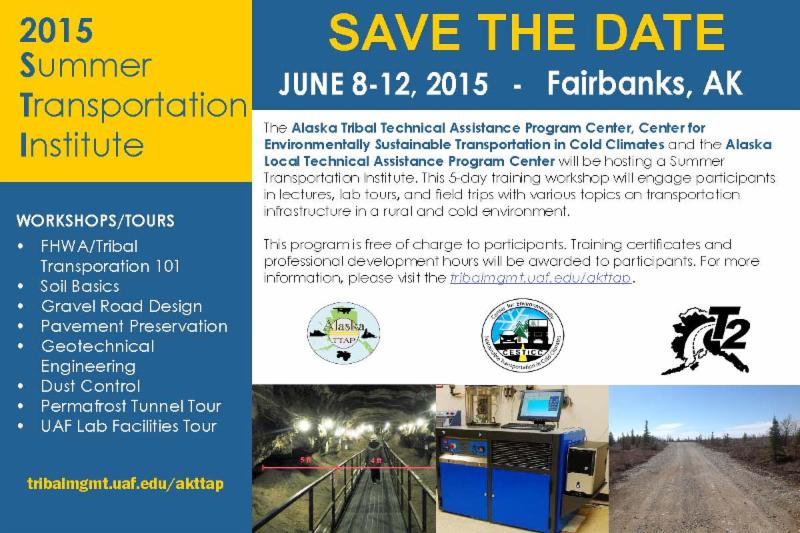
June 8-12, 2015 - Fairbanks, Alaska
The Alaska Tribal Technical Assistance Program Center, Center for Environmentally Sustainable Transportation in Cold Climates and the Alaska Local Technical Assistance Program Center will be hosting a Summer Transportation Institute. This 5-day training workshop will engage participants in lectures, lab tours, and field trips with various topics on transportation infrastructure in a rural and cold environment.
This program is free of charge to participants. Training certificates and professional development hours will be awarded to participants. For more information, please visit the tribalmgmt.uaf.edu/akttap.
Note: We will be looking into ways to video stream portions of the institute over the internet.
Workshops / Tours
FHWA/Tribal Transporation 101 * Soil Basics * Gravel Road Design * Pavement Preservation * Geotechnical Engineering * Dust Control * Permafrost Tunnel Tour
___________________________________________________________________________
|
|
|
|
|
|
| This material is based upon work supported by the U. S. Department of Transportation under Agreement No. DTFH61-12-H-00004. Any opinions, findings, and conclusions or recommendations expressed in this publication are those of the Author(s) and do not necessarily reflect the view of the Federal Highway Administration. |
|
|