 President's Message
 Greetings! Greetings!
Christmas has come in July for AARV members! In my last message I acknowledged that at least 60% of our members are interested in conducting clinical research in the field of veterinary rehabilitation, but there are barriers to our ability to carry out this research.
Two of the biggest challenges faced are the need for additional education in how to design and conduct research and the lack of access to a statistician. Well, we have received a gift-wrapped package from the University of Pennsylvania College of Veterinary Medicine. I am extremely excited to announce that AARV members now have an amazing new benefit - the opportunity to work with Drs. Dottie Brown, MSCE, DACVS, and Michelle Giuffrida, DACVS. Dr. Brown is the Director of Veterinary Clinical Investigations Center at the University of Pennsylvania College of Veterinary Medicine. Her areas of research include orthopedic disease, chronic pain, and methods of objectively assessing pain in veterinary patients. Dr. Brown developed the Canine Brief Pain Inventory. Dr. Giuffrida is a surgical and clinical trials oncologist at the University of Pennsylvania CVM.
Both Drs. Brown and Giuffrida have offered to help in the design and statistical analysis of clinical studies in the field of veterinary rehabilitation.
You will find Drs. Giuffrida and Brown's contact information in the Members Only section of the AARV website (rehabvets.org) on the Resources page (log-in required).
A big Thank You to Dr. Cara Blake for facilitating these relationships!
I am also excited to announce that the AARV is working with the Canine Rehabilitation Institute to develop an on-line course in "Designing and Conducting Clinical Veterinary Research." This course will be taught by Dr. Chris Zink, who, in addition to being a recognized expert on canine sports medicine has spent the past 35 years on faculty at Johns Hopkins Medical School where she has run a research laboratory focusing on the neurodegenerative effects of the HIV virus. She has great experience in creating and funding research projects, and has helped dozens of researchers complete their PhDs. She is excited to bring this experience to our colleagues in rehabilitation practice. AARV members will receive a substantial discount when enrolling in this exciting new class. Look for more details on this course in future newsletters.
I hope everyone is enjoying a fun summer!
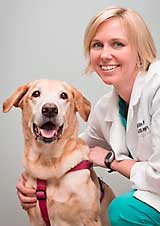
 Kristin Kirkby Shaw, DVM, PhD, CCRT Diplomate ACVS & ACVSMR |
 |
|
LEGISLATIVE UPDATE
Veterinary Practice Acts: Alabama, Alaska, Arizona and Arkansas
by Kristyn Richardson, DVM, CCRT, CVSMTLegislative Liaison  Hello, fellow Rehabilitation Veterinarians! Hello, fellow Rehabilitation Veterinarians!
Here we go - in alphabetical order - looking at our veterinary practice acts by state with regards to their mention of veterinary rehabilitation and their wording of the practice acts. The purpose is to take a look at how our practice acts impact us as a veterinary rehabilitative team. I promise this won't make your head hurt or your eyes bleed. It is just a glimpse into the rules that guide us by state - or lack thereof. Links to these practice acts and their complementary state practice acts for physical therapists are present on the State Practice Acts page of the AARV website for your reference, but I have included the first four for you to cut and paste into your browser if you are interested. Some of these acts are the most recent I can find. If you find you know of a more current version of the practice acts, please email the link to me and I will keep the site list updated. For your reference and comparison, here is a link to the AVMA Model Veterinary Practice Act-January 2013: https://www.avma.org/KB/Policies/Pages/Model-Veterinary-Practice-Act.aspx Alabama Link and reference: http://asbvme.alabama.gov/pdfs/licensee/practice_act_and_administrative_code.pdf In Alabama's practice act and administrative code, there is no provision specifying veterinary rehabilitation as the practice of veterinary medicine (34-29-61-(14) a), but the initial definition of the practice of veterinary medicine is "to diagnose, treat, correct, change, relieve, or prevent animal disease, deformity, defect, injury or other physical or mental condition; .." This is a very broad statement that covers a lot of area, but is not very specific. I wonder how that may impact our physical therapists in a rehabilitative team in Alabama. 34-29-61-(21) - In this part of the act, Alabama includes all other branches of specialties of veterinary practice. Since the ACVSMR is now considered a specialty, veterinary rehabilitation may be more specifically defined as practice done by a veterinarian in some interpretations. Again, how does this impact your veterinary rehabilitative team? To keep it short, I will just say that there are some very specific requirements for mobile clinics, satellite clinics, and referral clinics for veterinarians in the state. Alaska Link and reference: https://www.commerce.alaska.gov/web/portals/5/pub/VeterinaryStatutes.pdf In Alaska's veterinary statutes, there is no specific mention of veterinary rehabilitation or other specialized care. The definition of veterinary medicine is very similar to that above in Alabama. Most of the definition of veterinary medicine is in the definition section. There are no specific definitions of types of veterinary care (specialties, surgery, dental, reproductive, rehabilitative, spinal manipulation, acupuncture) as seen in other practice acts.
Arizona Link: https://vetboard.az.gov/sites/default/files/AZ STATUTES AMENDED_ revised July 2014.pdf In Arizona's veterinary statutes, Article 1, 32-2201.20 defines a specialist, which is standard in many veterinary practice acts. In Article 1, 32-2201.29, the definition of veterinary medicine "...includes veterinary surgery, obstetrics, dentistry, acupuncture, manipulation and all other branches or specialties of veterinary medicine and the prescribing, administering or dispensing of drugs and medications for veterinary purposes." This includes veterinary rehabilitation in the practice of veterinary medicine based on this inclusive definition. In Article 3, 32-2231A, " A person shall be regarded as practicing veterinary medicine, surgery and dentistry within the meaning of this chapter who, within this state: - By advertisement, or by any notice, sign or other indication, or by a statement written, printed or oral, in public or in private, made, done or procured by himself or any other at his request claims, announces, makes known or pretends ability or willingness to diagnose any animal condition, disease, deformity, defect, wound or injury or to perform any type of surgical procedure on animals.
- Advertises or makes known or claims ability and willingness to perform the following for hire, fee, compensation or reward that is directly or indirectly promised, offered, expected, received or accepted:
- Prescribe or administer any drug, medicine, treatment, method or practice for any animal.
- Perform any operation or manipulation on or apply any apparatus or appliance to any animal.
- Give any instruction or demonstration for the cure, amelioration, correction or reduction or modification of any animal condition, disease, deformity, defect, wound or injury.
- Diagnoses or prognosticates any animal condition, disease, deformity, defect, wound or injury for hire, fee, reward or compensation that is directly or indirectly promised, offered, expected, received or accepted.
- Prescribes or administers any drug, medicine, treatment, method or practice, performs any operation or manipulation, or applies any apparatus or appliance for the cure, amelioration, correction or modification of any animal condition, disease, deformity, defect, wound or injury for hire, fee, compensation or reward that is directly or indirectly promised, offered, expected, received or accepted." Certain exceptions are found is this section but, they do not pertain to veterinary rehabilitation specifically.
Arkansas Link and reference: http://www.arvetboard.com/sgvetboard/practice.pdf In Arkansas' practice act, the "'PRACTICE OF VETERINARY MEDICINE' means: - The diagnosis, treatment, correction, change, relief or prevention of animal disease, deformity, defect, injury or other physical or mental condition, including the prescribing or administration of any prescription drug, medicine, biologic, apparatus, application, anesthetic or other therapeutic or diagnostic substance or technique, on any animal including but not limited to acupuncture, dentistry, animal psychology, animal chiropractic, theriogenology, surgery (including cosmetic surgery), any manual, mechanical, biological or chemical procedure for testing for pregnancy or for correcting sterility or infertility or to tender service or recommendations with regard to any of the above;
- To represent, directly or indirectly, publicly or privately, an ability and willingness to do any act described in the paragraph above;
- The use of any title, words, abbreviations or letters in a manner or under circumstances which induce the belief that the person using them is qualified to do any act described in subdivision (2)(A) of this section. Such use shall be prima facie evidence of the intention to represent oneself as engaged in the practice of Veterinary Medicine;
- Collecting blood or other samples for the purpose of diagnosing disease or other conditions. This shall not apply to unlicensed personnel employed by the United States Department of Agriculture or the Arkansas Livestock & Poultry Commission in disease control programs carried out under the authority of USDA and/or the State of Arkansas.
This shall not apply to Veterinary Technicians or assistants acting under the direct supervision of a veterinarian as set forth in §17-101-306(b) and (e) of this Act except for collecting blood for State/Federal tests requiring that the licensed veterinarian draw the sample." Also the definition, ""VETERINARY MEDICINE" includes veterinary surgery, theriogenology, dentistry, acupuncture, animal psychology, chiropractic and all other branches or specialties of Veterinary Practice; ." These definitions are very similar to the above practice acts, but with more specific mention of different areas of veterinary medicine (theriogenology, acupuncture, dentistry, animal chiropractic). However, veterinary rehabilitation is not specifically mentioned but the practice of physical rehabilitation can be inferred from the definition. There are, however, specifications about "veterinary chiropractic" being performed by a licensed human chiropractor under immediate supervision of a veterinarian and requirements for those performing equine massage in this practice act.
Well, there you have it! We will continue to add more links to the State Practice Acts page on the AARV website for additional states.
|
We are happy to report that the AARV strategic plan is well underway. One of the goals we have identified is to get our members more actively involved with the organization. The good news is that we are hearing from many of you that this is exactly what you are looking for! We are now in the process of creating a number of committees that will report to the board of directors. Serving on a committee is a great way to share your talents and experience. It also gives you the opportunity to network with colleagues on a regular basis. You can have a direct impact on the direction of AARV and stay closely connected to what is happening in the field of veterinary rehabilitation. So give it some thought. Are you part of a successful rehab practice? Are you social media savvy? Do you have connections to the veterinary industry or academia? Are you invested in legislative issues related to the practice of rehabilitation? Research? We will get back to you in the next newsletter with more information about the new committees and opportunities for service..
|
2015 Graduates, Have You Claimed Your Free Year of Membership?
 This spring, the AARV Board of Directors decided to give all graduating student members an additional free year of membership for their first year in practice! Each student member who graduated this spring should have received an email asking them to respond and update their contact information to begin their free year of membership. If you are an AARV student member who graduated this spring and you have not received an email about a free year of membership, please email Vivienne Von Baillou, AARV's database administrator, with your name, graduation date, degree earned, and new contact information.
|
|
TECHNICIAN CORNER
Helping The Pet Owner Select and Use an Appropriate Land Treadmill for Their Pet
by Kristen L. Hagler, BS (An.Phys), RVT, CCRP, CVPP, OACM, CBWAARV Technician Liaison|
| |
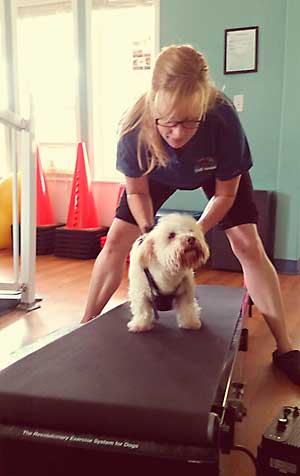
Jenn Panko, RVT, CCRP (OCMC, CAMPC), works with her client Logan on a land treadmill.
|
Veterinary prescribed and monitored home exercise programs are an integral part of veterinary physical rehabilitation. The Credentialed Physical Rehabilitation Veterinary Technician is an excellent resource to educate pet owners about the safe use and selection of appropriate and durable rehabilitation equipment to help their pet achieve fitness and rehabilitation goals and to maximize their lifelong mobility.
This month AARV Technician Member Jenn Panko, RVT, CCRP (OCMC, CAMPC), of The SPAW Pet Rehabilitation and Fitness in Aldergrove, British Columbia, Canada, writes: Clients often ask The SPAW's Companion Animal Rehabilitation Team how to use and choose a land treadmill for their pet. We provide the following guidelines for land treadmill selection and use: Size: - Belt length = stride length + 10-12 inches : Measure your dogs stride at the trot on a dry surface like cement, wood, or paper after dipping their feet in water and add 10 inches to account for variable stride length due to increased stance phase of gait on a treadmill and the potential for the dog to slide backwards at times.
- Belt width: The wider the better. Dogs often sway side to side during ambulation. A wider belt will allow for a larger margin of safety.
Safety Considerations Human Treadmill vs. Dog Specific Treadmill: - Side guards and barriers: Treadmills designed for human use do not come with the side guards and barriers that dog treadmills typically have. When selecting a dog specific treadmill it is recommended that the sides be removable as some dogs require the handler to stand over them for emotional or physical support (ie/ gait patterning in neurologic patients or hind end support in geriatric pets)
- Front console: Treadmills designed for human use often have a front console that can interfere with handler control and interaction with the pet. The console if present should allow for the handler to have complete access to the pet. The pet should NEVER be tied to any part of the treadmill.
- Belt material: Land treadmills designed for human use rely on their users to be wearing shoes. When selecting a land treadmill for pet use make sure the material and surface is bare foot/paw friendly.
- Gaps between belt and treadmill casing: Treadmills designed for human use may pose a risk for pets feet as toes can get caught between the belt and treadmill casing. It is important that potential treadmills be thoroughly examined for gaps and that the space between the belt and casing is non-existent.
- Off switch: It is recommended that the chosen treadmill have an immediate stop button that is easily accessible in case of emergency.
Land Treadmill Use: - Introducing your pet to the land treadmill: It is recommended to have your pet walk on and off the treadmill with you safely, slowly, and repeatedly using positive reinforcement. It is recommended that your pet observe the treadmill in motion before using it.
- Use of the land treadmill: It is recommended that pets wear a harness and leash while using a land treadmill and are under constant supervision. Sessions should begin with 1-2 minutes working up to no longer than 20 minute sessions.The treadmill should face an open interactive area. Using a land treadmill facing a wall may have negative effects on stride length, gait, and overall pet performance and willingness to use the land treadmill.
- Gait: The walk should be comfortable with long fluid strides. The pet should not struggle at the walk. If the treadmill is too slow when a walk is the desired gait they may appear to have difficulty with their coordination. When moving to a trot the selected speed should produce a fluid and even trot gait. Pacing on a treadmill can indicate an underlying medical condition or anxiety about the activity. If the pet paces on the land treadmill please see a veterinarian for a comprehensive mobility examination to rule out mobility issues.
- Land Treadmills and Cats: Cats often enjoy and benefit from land treadmill use. Constant supervision is required and the same specification and safety considerations other than stride length concerns apply to land treadmill use and selection for our feline friends.
About Jenn Jenn Panko owns and manages The SPAW, a Canine Rehabilitation, Sports Medicine, and Fitness Centre in Aldergrove, British Columbia Canada in partnership with The Aldergrove Animal Hospital. She is a Registered Veterinary Technologist (Seneca College, Ontario 2005) where she was the recipient of The Veterinary Technology Recognition and Appreciation Award for dedication to and excellence in animal care. She completed The University of Tennessee's Certified Canine Rehabilitation Practitioner Program in 2006. In 2012 she completed the University of Tennessee's Certified Osteoarthritis Case Management Program and was the recipient of The Ontario Association of Veterinary Technicians Award of Merit for enhancing the image of the veterinary technology profession and a long standing history of community service. In 2014 she completed the University of Tennessee's Companion Animal Pain Management Certificate Program. Her clinical experience includes a variety of work in private, referral, and academic companion animal practice, mobile, racetrack, and surgical equine practice, and wildlife rehabilitation. Jenn has a wide variety of experience in orthopedic, neurologic, weight loss, and conditioning rehabilitation. She developed her tool box of rehabilitation skills at The Mississauga-Oakville Veterinary Emergency Hospital and Referral Group coordinating CARE, The Companion Animal Rehabilitation Experts, Rehabilitation Service. She also managed The Neurology and MRI Service. Prior to her recent relocation to British Columbia she was part of the team at The Hill's Pet Nutrition Primary Healthcare Centre, as a primary healthcare technician and coordinator of The Companion Animal Rehabilitation Service at The Ontario Veterinary College, University of Guelph. She is pleased to provide rehabilitation lectures and workshops at conferences and veterinary meetings and teach large animal laboratory sessions at her local veterinary technician college.
Do you have an article in mind for the Technician Corner? Contact Kristen Hagler to submit an article (suggested length of 200-300 words) or suggest a topic.
|
 Are You Speaking at an Upcoming Meeting? Are You Speaking at an Upcoming Meeting?
 If you will be lecturing at a meeting in the next three to four months, please let AARV know! We will be adding a list of our members' upcoming speaking engagements to this newsletter. Please send your name and the topic of your talk along with the meeting name, dates, and location to AARV's public liaison at info@rehabvets.org. |
 Join Our Speaker Registry! Join Our Speaker Registry!
We are continuing to look for members who are interested in speaking at their local VMA meetings and also national meetings as part of our goal of increasing awareness of the field of veterinary rehabilitation and the AARV. If YOU are interested in being considered as a speaker, please send your name, your CV, and the state/s in which you would speak, as well as potential rehabilitation topics to Dr. Janet Van Dyke, AARV past president/programming committee chair ( janetvandyke@me.com). |
|
UPDATED BROCHURE!
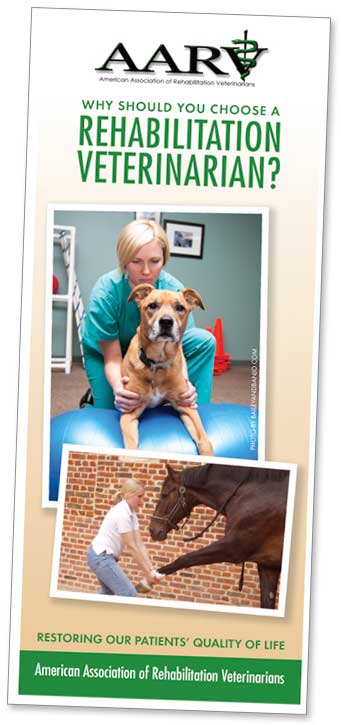
AARV Members: Download Our Updated Free Brochure for Your Clients and Colleagues
AARV has updated its brochure "Why Should You Choose a Rehabilitation Veterinarian?" and made it available as a free download for members from the website. The brochure is a high-resolution PDF that may be printed and distributed to clients and colleagues to help explain the benefits of working with a rehabilitation veterinarian. The brochure also may be customized with your practice's contact information on the back panel. To download the PDF, go to the Resources page in the Members Area (log-in required).
|
|

Have You Read the Latest Articles of Interest?
The July Articles of Interest are posted in the Members Only area of the website. Our Articles of Interest documents containing journal abstracts and citations are posted online to help you stay up to date on the latest research and publications. We also keep links to past Articles of Interest so you can easily catch up if you miss a month. Click here to read the July Articles of Interest and past Articles of Interest. Enter your username and password to log in, then go to the Articles of Interest page. You must have a current membership recorded in our database for access to the Members Only area. |
|
 Send Us Your News! Send Us Your News!
AARV members, we're looking for your news! Have you hired more staff, had a peer-reviewed article published, or accepted a leadership position with an organization? We'd like to get updates on your rehabilitation activities and share your news in our email newsletters. To see your news in print, email a brief description - and a photo if possible - to AARV's public liaison at info@rehabvets.org. |
|
NEW ARTWORK!
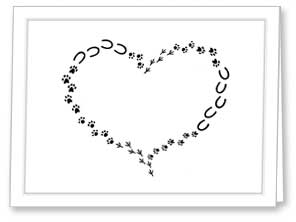
AARV Memorial Cards Feature Original New Artwork
AARV has updated its printed memorial cards with original new artwork by artist Carol Lavelle of Hawaii. The new artwork, which was created for AARV, features pawprints, hoofprints and footprints from a variety of animals arranged in a heart. These memorial cards may be sent to clients of your practice as an expression of sympathy from your staff. The card indicates that you have made a donation to AARV as a way of honoring the life of their companion animal. The inside of the cards contains blank space to allow you to personalize the card and the statement "This gift will support AARV's mission by providing opportunities for education and collaboration among veterinary professionals to introduce, educate, develop, and nurture the practice of rehabilitation in veterinary medicine and animal care." Cards come with matching envelopes and are sold in sets of 10 cards for $105 and 25 cards for $255 including shipping and handling to U.S. addresses. For international shipments, sets of 10 cards are $125 and sets of 25 cards are $275, including shipping and handling. Visit the Products page of the AARV website to order these memorial cards online.
|
|
Did You Miss Our Last Newsletter?
Our June 2015 issue included: - President's Message from Dr. Kristin Kirkby Shaw
- Congratulations to Dr. Leilani Alvarez, AARV's New Industrial Liaison!
- Call for Nominations for AARV Public Liaison
- AARV Research Grant Applications Due July 1
- Abstract Submissions for NAVC 2016 Due July 1
- Congratulations to Our Survey Winners!
If you missed this issue, you can read the June newsletter online or from the e-Newsletter page on the AARV website.
|
|
CLASSIFIED AD
Licensed Veterinary Technician - Full-time, The Animal Medical Center
Seeking a highly dedicated individual to join us in our beautiful newly renovated state-of-the-art facility. The AMC is a world-renowned referral/specialty hospital with unparalleled opportunities for professional growth. Successful candidate should be a team player with strong communication skills and work ethic. We are fully equipped with Class 3b/4 lasers, 2 UWTM's, hakomed pain management tub, shockwave, overhead lift and all standard exercise equipment/modalities. You will join 2 rehab certified DVM's, 3 rehab techs and 3 assistants. We offer competitive salary, CE and full health benefits. Please send letter of interest and resume to: Leilani.Alvarez@amcny.org.
|
|
|
Tier 1: Education and Research Sponsors
|
|
Tier 2: Sponsors Providing Member Discounts
|
|
Tier 3: Additional Sponsors
|
|
|
|
|