|
|
|
|
Greetings!
At Taylor, Warren & Weidner, we are dedicated to assisting those who need legal guidance. All of our firm's attorneys began practicing law with the goal of helping people and that vision remains today. With that vision in mind, we are poised to dedicate our knowledge and resources to you through this monthly newsletter.
Sincerely,
Taylor, Warren & Weidner, P.A.
850-438-4899
|
|
|
Will the New Texting While Driving Law Save Lives?

It is common knowledge that texting while driving is dangerous. Taking your eyes off the road every couple of minutes to hunt and peck for letters on a wireless device is going to impair your ability to safely operate a vehicle.
This is part of the reason why recent video of a Florida bus driver texting and driving at the same time has caused such outrage. Not only is the driver putting herself and other motorists at risk, but she is also compromising the safety of the innocent children on the bus. What has added to the furor is that the bus driver probably won't be prosecuted for her actions. Florida's texting while driving law doesn't go into effect until October 1st, 2013. Technically speaking, at the time the bus driver was caught, she wasn't even breaking the law.
What may anger Florida residents even further is that even after the new law goes into effect, many people who text and drive will not be caught and even fewer will be successfully prosecuted. When creating the law, the legislature stated that its intent was to crack down on the alarming increase in injuries and deaths associated with distracted driving. Sadly, the current law will not likely have that effect.
One reason why the law will not likely serve as a substantial deterrent to texting while driving is because its enforcement can only occur as a secondary action. What this means is that law enforcement cannot stop a driver just for texting and driving. The driver must commit some other primary violation, and then a police officer can stop the driver and charge them with texting while driving. Most other states have enacted laws that make texting while driving a primary action. In fact, 41 states currently ban text messaging for all drivers. All but 4 have primary enforcement. If the law is to truly deter drivers from texting while driving, police officers must be able to pull over motorists when they see them texting and driving.
Another reason why the law may not be as effective is because proving that someone is texting while driving can be difficult. For example, it is unclear if police can legally search your cell phone if they stop you.
Civil rights advocates have claimed that any search of a person's cell phone is an invasion of privacy and amounts to an impermissible warrantless search under the 4th Amendment. The United States Supreme Court may soon rule on this issue as it has been asked to rule on two cases that challenge the legality of warrantless cellphone searches under the Fourth Amendment in its upcoming session. The law in Florida allows the use of billing records as evidence to establish that someone was texting and driving, but how police will get those records and whether that will be admissible evidence remains to be seen.
Regardless of how the law is applied or whether the bus driver is ultimately held accountable for her actions, the fact remains that texting while driving is negligent. If
you or a loved one have been injured in an accident because the other party was texting while driving or distracted in some other way, please contact Taylor, Warren & Weidner, P.A. We will help protect your rights and hold the other party responsible for their negligent actions.
|
|
 |  |  |
Distracted Driving Statistics
As mentioned in our main article, the recent media uproar over the Florida bus driver who was texting while driving has brought increased attention to the dangers of driving while distracted.
Distracted driving is any activity that could divert a person's attention away from the primary task of driving including talking on the phone and texting.
While you may assume that distracted driving causes accidents, the sheer numbers may surprise you. For example:
According to the U.S. Department of Transportation, in 2011, 3,331 people were killed in crashes involving a distracted driver, compared to 3,267 in 2010.
In addition, 387,000 people were injured in motor vehicle crashes involving a distracted driver.
You are 23 times more likely to get into a crash if you engage in activities that distract you as a driver
According to research conducted by the CDC, 31% of U.S. drivers ages 18-64 reported that they had read or sent text messages or email messages while driving at least once within the 30 days prior to when they were surveyed.
|
|
|
|
|
Caught On Tape:
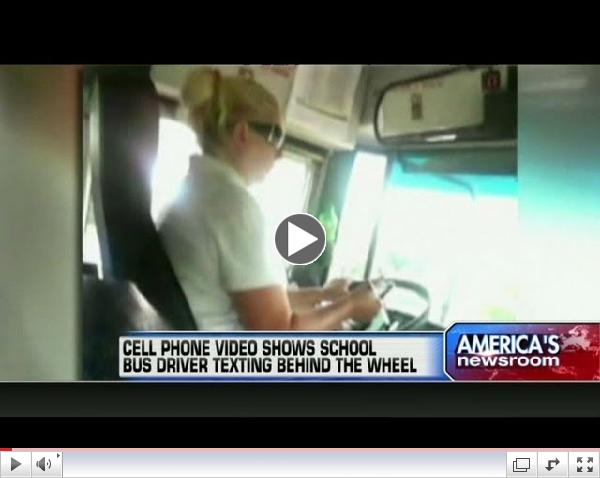 | | Florida School Bus Driver Caught Texting While Driving |
|
 | |
Case Spotlight:
Negligent Texting
 The American Bar Association recently published a report concerning the decision of a New Jersey Appeals Court which just created the tort of "Negligent Texting." That court just decided that a "Texter" (a person who sends a text) can be held liable for injuries to people miles away caused by a driver who received the text and became distracted and caused an accident. This court stated that in order to be held liable, the Texter had to know, or should have known, they were sending a text to someone operating a vehicle.
The court essentially held that a person who sends a text owes a duty of care to third parties who are located near the recipient of the text. Now, implicitly, a driver is at least partially excused from causing an injury when they "drive while distracted." The logic being the Texter is responsible for defeating the will-power of the driver due the overwhelming temptation to read or respond to their text. To get to this result however you have to conclude that a driver's duty to maintain a proper lookout is reduced if the driver is distracted by an overwhelming temptation.
From a jurisdictional standpoint the holding has problems. What if a person in California sends a text to a friend in New Jersey wherein an accident ensues? Does the New Jersey long arm statute apply to text messages sent to a person located in New Jersey. Is a text message substantial and sufficient contact to give a New Jersey Court jurisdiction over a person in California? What if texting and driving is legal in the state the text was sent from? Will that person have to answer to New Jersey for sending a text that was legal in his home state?
A "slippery slope" analysis of how this rule of law could be applied in other contexts demonstrates the extreme nature of this holding:
What if the recipient of your text, while walking, becomes distracted and walks into someone and inadvertently bumps them into traffic? Is the Texter liable for a distracting a walking person?
What if a driver becomes distracted by a person on the corner wearing a gorilla costume holding a sign that says "We Buy Gold"--isn't the sight of a gorilla costume at the corner of an intersection as tempting to look at as a text message?
Instead of a costume gorilla, what if that person is an attractive man or woman that distracts the driver-can you be liable for being "overly attractive" and deemed too attractive to be in public.
What if a driver became distracted by a road sign that was faded or confusing-should the government then also be liable for causing a distraction?
This New Jersey ruling is a one of first impression. There is no indication whether this ruling will be appealed. But for now, it may be a good idea not to text your friends in New Jersey or you may be forced to visit them for official reasons.
|
| |
Community Spotlight
7th Annual Glass Pumpkin Patch
 First City Art Center is holding its 7th Annual Glass Pumpkin Patch. Make sure you arrive early to get the "pick" of the patch. This is our biggest year yet, with over 1500 unique hand-blown glass and hand-thrown clay pumpkins to choose from. First City Art Center is holding its 7th Annual Glass Pumpkin Patch. Make sure you arrive early to get the "pick" of the patch. This is our biggest year yet, with over 1500 unique hand-blown glass and hand-thrown clay pumpkins to choose from. WHEN: Saturday, Oct 12, 2013
TIME; 10am - 2pm
WHERE: First City Art Center, Creative Warehouse 1
COST: No entry fee. 
Stephanie Taylor volunteers her time as the Vice President of the First City Art Center (FCA). The FCA is a non-profit with the goal of providing the Pensacola community an opportunity to participate in the creative process through a "working" art center. Through a broad range of studio classes, workshops and outreach programs, it serves over 1,000 adults and children each year.
|
| |
|
About Taylor, Warren & Weidner, P.A.
 From an office in Pensacola, Florida, Taylor, Warren & Weidner, P.A. ("TWW") represents individuals throughout Escambia County, Santa Rosa County and the surrounding areas. As a firm focused on helping people, we offer personalized legal services and effective client advocacy. Our firm offers legal counsel to people at times when they need it most. At TWW we have a firm culture of placing the interests of our clients first and serving those interests with professional, ethical and zealous advocacy. Preparation, devotion and resolve is the trademark of our successful firm. We are proud of our record and tradition of excellence. The firm's careful preparation and experience ensures that each case will be clearly developed and persuasively presented to achieve the most optimal level of success. At TWW we use cutting edge technology and innovative methods to develop and present our clients' cases. The lawyers and staff at Taylor, Warren & Weidner have been privileged to represent thousands of clients in resolving their legal problems. We take great pride in knowing our cases have helped victims recover from life changing events. We are proud of the fact that our advocacy has benefited our clients and changed the way insurance companies treat everyday people for the better. Our cases help improve the way products are manufactured, roads and buildings are designed and constructed, and how health care is provided. At TWW, we speak for the victims of those who have been injured by the negligence of others, treated unfairly by the powerful, and who are in need of justice. Taylor, Warren & Weidner, P.A. began with the simple vision of creating an unparalleled team of legal professionals to deliver the best results possible to clients. Our dedication to our clients has allowed us to successfully fulfill our vision and experience immediate growth. Today, TWW maintains the same results-oriented vision. The dedication to our clients continues to drive our success. While we have expanded our staff and services, we have never lost sight of the reason for our success. We hope you will give us the opportunity to show you why our clients trust us to deliver the best results possible.
|
| |
|
|
|
|
|
|
|



