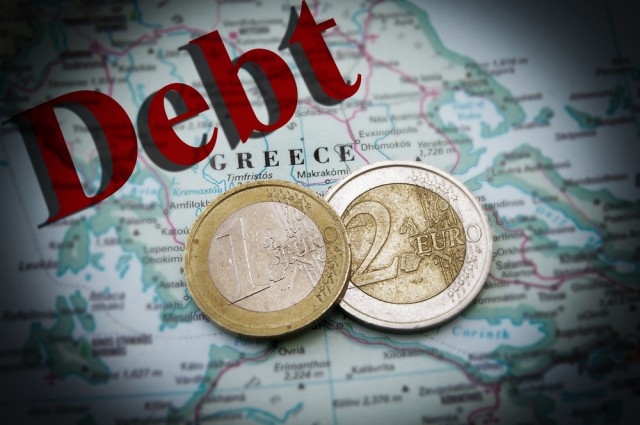
From the days when monarchs over-borrowed for their mercantile adventures, countries have long run into trouble paying back what they have borrowed. Spain's 16th-century king, Philip II, reigned over four of his country's defaults. Greece and Argentina have reneged on their commitments to bondholders seven and eight times respectively over the past 200 years. And most countries have defaulted at least once in their history.
But what precisely happens when countries stop paying what they owe?
When a country fails to pay its creditors on time, it is said to go into "default", the national equivalent of going bankrupt. But country defaults are quite different from business bankruptcies as it is far harder for creditors to repossess the assets of a country than to repossess the assets of a company.
In the first instance, to curry favor in international markets, defaulting countries tend to restructure their debt rather than simply refusing to pay anything at all. When Greece defaulted in 2012, bondholders were forced to take hits as high as 50%. In less severe cases, countries may choose to restructure their debt by requesting more time to pay. This has the effect of reducing the present value of the bond-so it isn't entirely pain-free for investors. This is the course that Greece was trying to pursue before the weekend.
Defaults can also be very painful for the offending country. Typically, domestic savers and investors, anticipating a fall in the value of the local currency, will scramble to withdraw their money from bank accounts and move it out of the country. To avoid bank-runs and precipitous currency depreciation, the government may shut down banks and impose capital controls. This is happening currently in Greece and is standard operating procedure.
As punishment for default, capital markets will either impose punitive borrowing rates or refuse to lend at all. And credit-rating agencies will no doubt warn against investing in the country. But as history shows, in most countries yield-hungry lenders will eventually start lending again so long as they are adequately rewarded for the risk they are taking by earning higher interest rates. Moreover, credit-default swaps-financial instruments which act as a form of insurance against sovereign and corporate defaults-allow bondholders to hedge their risk.
One of the investments that is the temporary beneficiary of this uncertainty is U.S. Government bonds. The "flight to safety" is a common sentiment when uncertainty rises above normal levels. High quality U.S. government bonds
attract buyers as traders move money from more volatile asset classes to lower risk investments. This is why every DMM client has some allocation to high quality, dollar-denominated, government bonds. Owning these bonds dampens the volatility of portfolios during periods of elevated global uncertainty. When the global markets opened after the weekend, predictably, stocks were down and U.S. bonds were up.
There is a plan in place to deal with these uncertainties This too shall pass.