|
|
|
| Upcoming Dates |
October 26, 2016:
CGFA and NGFA Joint Grain Safety Seminar
DoubleTree, Fresno, CA
2017
January 11-12, 2017
Grain & Feed Industry Conference
Embassy Suites, Monterey Bay, CA
April 26-29, 2017
CGFA Annual Convention
Hyatt Regency Lake Tahoe Resort, Spa & Casino
May 10 - 11, 2017:
California Animal Nutrition Conference (CANC)
|
|
Benefits of Belonging to CGFA
|
- State & Federal Legislative Advocacy
- Industry & Small Business Issues
- Business Advocacy
- Weekly Updates on Current Issues
- Networking Opportunities
- Industry Specific Directories
- Advertising Venues
- Social Media Sites
- Cost Saving Insurance Programs
- Environmental and Safety Resource
- Continuing Education and Training
- Political Action Committee Administration
- Annual Convention
- Education Programs
- District Meetings
|
|
|
CGFA Tour of the UC Davis Feed Mill
|
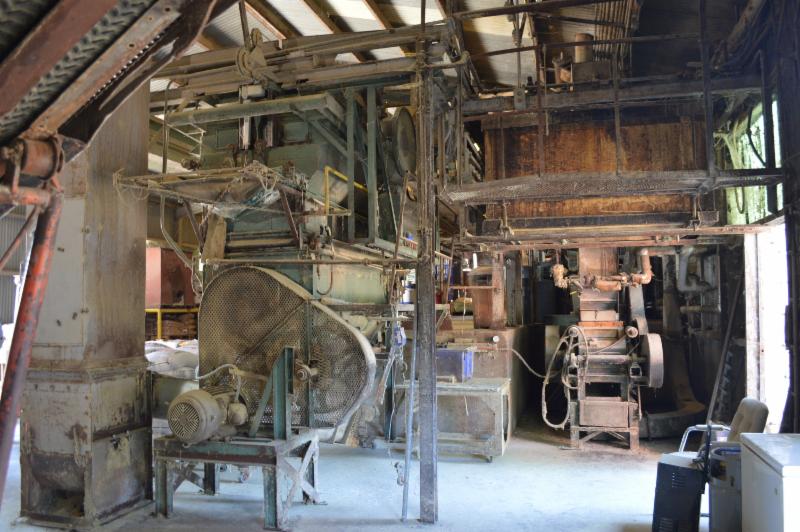
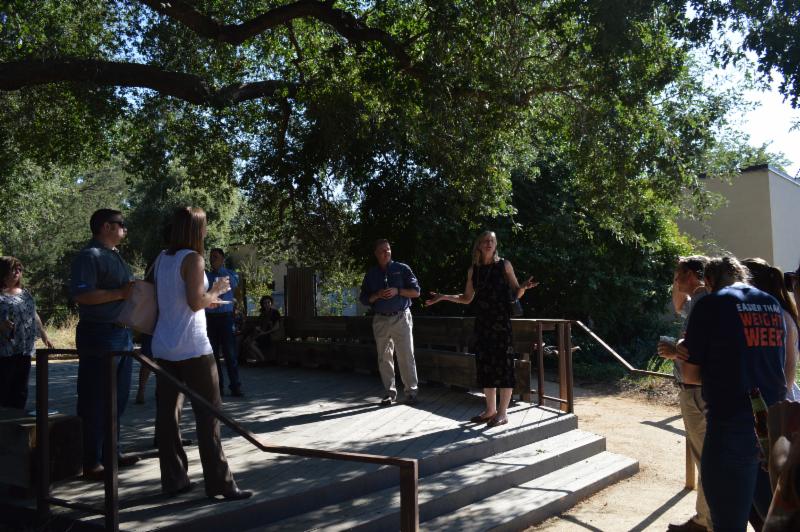
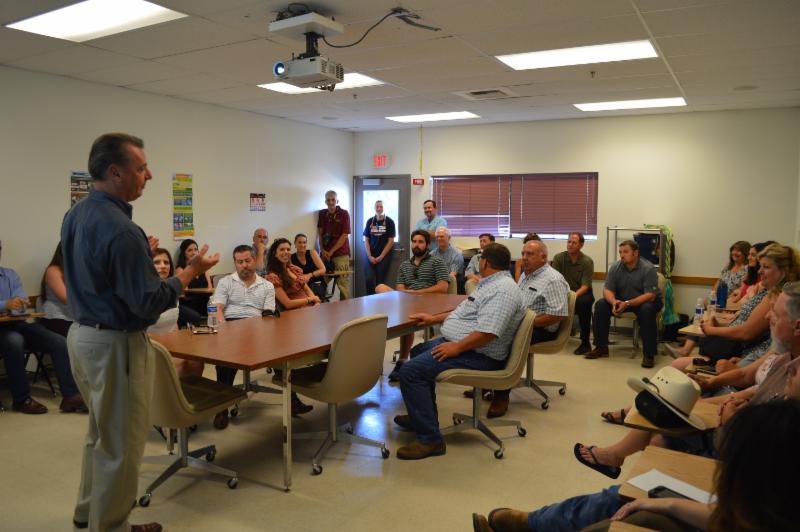 On Tuesday, July 26th CGFA board members, staff and guests headed to UC Davis for a tour of the feed mill, where they also saw the swine facility, feedlot, and bovine bubbles. Upon arrival they were welcomed into the Swine Center classroom by UC Davis Animal Science faculty and graduate students, including Professor and Air Quality Specialist, Dr. Frank Mitloehner who presented on UC Davis' drive to connect academic firepower with industry needs. He spoke about the research and air quality studies he and his students are conducting including how their findings have disproved the California Air Resource Boards report's claims that livestock is the number one contributor to greenhouse gas emissions. This conclusion was derived from the same faulty data behind "Livestock's Long Shadow" produced by the Food and Agriculture Organization of the United Nations (FAO). Dr. Mitloehner's white paper Livestock and Climate Change: Facts and Fiction debunked this widespread misinterpretation behind Meatless Mondays. Read more about Dr. Mitloehner's work to provide the truth about livestock and climate change in his profile The Faces of a Sustainable Industry in the July issue of Real Faces of Dairy. 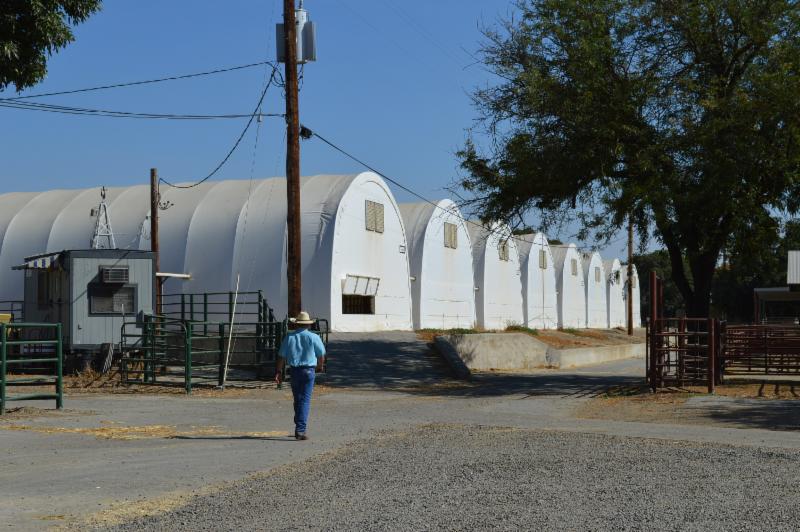 The group was then given a tour of the Animal Science facilities at the location, starting with the original bio-bubble, also known as a bovine bubble. The controlled environment of this greenhouse-like structure sends air to a mobile unit that allows researchers to quantify airborne emissions from livestock. A set of more precise bovine bubbles were constructed in recent years to allow researchers to more accurately quantify emissions in simulated real life environments. 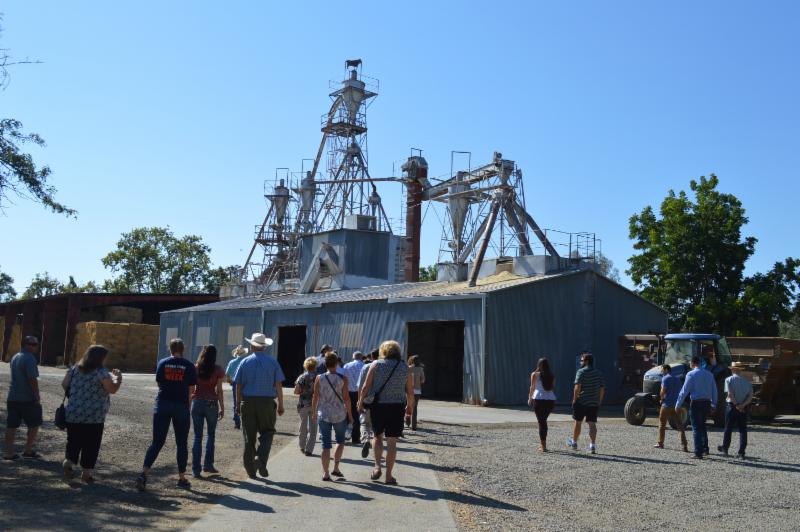 The tour ended at the UC Davis feed mill which was built in 1960. UCD faculty and CGFA Board members expressed their hopes to improve the mill with upgraded machinery to bring the mill into the 21st century. In order for nutrition research to be conducted accurately with concrete results and for students to receive more relevant training, this ailing facility needs major upgrades. The number one research facility in California for Animal Science requires a state-of-the art feed mill. If you would like to be involved in the remodel please contact the CGFA office at (916) 441-2272. Following the mill tour, CGFA board members and staff joined Animal Science faculty and graduate students in the Animal Science Getaway Gardens for a social hour featuring UC Davis sausages and beer from Sudwerk Brewery. Dr. Anita Oberbuaer, Chair of the Animal Science Department, welcomed the tour group and thanked the industry for their support.
|
|
|
|
Pine Creek Nutrition Internship Announcement
|

Jessica Baber will be joining Pine Creek Nutrition Services, Inc. for a summer internship position. Jessica is from Weston, Missouri, and grew up working on their family farm growing corn and soybeans and raising beef cattle. She completed her Bachelor's degree in May 2014 from Texas A&M University with a double major in animal science and agricultural economics. Afterwards, she took a summer internship working on a feedyard in the Texas panhandle. As a graduate student currently, Jessica is the research coordinator and lab manager for ruminant nutrition graduate students and teaches a feeds and feeding class. In addition to research in ruminant nutrition, she has had the opportunity to work closely with the agricultural economics department to develop financial models of beef cattle production systems. She will graduate from Texas A&M University in December 2016 with a Master's degree in beef cattle nutrition and a business certificate.
 Hannah Price Hannah Price will be joining Pine Creek Nutrition Services, Inc. for a summer internship position. Hannah is from Leona Valley, CA where her and her older siblings grew up raising livestock for their 4-H projects since she was 5 years old. Hannah currently attends Fresno State and will be starting her senior year in the fall majoring in Animal Science with an emphasis in Livestock Business Management. Hannah was a member of the 2015 Livestock Judging Team and currently competes on the 2016 Meats Judging Team. She is also a member of the Phi Kappa Phi Honors Society as well as the Jordan College Honors Program where she will be conducting an undergraduate research project in the fall on the Effects of Diet and Paylean on Swine Growth and Pork Quality. She also works at the school swine unit and gives farm tours to elementary school students. After completing her undergraduate at Fresno State in December 2017, Hannah plans to further her education and attend Graduate School for livestock nutrition. She plans on using her experiences with Pine Creek Nutrition Services, Inc. this summer and her research project in the fall to help her decide between cattle nutrition and swine nutrition as her point of interest in Graduate School.
|
UC Looks Into Growing More Millet in California
|
By Ching Lee, AgAlert
|
| |
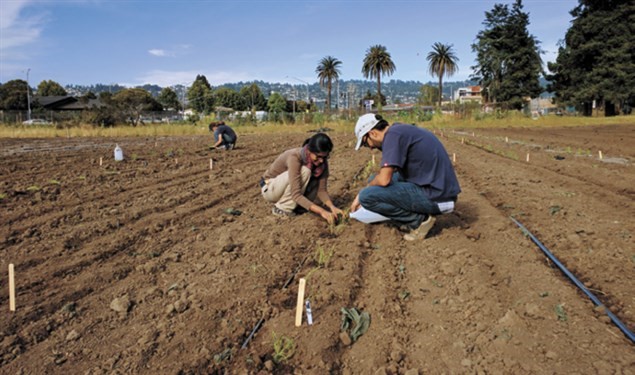
At the UC Tract Gill Community Farm in Albany above Amrita Hazra foreground left and Pedro Goncalves plant seedlings of teff a type of millet often used in Ethiopian cuisine for making injera a traditional bread. Photo Patricia Bubner
|
Although wheat, rice and corn continue to be the most widely grown cereal grains in the world, University of California researchers are trying to promote a lesser-known grain they say packs a nutritional punch and requires little water to grow.
The UC researchers are in their second year of testing how varieties of millet perform in different California soils and microclimates. Millet refers to a number of small-seeded grasses that have been widely cultivated and consumed in many regions of the world, including Africa and Asia. In this country, the ancient grain has largely been under the radar, used primarily for bird feed.
The UC Millet Project is working to change that, with hopes of expanding farmers' grain portfolio-and diversifying American diets.
Patricia Bubner, a postdoctoral researcher at UC Berkeley and a member of the Millet Project team, described its goals this way: "On the one hand, create a market for it, and on the other hand, have farmers grow it and realize what a great grain it is to grow."
Another team member, Amrita Hazra, first had the idea for the project in 2014 when she was doing her postdoctoral research in plant and microbial biology at UC Berkeley. Ever since moving to the U.S. from India in 2005, she said she was "surprised and saddened" by what she perceived as a lack of diversity in the ingredients of U.S. food products.
California's multi-year drought got her thinking about the millets that were available in India but not here. Many millet varieties, she noted, are known to be drought-tolerant, easy to grow, with low input requirements and decent yields. With farmers looking for alternative crops to grow, "millet makes for a good crop to experiment with, as it has a short growing time and is low maintenance," she said. In addition to being food for humans and birds, millets can be used for grazing or cut for silage, she noted.
A $24,000 grant from the Berkeley Food Institute provided the initial funding for the Millet Project. Last year, researchers experimented with four different types of millet: proso, foxtail, pearl and Japanese barnyard. This year, they've added teff and finger millet to the mix, after learning there is local demand for it from Ethiopian restaurants that use it in making injera, a traditional bread.
Bubner said the market is growing for alternative grains such as millet. She said proso millet is already being grown in other states such as Colorado, the Dakotas and Nebraska, with most of it exported to Europe and Asia, where millet is a more-common staple. Domestically, millet may not be used as much as a main ingredient but can be found in products such as energy bars and cereal mixes, she added.
Fetlework Tefferi, who runs Café Colucci, an Ethiopian restaurant in Oakland, currently imports millet from her home country and said she would love to have a local source for the grain, which she described as good for making a whole host of baked goods and for brewing beer.
"It's very versatile," she said. "I think the market is here. I have no doubt that there's a market for ancient grains."
Because millet is naturally gluten-free, specialty bakers already use it in their products.
Greg Sawicki, general manager of Alameda-based New Bread Co., which makes gluten-free baked goods, buys proso millet from an Oregon mill that acquires it from farmers in the Dakotas. Two of his breads feature millet as a main ingredient. He said he would be "the first in line" to buy California-grown millet if it were available.
"With people discovering ancient grains and asking for more products made of ancient grains, I think this could be a very successful enterprise for California farmers and grain growers," he said.
This summer, further UC trials are underway in Albany, Davis, Bolinas, Healdsburg, Upper Lake and Parlier, building on what was learned last year, which is that "millets can be grown in many different geographical conditions," Hazra said.
At the UC Gill Tract Community Farm in Albany, researchers experimented with different irrigation scenarios, from giving no water to some plants to giving others regular irrigation. In all cases, the plants produced grain, Bubner said, although yield was lower in plants that received little or no irrigation. But compared to the fully-watered crop, plants that had limited watering grew to 80 percent of their full height without a huge difference in yield, she added.
"That was pretty amazing and showed how resilient millet is," Bubner said.
Lake County grain farmer Mai Nguyen, a collaborator in the project, said she appreciates that millet is a short-season crop-able to form grains in 90 to 110 days-allowing farmers to double-crop.
"It grows in the time period when other vegetables can't grow very well," she said. "So it's holding me over in terms of the land use: I get a cover crop, I get to suppress weeds, I get a product from it, and it didn't require a lot of inputs."
One area that could benefit from more research, she said, is in harvesting the tiny seeds, which she did by hand last year. To avoid shattering the seeds in the field, she harvested the crop before it was fully ripe and then cured the seeds indoors.
Yolo County farmer Paul Underhill, who grows millet for the bird-feed market, said using a mechanical harvester would be problematic for the varieties he grows, because the seed heads hang low to the ground. He, too, harvests his millet by hand-and sells the whole seed head intact to bird owners.
Because the plant has a shallow root system and is slow to establish, Underhill said the millet he grows is not particularly drought-tolerant. But he noted he's growing varieties with qualities that appeal to bird owners, and those qualities may not be what researchers are looking for in millet for human consumption.
Whether grown for food or feed, Underhill said farmers want varieties that yield well and are easy to harvest. He said he sees an opportunity for the Millet Project to hybridize different varieties to make them more productive.
"Farmers can use more options," he said. "If you were to grow it as a commodity, you would definitely want to have a more vigorous plant that is easier to grow."
In addition to establishing cultivation of millets in the state, Hazra said the project is working to raise money to buy equipment capable of dehulling and processing the small millet seeds. Providing this infrastructure, she said, would make it easier for California farmers to grow millet.
|
California Legislative Report
|
By Dennis Albiani, Legeslative Advocate

The legislature returned to Sacramento this week with a long list of legislation they will be considering, much of which could impact agriculture, food processors and suppliers.
Key dates moving forward include:
- August 1, Legislature reconvenes.
- August 12, last day for fiscal bills to be reported out of Appropriations Committee.
- August 31, last day for each house to pass majority vote bills.
- September 30, last day for Governor to act on Bills.
Major issues being considered in this final month of the legislative process include:
Climate Change
The Governor's office has enlisted many administration officials to push for "post 2020" climate goals reduction mandates. Association representatives attended meetings on climate change legislation with CDFA Secretary Ross and the Governor's office. The administration has stated it is the Senate's directive to get something passed with a majority vote. However, it is their opinion that agriculture can benefit with a 2/3 vote bill by promoting funds for biodigestion, biomass, biodiesel and investment in rural areas and needs. Below are three bills currently being opposed by the association and a broad coalition of agriculture interests.
SB 1383 (Lara) Short Term Climate Pollutants Regulation mandates a 40% reduction in Methane, 40% reduction in refrigerants, 50% Reduction in black carbon. This bill is a major threat to livestock producers. The bill has moved through the policy committees and is pending in Assembly Appropriations Committee. A broad coalition of livestock groups are opposing but have provided amendments to the Senator for consideration. The amendments would prevent implementation of regulatory measures on livestock operations until a funding mechanism for the regulatory compliance issues is in place.
SB 32 (Pavley) Mandates GHG reductions of 40% of 1990 level by 2030 and previous version required 80% reduction by 2050. As discussed above, the administration is starting a full court press on post 2020 GHG reductions. Approval would include extending the "cap and trade" program as well as the mandated reductions. AB 197 (Garcia) Intends to reform the Air Resources Board and provide additional "Legislative Oversight" of their actions and improve accountability. Specifically the bill establishes the Joint Legislative Committee on Climate Change Policies, consisting of three members of the Senate and three members of the Assembly, to ascertain facts and make recommendations to the Legislature concerning the state's climate change programs and policies. The bill further requires ARB rank GHG emission reduction measures based on reductions in GHG emissions, criteria pollutants, toxic air contaminants, and cost-effectiveness. They also "double joined" this legislation with SB 32 (Pavley) so they both must be passed in order for either to become operative.
Ag Overtime Bill Returns
Just days after a stunning defeat of the ag overtime bill on the Assembly floor, the author of the legislation "gutted and amended" an Education Code bill in the Senate and replaced it with substantially similar language to the ag overtime bill that was defeated.
AB 1066 (Gonzalez) would change the current ag overtime rules which require time and one half after 10 hours worked in a day and after 6 work days in a week, and double time after 12 hours, to require time and one half after 8 hours and after 5 days worked in a week.
There is a strong coalition of agriculture and business representatives advocating against this legislation. Main points of opposition:
- The existing overtime rules for agriculture employees are not unique to agriculture. There are several industries that have similar rules because of the key elements of their industry including ski lift operators, camp counselors, ambulance workers, nurses and truck drivers. The industry requirements drive the overtime rules.
- California's overtime rules for agriculture are the most progressive for agriculture workers in the country. California is only one of 6 states that provides overtime for agriculture employees and none provide it after just 10 hours.
- With minimum wage being raised to $15 an hour in the near future, this is an additional compensation benefit that makes California agriculture less competitive and will reduce the job opportunities for all and promote mechanization.
The association has developed a standardized letter, talking points for association members and directors to call their representatives in opposition. The association has also joined a public relations effort assisting members who opposed the legislation previously to maintain their opposition.
|
|
|
Please find the Drought Update document below from the Drought Task Force as well as the following updates related to the California drought:
Application Deadline for State Water Efficiency and Enhancement Program Due Friday, August 5: The California Department of Food and Agriculture (CDFA) began accepting applications June 20, 2016, for the State Water Efficiency and Enhancement Program (SWEEP). An estimated $18 million will be available for competitive grant funding to provide financial assistance to implement irrigation systems that reduce greenhouse gases and save water at California agricultural operations. This project is part of the California Climate Investments, which use proceeds from the state's cap-and-trade auctions to reduce greenhouse gas emissions while providing a variety of additional benefits to California communities. More Information
Study Revealing California 'Water Windfall' Overhyped: By David Gutierrez, Special to The Bee: California's drought has grabbed headlines across the country and world for several years. So when Stanford University researchers recently proclaimed they had found in California a "water windfall" - three times the "freshwater and useable water" than previously known - it was no surprise the media went into overdrive. But it would be a poor use of resources and energy to attempt to tap this water, given the expense of deep drilling, the impact on an area already experiencing alarming subsidence and the questionable quality of the water itself. Most importantly, the authors miss the point that California must be able to depend on groundwater by using and recharging it in responsible, sustainable ways.
July 26: State Water Resources Control Board Hearing on WaterFix: The purpose of the hearing is for the State Water Resources Control Board (State Water Board or Board) to receive evidence relevant to determining whether the State Water Board should approve, subject to terms and conditions, the California Department of Water Resources' and the U.S. Bureau of Reclamation's (petitioners) joint petition to add three new points of diversion and/or points of rediversion of water to specified water right permits for the State Water Project and the Central Valley Project associated with the California WaterFix Project. Notice Press Release
Sustainable Groundwater Management Program Best Management Practices: The purpose of the Best Management Practices (BMP) Development Framework (Framework), now available on the DWR BMP webpage, is to outline the Department of Water Resource's approach to and timing for developing and updating BMPs as part of the Sustainable Groundwater Management (SGM) Program. The Framework describes how interested parties, advisory groups, local agencies, and basin stakeholders can participate in the development of BMPs, and presents the schedule for developing the initial set of BMPs.
State Water Board Approves Prop 1 Storm Water Planning Grants: The State Water Resources Control Board has announced it is awarding $9.5 million in grant funds to 28 storm water planning projects under the Proposition 1 Storm Water Grant Program. The grant funds will supplement more than $8.8 million in local matching funds. More Information
Public Policy Institute of California Issued Report Entitled "Accounting for California's Water": Understanding California's balance sheet for water-how much there is, who has claims to it, and what is actually being "spent"-is key to effectively managing the state's limited water supply in support of a healthy economy and environment. This report compares California's water accounting systems to those of 11 other western states, Australia, and Spain. It identifies gaps in California's water information systems, and proposes a dozen ways to bridge them. Read a summary of the report's policy recommendations. Full Report
Reclamation Increases Friant Division 2016 Class 1 Water Supply Allocation to 75 Percent Along With an Exchange Agreement to Support South-of-Delta Operations: The Bureau of Reclamation announced an additional increase in the water supply allocation to the Friant Division contractors of their Class 1 water from 65 to 75 percent. The initial Friant Division water supply allocation announced on April 1, 2016, was 30 percent Class 1 water supply; an additional 100,000 acre-feet of Uncontrolled Season supply was made available to avert flood control concerns and needed to be delivered by the end of April. More Information
Burn Ban Restrictions: During certain times of the year, when fire danger is high, residential debris burning of dead vegetation is unsafe. When the weather begins to warm up and fire danger increases, CAL FIRE will restrict all residential debris burning. When a burn restriction is in place there is absolutely no debris burning allowed. A list of all the burn bans currently in effect can be found here: Burn Bans.
Water Efficiency Rebates: The Department of Water Resources is still offering rebates for removing turf and replacing it with low water using landscapes and replacing toilets at California single-family residences to support the State's drought response. For more information, visit SaveOurWaterRebates.com.
Report Water Waste: Save Water Report is an online tool that allows you to help save water in your community. California is suffering one of the most severe droughts in state history. Every drop of water saved and every suspected leak fixed will help secure our water supply. This site lets you easily report water waste from your phone, tablet or computer. Select the type of water waste, type in the address and click send. Your report is directed to the water agency serving the location where the report was made. All reporting is anonymous. SaveWater.CA.Gov
|
USDA to Pay Highest Dairy Safety Net Assistance since 2014
|
With a global glut of milk and plummeting prices at home and abroad, the dairy industry this week welcomed Agriculture Secretary Tom Vilsack's announcement that USDA was writing about $11.2 million in farmer financial assistance under the Margin Protection Program for dairy (MPP). The May-June payment is the largest since the program began in 2014.
The MPP program pays out when, depending on the coverage purchased by the producer, the margin between the national average price of milk and feed costs narrows, and was created in the 2014 Farm Bill to replace an array of other federal dairy industry support programs.
While the industry praises the program generally, it has recently called for changes and improvements. The global oversupply pressure and plummeting domestic prices led to 61 Senators writing to Vilsack last week to take any and all legal actions available to the secretary to help them out.
"We understand the nation's dairy producers are experiencing challenges due to market conditions," said Vilsack. "MPP-Dairy payments are part of a robust, comprehensive farm safety net that help provide producers with greater peace of mind."
Dairy producers who enrolled at the $6-8 margin trigger coverage level will get checks, Vilsack said. Payments are triggered when the national average margin - the price of milk versus the cost of feed - falls below the level of coverage chosen by the producer, ranging from $4-8 for a consecutive two-month period.
|
U.S., Brazil Strike Beef Trade Deal; NCBA Not Happy
|
U.S., Brazil Strike Beef Trade Deal; NCBA Not Happy
It's 13 years since Brazilians could buy U.S. beef, and nearly 16 years since Brazilian beef was seen in U.S. supermarkets, but all of that changes with an agreement announced this week by USDA. It took 10 years of negotiations, but this week the two governments agreed to reciprocal trade in fresh beef.
While not mentioning the opening of Brazilian markets to U.S. beef, the National Cattlemen's Beef Assn. (NCBA) slammed USDA's decision to let Brazilian beef into U.S. markets. The group said USDA's evaluation of Brazil's risk protocols for cattle diseases, particularly foot-and-mouth disease (FMD), are lacking sufficient science-based review mechanisms, and the USDA "lacks FMD preparedness." An outbreak of the cattle disease, not seen in the U.S. since 1929, would devastate the U.S. cattle herd, NCBA said.
For its part, USDA said, "Brazil's action reflects the U.S.'s negligible risk classification for BSE by the World Organization for Animal Health (OIE), and aligns Brazil's regulations with OIE scientific international animal health guidelines." USDA also said the department's Food Safety & Inspection Service (FSIS) "recently determined Brazil's food safety system...remains equivalent to that of the U.S. and that fresh (chilled or frozen) beef can safely be imported from Brazil."
"The Government Accountability Office (GAO) is still reviewing the methodology used during the decision-making process," said NCBA. "Furthermore, USDA has failed to provide the detailed and documented science-based review of the risk evaluation protocols for determining an animal health status for countries - information requested by the U.S. beef industry and Congress last year."
"We need the U.S. government to take the proper precaution and ensure a robust FMD vaccine bank. The U.S. cattle herd has not been exposed to FMD since 1929, and the current lack of FMD preparedness could devastate our industry if our herd is exposed to the highly communicable disease."
|
Record 2016-2017 Corn Production Forecast; Exports to Grow: USDA
|
Corn production in 2016 could reach 14.5 billion bushels, 939 million more than produced last year and 324 million more than harvested from the record 2014-2015 crop, USDA reported in its July Crop Production report. The forecast is based on 94.1 million acres planted to corn in 2016-2017, with about 86.6 million acres expected to be harvested for grain, a 5.9-million-acre jump over last year, the department said.
Ethanol use of corn is expected to increase "modestly" to 6.7 million bushels. Feed and residual use is expected to consume 5.5 billion bushels, up 300 million from 2015-2016, USDA said. Ending stocks are forecast to be 2.1 billion bushels, up from the 1.7 billion expected at the end of the 2015-2016 crop year.
The monster crop is expected to dampen global corn prices and boost U.S. corn exports, USDA said, with overseas sales likely hitting 2.1 billion bushels in 2016-2017, up from 1.9 billion the year before and the highest since 2007-2008, when the corn exports hit 2.4 billion bushels.
|
USDA Takes Up GE Labeling Battle, Pro-labeling Groups Pressure Food Companies
|
With the legislative battle won by agriculture and the food industry, and the president's signature firmly affixed, the new federal law preempting state genetically engineered (GE) food labeling laws shifts the battle to USDA, where the Agriculture Marketing Service (AMS) is reportedly already busy drafting rules. Meanwhile, pro-labeling activist groups are ratcheting up public relations pressure on food companies to label above and beyond what the new law requires.
The task of creating the rules by which on-label mandatory disclosure of food ingredient information can be accessed by consumers is in the hands of AMS, which created a working group to deal with the rulemaking before Congress finalized the legislation and the president signed it. The agency has two years to finalize the rulemaking process. The agency has set up a website on the issue. Details of the AMS effort can be found here.
Because USDA is given wide flexibility in making decisions as to what's labeled and what isn't based on ingredients, the law's definition of "bioengineering, etc.", groups on both sides of the labeling question are watching closely. "We expect it to continue to be a fight on how they (the rules) are rolled out, and to make sure it's done in a way that is truthful, not misleading and grounded in science," the American Farm Bureau Federation (AFBF) told Politico. At the same time, both sides of the issue fully expect once the rules are published, lawsuits are inevitable.
In fact, the Center for Food Safety (CFS), renowned for its penchant for filing lawsuits against laws and rules it doesn't like, said this week in a fundraising mailing it will file a lawsuit within the next few weeks to try and block the new law as "unconstitutional on a number of grounds," a contention other Washington, DC, lawyers say is generally unfounded. CFS said it "has no intention of letting this anti-democratic, discriminatory fake labeling bill stand."
The other main criticism of the new law is that it lacks enforcement provisions for failing to provide mechanisms through which consumers can find out about ingredients. Supporters of the bill cite the wide array of federal labeling program enforcement authority, as well as several consumer protection laws on the books as more than sufficient for USDA to enforce the law.
Human food companies - animal foods are not covered by the on-package mandatory disclosure requirements - have a variety of options when it comes to how they will provide consumers access to ingredient information. The can use on-label statements, a quick review (QR) code, a toll-free telephone number, a symbol to be developed by USDA, or if they're smaller companies, simpler mechanisms will be available. Many of the options follow the Grocery Manufacturers Assn. (GMA) "SmartLabel" program, already embraced by a growing number of food companies.
Vermont officially stopped enforcing its GE labeling law that went into effect July 1, and the state's Attorney General William Sorrell, who pledged close involvement in the USDA rulemaking process, called on food companies which changed their labels to comply with his state's controversial labeling requirements to keep their labels just as they are because "it's the right thing to do." Activist groups, including Consumers Union, Friends of the Earth, the Center for Food Safety and Food & Water Watch are also publicly urging companies like Pepsi, Kellogg's, General Mills and Dannon, to retain their Vermont-compliant labeling while the rules are written for the new federal program.
"In response to Vermont's groundbreaking GMO labeling law, you have already changed your packages to disclose the presence of GMOs," wrote Gary Hirshberg, chair of Stonyfield Farm, to several food companies. Stonyfield is a Vermont organic dairy. "Your consumers will be watching closely to see whether you continue to provide this basic factual information - and so will we." "We" is the pro-labeling group Just Label It!, which Hirshberg chairs.
Meanwhile, the University of Pennsylvania's Annenberg Public Policy Center and Rutgers University's Department of Human Ecology released this week the results of a late-July poll of 1,011 adults, revealing only 40% of those polled were likely to scan a QR code on a food label, while 59% said they were unlikely or definitely wouldn't scan the code. USDA has one year to study whether such electronic labeling options provide consumers with enough information.
|
TPP's Fate is Up to Congress, says White House, USDA; Ryan Says Lame Duck Vote Unlikely
|
The ultimate fate of the Trans-Pacific Partnership (TPP), the 12-nation trade accord so favored by President Obama as part of his Asian policy legacy and strongly supported by U.S. agriculture and business, is now in the hands of Congress, said the White House, its chief ag trade negotiator and USDA this week.
During a press conference as part of a state visit this week by Singapore's Prime Minister Lee Hsien Loong, Obama said he hopes TPP will get congressional action after "the dust settles" from the November 8 presidential election. With both Donald Trump condemning the deal, and Hillary Clinton allowing that some sections need to be reworked, Obama said that after the election "there will be more attention paid to the actual facts behind the deals and it won't just be a political symbol or a political football." He said he welcomed the opportunity to sit down with critics and explain to them just what's in the treaty and what isn't.
However, House Speaker Paul Ryan (R, WI) this week said he sees no point in bringing up TPP in the post-election lame duck session because "we don't have the votes." Ryan told Wisconsin Public Radio he sees no point in bringing the treaty to the floor only to see it defeated. He blamed certain provisions of the treaty agreed to by the White House, saying Obama signed off on a deal "that cost him dozens of votes in Congress." The AFL-CIO, a strong TPP opponent, told its members this week a congressional vote is unlikely during lame duck, but urged them to prepare "just in case."
For Lee, whose country was one of the first Pacific Rim nations to begin discussions of a multi-national trade treaty, he expressed hope that a "calmer, cooler atmosphere" will prevail after the elections. He said TPP is important for the U.S. when it comes to where China winds up in the economic balance of power in Asia. During TPP negotiations, Obama repeatedly said the treaty allows the U.S. and other democracies to lead in Asia; to abandon the deal, puts China in the driver's seat.
Secretary of Agriculture Tom Vilsack told The Hagstrom Report during an interview at the Democratic Convention that the fate of the trade pact is in the hands of Congress, not the President or Clinton. "It would be one thing if it were in the process of being negotiated," Vilsack said, adding that now the final agreement is in hand, "Congress should make the call. It is Congress' responsibility. They need to make a decision; they need to share with the country what that decision is."
Perhaps the dourest prediction on the fate of TPP came from the chief agriculture negotiator in the U.S. Special Trade Representative's office. Ambassador Darci Vetter told a sugar industry audience TPP will die a quiet death if not taken up in the lame duck session.
|
Low Prices Could Mean New Farm Bill Needed Sooner, Not Later: Peterson
|
House Agriculture Committee ranking member Rep. Collin Peterson (D, MN) told a Minnesota radio station this week that low commodity and dairy prices could force his committee to write a new Farm Bill next year rather than waiting for the current farm policy package to expire in 2018.
Peterson said the problem with the Farm Bill now in effect is that it was written during a time of high prices and income safety net programs are not sufficient to deal with the current downturn in prices to farmers.
"It hasn't gotten to be too much of issue so far, but I think this winter is going to be a big problem," Peterson told the Minnesota News Network during an appearance at FarmFest. "If it gets bad enough, it might force us to move a year early on the Farm Bill, which wouldn't be a bad idea."
Meanwhile, Agriculture Committee Chair Mike Conaway (R, TX) is silent on any schedule for Farm Bill rewrites. Conaway is busy identifying issues within his committee's jurisdiction which are important to urban House members as a means to build support for a new Farm Bill when it comes.
Peterson said talk of stripping the Supplemental Nutrition Assistance Program (SNAP) - federal food stamps - out of the Farm Bill is unfounded, even though the GOP presidential platform calls for such action. "What'll happen if you split them, food stamps will go on and the Farm Bill will end because there's nobody to vote for the Farm Bill," Peterson said. "People just don't get it. They're not going to get rid of food stamps. It's just not going to happen."
|
GM Wheat in Washington Field Likely Won't Harm Exports, Wheat Group Says
|
The discovery of 22 unapproved genetically engineered (GE) Monsanto wheat plants in a Washington State commercial field last week hopefully won't cause foreign wheat buyers to cut off purchases, at least that's the hope of U.S. Wheat Associates. However, USDA confirmed this week Japan and South Korea have temporarily suspended new U.S. wheat buys.
This is the third time unapproved GE wheat has been discovered in commercial fields not associated with field trials. The first case was in 2013 on an Oregon farm, and a second discovery of unapproved wheat was found in Montana in 2014.
U.S. Wheat Associates said the Asian buyers' initial action is likely temporary, and once a new testing protocol is used to check recently and soon-to-arrive wheat shipments, the market should return to normal. South Korea already has the new testing kits from USDA and should begin using them by early next week before releasing stored U.S. wheat to local millers.
Japan, however, wants all testing protocols provided by USDA and Monsanto to be customized for the testing of Western white wheat, a mixture of soft white and club wheat grown in the Pacific Northwest. The process could take two to three weeks, U.S. Wheat Associates said.
USDA continues to scratch its head over how the GE wheat plants got into the farmer's field since the land in question was last planted in the spring of 2015, and has not been used as a Monsanto test plot. "There are no genetically engineered wheat varieties for sale or in commercial production in the U.S. at this time as USDA has not deregulated any GE wheat varieties," the department said in a statement.
|
NITL Claims Victory in STB Reciprocal Switching Decision, Proposed Rules
|
It took five years, but late last week the Surface Transportation Board (STB) handed the National Industrial Transportation League (NTIL) a significant, albeit partial victory, when it granted a 2011 NITL petition on reciprocal switching and proposed new rules which the league says would allow shippers "served by one railroad to gain access to a second."
The STB also tossed out its current reciprocal switching rules which NITL says have never been applied to provide a shipper with competitive access to a second railroad. The newly proposed rules are open for public comment through September 26.
The original NITL petition asked the STB to require all Class I railroads to enter into competitive switching agreements whenever a shipper or a group of shippers could show that certain conditions exist, including a shipper's facility was captive to a single Class I carrier; there is no effective inter or intramodal competition for the rail movements which could be conclusively established based on certain rate or market share standards, and there is or could be a "working interchange" between a Class I carrier and another Class I carrier within a "reasonable distance" of the shipper's facilities.
The STB decided against the league's proposed "fast track approach," instead opting for a two-path, case-by-case approach, with shippers ultimately having to show that a competitive switch is "practicable and in the public interest" or "necessary to provide competitive rail service." At the same time, a railroad could argue against a proposed switching agreement because the action "is not feasible or is unsafe."
|
|
|
ARA Tells Members to Let EPA Know about Atrazine - The Agricultural Retailers Assn. (ARA) this week told its members to step up and tell EPA how important the pesticide atrazine is to their operations. The agency recently reported finding the chemical can cause harm to the reproductive systems of some animals, a development ARA says is based on "scientific errors and flawed interpretations." ARA said the mistakes made in the atrazine evaluation must be corrected or other important crop chemicals are at risk of being taken off the market. "It is critical for our industry to weigh in with EPA to ensure they are following sound science and accurate data...the agency needs to learn about the importance of these products," ARA said.
Appeals Board Backs EPA on Flubendiamide Withdrawal - EPA's Environmental Appeals Board this week said the agency is correct in its decision to pull the approval of the Bayer CropSciences' pesticide flubendiamide, but also said EPA has no reason to force the company to pull existing stocks of the chemical off store shelves. The Appeals Board said the withdrawal of the approval was justified based on the terms agreed to by Bayer and Ninchino America when the product was registered in 2008. Those terms included testing flubendiamide for risks to aquatic animals. If those terms are unreasonable, the board said, then Bayer should have challenged them at that time. Bayer has not said if it will challenge the Appeals Board's decision in federal court.
|
Dairy Industry Needs Emergency Financial Assistance: Lawmakers
|
On the heels of USDA's spending nearly $300 million to aid cotton growers, more than 60 lawmakers last week called on Secretary of Agriculture Tom Vilsack to provide emergency financial assistance to dairy producers who face depressed domestic prices based on a global surplus of milk, a production situation which has significantly cut U.S. dairy exports.
The price depressing impact of the milk glut - centered in the U.S., the European Union (EU) and Asian countries - can be mitigated, the bipartisan group wrote, if Vilsack will use Commodity Credit Corp. (CCC) authority to come up with a plan to aid farmers. In the past, such plans have generally embraced the department buying surplus dairy production.
Producers are still adjusting to the 2014 Farm Bill's introduction of margin insurance for dairies - income support payments based on feed costs - and that program is in need of strengthening as it does not provide sufficient protection to farmers, the House and Senate members wrote. "We encourage USDA to take any and all actions available in order to make an immediate market injection and offer financial assistance that will directly support U.S. dairy farmers equally." Any aid, they wrote, must not "stimulate overproduction."
For its part, USDA said it's working to implement the margin insurance program, but told one Capitol Hill publication, the department will "do everything we can within our authorities to make sure our dairy producers have a strong, effective safety net, in addition to expanded market opportunities both domestically and abroad."
Similar action is taking place in the EU where the European Commission (EC) is pumping nearly 500 million euros into the dairy industry, blaming an EU move more than a year ago to scrap milk quotas for overstimulating milk production.
|
Trade Serious Agriculture Concern in White House Race; Positions "Evolving"
|
The primary run-up to last month's Republican and Democrat national party conventions featured stump speeches by both Donald Trump and Hillary Clinton denouncing the Trans-Pacific Partnership (TPP) specifically and trade agreements broadly. TV coverage of the Democrat convention the night Sen. Bernie Sanders (I, VT) spoke featured wall-to-wall "No TPP" signs.
Trump calls TPP "unfair," wants to renegotiate the North American Free Trade Agreement (NAFTA), and says the U.S. will only pursue bilateral trade deals if he wins the White House. Clinton, who as Secretary of State promoted TPP as the "gold standard" of trade treaties, now says TPP will cost the U.S. jobs, but sections can be renegotiated to make the agreement more positive to the U.S.
President Obama considers TPP part of his presidential legacy; however, congressional Democrats criticize TPP because Obama did not consult with them prior to finalizing the deal. Last week, House Minority Leader Nancy Pelosi (D, CA) sent a letter to her constituents informing them she opposes TPP "in its current form," bringing her public position in line with Clinton's.
Both candidates, however, emerged from their conventions with trade positions somewhat different than when they went in. For the Democrats, the party platform recognizes the importance of trade to the U.S. economy, but says Congress must not try and approve the 12-nation TPP trade deal during the post-election lame duck, the latter being a bow to Sanders. Trump has modified his message to also recognize the economic reality of trade in a global marketplace, but says new deals must be balanced and broadly beneficial to the economy. Neither candidate, however, has provided details on how U.S. trade policy would change under their individual leadership.
Former Nebraska Gov. Dave Heineman, a Trump surrogate on ag and rural issues, told Agri-Pulse in a GOP convention interview that agribusiness leaders must understand that Trump wants trade treaties to benefit all sectors of the U.S. economy, not just agriculture.
"Talk to governors of large industrial states and they will tell you that while ag was favored in trade relations in these trade deals, the manufacturing sector and other sectors of the economy weren't," Heineman said. He added Trump will "continue to favor trade that promotes agriculture...but we want to make sure the other industries...critical to the growth of America, are also treated favorably," Agri-Pulse reported.
Agriculture critics of the candidates' respective anti-trade stances point to the fact the U.S. market for grains, oilseeds, wheat, meat, milk and dairy has plateaued, and the most immediate growth engine is to expand overseas markets for U.S. agriculture products. This effort, they add, is why agricultural exports have been generally the only positive component of the U.S. balance of trade.
|
Candidates and Running Mates Chosen, Formal Campaign Begins; Ag, Rural Issue Handling Emerging
|
It's official - with the close of the Republican convention two weeks ago in Cleveland, Ohio, and the ending gavel of the Democrat's convention in Philadelphia last week, the presidential slates are final. Donald Trump is the Republican nominee for president and Gov. Mike Pence (R, IN) is his running mate. Democrat Hillary Clinton, the first woman to be the presidential nominee of a major national party, will run for the White House with Sen. Tim Kaine (R, VA) at her side.
For both conventions, the audiences were generic, the messages heart-warming and philosophical, the call was for unity, and the messages clear: The other presidential candidate is unfit to govern. At the Democrat convention during the state delegation roll call of votes, Senate Agriculture Committee ranking member Sen. Debbie Stabenow (D, MI) announced the Michigan delegation's vote, and Ann Toberg, a dairy farmer from Beresford, SD, chair of the state Democrat party, announced her delegation's vote, enough to formally clinch Clinton the party nomination.
When it comes to the chosen running mates, both Pence, a farm state governor and former House member who sat on the Agriculture Committee, and Kaine, a former Virginia governor and a sitting Senator, are seen as safe complements to the folks at top of the tickets. Both vice presidential candidates get high marks for their support of agriculture and rural issues, but neither is considered a stand-out congressional or state leader on major issues such as immigration reform, regulatory overreach, alternative energy or trade. Kaine - born in Minnesota, raised in Kansas and elected in Virginia - has the strongest national security credentials based on his Senate assignments. However, both find themselves having to modify positions previously taken on key ag/food issues, such as trade, in order to keep order in their respective campaigns.
It was only as the delegates converged on the respective party gatherings that agriculture and rural issues were identified, along with campaign mechanisms to inspire farmer, rancher and rural business votes. However, only a few clear policies or programs emerged from either side of the White House run, with both party platforms containing broad political statements and a commitment to the need for a strong rural America.
The GOP platform recognizes the importance of trade to the U.S. economy, but also says Congress should not consider any major trade agreements (TPP) during a lame duck session. The Republicans also went on record opposing any mandatory federal labeling of foods containing genetically engineered (GE) ingredients. The platform calls for splitting out of the next Farm Bill the Supplemental Nutrition Assistance Program (SNAP) - the former food stamp program - just at a point that House Agriculture Committee Chair Mike Conaway (R, TX) has begun identifying issue priorities among urban House members as a means of securing their support for the next Farm Bill.
The Democrat platform calls for "working to build a stronger rural and agricultural economy," pledging to increase federal spending to support the next generation of farmers and ranchers, with particular attention to promote environmentally sustainable practices." The Democrats also talk about protecting family farms - "a cherished way of life for millions of Americans" - and expansion of farmers markets and regional food systems. The platform calls for protecting farm workers from pesticides and herbicides, and calls for "stronger agricultural worker protections including regulation of work hours, elimination of child labor, ensuring adequate housing for migrant workers and sanitation facilities in the fields. The platform also touches on increased broadband access, clean energy, more equity capital for small business and a doubling of loan guarantees for the "bio-based economy".
For the Trump campaign, a formal 15-member agribusiness advisory council, along with a major position paper on agriculture and rural issues, will be unveiled toward the end of this week. Nebraska Angus breeder and farmer Charles W. Herbster, who also owns Conklin Co. and unsuccessfully ran for Nebraska governor in 2012, will chair Trump's soon-to-be-unveiled farm and agribusiness advisory panel, which the campaign says will include several "stars" of American agriculture. Herbster is aided in the effort by former Nebraska Gov. Dave Heineman as the campaign reaches out to agriculture. Trump ag surrogates say they're out to "energize" agriculture and rural support, focusing on Trump's experience as a businessman because "farming and ranching is a business." The ag voices in the Trump campaign also say their candidate guarantees regulatory relief.
In addition to the Democrat National Committee's Rural Council, at which Secretary of Agriculture Tom Vilsack was the designated Clinton champion and attack dog on Trump, he told convention attendees Clinton is the better candidate because "she listens...she's a problem solver." There's also now a "Rural for Hillary" group. The group, while not formally part of the Clinton campaign, is coordinated in Washington, DC, by Vicki Hicks, vice president for government affairs at AgriBank, and Trevor Dean, a former Clinton Senate aide and former staffer to then Senate Majority Leader Tom Daschle (D, SD). Dean told a meeting of the DNC's Council last week, "We want everyone in rural America to understand that Secretary Clinton is looking out for them." Dean also met with a group of agribusiness leaders and Vilsack on how Clinton can improve her rural outreach.
In mid-June, Washington, DC leaders from several production agriculture associations traveled to New York City to meet with the Clinton campaign staff to talk agriculture. A "substantial meeting" with a sufficiently senior" audience in New York was had, the ag groups talking trade, food safety, Farm Bills, biotechnology, consumer education and immigration/labor issues. One ag leader said after the New York session, "This is not a one and done meeting."
On June 9 and 10 agriculture leaders, including a dairy producer and wheat farmer, met with Trump personally in New York City to discuss agriculture. One industry leader who participated in the two-hour meeting described Trump as "very attentive," "on-point and serious," and asked good questions.
|
|
|
|
Three New Soybean Traits Approved in Europe
|
The European Union (EU) last week confirmed it has approved three traits in genetically engineered soybeans for import to and processing in Europe. The action comes after months of soybean industry pressure on U.S. and EU regulators to approve the three traits, pending since January, 2016.
The three varieties include Monsanto's Roundup Ready 2 Xtend with dicamba and glyphosate tolerance, now growing in the U.S. and approved in China last February; Monsanto's Vistive Gold, a product with a high glyphosate tolerance being grown in the U.S. for transfat-free soybean oil for use in foods, and Bayer CropScience's Balance GT, a soybean trait that includes glyphosate and isoxaflutole tolerance, designed for seed multiplication and expected to be available this Fall.
EPA is in the last stages of formal review of the traits - particularly for the in-crop use of dicamba - prompting Monsanto to say it expects "full system launches" of the products in 2017.
|
1st Annual Farm Tank Conference
|
Food Tank, in partnership with the Sacramento Convention & Visitors Bureau, Farm-to- Fork Program, and University of California- Davis, is excited to announce the 1st annual Farm Tank Conference at the Hyatt Regency Sacramento. This two-day event will feature more than 35 different speakers from the food and agriculture field. After a day of interactive panels moderated by top food journalists, networking, and delicious food, there will be a day of hands-on activities and opportunities for attendees.
WHEN Thursday, September 22, 2016 at 9:00 AM - Friday, September 23, 2016 at 5:00 PM
WHERE Hyatt Regency Sacramento 1209 L Street, Sacramento, CA 95814 Event info including a full line up of speakers and tickets can be found at the link below.
|
|
|