|
|
|
| Upcoming Dates |
October 26, 2016:
CGFA and NGFA Joint Grain Safety Seminar
DoubleTree, Fresno, CA
|
|
Benefits of Belonging to CGFA
|
- State & Federal Legislative Advocacy
- Industry & Small Business Issues
- Business Advocacy
- Weekly Updates on Current Issues
- Networking Opportunities
- Industry Specific Directories
- Advertising Venues
- Social Media Sites
- Cost Saving Insurance Programs
- Environmental and Safety Resource
- Continuing Education and Training
- Political Action Committee Administration
- Annual Convention
- Education Programs
- District Meetings
|
|
|
California FFA Foundation Honors CGFA
|
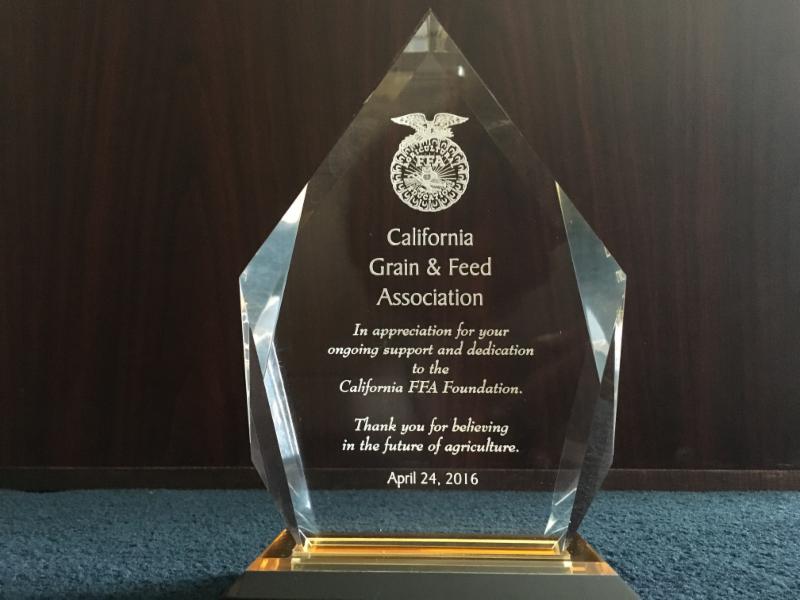
The California FFA Foundation has honored CGFA for their ongoing support and dedication! This award was presented to CGFA at the State Convention in Fresno last month. Thank you for believing in the future of agriculture!
|
| New Hope for Old Feed Mill at UC Davis |
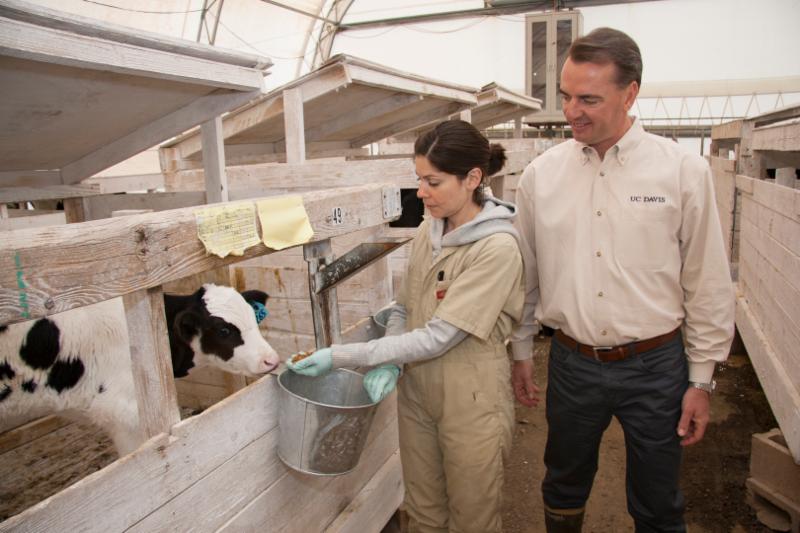
Thanks to industry support, the aging feed mill at UC Davis is close to landing the overhaul it so badly needs to support the campus' world-class science and education in livestock production, animal welfare, and environmental quality.
Together, the California Grain and Feed Association and other industry leaders have contributed $750,000 toward the $1.2 million cost to upgrade the dilapidated, rusty mill.
"We're thrilled to help with the effort," said Chris Zanobini, chief executive officer with the California Grain and Feed Association. "When you have a program working so hard to keep agriculture productive and sustainable, you want to do all you can to support it."
The mill does more than generate feed to maintain the department's thousands of cattle, swine, goats, sheep, horses, and poultry. Researchers must carefully control and monitor what feed goes in and out of animals to measure efficiency and environmental impact.
"We integrate very small amounts of additives into feed to reduce nutrient losses," said Frank Mitleohner, animal science professor and Cooperative Extension air quality specialist. "Much of our research depends on the ability to customize feed."
Mitloehner recently completed chairing a United Nations Food and Agriculture Organization committee to assess the environmental impacts of the global livestock and feed industry. He is now the scientific lead for the North American section of the Global Feed Life Cycle Assessment Institute, which is supported and joined by 80 percent of the feed industry. Mitloehner and his team will build a comprehensive database on all relevant variables and develop a tool to assess the industry's environmental footprint.
UC Davis had been trying to build a new mill, but the cost was prohibitive. Mitloehner says the scaled-back renovation will still provide the sophisticated equipment the Department of Animal Science needs to conduct cutting-edge research and educate tomorrow's leaders.
"It will bring our feed mill into the 21st century," Mitloehner explained.
UC Davis animal scientists are awarded millions of dollars in grant funding, but that money can't be spent on infrastructure, like a feed mill. The current mill was a gift from the California Cattle Feeders Association in 1961.
"It was state-of-the-art at the time," Mitloehner said.
UC Davis is about $450,000 short the cost of the renovation, but Zanobini predicts other industry leaders will support the effort.
"I know others will join us because the work Frank Mitloehner is doing with air quality-as well as all the work they're doing in animal science-is important to our operations," Zanobini said. "It's vital to our future, not just for our industry, but for our state, nation, and world."
Media contacts:
|
|
|
|
California Legislative Report
|
By Dennis Albiani, Legislative Advocate

Ag Overtime Bill Defeated
Thursday evening months of a collaborative lobbying campaign came to a culmination with the long awaited vote on AB 2757 (Gonzalez) which would have altered the current overtime requirements for Ag employees covered under Wage Order 14. Working alongside a coalition of agriculture interests and suppliers, the association successfully killed the bill. The final vote was 38-35. The bill needed 41 votes to pass.
Currently, ag employees are required to be paid overtime after 10 hours in a day and 6 days in the week. This legislation would have mandated overtime to be paid at 1.5 times pay after 8 hours in a day, and five days worked in a week. Double time would have still been required after 12 hours, as already mandated in existing law.
The coalition focused on the unique aspects of the industry managing planting, harvesting seasonality and weather, the impact on the gross income of the farmworker if they were restricted to 40 hours in a week and the impact on the long term viability of the industry. The grassroots efforts of farmers and association members meeting with legislators, logging in calls and emails and writing letters helped defeat this measure. Additionally, strategically building relationships with key urban legislators assisted in the effort as well.
The author, Lorena Gonzalez, who is chair of the powerful Assembly Appropriations Committee has stated an intention to bring the legislation back. Diligence on the part of the association and industry will be required to continue to manage the issue. Here is a link to the final vote count, which may be of interest to association members since several key ag legislators voted in favor of the legislation.
Legislation Further Regulating Neon's Fails
Legislation that would require additional regulations on neonicotinoids pesticides failed the State Senate yesterday with a vote of 15-18, 21 votes are needed to pass. SB 1282 (Leno) would have required labeling of commercially available seeds and plants sold at retail establishments that have been treated with a neonicotinoid pesticide with the words "STATE OF CALIFORNIA SAFETY WARNING: MAY HARM BEES" and have a logo to be designed by the director. More concerning, was the legislation would have usurped the scientifically based review process ongoing at the Department of Pesticide Regulation (DPR) to determine classification of pesticide. The legislation would have mandated that neonicotinoid pesticides be classified as a restricted materials by January 1, 2018. Currently DPR is reviewing this class of pesticides to determine appropriate science based category and regulations.
Prohibition on New Wells Passes Senate
Legislation that would prohibit new wells from being drilled passed the Senate Thursday with the bare minimum votes 21-17. SB 1317 (Wolk) would usurp local control by requiring conditional use permits for new wells and prohibiting the issuance of permits for wells in basins that are in or near overdraft. Many argue the bill conflicts with the recently enacted Sustainable Groundwater Management Act (SGMA) because it dictates how locals must proceed and prohibits them from issuing permits unless they have an ordinance that takes similar actions. SGMA was structured to have local management or groundwater resources, planning and implementation.
The bill is headed to the Assembly Water parks and Wildlife Committee where it will be heard and may meet with more skeptical legislators. The association has joined a coalition of local government and agriculture entities to oppose the legislation.
Organic Farming Legislation Passes Assembly
An effort to address perceived inequality in fees, increase enforcement and reform the State Organic Program passed its first committee this week. AB 1826 (Stone) which is sponsored by the organic farmers passed the Assembly earlier this week. The legislation includes a number of reforms such as changing the composition of the Organic Advisory Committee and provides the secretary additional authority to enforce the act. The most controversial element is the fee structure. The minimum fees have been raised and the overall income has been capped. The bill will continue to evolve and be amended as it moves through the process.
|
|
|
Curtailment Notices
On June 2, 2016, the State Water Resources Control Board (State Water Board) issued curtailment notices to holders of 93 permits and licenses in the Sacramento-San Joaquin watershed and Delta with Term 91 as a condition. The State Water Board has been monitoring flow conditions in the Sacramento-San Joaquin watershed and Delta and determined the following two conditions which trigger curtailment under Term 91 have occurred: (1) Supplemental Project Water is being released in the Sacramento-San Joaquin Delta Watershed and (2) the Delta is in Balanced Condition. The curtailment notice can be viewed here.
Executive Order Listening Sessions - Agricultural directives session on June 7
Agencies of the State of California will host public listening sessions regarding the implementation of Governor Brown's Executive Order to continue water conservation. The June 7th session will address agricultural and county drought planning implementation. These listening sessions are hosted by the Department of Water Resources, the State Water Resources Control Board, and the Department of Food and Agriculture. More information here.
Governor Brown Redoubled Commitment to Fiscal Prudence in Revised Budget Proposes Additional Drought Funding in May Revise
As revenues fall short of projections and California stretches into an eighth year of economic recovery, Governor Edmund G. Brown Jr. released a revised state budget that funds core programs while paying down debt, saving money and holding the line on new obligations. "The surging tide of revenue has begun to turn," said Governor Brown. "Quoting Aesop's fable of the ant and the grasshopper: 'It is best to prepare for the days of necessity.'"When Governor Brown took office, the state faced a massive $26.6 billion budget deficit and estimated annual shortfalls of roughly $20 billion. These deficits, built up over a decade, have now been eliminated by a combination of budget cuts, temporary taxes and the recovering economy. Barring any significant changes, the budget over the next two years remains in balance. However, in the years that follow, the state's commitments will exceed expected revenues with annual shortfalls forecasted to exceed $4 billion by 2019 - or worse with an economic slowdown or recession. The Governor's Revised Budget also proposes an additional $323.1 million to continue the state's emergency response to the drought. Please see attached document for more details. Find more about the May Revise attached and online at More Information
DWR Regulations to Guide Local Sustainable Groundwater Management Plans Approved by California Water Commission
The Department of Water Resources (DWR) regulations that will guide local groundwater sustainability agency management and regulation of California's groundwater basins as outlined in the historic Sustainable Groundwater Management Act (SGMA) enacted by Governor Edmund G. Brown Jr. in 2014 were approved by the California Water Commission. "Today we reach a major milestone in California's quest to sustainably manage groundwater," said DWR Director Mark Cowin. "These regulations will help communities bring aquifers into balance and prepare for a changing climate and future droughts." More Information
State Water Board Adopts 'Stress Test' Approach to Water Conservation Regulation
The State Water Resources Control Board adopted a statewide water conservation approach that replaces the prior percentage reduction-based water conservation standard with a localized "stress test" approach that mandates urban water suppliers act now to ensure at least a three year supply of water to their customers under drought conditions. Recognizing persistent yet less severe drought conditions throughout California, the newly adopted emergency regulation will replace the Feb. 2 emergency water conservation regulation that set specific water conservation benchmarks at the state level for each urban water supplier. The adopted regulation, which will be in effect through January 2017, requires locally developed conservation standards based upon each agency's specific circumstances. More Information
We've been blogging! Check out our Planting Seeds Blog here.
|
Supreme Court Rules Landowners can Challenge Federal Wetland Orders; WOTUS Foes Encouraged
|
The U.S. Supreme Court this week unanimously ruled private landowners and individuals can sue the federal government, demanding "prompt judicial review" by federal courts of wetland designations by EPA and the U.S. Army Corps of Engineers. At issue is the federal government's legal authority to designate otherwise dry land as a protected wetland, and this week's decision likely kicks open the door to multiple federal court challenges.
The government argued that landowners could go without CWA permitting and challenge any subsequent enforcement action that designated lands as protected wetlands, or an owner could seek permits - a complicated and expensive process - and challenge determinations made after those permits were issued. Supreme Court Chief Justice John Roberts wrote in his opinion that the high court disagreed with the government on both counts.
While the decision was unanimous, four of the eight sitting justices wrote opinions. Special attention is being paid to the opinion of Justice Anthony Kennedy, considered a swing vote by both the White House and industry, state and private plaintiffs in dozens of related legal actions to stop EPA and the Corps from extending their authority under the Clean Water Act (CWA) using the controversial "waters of the U.S. (WOTUS)" regulations. Those regulations have been blocked by a federal appeals court pending higher federal court decisions and the likelihood the Supreme Court will be petitioned to make the final decision on whether WOTUS stands or falls.
An EPA spokesperson said the agency is "reviewing the decision with the Department of Justice and the Army Corps of Engineers," adding this week's high court ruling has no effect on the WOTUS rule or the "scope of CWA jurisdiction."
What makes the Kennedy opinion so interesting to supporters of the high court's decision - and those who wish to kill WOTUS - was Kennedy's statement during oral arguments that the CWA may be "unconstitutionally vague." Reports indicate his opinion this week reiterated that concern, with Kennedy writing the CWA "continues to raise troubling questions" on private landowners rights to the "full use and enjoyment" of private property. It was Kennedy's opinion in a related 2006 CWA wetlands case which EPA says compelled it to ultimately issue the WOTUS rule.
However, environmental groups contend Kennedy's opinion actually goes to the validity of WOTUS, referred to by EPA as "the clean water rule," and they contend jurisdiction and authority are clarified by this week's action. Veteran agriculture and industry attorneys, however, contend there isn't much meat in the Kennedy opinion to indicate how the court might rule should WOTUS reach them.
Sen. John Barrasso (R, WY) said the decision "is the latest blow to president's regulatory rampage."
Several agriculture groups filed amicus briefs in the case. The American Farm Bureau Federation (AFBF) said "it's hard to overstate the importance of this ruling," and the National Cattlemen's Beef Assn. (NCBA) said the Supreme Court decision is important because it removes a barrier to challenging federal wetland designations, and is a "major victory for landowners across the U.S." The "subjective nature" of wetland determinations and "inconsistent application" of the CWA made the law "ripe for a challenge," said NCBA.
|
Atrazine has Problems says EPA Preliminary Risk Assessment
|
EPA this week released a 520-page preliminary risk assessment on atrazine, revealing its assessment demonstrates reproductive problems in animals exposed to the widely used herbicide. The EPA report says the chemical is harmful to animals, fish and plants through ground and surface water exposure.
The agency's review of atrazine is part of a routine, periodic review of chemical registrations. The risk assessment included reviews of hundreds of toxicity reports, EPA said. The preliminary report indicates in areas where atrazine is heavily applied, the concern over chronic risk levels to birds is more than 22 times the allowable rate; to mammals, the risk is 198 times greater, and for fish, the allowable level is exceeded by 62 times.
The report will be open for public comment once formally published in the Federal Register. The ultimate fate of the herbicide won't be decided for several years.
The National Association of State Departments of Agriculture (NASDA) wasted no time in releasing a statement calling on EPA to ignore certain studies which may have contributed to the agency assessment as based on questionable science. NASDA also asked the agency to explain why it mistakenly posted a draft report to its website, then pulled the report down.
NASDA President & CEO Dr. Barbara Glenn said in a letter to EPA Administrator Gina McCarthy that NASDA has "significant concerns" with the way the agency mishandled information, alleged scientific shortcomings in the preliminary assessment, and how these missteps may affect agricultural producers. Glenn reminded McCarthy "more than 400,000 U.S. corn, sorghum and sugar cane growers depend on this essential crop protection tool" and that atrazine's safety is supported by "nearly 7,000 scientific studies over the past 50 years."
The National Corn Growers Assn. (NCGA) said it is concerned the agency included in its review several studies that EPA's own 2012 Scientific Advisory Panel (SAP) deemed flawed, adding, "This undermines public confidence in the review process and goes against the mission of using the best available science."
USDA said it's reviewing the "EPA's draft ecological risk assessment," and Secretary of Agriculture Tom Vilsack said his department would work closely with EPA on the issue.
"We understand the agricultural community and others have significant questions about the scientific models employed by the EPA, their implicit assumptions, as well as the accuracy of the use and usage data incorporated into the models," Vilsack said in a statement. He encouraged EPA to "reach out to these stakeholders and explain their methodology and encourage comments."
|
House Panel Approves Water Resources Department Act Package
|
Clearing the way for action by the full House, the Transportation & Infrastructure Committee has approved its version of the Water Resources Development Act (WRDA). The Senate Environment & Public Works Committee approved its version in late April.
Included in House bill is an amendment offered by Rep. Rodney Davis (R, IL) and accepted by voice vote, directing the Government Accountability Office (GAO) to look into alternative ways the Inland Waterways Trust Fund can be managed, including transferring management to a separate federal corporation.
The bill also carries language that would move the Harbor Maintenance Trust Fund (HMTF) from discretionary to mandatory spending, meaning Congress would be compelled to fund the trust fund, even in times of spending shortfalls, and overall, could mean more federal investment in expansions and upgrades. The 2014 WRDA bill called for conventional increases in the HMTF annually under discretionary spending.
Industry is unsure about the language, and the American Soybean Assn. (ASA) this week said it is awaiting the final evaluation of a task force set up by the American Association of Port Authorities (AAPA) before taking a position.
|
CFTC Makes Acceptable Hedging Plans, Limits Broader
|
The types of hedging programs which can be exempted from Commodity Futures Trading Commission (CFTC) rules on position limits were expanded this week by the commission as part of a supplemental proposal to make sure "anticipatory hedging practices" would make the grade for a "bona fide hedging" exemption.
The National Grain & Feed Assn. (NGFA) said the CFTC proposal is a "huge improvement over the original proposal," and now mirrors the Commodity Exchange Act (CEA) definition of bona fide hedging. The CFTC action is particularly relevant to hedging plans used by grains elevators and others over weekends when exchanges are closed. NGFA previously registered concerns the commission was ratcheting the definition too tightly in previous rulemaking proposals.
The decision pleases the grain trade and takes some pressure off the CFTC as it tries to implement rulemakings under the Dodd-Frank law. Commission Chair Timothy Massad said the CFTC listened to the concerns of market players, with special attention on the concerns of commercial end users who use markets daily to manage risk. House and Senate CFTC reauthorization legislation - stuck in Congress - include language requiring the commission to include anticipatory hedging in its bona fide hedging final rule.
|
USDA Extends "Actively Engaged" Registration Deadline
|
USDA has extended by 30 days the deadline for farmers and ranchers to record with the department farm organization "structures" related to the department's required definition of "actively engaged in farming" when it comes to who qualifies for federal income support payments.
Farms now have until July 1 to complete any necessary restructuring or to finalize organizational changes, USDA said.
The 2014 Farm Bill directed USDA to define "actively engaged" for payment qualification purposes. The final rule sets limits on the number of individuals who can qualify, and only a single payment limit for management is allowed under the rule. However, up to two additional qualifying managers can be requested for large and "complex operations."
The rule doesn't apply to farming operations completely run by families. The rule doesn't change the current regulations on contributions of land, capital, equipment or labor, or the existing rules related to landowners with a risk in the crop or to their spouses. Payment limits are generally set at $125,000 per individual or entity.
|
Sensenbrenner Doesn't Like EPA Move to Raise RFS
|
Consumers are getting a raw deal under a proposal last week by EPA to increase the Renewable Fuel Standard (RFS) for corn ethanol to 19 billion gallons in 2017, said Rep. Jim Sensenbrenner (R, WI) last week, fueling speculation that some House lawmakers may move to change or kill off the RFS.
"Proposing that nearly 19 billion gallons of ethanol be incorporated into the fuel supply is another example of excessive EPA bureaucratic overreach," Sensenbrenner said in a release. He echoed other critics who contend that environmentally, the higher ethanol RFS does more harm than good, citing increased emissions, misfueling, voided warranties and damaged engines.
Sensenbrenner has introduced legislation over time that sought to kill 15% gasoline/ethanol blends (E15), along with additional testing of E10 fuels.
|
USDA Pays $8.8 Million in Advanced Biofuels Support
|
USDA announced late last week it has paid out over $8.8 million to increase production of advanced biofuels and "sustain jobs" in 39 states, the money is coming from the department's Advanced Biofuel Payment Program created in the 2008 Farm Bill. To date, USDA has made $308 million in payments to 382 producers in 47 states and territories.
Advanced biofuels are defined in law as biodiesel, renewable diesel and cellulosic ethanol, fuels for which the carbon footprint in refining is below a set level.
The payments are made to refiners based on how much qualifying fuel they produce from "renewable biomass," excluding corn kernel starch. Eligible feedstocks include crop residue, food and yard waste, vegetable oil and animal fats.
|
|
|
U.S. Group, Cuban Coalition Sign MOU on Trade - The U.S. Agriculture Coalition for Cuba (USACC) and the Cuban Grupo Empresarial Agricola (GEA) have signed a formal memo of understanding (MOU) to modernize a Cuban marketplace for U.S. food and agricultural products. The MOU says the two groups will meet regularly to ensure the business arrangement is "mutually productive and beneficial." The American Soybean Assn. (ASA) endorsed the MOU, and called on Congress to end the trade embargo in place since 1961.
U.S., EU Relationship Testy as TTIP Talks Continue - Whether it's increasing pressure from both governments to get a deal done by the end of 2016 or frustration with the lack of progress on contentious agriculture issues, U.S. and European Union (EU) trade negotiators this week traded tough talk as efforts continue to finalize the Transatlantic Trade & Investment Partnership (TTIP). President Obama is pushing to get the historic free trade pact done before he leaves office in 2017; however this week a note from the European Commission (EC) to the 28 EU member nations said unless the U.S. changes its position, there won't be a deal by the Obama deadline. The EC memo comes after the U.S. last week sent the member nations a similar communication, complaining that EU Agriculture Commissioner Phil Hogan had made a "series of misleading statements in the press," and provided a detailed list of the statements. Hogan responded in like fashion, contending it is the United State's refusal to negotiate "geographical indications, wine and non-tariff barriers" that have stymied progress.
EC Proposes "Temporary" Glyphosate Reauthorization - After weeks of speculation as to whether the European Commission (EC) would grant glyphosate - RoundUp - a multiyear reauthorization, it appears internal European politics overwhelmed the process, with the EC expected June 6, to recommend approval of the herbicide for 12-18 months. Officials said the "majority" of the 28 European Union (EU) member nations favor reauthorization, but the EC lacked a "qualified majority" to go for a multiyear reauthorization. The politicians have until June 30 when the current authorization expires. If no final decision is reached, glyphosate would no longer be legal in Europe. In a related development, the European Chemicals Agency (ECA) is likely going to erase the possible cancer link of glyphosate after a report by the German Federal Institute for Occupational Safety & Health found that data from epidemiological studies and long-term rat and mouse studies don't warrant a classification for carcinogenicity.
|
|
In Politics...
|
Trump's Energy Plan - Speaking last week to a North Dakota farm audience, GOP presumptive presidential nominee Donald Trump said among his first actions when he's elected will be to "rescind job-destroying Obama executive actions, including the White House Climate Action Plan and EPA's "waters of the U.S. (WOTUS)" rule, but added his support for the Renewable Fuel Standard (RFS) past its 2022 end date is evolving to the point he's planning to meet with Iowa Gov. Terry Brandstad, a well-known ethanol/RFS supporter. Interestingly, North Dakota Gov. Kevin Cramer is reportedly advising Trump on energy issues, and Cramer favors letting the RFS expire in 2022.
The New York real estate mogul talked about increasing energy development on federal land, use of new drilling technologies, and getting out from under "unwarranted restrictions." Trump said he supports all forms of energy production, just not at the expense of one form over the other, and that cheaper energy benefits agriculture. However, he was less than enthusiastic when commenting on wind and solar energy.
|
|
|
|
|
|
|