|
|
|
| Upcoming Dates |
April 27-30, 2016:
CGFA Annual Convention The Manchester Grand Hyatt San Diego
California Animal Nutrition Conference at the DoubleTree by Hilton Fresno Convention Center
Fresno, CA
|
|
Benefits of Belonging to CGFA
|
- State & Federal Legislative Advocacy
- Industry & Small Business Issues
- Business Advocacy
- Weekly Updates on Current Issues
- Networking Opportunities
- Industry Specific Directories
- Advertising Venues
- Social Media Sites
- Cost Saving Insurance Programs
- Environmental and Safety Resource
- Continuing Education and Training
- Political Action Committee Administration
- Annual Convention
- Education Programs
- District Meetings
|
|
|
|
|
The CGFA Annual Convention April 27-30, 2016 at the Manchester Grand Hyatt, San Diego is right around the corner! Don't miss the great line up of speakers and entertainers.
Thursday Business Session
- Three Fundamental Shifts Impacting U.S Agriculture for Years to Come by: Richard Brock, Brock Associates
- Dairy Economics/Outlook by: Annie AcMoody, Western United Dairymen
- CGFA Annual Meeting/Reports by: President, John Kauffmann, J.D. Heiskell & Co. and Chief Executive Officer, Chris Zanobini and Legislative Advocate, Dennis Albiani
- Agriculture, Human Health, and the Environment by: Dr. Patrick Moore
Spouse Program: Brunch & Canvas Painting Adventure!
Group Luncheon & Keynote Address
Performance by Artist David Garibaldi
"Paint, Passion & Purpose" ( see video link click here)
There are still a few spot open for the Wed JDH Golf as well as some of the Friday group activities. Join your industry friends.
|
| | Grand Manchester Hyatt San Diego |
|
| USS MidWay Museum for Friday Night Dinner
Watch the Luncheon Performer Preview....
|
|
|
|
|
Careers Center Outreach Activities
|
Throughout the Winter and Spring CGFA has continued CGFA Careers Center outreach to students, alumni, faculty and staff at its four target universities: Cal Poly San Luis Obispo, CSU Chico, CSU Fresno and UC Davis. Members were informed of this new recruitment tool at GFIC and encouraged to post available positions.
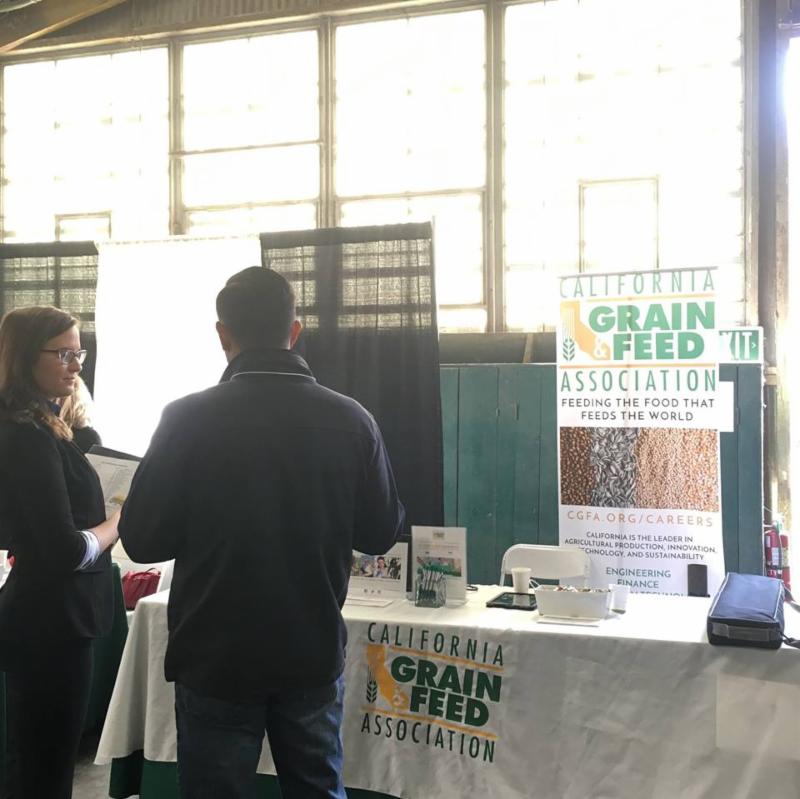 The following day, CGFA had a booth at the Cal Poly Ag Showcase where Cal Poly alumni Stephen Silva, E.B. Wakeman, and CGFA staff interacted with approximately 40 students in agriculture programs, encouraging them to use the CGFA Careers Center as a resource. Silva also spoke to a General Dairy Husbandry Class at Cal Poly in January on career opportunities in the grain and feed industry and this Wednesday, CGFA President John Kauffmann presented to the Young Cattlemen's Committee at Cal Poly. The CGFA video showcasing a variety of career options in the industry has been a valuable outreach tool during presentations to offer students an industry overview and inspire them to look at the industry as a promising career option.  At the CSU Chico College of Agriculture Careers & Internship Fair on Feb. 17, CGFA was represented by Brian Alves, California Mill Equipment Co. and Holly Klein. Around 60 students stopped by the CGFA booth to learn more about careers in the industry and available positions on the Careers Center. In early March, Grant Garland, Bar ALE, Inc. spoke to the newly formed United Students of Agriculture (USA) club at Chico State, an affiliate of the national Minorities in Agriculture, Natural Resources and Related Sciences (MANRRS). In February, Aubrey Michael, Western Milling and John Kauffmann, J.D. Heiskell & Co. spoke to the Agribusiness Club at CSU Fresno, sharing the Careers Center as a resource as well as their own experiences in the industry. At CSU Fresno 's campus-wide Career & Internship Fair on March 1 , CGFA was represented by Barbara Abeloe, NuWest Milling; Ken Zeman, Harris Ranch and John Kauffmann, J.D. Heiskell & Co. who offered various perspectives on possible career paths. Of 50 students who visited the CGFA booth, quite a few created a Careers Center profile on the spot, reminding them to search for positions and upload their resumes afterwards. CGFA Past President, Phil Waddell, Foster Farms, also spoke to a class at CSU Fresno later in March. 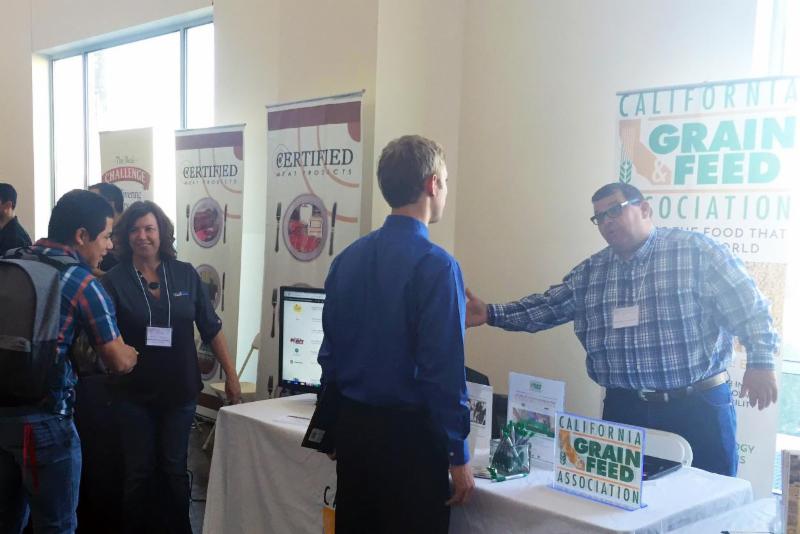 During the UC Davis Winter Internship and Career Fair, Aimee Darville and Holly Klein engaged with over 100 students and alumni on behalf of CGFA. A number of students reported that they would be applying to at least one the half dozen summer internships listed on the Careers Center. A member of CGFA will also be speaking this Spring to the UC Davis MANRRS student club and Sigma Alpha, the only professional agricultural-based sorority on campus. 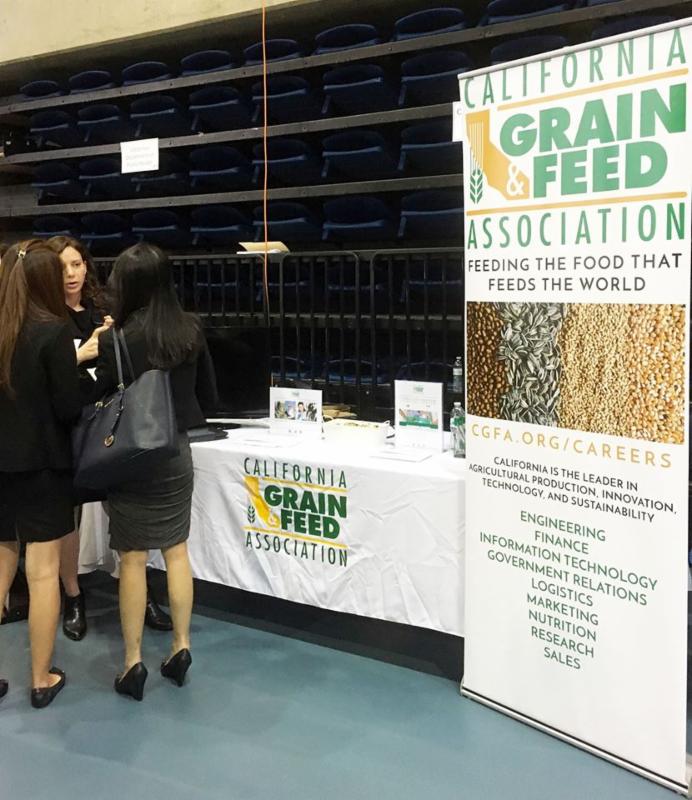 CGFA has established relationships with key faculty and staff members at each target university to foster continued outreach activities. A spike in job seekers using the Careers Center was seen after each Career Fair and campus outreach activity; students and alumni are eager to learn of employment opportunities in the grain and feed industry. If you are interested in speaking to a class or student club at any of CGFA's target universities next Fall, please email info@cgfa.org. Click here to begin posting available positions after creating a brief profile.
|
SB 3 (Minimum Wage) Opposition Letter from California Grain & Feed Association
|
California Grain & Feed Association sent the letter below in opposition to SB 3 (Leno) Minimum Wage: Annual Adjustment, to members of the California State Assembly on March 30. The letter signed by the California Chamber of Commerce and dozens of other organizations, identifies SB 3 as a job killer and outlines the negative anticipated outcomes of a 50% increase in the minimum wage over the next six years for employers with more than 25 employees.
|
Governor to Sign Legislation to Raise California's Minimum Wage on Monday in LA
|
FOR IMMEDIATE RELEASE:
Thursday, March 31, 2016
Contact: Governor's Press Office
(916) 445-4571
LOS ANGELES - Governor Edmund G. Brown Jr. will join supporters from across the state on Monday in Los Angeles to sign landmark legislation SB 3, passed by both houses of the Legislature today, that makes California the first state in the nation to commit to raising the minimum wage to $15 per hour statewide.
"California is proving once again that it can get things done and help people get ahead," said Governor Brown when the deal was announced earlier this week. "This plan raises the minimum wage in a careful and responsible way and provides some flexibility if economic and budgetary conditions change."
Under the plan, minimum wage will rise to $10.50 per hour on January 1, 2017 for businesses with 26 or more employees, and then rises each year until reaching $15 per hour in 2022. This plan also recognizes the contributions of small businesses - those with 25 or fewer employees - to California's economy and allows additional time for these employers to phase in the increases.
The purpose of the plan is to increase the minimum wage over time, consistent with economic expansion, while providing safety valves - known as "off-ramps" - to pause wage hikes if negative economic or budgetary conditions emerge. The Governor can act by September 1 of each year to pause the next year's wage increase for one year if there is a forecasted budget deficit (of more than one percent of annual revenue) or poor economic conditions (negative job growth and retail sales).
Once the minimum wage reaches $15 per hour for all businesses, wages could then be increased each year up to 3.5 percent (rounded to the nearest 10 cents) for inflation as measured by the national Consumer Price Index.
This plan also phases in sick leave for In-Home Supportive Services workers starting in July 2018.
Governor Brown signed AB 10 in September 2013 to raise California's minimum wage 25 percent, from $8 to $10 per hour, effective January 1, 2016. There are approximately 7 million hourly workers in California, of which about 2.2 million earn the minimum wage.
Additional information on the minimum wage deal can be found here.
|
California Legislative Report
|
By: Dennis Albiani, Legislative Advocate
Legislature Passes, Governor to Sign, Significant Increase in Minimum Wage
Over the spring break, while Legislators were in their districts and on vacations, Governor Brown and labor leaders negotiated a sweeping multi-year minimum wage deal that when fully enacted will raise the minimum wage to $15 an hour. The "deal" was then placed into SB 3 (Leno, De Leon) on Tuesday, heard in the Assembly Appropriations Committee on Wednesday and passed both the Assembly and Senate floors on Thursday. Governor Brown will join supporters from across the state on Monday in Los Angeles to sign the minimum wage legislation. The association joined a coalition of business groups to oppose the legislation but the deal was pushed through to avoid opposition and additional scrutiny.
Under the plan, minimum wage will rise to $10.50 per hour on January 1, 2017 for businesses with 26 or more employees, and then rises each year until reaching $15 per hour in 2022. This plan also recognizes the contributions of small businesses - those with 25 or fewer employees - to California's economy and allows an additional year for these employers to phase in the increases.
The purpose of the plan is to increase the minimum wage over time, consistent with economic expansion, while providing safety valves - known as "off-ramps" - to pause wage hikes if negative economic or budgetary conditions emerge. The Governor can act by September 1 of each year to pause the next year's wage increase for one year if there is a forecasted budget deficit (of more than one percent of annual revenue) or poor economic conditions (negative job growth and retail sales).
Once the minimum wage reaches $15 per hour for all businesses, wages could then be increased each year up to 3.5 percent (rounded to the nearest 10 cents) for inflation as measured by the national Consumer Price Index. The legislation also phases in sick leave for In-Home Supportive Services workers starting in July 2018.
The plan is estimated to cost the state an additional $3.6 billion a year in direct wages for minimum wage workers, and unidentified billions in increases to keep all other public employees equally well compensated. This will create additional budget and political pressure to extend the "temporary" Proposition 30 tax increases which will be on the November Ballot.
Click here for additional information concerning the minimum wage requirements.
Key Legislation to Be Considered Next Week
The legislature is in full gear with policy hearings almost every day and beginning budget considerations. Key legislation that will impact agriculture next week includes:
SB 1247 (Jackson) This legislation would create "Environmental Farming Zones" within 1 mile of every school and day care center. It is estimated to impact approximately 11,741 public schools (not including any colleges), 3,085 private schools and 12,301 child care centers. This does not include senior centers and residential areas which would add many more acres that would have to be prioritized by CDFA to implement this program. The concern is that these would become "de facto" buffer zones prohibiting the application of crop inputs such as synthetic fertilizer, pesticides, fungicides and common tillage practices. Senate Ag 4/05/16.
SB 1383 (Leno) This legislation would mandate an additional decrease of Methane by 40%, F-gasses by 50% and black carbon by 50% upon a 2013 baseline. These mandates would be in addition to AB 32 emission reduction requirements as well all other air pollution control laws. This bill will have greatest impact on livestock production, commercial refrigeration and trucking. Senate EQ 4/06/16
AB 2757 (Gonzalez) Removes the exemption for overtime after 8 hours and 6 days for agriculture field employees. Current law requires overtime after 10 hours worked and on the 7th day. Asm Labor 4/06/16.
Reclamation Announces Initial Water Supply Allocation for the Central Valley Project
The Bureau of Reclamation today announced the initial 2016 water supply allocation for Central Valley Project (CVP) contractors. This allocation is based on a cautious estimate of the amount of water that will be available for delivery to CVP water users and reflects current reservoir storages, precipitation and snowpack in the Central Valley and Sierra Nevada.
The California Department of Water Resources (DWR) reports that as of March 30, 2016, the statewide average snow water equivalent in the Sierra Nevada is 24.4 inches, as compared to two inches on this date last year, and rainfall is currently at 125 percent of the historical average. However, in 2015 California experienced its fourth year of drought, and although conditions have greatly improved, Gov. Jerry Brown's Emergency Drought Proclamation, issued January 17, 2014, remains in effect.
"While we are on track for near-average precipitation season this year, the ongoing and residual impacts of the multi-year drought continue. The impacts this summer will be greatest on the west side of the San Joaquin Valley and some areas served by New Melones Reservoir," said Reclamation Mid-Pacific Regional Director David Murillo.
Reclamation determines the allocation of CVP water for agricultural, environmental, and municipal and industrial (M&I) purposes based upon many factors including hydrologic conditions, reservoir storage levels, water quality requirements, relative priority of water rights, contractual obligations, and endangered species protection measures.
This initial CVP allocation is also based on conservative assumptions regarding Delta operations over the next couple of months; however, should conditions improve, CVP supplies could also improve, with increased supplies to Reclamation contractors in the hard-hit San Joaquin Valley. Reclamation will continue working with the DWR, federal and state fishery agencies, our contractors, and others to effectively carry out project operations and improve water supply consistent with all applicable laws.
North-of-Delta Contractors
- Agricultural water service contractors North-of-Delta are allocated 100 percent of their contract supply.
- M&I water service contractors North-of-Delta are allocated 100 percent of their contract supply.
- Sacramento River Settlement Contractors are allocated 100 percent of their contract supply.
In-Delta
- The Contra Costa Water District, which receives water directly from the Delta, is allocated 100 percent of its contract supply.
South-of-Delta Contractors
- Agricultural water service contractors South-of-Delta are allocated 5 percent of their contract supply.
- M&I water service contractors South-of-Delta are allocated 55 percent of their historic use.
- San Joaquin River Exchange and Settlement Contractors are allocated 100 percent of their contract supply.
Wildlife Refuges
- Wildlife refuges (Level 2) North- and South-of-Delta are allocated 100 percent of their contract supply.
Friant Division Contractors
- Pursuant to Reclamation's March 18 notification to Friant Division contractors and based upon Millerton Lake storage and current and forecasted hydrologic conditions in the Upper San Joaquin River Basin, the Friant Division allocation is 30 percent of Class 1 supplies.
- In addition, an Uncontrolled Season supply of 100,000 acre-feet and Unreleased Restoration Flow supply related to the San Joaquin River Restoration Program of 85,000 acre-feet are being made available as blocks that need to be scheduled and delivered by May 1 and May 15 respectively to avert flood management concerns.
Eastside Water Service Contractors
- Eastside water service contractors (Central San Joaquin Water Conservation District and Stockton East Water District) will receive 0 percent of their contract supply due to a lack of available CVP supplies from New Melones Reservoir.
In 2015, Reclamation undertook extraordinary actions to provide public health and safety supplies to our M&I contractors, meet our obligations to the San Joaquin River Exchange Contractors and South-of-Delta refuges, and facilitate water transfer and water sharing agreements throughout the Central Valley.
The CVP began the water year last October with only 47 percent of average storage overall and just 27 percent of average storage in the Federal share of San Luis Reservoir. This compares to 85 percent of average overall for the CVP and 53 percent of average storage in the Federal share of San Luis Reservoir today. Dry conditions in the fall of 2015 also hampered the filling of San Luis Reservoir. Further, throughout the fall and most of the winter, Reclamation held releases to minimal levels to conserve storage in upstream reservoirs.
The combined effect of four years of drought, lack of available water at the beginning of the 2016 water year, and restrictions to protect listed species are impacting the amount of water that can be allocated to South-of-Delta agricultural water service contractors. As the water year progresses, changes in hydrology and opportunities to deliver additional water will influence future allocations. Water supply updates will be made as appropriate and posted here.
|
|
|
State Water Project Allocation Increased: Storms Improve Conditions, but Drought Remains: With March storms boosting reservoir levels, the Department of Water Resources (DWR) on March 17 increased its water delivery estimate (allocation) for most recipients to 45 percent of requests for the calendar year. DWR's initial State Water Project (SWP) allocation of 10 percent of requests, announced in December, was increased to 15 percent on January 26 and to 30 percent on February 24 after January storms increased the Sierra snowpack and brought significant rainfall to the drought-parched state. More Information
Long-Term Drought Resilience- Federal Action Plan of the National Drought Resilience Partnership: On World Water Day, March 22, the administration released a Federal Action Plan of the National Drought Resilience Partnership which accompanied the Presidential Memorandum on Drought. It lays out a series of activities to fulfill the President's Drought Resilience goals. These actions will be carried out in FY 16 and FY 17 by the federal agencies of the National Drought Resilience Partnership- including USDA. Multiple USDA agencies' work is highlighted in the Action Plan including Natural Resources Conservation Service, US Forest Service, Rural Development, the National Institute for Food and Agriculture, Agricultural Research Service, Economic Research Service, Office of the Chief Economist, and others. Action Plan
March 22: White House Water Summit: In conjunction with the United Nations World Water Day, the Administration hosted a White House Water Summit to raise awareness of water issues and potential solutions in the United States, and to catalyze ideas and actions to help build a sustainable and secure water future through innovative science and technology. USDA Natural Resources and Environment Under Secretary Robert Bonnie hosted a panel on the role of agriculture and forestry in providing solutions to water quality and quantity issues. The panel was comprised of Tom Martin, President of American Forest Foundation; Tina May, Former U.S. Senate Committee on Agriculture Professional Staff and USDA Official; and Congressman Jared Huffman, U.S. Representative for California's 2nd District Watch the Event
Fact Sheet: Working Together to Build a Sustainable Water Future: Water challenges are facing communities and regions across the United States, impacting millions of lives and costing billions of dollars in damages. These challenges are particularly problematic in predominantly poor, minority, or rural communities, where water inequality can go hand-in-hand with socioeconomic inequality. Recent events, including record-breaking drought in the West, severe flooding in the Southeast, and the water-quality crisis in Flint, MI, have elevated a national dialogue on the state of our Nation's water resources and infrastructure. This dialogue is increasingly important as a growing population and changing climate continue to exacerbate water challenges. Accordingly, we must work together to build a sustainable water future-one in which everyone has access to the safe, clean, and affordable water they need, when and where they need it. More Information
Presidential Memorandum: Building National Capabilities for Long-Term Drought Resilience: By the authority vested in me as President by the Constitution and the laws of the United States of America, I hereby direct the following: Section 1. Purpose. Our Nation must sustain and expand efforts to reduce the vulnerability of communities to the impacts of drought. Every year, drought affects millions of Americans and poses a serious and growing threat to the security and economies of communities nationwide. Drought presents challenges to the viability of agricultural production and to the quantity and quality of drinking water supplies that communities and industries depend upon. Drought jeopardizes the integrity of critical infrastructure, causes extensive economic and health impacts, harms ecosystems, and increases energy costs. In responding to and recovering from past droughts, we have learned that focused collaboration across all levels of government and the private sector is critical to enable productive and workable solutions to build regional resilience to drought. Full Memorandum
Groundwater law and winter rain trigger flood of aquifer-recharge projects around California: "A historic 2014 law requiring water agencies across California to replenish the state's imperiled aquifers created a new problem: Many local officials just weren't sure how to do it. But this winter's abundant rains are triggering a flood of experiments that have turned the state's agricultural regions into aquifer-recharge laboratories. Farmers in Modesto inundated an almond orchard with the city's stormwater. Water managers in and around Fresno have more than 20 new groundwater recharge projects in the works. On the Central Coast, researchers in the Pajaro Valley are carefully designing percolation basins to capture rainfall before it gushes out into the Pacific. ... " Read more from the San Jose Mercury News here: Groundwater law and winter rain trigger flood of aquifer-recharge projects around California
CDFA's Planting Seeds blog - Sustainable Groundwater Grants: The Department of Water Resources (DWR) has announced it is awarding 21 counties a total of $6.7 million in grants to help with sustainable groundwater planning. The Proposition 1 Sustainable Groundwater Planning Grant Program provides funding for county projects that will develop groundwater plans consistent with the Sustainable Groundwater Management Act (SGMA) enacted by Governor Edmund G. Brown, Jr. in 2014.The awards were made to counties with high and medium priority groundwater basins, some of which are in critical over-draft. The blog post here.
Valley counties receive money for water studies: "Four central San Joaquin Valley counties have been awarded state grants to improve their understanding of underground water so they can prepare for a state law that takes effect in four years. Fresno, Tulare, Kings and Madera counties each will get $500,000 in Proposition 1 funding set aside for local governments to adhere to guidelines of California's Sustainable Groundwater Management Act. The money will help local governments undertake projects in cooperation with other agencies to bring their basins into balance and make them sustainable long term, said Lauren Bisnett, the Sacramento-based information officer for the state's program overseeing the groundwater management act program. ... " Read more from the Fresno Bee here: Valley counties receive money for water studies
|
USDA Reports Show 6% Higher Corn Plantings, Stocks up Slightly
|
Analysts see farmers betting on higher corn sales to offset slumping prices as USDA this week reported producers report they'll plant 93.6 million acres of corn for 2016, up 6% from a year ago and much higher than the 90 million acres the market expected based on numbers released at the USDA Outlook Conference in February. Corn futures were off about 15 cents a bushel on the news, hitting $3.51 for May delivery.
In the Grain Stocks report also released this week, USDA reported corn stocks in all positions March 1 hit 7.81 billion bushels, up about 1% from last March, and slightly higher than the market expected. The corn crop, if producers make good on intentions, will be the biggest crop since 2013, and the third highest acreage since 1944, the department reported in its Prospective Plantings report. Soybean acreage is predicted to hit 82.2 million acres, about 1% less than 2015, and less than the 83 million acres analysts expected. Soybean stocks hit 1.53 billion bushels, 15% higher than a year ago, USDA said. Wheat acreage is predicted to be slightly less than the department reported in February, with farmers reporting they intend to plant 49.6 million acres. The February wheat acreage projection was expected to be about 6.7% less than the year before, but this week's report shows planted acreage off closer to 9% from 2015. Wheat stocks jumped 20% from the year before to 1.36 billion bushels.
|
Vilsack Continues Push for GM Label Disclosure
|
Congressional action on preemption of state laws mandating food/feed labeling for genetically modified (GM) ingredients stymied as Senators wrangle over how much label disclosure is enough disclosure and should such a requirement be mandatory or voluntary. With several New England states ready to follow Vermont on GM labeling, Secretary of Agriculture Tom Vilsack this week in Chicago for the Good Food Festival, gave the Chicago Tribune his take on the status of the preemption effort.
In an article headlined: "GMO Labeling: Five Questions with Ag Secretary Tom Vilsack," Tribune reporter Greg Trotter says the issue of labeling "has roiled the food and agriculture industries in recent weeks," and with Vermont's law set to take effect July 1, Vilsack "lamented the debate that's divided the farming community." On the stalled Senate bill and four major food companies announcing plans to label for GM ingredients, Vilsack said, "I think it's also going to create a confusing mixture of ways in which individual companies and individual states are going to approach this issue. I think it begs for some kind of standardization...and I'm hoping...that the folks in the Senate don't stop working on this issue and figure out a way to reach common ground." When asked if Congress can get its act together before July 1, Vilsack said "I think it's certainly possible and doable" if lawmakers and private interests are willing to compromise. "I think there are very valid reasons for consumers to have information... (but) if the information is conveyed in a particular way, it sends the wrong message about the safety of the product...because there's no scientific evidence to suggest that GMO food is unsafe...(and) at the end of the day, it's not about food safety." Vilsack reiterated his support for mandatory disclosure through a variety of means to give consumers ways to find out if GM ingredients are used in various products, including QR codes, websites, 1-800 numbers, etc. He also said "there should be enough time to educate consumers about where this information is...so they know precisely where to look for the information." He said the industry could have done this 20 years ago, but "they didn't so now they're playing catch-up."
|
Obama Antibiotic Resistance Advisory Council OKs Report, Supports FDA, Need for Federal Dollars
|
President Obama's Advisory Council on Combating Antibiotic-Resistant Bacteria held a two-day meeting in Washington, DC, this week, approving a 125-page report on next steps that support FDA's current actions on antibiotic use in agriculture, while calling for more federal spending to track on-farm use.
Saying the broad issue of battling antibiotic resistance needs to be raised to the cabinet level, the panel says managing antibiotic use in agriculture - most antibiotics are given to animals through feed and water - would benefit from policies and federal funding in order to measure the effectiveness of FDA's current cooperative program with industry to limit on-farm use of the animal medicines. That program has successfully led to drug companies surrendering label claims for feed efficiency and growth promotion, as well as industry agreeing that all antibiotic use should be under veterinary supervision using the existing, updated Veterinary Feed Directive (VFD) program. The agriculture antibiotics effort also needs to coordinate with state governments, the industry and universities to enhance producer education, use surveillance and the development of alternatives to antibiotics also used in human medicine. Congress also needs to provide funding to both FDA and USDA to broaden what the Administration calls a "public health priority." However, in the FY2016 omnibus spending bill, the human medicine side of FDA received $375 million to fund its antibiotic resistance work; the feed/animal drug side of the agency received zero. Critics of on-farm antibiotic use, including groups who want to see the practice banned, were disappointed with the report because it affirms the status quo, does not include antibiotic reduction targets for agriculture, nor does it call for reporting of very specific use data, data that could only be supplied by feed mills and veterinarians. However, the report says FDA will likely publish this Spring a new rulemaking to require "estimates" of animal-specific sales data, along with a metric for determining when the products are being used on farms appropriately.
|
|
|
EPA IG Review of Herbicide-Tolerant Plant Oversight Underway - Several newsletters which track EPA say the agency's Inspector General's (IG) office has launched an investigation/review into how the agency regulates herbicide-tolerant weeds and crop chemicals, including glyphosate, applied to those weeds and genetically modified (GM) crops. A memo posted last week to the EPA website says the IG is preliminarily looking at how EPA evaluates the human health risk of herbicides/pesticides, and how the agency handles so-called "superweeds," which critics contend evolve from an overuse of GM crops. While there's no timeline for the IG effort, the memo said the agency will "begin preliminary research to assess the EPA's management and oversight of resistance issues related to herbicide tolerant genetically engineered crops."
Agency Moves to Cancel Flubendiamide Registration after Bayer Refusal - EPA this week said it is initiating the process to take flubendiamide pesticide products off the market after Bayer Crop Science refused to voluntarily end sales of the product known as "Belt." Bayer has formally requested a hearing before an agency administrative law judge to justify maintaining the Belt registration. Bayer was asked by EPA in January to pull the product that's used in more than 200 crops in the U.S. Belt, which received a conditional registration in 2008 pending reports of any negative environmental effects, breaks down in a "more highly toxic material that harmful to species that are an important part of aquatic food chains...and is persistent in the environment," the agency contends. EPA said if evidence were to develop of environmental harm, an automatic voluntary cancellation is required and that without that condition, the product would never have been approved. Bayer says the agency is basing its cancellation action on "theoretical computer modeling which is, of course, dependent on many assumptions and inputs."
|
|
|
Bipartisan Senate Group Wants Higher RFS - With EPA on record pledging its next formal report on levels of biofuel gasoline blending under the Renewable Fuels Standard (RFS) will be released on time, 19 Senators this week from both sides of the aisle sent a letter to the agency telling it to set the RFS at levels set in the 2007 authorizing law. The 11 Democrats and eight GOP lawmakers said, "The forthcoming proposal to set blending targets for 2017 is the EPA's chance to fulfill the commitment...to get the program back on track." Last year, the agency set RFS ethanol levels for 2014, 2015 and 2016, and for biodiesel, set a 2017 target as well. And while the levels reported were higher than originally proposed, they fell far short of levels called for in the RFS law. EPA said at the time that "infrastructure concerns" wouldn't allow it to set the RFS at the higher levels, but agency Administrator Gina McCarthy said the agency continues to work toward "making sure the RFS program is actually moving toward the levels Congress intended."
House Members Assail EU Biofuel Import Tariffs - U.S. Special Trade Representative Michael Froman this week heard from nine House members that he needs to make sure the European Union (EU) gets rid of tariffs on U.S. ethanol and biodiesel imports as part of U.S. work on the Transatlantic Trade & Investment Partnership (T-TIP), the U.S.-EU free trade agreement currently being negotiated. The bipartisan group of lawmakers told Froman to use leverage to eliminate "any tariffs on U.S.-produced energy, including ethanol." The House members, primarily from major ethanol-producing states, said the U.S. has been unfairly targeted by EU tariffs, action that has "subsequently eliminated the U.S. share of the European market." U.S. ethanol exports to the EU dropped from a high of 291 million gallons in 2011, to 37 million in 2015; biodiesel exports dropped from 34 million gallons in 2011 to zero in 2015, both declines thanks to an $83/metric ton tariff imposed by the EU in 2013. T-TIP is hoped to be completed this year.
|
|
|
|
|
|
|