|
|
|
| Upcoming Dates |
Feb. 29, 2016:
Ridge Creek Dinuba Golf Club
Dinuba, CA
April 27-30, 2016:
CGFA Annual Convention The Manchester Grand Hyatt San Diego
California Animal Nutrition Conference at the DoubleTree by Hilton Fresno Convention Center
Fresno, CA
March 8-10, 2016:
2016 Golden State Dairy Management Conference
Seaside, CA
|
|
Benefits of Belonging to CGFA
|
- State & Federal Legislative Advocacy
- Industry & Small Business Issues
- Business Advocacy
- Weekly Updates on Current Issues
- Networking Opportunities
- Industry Specific Directories
- Advertising Venues
- Social Media Sites
- Cost Saving Insurance Programs
- Environmental and Safety Resource
- Continuing Education and Training
- Political Action Committee Administration
- Annual Convention
- Education Programs
- District Meetings
|
|
|
CGFA District Meeting & Golf Tournament
|
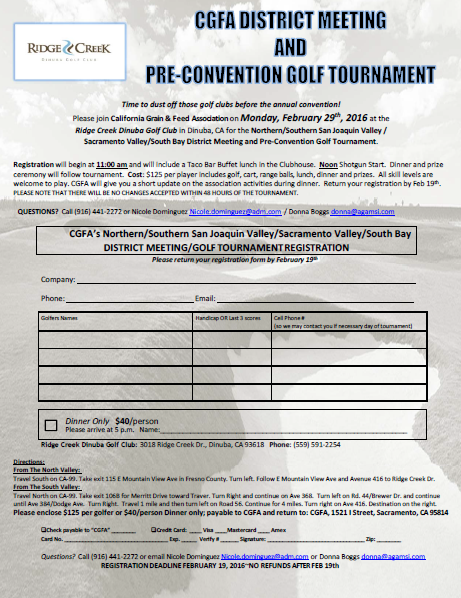
District Chair Nicole Dominguez of ADM invites all CGFA members to the upcoming district meeting on Monday, February 29, 2016 at the Ridge Creek Golf Course in Dinuba.
This is a perfect opportunity to get in a round before the annual convention AND a perfect excuse to spend your "extra" Leap Day golfing!
Join us for the Northern/Southern San Joaquin Valley/Sacramento Valley/South Bay District Meeting and Pre-Convention Golf Tournament! Registration includes a taco bar buffet lunch in the Clubhouse, tournament, range balls and cart followed by a dinner and prize ceremony. Please register by February 19th.
|
Save the Date: FSMA Seminar on March 10th
| |
|
CDFA Announces Vacancies on the Feed Inspection Advisory Board
|
The California Department of Food and Agriculture (CDFA) is announcing three vacancies on the Feed Inspection Advisory Board (FIAB). The board makes regulatory and enforcement recommendations to the department to help ensure that commercial feed inspections contribute to a clean and wholesome supply of milk, meat, and eggs.
The FIAB vacancies are for commercial feed industry representatives, and applicants must hold a current California Commercial Feed License. The term of office is three years. Members receive no compensation, but are entitled to payment of necessary traveling expenses in accordance with the rules of the California Department of Personnel Administration.
Individuals interested in serving on the Feed Inspection Advisory Board must submit a short resume along with a completed Prospective Member Appointment Questionnaire, available on the CDFA website by February 20, 2016.
California Department of Food and Agriculture
Feed and Livestock Drugs Inspection Program
Attention: Maria Tenorio
1220 N Street
Sacramento, California 95814-5607
For further information on the Feed Inspection Advisory Board and vacancies, you may contact Maria Tenorio at (916) 900-5022 or maria.tenorio@cdfa.ca.gov.
|
|
|
|
California Legislative Report
|
by: Dennis Albiani, Legislative Advocate
Governor Names New Cabinet Secretary 
Earlier this week Governor Brown announced the appointment of California Department of Finance chief deputy director for budget Keely Bosler as Cabinet Secretary in the Office of the Governor. "Keely has done great work at the Department of Finance and will continue to be a huge asset in her new role," said Governor Brown.
The Cabinet Secretary is an important position. She will coordinate the activities of the agencies throughout the administration, settle conflicts between agencies and policies, and advise the Governor on major actions. Essentially, the Cabinet Secretary makes sure the trains run on time but also that they are traveling in the direction that the Governor wants. Below is the announcement.
Bosler, 40, of Sacramento, has served as chief deputy director for budget at the California Department of Finance since 2013. Bosler served as staff director for the California State Senate Budget and Fiscal Review Committee from 2010 to 2013, where she was a consultant from 2004 to 2009. She served as associate director for fiscal services at the California Department of Corrections and Rehabilitation's Budget Management Branch from 2009 to 2010 and as a fiscal and policy analyst at the California Legislative Analyst's Office from 2000 to 2004. Bosler earned a Master of Science degree in applied economics from Cornell University. Not in the announcement is that Keely grew up in northern California on a dairy and has an undergraduate degree from Chico State. She managed the Natural Resources and Water issues for the Senate Budget Committee in the 2000's and has a strong understanding of agricultural policy. Gatto Announces PUC Reform Initiative A trio of lawmakers led by new Assembly Utilities and Commerce Chair Mike Gatto, announced the most far-reaching reform of the embattled California Public Utilities Commission to date, announcing at a press conference Wednesday that a constitutional amendment would be introduced asking voters to strip the agency's constitutional authority and allow the Legislature to redistribute its power to other state agencies. The constitutional amendment would need to be approved by two-thirds of the Legislature in order for it to be placed before voters in November. "The people of the state of California are deeply concerned with the CPUC's failures in recent years - you have people in the Bay Area, justifiably concerned about a pipeline explosion; you have folks in Orange County worried about nuclear waste; Sacramento and the Central Valley is on edge about rail safety, specifically oil trains; and of course Los Angeles is deeply concerned after a gas leak. With each of these issues, lawmakers and the media have identified specific failures by the CPUC to do its job properly or, in some cases, ethically. In a statement, the CPUC wrote that "there is still much to do, and we look forward to working with the Legislature on any constructive and helpful reform initiative that is put forward. Only by working together on real changes that have the ability to succeed can we make the CPUC stronger and more efficient, and our relationship with the Legislature more productive." Last year, Gov. Jerry Brown vetoed six bills that would have changed how the commission conducts business. Three bills by now-Assembly Speaker Anthony Rendon would have established new oversight measures on the commission. Another of the vetoed bills, by state Sen. Mark Leno, D-San Francisco, would have tightened rules on private communications between utility executives and state regulators. It also would have tightened conflict-of-interest rules and limited the CPUC president's powers. And two bills from state Sen. Jerry Hill, D-San Mateo, would have set performance criteria for the agency and included commission meetings in transparency laws. Employment Related Legislation Introduced As the February 19th deadline to introduce bills nears, legislation is beginning to trickle in. Only a few bills have been introduced but the pace will quicken over the next two weeks. AB 1676 (Campos) that seeks to set a new basis to sue an employer if they inquire about past pay levels of prospective job applicants. AB 1732 (Ting), as introduced, sets new signage requirements on any business or place of public accommodation that has only one bathroom to indicate it is an all gender toilet facility. This is likely to require gender neutral toilets in public owned buildings and facilities open to the public such as restaurants and business parks. Americans with Disabilities (ADA) Act Reform AB 54 (Olsen) requires any attorney who sends a business or entity a "demand" letter indicating ADA violations to also send a copy of the demand letter to the State Bar as well as to the Commission on Disabilities. This will help quantify and track ADA demand letters and the individuals that are sending them. SB 269 (Roth) set a new process that seeks to limit liability of businesses with 50 or fewer employees by permitting those businesses to respond to and repair certain technical violations in a timely fashion, among many other provisions. It is likely that another 1000 to 1500 bills are being drafted and readied for introduction by the February 19, 2016 deadline. Newly introduced bills have to sit untouched for at least 30 days after their introduction in order to permit the public to become aware of them. Then bills can be set for hearing and amendments may occur. Policy committee hearings will go into full swing beginning in early March for most bills. At the same time, the state budget process continues to examine the Governor's proposed budget and make suggested changes to proposed appropriations.
|
A Successful 2016 Grain & Feed Industry Conference In Monterey
|
 The 2016 Grain & Feed Industry Conference (GFIC) was held on January 13-14, 2016 at the Embassy Suites Hotel on Monterey Bay. Attendance in the meetings reached a record high and participants commented that the line-up of speakers and topics were very timely and informative. Attendees returned to the mills armed with practical insights and valuable skills to implement. A special thanks to Chairman Doug Stabelfeld, Foster Farms and the efforts of the entire committee: Brian Alves, California Mill Equipment; Barney Barnes, Arizona Grain Inc.; Grant Garland, Bar ALE, Inc.; Scott Herron, Petaluma Poultry; Geoff Holland, J.S. West Milling; Kate Horstmann, Foster Farms; Mike Janich, Pacific Agri Sales; David Mitchell, Diamond V; Dave Newton, Kelzyme Research; John Rocha, Foster Farms; John Silva, NutraBlend; Don Sneddon, Evonik Industries; Bob Swaggerty, Pacific Agri Sales; Larry Thompson, Church & Dwight Co.; Doug Vickery, R.F. MacDonald Co.; Bob Weatherly; and Ken Zeman, Harris Feeding Co. These individuals did an outstanding job putting together this year's top notch program. The presentations from the speakers for the two day event are listed on the CGFA website (www.cgfa.org) under the Resources tab on the Publication page (www.cgfa.org/publications). The 2016 Grain & Feed Industry Conference (GFIC) was held on January 13-14, 2016 at the Embassy Suites Hotel on Monterey Bay. Attendance in the meetings reached a record high and participants commented that the line-up of speakers and topics were very timely and informative. Attendees returned to the mills armed with practical insights and valuable skills to implement. A special thanks to Chairman Doug Stabelfeld, Foster Farms and the efforts of the entire committee: Brian Alves, California Mill Equipment; Barney Barnes, Arizona Grain Inc.; Grant Garland, Bar ALE, Inc.; Scott Herron, Petaluma Poultry; Geoff Holland, J.S. West Milling; Kate Horstmann, Foster Farms; Mike Janich, Pacific Agri Sales; David Mitchell, Diamond V; Dave Newton, Kelzyme Research; John Rocha, Foster Farms; John Silva, NutraBlend; Don Sneddon, Evonik Industries; Bob Swaggerty, Pacific Agri Sales; Larry Thompson, Church & Dwight Co.; Doug Vickery, R.F. MacDonald Co.; Bob Weatherly; and Ken Zeman, Harris Feeding Co. These individuals did an outstanding job putting together this year's top notch program. The presentations from the speakers for the two day event are listed on the CGFA website (www.cgfa.org) under the Resources tab on the Publication page (www.cgfa.org/publications).
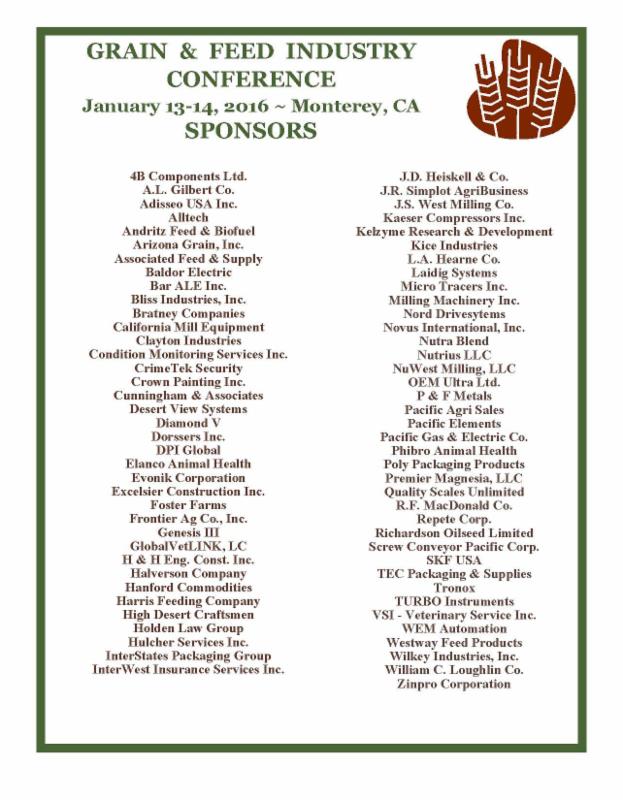
The GFIC also gives the association the opportunity to showcase some of the current programs and activities of CGFA. In addition to the educational components, the networking opportunities and the exhibits are important elements of the Grain & Feed Industry Conference. Through the support of CGFA, 20 students from 5 colleges, were sponsored to attend and learn more about the career opportunities in the grain & feed industry. There were 40 booths this year in the exhibit hall and the sponsorship support from the industry was overwhelming. The CGFA Career Center was showcased at one of the booths where students were able to post their resumes. Additionally, member companies were assisted in creating their own company profile to post their job opportunities. If you haven't created your company profile and taken advantage of this free resource to members please call our office. Over 100 firms contributed to the support of the 2016 GFIC. Your support enables CGFA to keep the cost of attendance low, allowing more people per company to register. A copy of the on-site program listing the contact information for all the vendors in the exhibit hall as well as a list of all the sponsors is available (click here).
Our sincere appreciation to the generous support from the companies who sponsored the GFIC and to all the companies that sent attendees, we hope you found the conference educational and worthwhile.
GFIC Major Sponsors
Event
A.L. Gilbert Company
California Mill Equipment
Desert View Systems
P & F Metals
Pacific Elements
Speakers
DPI Global
Nutra Blend
Westway Feed Products
Hors D'oeuvres at Reception
Adisseo USA Inc.
California Mill Equipment
Nutra Blend
P&F Metals
Richardson Oilseed Ltd.
Westway Feed Products
COFFEE BREAK SPONSORS
Associated Feed & Supply
California Mill Equipment
Dorssers Inc.
Harris Feeding Company
Nutrius LLC
P&F Metals
Pacific Elements
Pacific Gas & Electric Co.
CASINO NIGHT TABLE SPONSORS
Alltech
California Mill Equipment
Dorssers Inc.
Frontier Ag Co., Inc.
J.R. Simplot AgriBusiness
Laidig Systems Inc.
Nutra Blend
P&F Metals
Westway Feed Products
John Gonsalves Student Sponsorship Fund
A.L. Gilbert Co.
Associated Feed & Supply
CA Grain & Feed Association
CPM/Roskamp Champion
Harris Feeding Company
J.R. Simplot Agribusiness
J.S. West Milling Co.
Jake Kramer
Nutra Blend
NuWest Milling LLC
Pacific Agri Sales
R.F. MacDonald Company
The Stuart Company
|
2014 - 2015 California Ag Statistics Review
|
CDFA recently released a report of the statewide crop statistics for 2014 which shows trends for farm sales, exports, etc.
|
|
|
Registration is now open for the CGFA Annual Convention April 27-30, 2016 at the Manchester Grand Hyatt, San Diego!
|
Senate Energy Bill Hit by RFS, Coal, Flint Water Amendments
|
The bipartisan Senate energy bill which moved relatively easily through committee and was supposed to sail as easily to approval on the Senate floor was derailed this week over partisan battles related to water contamination issues in Flint, Michigan, amendments designed to kill the Renewable Fuel Standard (RFS), and President Obama's decision to temporarily end federal coal leasing.
The bill, aimed at increasing energy research, modernizing liquefied natural gas export permitting, requiring reliability and security fixes to the national electrical grid, and raising efficiency standards for federal and commercial buildings, took on new importance in the wake of Sen. Ted Cruz's (D, TX) win in the Iowa caucuses despite ethanol opposition to his stand on sunsetting the Renewable Fuel Standard (RFS), and the Michigan water crisis.
Opponents of the RFS, which mandates how much biofuel must be blended with gasoline each year, saw the Cruz victory as a strong signal the RFS must go, and several amendments aimed at either killing the RFS or dramatically reworking the system were filed on the energy bill. Sens. Pat Toomey (R, PA) and Diane Feinstein (D, CA) filed an amendment to repeal the corn ethanol part of the RFS; Sen. Bill Cassidy (R, LA) filed an amendment to kill the RFS, and Sen. Jeff Flake (R, AZ) filed an amendment to stop USDA from spending federal dollars on blender pump installations. However, given the controversy surrounding the RFS and Senate Majority Leader Mitch McConnell's (R, KY) priority on moving the energy bill, most of those amendments may be talked about, but won't get formal votes. The energy bill also became Sen. Debbie Stabenow's (D, MI) vehicle of choice for an amendment to provide federal intervention and assistance to Flint, Michigan, to fix corrosion problems in the city water system and provide aid to families affected by lead levels in Flint water. When bipartisan support for Stabenow's effort did not appear - critics called it an "earmark" aimed at rebuilding a single water system when nationally, several others need help - and then a cloture vote to limit debate failed, the GOP floated a compromise proposal to counter Democrat-supported actions for Flint. The Republican approach would provide federal loan guarantees to help the city fix and replace its water system. Discussions are expected to continue this weekend in hopes of reaching an agreement by early next week to finish work on the bill.
|
EPA "Impact" Hearing Set in House Ag; Energy & Commerce Looks at Agency "Overreach" Bills
|
EPA Administrator Gina McCarthy will appear before the full House Agriculture Committee on February 11, to explain "the impacts of EPA actions on the rural economy." At the same time, this week, the House Energy & Commerce Committee took a look at two bills designed to counter EPA "overreach."
"America's farmers and ranchers are the original conservationists, and they have a vested interest in protecting our natural resources. Yet, when it comes to the regulatory agenda of the United States Environmental Protection Agency (EPA), we are repeatedly confronted by an agency seemingly oblivious to the voluntary conservation efforts of America's farmers and ranchers, and perhaps most alarmingly, apparently addicted to writing regulations that ignore Congressional intent, ignore the input of stakeholders - including other Federal agencies - and put our ability to produce food and fiber at risk in the U. S.," said Rep. Mike Conaway, chair of the House ag panel. "Next week, EPA Administrator Gina McCarthy will be called on to explain her agency's decisions and discuss with members of Congress how we might work together to ensure that future actions by the EPA do not harm American agriculture." In the Energy & Commerce Committee, the panel examined HR 3797, the Satisfying Energy Needs & Saving the Environment (SENSE) Act, to shift EPA rules to ensure that the coal "refuse-to-energy" continues to provide affordable energy, while remediating formerly polluted coal sites. The other bill, yet to be introduced, would minimize or eliminate industry interference from EPA rules, now challenged in court, under the "Brick MACT" rulemaking.
|
GM Labeling Battle Heats Up as Food Industry Focuses on Senate
|
After two failed attempts by USDA to broker a deal between warring factions on whether or not food/feed products contain genetically engineered ingredients should be labeled, the Coalition for Safe & Affordable Food (CSAF) this week blitzed the Senate and House ag leaders in a series of meetings designed to preempt legislation to preempt state labeling laws.
The result was a commitment from Sen. Pat Roberts (R, KS), chair of the Senate Agriculture Committee to jump start the process, with Robert's report he will release draft language as soon as next week on a labeling preemption bill. The language, now under construction, will likely be much narrower than the bill approved by the House last year, and will focus on preemption. Roberts also told the National Association of State Departments of Agriculture (NASDA) this week that it's regrettable the issue is so politicized, but that it "must be reconciled." He also said time is of the essence given Vermont's state GE labeling law goes into effect July 1. The Kansas lawmaker said the Vermont law is "very restrictive," and that he strongly supports voluntary labeling for the presence or absence of GE ingredients. The coalition also met with several ag state Senators, including committee ranking member Sen. Debbie Stabenow (D, MI) and Sen. John Hoeven (R, ND), who has been working to get a bipartisan legislative vehicle ready for Senate action.
|
TPP Signed in New Zealand; Tough Road to U.S. Approval Begins
|
The 12 Pacific Rim nations which successfully negotiated the Trans-Pacific Partnership (TPP) trade agreement, met this week in Auckland, New Zealand, for a formal TPP signing ceremony. Now, each nation must officially approve the trade pact, and the road to U.S. approval is just beginning.
President Obama must now submit his formal TPP package to Congress, requesting it approve the treaty. Congress can't amend the final TPP agreement, but could disapprove the treaty, with lawmakers on both sides of the aisle pointing out their problems with the massive trade agreement. Leadership in both the House and Senate have said there will be no vote on TPP before the November general election, and votes in the post-election lame duck session may be elusive as well. Sen. Orrin Hatch (R, UT), chair of the Senate Finance Committee, said he shares Obama's goal of getting TPP approved as soon as possible, but said this week on the Senate floor, "No one should be under any illusions that, because the TPP is signed today, an up or down vote on the agreement is imminent, or that our oversight responsibilities are at an end. It's not an exaggeration - or even all that remarkable - to say that it can take years to get an agreement through Congress after it is signed." Sen. Pat Roberts (R, KS), Senate Agriculture Committee chair, said the treaty's prospects for a vote this year are dim at best. He told the annual meeting of the National Association of State Departments of Agriculture (NASDA) that TPP approval "ain't going to happen this year." At the same meeting, House ag panel ranking member Rep. Collin Peterson (D, MN), said, "From what I'm hearing, if they brought up that agreement now in the House, it would fail." TPP proponents strongly urge Congress to approve the treaty this year. In 2014, the U.S. exported more than $10 billion in feed, feed ingredients and pet food, including soybean meal, corn co-products and other feed additives, and about 60% of feed/ingredient those exports go to TPP countries, said the American Feed Industry Assn. (AFIA) after the New Zealand signing ceremony. "Congress should vote to approve TPP. International trade offers the greatest potential for the U.S. animal food industry's future growth, through both direct feed and ingredient exports and the increased overseas sale of U.S. livestock, poultry and dairy products. Free trade agreements, such as TPP, are the tools that open those international markets and make continued U.S. growth possible," AFIA said in a statement. The American Soybean Assn. (ASA) echoed the feed industry statement, saying, "With valuable established markets alongside promising emerging markets, the 11 partner nations within TPP combine to make this one of our most significant policy priorities right now." However, congressional approval may be an uphill battle in the country. Agri-Pulse newsletter reported this week that a new poll it commissioned by Aimpoint Agriculture shows 74% of farmers and ranchers aren't "familiar" with TPP." Of those who knew something about the treaty, only 33% said they would support congressional passage, while 36% said they wouldn't, and 31% said they didn't know how they felt.
|
USDA Wants Comments on Biotech Regulation, Environmental Impact Statements
|
USDA is putting together a "programmatic" draft environmental impact statement (EIS) that will allow it to evaluate several options as it moves to modernize biotech review and approval regulations and is looking for public comment on what the EIS should include, as well as definitions the agency will use.
The Animal & Plant Health Inspection Service (APHIS) has wanted to rewrite parts of its biotech regulations since 1987, to keep pace with the technology and "lessons learned" on plant pest and noxious weed risks. The current effort would "increase the efficiency and precision of our regulations." "The proposed revisions would align the range of risks that may be considered under APHIS' biotechnology regulations with both the plant pest and noxious weed authorities of the Plant Protection Act (PPA) to ensure a high level of plant health protection, improve regulatory processes so that they are more transparent to stakeholders and the public, and provide regulatory relief so that unnecessary regulatory burdens are eliminated," the agency said. The agency previously withdrew a similar rulemaking effort because federal rules limited how much "ex parte" communication about alternatives with stakeholders could be conducted, APHIS said.
|
Rein in Big Bank Commodity Trading: Brown
|
The ranking member of the Senate Banking Committee this week said the Federal Reserve must propose rules to limit risks created by big banks involvement in the trading of physical commodities. Sen. Sherrod Brown (D, OH), said the Fed has so far "failed" live up to commitments on new constraints on banks' trading in physical commodities and assets, including oil, electricity, warehouses, aluminum and tankers.
"The recent disruption in various markets underscore the risks commodities present for bank holding companies," Brown wrote in a letter to Fed Chair Janet Yellen. "Given there is no way to predict how long the supply and demand imbalances will persist across the commodity markets, or how severely they will impact the banking sector, it is past time for the Board to propose rules for bank holding companies' commodity-related activities." Brown's concern is that banks hold owned commodities in bank-owned warehouses or oil in storage tankers, allowing the bank holding companies to effectively drive up the cost of "everyday commodities," including food and gasoline.
|
Cruz, Clinton Take Iowa Caucuses, Rubio Third behind Trump; Audit May be Coming
|
With the Iowa caucuses - the first-in-the-nation presidential popularity contest-boasting record turnout, with 40% first-timers, Sen. Ted Cruz (R, TX) beat back ethanol opposition to win the day, and former Secretary Hillary Clinton squeaked out a win on the Democrat side. However, in a replay of messy 2012 vote counts where former Sen. Rick Santorum (R, PA) wound up the GOP winner days after the fact, there's pressure on the Iowa Democrat party to "audit" the results of the Democrat caucuses.
When the dust settled early on February 2, Hillary Clinton and Sen. Bernie Sanders (I, VT) pretty much split the Democrat pot, with former Secretary Clinton winning in what experts say is the closest race in Iowa Democrat caucus history. Clinton won just under 49.9% of the votes cast to Sanders' 49.6%, with one lonely Des Moines precinct still to report. That margin narrowed slightly over the next 24 hours. After the Des Moines Register called for a "complete audit of results" in a February 3 editorial, party leaders said it's almost impossible to recreate the rollercoaster opinions and vote changes of small precinct caucuses across the state. "What happened Monday night at the Democrat caucuses was a debacle," the paper wrote. "The Iowa Democrat Party must act quickly to assure the accuracy of the caucus results beyond a shadow of a doubt." Critics want the party to release raw vote totals. Sanders supports the audit, but doesn't think it will do much to change the results; Clinton said whatever the party decides to do is "fine with me." On the GOP side, Cruz won with 27.6%, Trump garnered 24.3%, and Rubio racked up 23.1% -- less than 5% separating the top three vote-getters. Pundits had called it a two-candidate race - Donald Trump versus Sen. Ted Cruz (R, TX) battling for conservative, evangelical and undecided caucus goers. However, Sen. Marco Rubio (R, FL), previously consigned to a "distant third place finish," finished significantly stronger than polling suggested, coming in just a point or so behind second-place finisher Donald Trump and reinvigorating his campaign going into next week's New Hampshire primary. A big Iowa surprise was Cruz's win in the face of massive opposition from corn ethanol interests, with the Texan winning most of Iowa's biggest corn producing counties despite his strong opposition to the ethanol Renewable Fuel Standard (RFS). America's Renewable Future (ARF) the pro-ethanol coalition which dogged Cruz throughout his campaign, rates Cruz as "bad" on ethanol/RFS, and all other frontrunners as "good." While Cruz pledges to "tear down that blendwall," sunsetting the RFS after five years, Rubio says he'd take down the RFS in seven years. Trump, Clinton and Sanders are 100% on board with the retaining the ethanol RFS.
|
|
|
|
|
|
|