|
|
|
| Upcoming Dates |
January 13-14, 2016:
Grain & Feed Industry Conference
The Embassy Suites on Monterey Bay
April 27-30, 2016:
CGFA Annual Convention The Manchester Grand Hyatt San Diego
California Animal Nutrition Conference at the DoubleTree by Hilton Fresno Convention Center
Fresno, CA
|
|
Benefits of Belonging to CGFA
|
- State & Federal Legislative Advocacy
- Industry & Small Business Issues
- Business Advocacy
- Weekly Updates on Current Issues
- Networking Opportunities
- Industry Specific Directories
- Advertising Venues
- Social Media Sites
- Cost Saving Insurance Programs
- Environmental and Safety Resource
- Continuing Education and Training
- Political Action Committee Administration
- Annual Convention
- Education Programs
- District Meetings
|
|
|
| CGFA at Fresno State and Chico State Career Fairs |
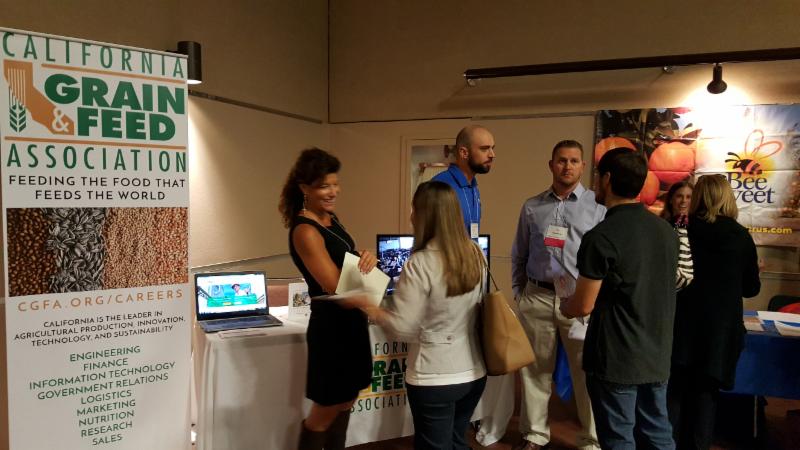
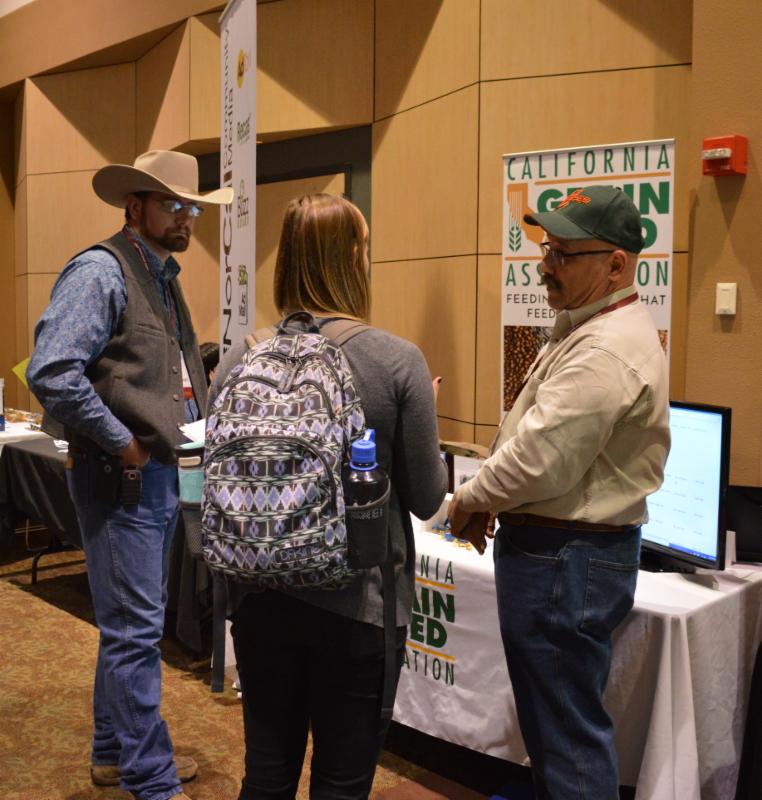
CGFA recently participated in the Fresno State and Chico State Career Fairs, the last career fairs for 2015. On October 20, CGFA had a booth at the Fresno State Agriculture & Food Industry Career Fair. Representing CGFA at Fresno State were Board President John Kauffman of J.D. Heiskell & Company and CGFA members Greg Thon from ADM and Fresno State Alumnus Brett Von Berg with BVB Trading Company. Marilyn Dolan, with The Communications Department, the consultant responsible for developing the CGFA Careers Center also attended.
The Fresno State Agribusiness Club has invited a speaker from CGFA to discuss career opportunities in the grain & feed industry at a February 2 meeting. Please contact info@cgfa.org if you are interested in speaking to students in this or other student organizations in 2016.
On Tuesday November 3, CGFA had a booth at the Chico State Career & Internship Fair and was represented by CGFA members Brian Alves with California Mill Equipment Co. and Chico State Alumnus Joe Lemenager with Bar ALE, Inc.. CGFA Communications Director Aimee Darville also attended.
During both career fairs CGFA engaged with over 100 students, who have begun uploading their resumes to the CGFA Careers Center. All of the resumes collected at the Fall career fairs will be added to the Careers Center for your review.
If your company has a job or internship opening, you can post it here. Openings will be shared on the CGFA Facebook page and with students and alumni who are currently searching for internship and job opportunities for the 2016 schoolyear and summer!
|
California Legislative Update
|
The first year of the legislative session is finished with GovernorBrown addressing the 941 bills passed by the Legislature. The Governor signed 808 bills and vetoed 133. This year's veto rate was just over 14% which is slightly higher than the Governor's average veto rate (12.9%) during his current term (2011-15) which in turn is significantly higher than his veto rate during his first two terms (4.63%). If you look at all 13 years as Governor (1975-82 and 2011-15), Brown has considered 16,183 bills and vetoed 1,145 bills, or 7% of all bills considered. Below is a synopsis of the final few weeks of the Governor's actions on priority legislation. For ag and business interests, the year was dominated by discussion and legislation attempting to address climate change. The Governor signed several bills focused on reducing greenhouse gas emissions in California. Additionally, there was important legislation passed on labor, groundwater adjudication and antibiotics. AAMSI Sponsored Legislation AB 689 (Dodd) Shell Egg Inspection Program Enforcement Bill - this measure will increase the authority of local ag commissioners and the secretary to enforce the Shell Egg Inspection Act by providing civil enforcement authority and increasing fines. Signed.
SB 770 (Mendoza) Antibiotics in Feed Inspection Program - Maintain the medicated feed program within the California Department of Food and Agriculture regardless of issues such as over the counter availability. Signed.
AB 264 (Dahle) Seed Transaction Harmonization - This bill will harmonize all seed transactions and clarify they are governed solely by the Seed Labeling Act and applicable federal law and not subject to the oversight and fees of the Market Enforcement Branch. Signed.
AB 655 (Quirk) Rendering Program Reform - This bill will address key rendering funding issues, organic recycling issues and position rendering in the state as a carbon reduction technology. 2- year bill.
AB 1363 (Salas) Livestock Placeholder - We are working with a coalition of animal agriculture groups to have a livestock bill in place in case an animal welfare bill or some other offensive bill to the feed or livestock industry is introduced. On Sen Floor.
AB (1390) Alejo Streamlined Adjudication - This measure which will be proposed by the Farm Bureau and a coalition of agriculture and water entities is intended to provide certainty and a rational process for adjudicating groundwater basins for those who enter this process. Status: Sent to Enrollment.
|
|
|
|
Senate Bill to Kill WOTUS Fails; Resolution to Nullify Rule Approved
|
A Senate bill to force EPA to withdraw its "waters of the U.S. (WOTUS)" rule and start anew failed this week to clear procedural hurdles to cut off debate. However, the Senate turned around and approved 53-44 a resolution of disapproval by Sen. Joni Ernst (R, IA) of the WOTUS rule.
The resolution is authorized by the Congressional Review Act (CRA) and now goes to the House for expected concurrence. CRA allows Congress to override an agency rulemaking and block the agency from revisiting the issue, and has only been used successfully once when Congress overrode a Clinton Administration OSHA rulemaking on a national workplace ergonomics rule. While President Obama has said he'll veto the Ernst resolution, supporters say it will put members on record either favoring regulatory "overreach" or not going, into the 2016 general election.
The bill, authored by Sen. John Barrasso (R, WY) with bipartisan ag lawmaker support, failed 57-41 - it needed 60 votes to cut off debate - even after Senate Agriculture Committee Chair Pat Roberts (R, KS) took to the floor and urged colleagues to vote for the measure, a companion to a House approved bill that tells EPA to kill the current rule, start the process again, but this time increase stakeholder input, including direct discussions with farmers and ranchers. Roberts told his colleagues over 90 national organizations oppose the rule, and that EPA is facing not only a nationwide federal court stay on implementation, but 31 states have filed suits challenging the rule. The Barrasso bill's demise was hailed by environmental groups, and President Obama has said he'd likely veto the measure if it passed. Sen. John Cornyn (R, TX) accused Democrats of "doing everything they can to protect the Administration" on the controversial rulemaking which extends EPA and U.S. Army Corps of Engineers legal authority under the Clean Water Act (CWA) to regulate non-navigable waters across the country. Meanwhile, House GOP lawmakers are eyeing two appropriations bills - energy-water and interior-environment - to carry language killing the WOTUS rule, ignoring Democrats warnings they'll reject spending bills - or an omnibus spending package - that carry major policy riders. December 11 is the deadline for approving the spending package. The American Farm Bureau Federation (AFBF) supports the spending rider move, saying it will be tougher for President Obama to veto an omnibus spending package and risk shutting down the federal government just before Christmas.
|
White House Should Focus on Exports for Biotech Approval Review
|
As the White House continues its review of existing programs for federal biotechnology product approvals, the National Grain & Feed Assn. (NGFA) this week urged the administration to keep the needs of export markets in mind.
Meanwhile, consumer groups told the White House the regulatory review should focus on setting new, stricter rules for biotech approvals, while biotechnology supporters urged the administration to make biotech oversight "truly risk-based," and "restore the balance between oversight and product safety." Said one lawyer, "While too much regulatory oversight will stifle innovation, too little with result in public rejection of the technology due to a lack of trust." "This review must address the challenge of achieving regulatory coherence and compliance in the global market," said NGFA President Randy Gordon at a public meeting this week before USDA, EPA, FDA and White House biotech overseers. Gordon reminded regulators of the hurdles faced by grain exporters trying to move into major new markets, including China, and these hurdles have cost exporters millions in lost sales. Consumers Union (CU) said the federal biotechnology review and approval systems is broken, using laws "that were never designed to address biotechnology, trying to put square plugs into round holes." The Center for Food Safety (CFS) said new rules need to take into account novel forms of genetic engineering, such as gene editing and RNA interference technologies, as products using these techniques are not routinely regulated. The review takes a look at what's called the "Coordinated Framework" for approving products of biotechnology. The Obama White House contends the system is in need of review and modernization as it sets the system for agency responsibility and review criteria for biotechnology approvals.
|
|
|
EPA's draft final rule on how much of various biofuels must be blended with gasoline in coming years as part of the Renewable Fuel Standard (RFS) has been sent to the Office of Management & Budget (OMB) for its blessing prior to publication by the November 30 deadline for release. Biofuel makers continue to push for higher RFS levels than earlier proposed, with corn ethanol refiners wanting the levels set by statute in 2007.
As part of the political gamesmanship surrounding the final RFS rules for 2015 and 2016, and in some cases, 2017, this week 184 House members from both sides of the aisle sent a letter to EPA warning the agency not to "breach the blendwall" in its RFS rulemaking. Currently, there's a 10% maximum blend rate for biofuels with gasoline. Gasoline makers contend that as gas sales drop, they're forced to blend at higher rates to meet the RFS total gallon targets for biobased fuels.
The House letter says EPA's proposed RFS levels will force gasoline makers to go beyond the 10% blend ceiling, and "Congress overestimated the growth in gasoline demand when it set up the program." A separate letter from a bipartisan House group sent October 30, urges EPA to not reduce RFS levels from the proposed rule, and "EPA's approach to the RFS should not be inconsistent with the Administration's efforts to reduce carbon emissions and address global climate change. Reducing the biofuel volume requirement will affect our economy and health and is against congressional intent." The letter states.
|
House Approves Six-Year Highway Bill; Rejects Heavier Trucks, Ex-Im Bank Reboot Survives
|
After more than 34 short-term extensions, the House took three days of floor time, handled 126 amendments, and ultimately approved 363-64 this week a six-year federal highway program reauthorization bill. Technically the bill is a package of amendments to the already-approved $342-billion Senate highway bill, but not among them is language pushed by shippers to allow states to permit 91,000-pound trucks with six axles on interstate highways within their borders.
The House moved quickly to prepare the bill for conference with the Senate, with Speaker Paul Ryan (R, WI) naming 28 conferees - with more to be named later - and House Minority Leader Nancy Pelosi (D, CA) naming 12 conferees, all members of the Transportation & Infrastructure Committee. The current extension of existing authority runs out November 20, giving conferees just about two weeks to cut a final deal. The heavy truck amendment, proposed by Rep. Reid Ribble (R, WI), would have allowed the heavier trucks on federal interstate highways if individual states decided to permit the vehicles. Twenty-five states already allow on state roads trucks heavier than the current 80,000-pound federal weight limit, which has not been modified since 1982. Ribble's amendment was supported by the Coalition for Transportation Productivity (CTP), a group of more than 250 national and state associations, as well as major corporations. The shippers want the heavier trucks because the current federal weight limit forces them to put partially loaded vehicles on the road, meaning more trucks, more fuel burned and a bigger carbon footprint. Opponents, led by the railroads who fear loss of cargo, played the safety card, demonizing the Ribble language as permitting dangerous "bigger trucks" on the highways. Also opposed were several state and local law enforcement groups, and topping off the opposition was a statement by the Department of Transportation (DOT) that a recent study it conducted did not provide enough safety data on the heavier trucks to justify changing the federal weight limit at this time. A related amendment that would have allowed livestock haulers' trucks to weight up to 95,000 pounds also failed. The National Cattlemen's Beef Assn. (NCBA) said the loss of the Ribble and livestock trucking amendments forced it to "strongly oppose" the final highway package. However, Included by the transportation panel during markup of the underlying bill is language allowing states to permit milk haulers at weights exceeding the federal weight limit due to the "unique situation" in hauling milk, and language allowing emergency vehicles weighing more than 80,000 pounds to roll on interstate highways. Proving to be more popular and resilient than previously thought, language in the House package to reauthorize the Export-Import Bank, on which several sectors of agriculture rely for trade financing, survived 10 separate amendments designed to derail or constrain the reboot of the federal lending agency. The Senate bill contains Ex-Im Bank reauthorization language, so the issue is technically not debatable in conference and the bank is set to begin normal operations when the President signs the bill. Conferees can ignore the rules, but a change in the Senate-approved language means reconsideration by the Senate with all the procedural hurdles that includes. The bank ceased new lending in July, but has been managing its loan portfolio in the meantime. The recently approved two-year budget agreement signed last weekend by President Obama is a boon to the conference committee because the $80 billion in additional discretionary spending will allow House Democrat conferees to support the more expensive Senate bill, eliminating Senate grumbling over the flat spending contemplated in the House. At the same time, conferees will be challenged to find federal dollars to cover the full cost of the measure. Further, Reps. Randy Neugebauer (R, TX) and Bill Huizenga (R, MI) successfully offered an amendment replacing a funding gimmick in the Senate bill that would cut the Federal Reserve dividend to banks and increase fees charged by Freddie Mac and Fannie Mae to pay for part of the $45-billion needed to offset the cost of the bill. Instead, the amendment would liquidate the Federal Reserve's surplus account designed to protect it against "losses" - valued at about $29 billion, with $11 billion more expected to be deposited over 10 years - and shift that money to the General Fund to help pay for the highway bill.
|
White House Releases Text of TransPacific Partnership; 60-day Public Review Begins
|
The full, formal text of the TransPacific Partnership (TPP) trade pact signed by 12 Pacific Rim nations, including the U.S., was released by the White House this week, starting the 60-day public review period - including congressional oversight - as required under President Obama's trade promotion authority (TPA). At the end of that time - which includes congressional hearings - Congress will vote up or down on whether to ratify the trade treaty.
Review will be tough. In addition to the 30-chapter trade agreement, there are several "side letters" to the pact which contain exemptions, clarifications and details. All of these need to be reviewed in the context of the underlying treaty language so an informed decision can be made on the impact of the pact on U.S. industry. At the same time, the treaty is not just about tariff elimination - there are thousands of individual tariff changes - but also includes new rules, new chapters on sanitary-phytosanitary requirements, along with new language on protecting "common food names." Democrats were the first out of the box this week as House Ways & Means Committee minority membership announced it will hold a series of TPP-related "public events" beginning the week of November 16. Committee ranking member Rep. Sandy Levin (D, MI) called the events hearings, but no hearings have been announced by the GOP leadership. Levin said the events will cover environment, worker rights, investment (including tobacco), automotive and agricultural market access, rules of origin, state-owned enterprises, access to medicines, currency manipulation and the impact of TPP on U.S. jobs and the economy. Sen. Orrin Hatch (R, UT), chair of the Finance Committee, said the Administration's obligation to convince Congress this is the best deal possible for U.S. interests still remains. "Only Congress can enact the trade agreement and for that to happen, the agreement must meet the requirements laid out in the bipartisan TPA. "Transparency and accountability are key objectives of TPA," Hatch said. TPP represents an agreement among nation's representing about 40% of global gross domestic product, and has been a major trade and Asia policy priority of the Obama Administration. U.S. Special Trade Representative Michael Froman said in a statement this week, "This release complements a number of additional resources we have made available...including state-by-state fact sheets, issue briefs and chapter summaries. All of the information available on TPP can be found by going to www.ustr.gov and clicking on the TPP website. With the exception of the National Farmers Union (NFU) and R-CALF, national agriculture groups were nearly unanimous in their initial praise of TPP. The American Feed Industry Assn. (AFIA) said after its initial review, the final text is "extremely positive." "If ratified and put into force, TPP will allow the U.S. feed industry to operate on a more level playing field in the Pacific Rim region...where the U.S. has been put at a disadvantage," said Gina Tumbarello, AFIA director of international policy and trade. AFIA urged Congress to swiftly approve TPP after the 60-day review. NFU said, "This agreement has been peddled to farmers and ranchers as a potential gold mine for farm exports. But as with other trade deals, these benefits are likely to be overshadowed by increased competition from abroad, paired with an uneven playing field that will not only reduce revenues for farmers and ranchers, but will speed the loss of U.S jobs."
|
|
|
House Subcommittee OKs Resolutions to Stop Carbon Rule - EPA's controversial carbon recapture/CO2 mitigation rule for existing and new power plants would be nullified under two measures approved this week by the energy and power subcommittee of the Energy & Commerce Committee. The resolutions of disapproval - one aimed at older power plants, the other at new facilities - are an option provided Congress under the Congressional Review Act (CRA) that would nullify the rulemaking and prevent EPA from revisiting the issue. The action was approved on straight party line votes. Similar resolutions are pending in the Senate, and the subcommittee action this week now moves to the full committee where the schedule is uncertain.
House Member Takes on Ozone Rule - House Energy & Commerce Committee member Rep. Bob Latta (R, OH), this week said in an Akron Beacon Journal editorial that EPA's pending ozone rulemaking is unnecessary because "ozone levels are down one third since 1980 and continue to trend downward because of already stringent standards on the books." The new proposal - to take allowable ozone levels from 75 ppb to 70 ppb - will cost jobs and threaten economic growth. "It stands to be the costliest regulation in history, imposing new standards that are overly burdensome, technically unattainable and deficiently demonstrative of providing any environmental or public health benefits," Latta wrote. EPA Wants to Ban Chlorpyrifos - EPA on October 30 proposed a total ban on chlorpyrifos, an insecticide approved for agricultural uses because it can't make a safety determination in time to meet a court-ordered deadline under Federal Food Drug & Cosmetic Act (FFDCA) requirements. The agency is taking comments for 60 days on the proposal, and said the final decision will be based on stakeholder comments. The current analysis, the agency said, "does not appear to show risks from exposure to chlorpyrifos from food, but when that exposure is combined with drinking water in certain watersheds, the EPA cannot conclude that the risk from the potential aggregate exposure meets the FFDCA safety standard." The chemical was banned for residential use 15 years ago, and critics contend continued use risks brain damage in children and negatively impacts field workers. DowAgroSciences says it's confident that "a more refined analysis of data" will show the existing tolerances to be sufficient. Obama and Offsetting Environmental Harm - The White House this week ordered five agencies and departments to streamline regulations designed to offset environmental harm and expedite "independent mitigation efforts." A memo was sent to the secretaries of agriculture, defense, and interior, as well as to the administrators of EPA and the National Oceanic & Atmospheric Administration (NOAA) ordering the regulators to create a "net benefit goal" for natural resource use, or "no net loss of land, water, wildlife and other ecological resources" from federal actions and/or permitting. Critics Go After Major Cuts in Crop Insurance The two-year budget deal approved by the House and Senate and signed by President Obama last weekend was almost derailed by a proposed $3-billion cut in federal crop insurance programs over 10 years. Farm state lawmakers got out of the way of the budget deal approval when leadership in both chambers promised to fix the cut in the expected omnibus spending package being cobbled together for a December vote. That may be tougher than it sounds. Instead, bills are being introduced in the House and Senate to cut the federal crop insurance program far more than the $3 billion, with one bill proposing to slash the program by $24 billion over 10 years. $19 billion would be cut over a decade by killing Harvest Price Option (HPO) revenue policies, the remainder would come from cutting reimbursement to crop insurance companies and agents and reducing producer premium subsidies. The House bill will be introduced by Rep. Jim Sensenbrenner (R, WI) and Rep. Ron Kind (D, WI). The Senate bill is expected to be introduced by Sen. Jeff Flake (R, AZ). Called the Assisting Family Farmers through Insurance Reform (AFFIRM) Act, the original budget deal with $3-billion cut in insurers rate of return is included, cut to 8.9%. Insurers' administrative and operating cost reimbursement would be capped at $900 million a year. The rest of the bill is a collection of cuts to crop insurance proposed unsuccessfully for years. Part of the bill would cap premium subsidies at $40,000 a year, and means test for premium subsidies. Farmers with adjusted gross incomes over $250,000 a year would be ineligible for subsidies. This, supporters say, would save $2.3 billion over 10 years.
|
Ryan Joins McConnell - No Immigration Reform While Obama President
|
House Speaker Paul Ryan (R, WI) this week joined Senate Majority Leader Mitch McConnell (R, KY) in telling reporters there will be no action on comprehensive immigration reform as long as President Obama is in the White House.
"We won't bring immigration legislation with a president we can't trust on this issue. If we have consensus on things like border enforcement and interior security, that's one thing. But I do not believe we should advance comprehensive immigration legislation with a president whose proven himself untrustworthy on this issue," Ryan told "This Week" on ABC, and "Meet the Press" on NBC. Ryan's declaration echoes that of McConnell made last summer when pushed on the prospect of another immigration bill moving in the Senate. Both lawmakers are reacting to President Obama's executive orders issued last year seeking to exempt from deportation certain classes of illegal immigrants, action GOP lawmakers contend is illegal, and which is now pending in federal court.
|
|
|
Please see the items below for a brief update on drought activities:
Californians Meet Governor's Water Conservation Mandate for Fourth Consecutive Month:
Californians reduced water use by more than 26 percent during September, exceeding Governor Edmund G. Brown Jr.'s 25 percent conservation mandate for a fourth straight month. "Millions of Californians have saved water during the summer months, which are the four most critical months to save water," said Felicia Marcus, chair of the State Water Resources Control Board. Press Release
Governor Brown Takes Action to Protect Communities Against Unprecedented Tree Die-Off:
As record drought conditions exacerbate bark beetle infestation that is killing tens of millions of trees across California, Governor Edmund G. Brown Jr. today declared a state of emergency and sought federal action to help mobilize additional resources for the safe removal of dead and dying trees.
"California is facing the worst epidemic of tree mortality in its modern history," said Governor Brown in a letter to U.S. Agriculture Secretary Tom Vilsack. "A crisis of this magnitude demands action on all fronts." Press Release Letter from Governor Brown
Almond Industry and Sustainable Conservation Launch New Partnership to Explore Almond Acreage Groundwater Recharge Potential:
The Almond Board of California and Sustainable Conservation, a conservation nonprofit that unites people to steward California'sresources in ways that make economic sense, Monday announced a new partnership focused on exploring the potential of California's one million acres of almond orchards for groundwater recharge. The partnership launches just as California is entering a much-anticipated El Niño year, which could bring an exceptionally wet winter. Groundwater recharge returns water to underground aquifers, collectively California's largest water storage system, through managed flooding with seasonal floodwaters. Article Blog Post
Also, a new online tool available from the California Soil Resource Lab at UC Davis and UC ANR offers access to an extended version of the Soil Agricultural Groundwater Banking System (SAGBI). The tool can be found here.
Karen Ross, Secretary
California Department of Food and Agriculture
1220 N Street, Suite 400
Sacramento, CA 95814
|
|
|
|
|
|
|