|
Conveyor Currents March 28, 2014
|
|
|
| Upcoming Dates |
2014
April 23-26, 2014 CGFA Annual Convention ~ The Sheraton Resort, Maui, HI
*** Information Click Here ***
May 14-15, 2014 California Animal Nutrition Conference, Radisson Hotel in Fresno, CA
*** Information Click Here ***
2015
January 14-15, 2015 Grain & Feed Industry Conference - Embassy Suites on Monterey Bay
April 22-25, 2015 CGFA Annual Convention - The Monterey Plaza Hotel on Cannery Row.
|
| Quick Links |
California Dept. of Food & Ag
|
|
|
CGFA Annual Convention - April 23rd - 26th
|
Aloha members - there is still time to register and join us at the 90th Annual CGFA Convention. I have 4 rooms left (Tues/Sun) if you need a room - please call me direct at (916) 441-2272 or email donna@agamsi.com.
We are facing new challenges in our markets, and coming together to network as an industry will be key to our continued success. This year's event will be on the island of Maui at the Sheraton Maui Resort & Spa from April 23-26, 2014. The facility and setting are the perfect combination for interacting with everyone in our industry. I would like to personally invite you to participate in the 2014 convention. We have lined up some outstanding speakers who will address what the future holds for agriculture and what challenges we face as an industry. The CGFA Annual Convention traditionally draws attendees from across the nation. It is an essential link in bringing greater communication and stability to the grain & feed industry. Your support and participation are invaluable in keeping our Association strong. |
|
|
|
| Article Headline |
** CGFA Member Call To Action Alert ~ Comments Needed **
Re: Deadline to Submit Comments on FDA's Proposed Current Good Manufacturing Practice and Hazard Analysis and Risk-Based Preventive Controls for Food for Animals is Monday, March 31st
CGFA has provided input to AFIA, NGFA and NRA - who have developed extensive and very detailed comments to the proposed rule. However, it's very important that the FDA hears from individual companies regarding the proposed rule. We've prepared a template for your use, but would encourage you to use it as a starting point and edit it in your own voice.
HOW TO SUBMIT YOUR COMMENT - DUE BY 11:59 EDT - MONDAY MARCH 31st.
To submit a comment, go to regulations.gov. This link will take you directly to the docket where you can comment; the docket number is FDA-2011-N-0922. You'll see a section called "Primary Documents." At the top is the proposed rule "Current Good Manufacturing Practice and Hazard Analysis and Risk-Based Preventative Controls for Food for Animals." Click on the "Comment Now!" button. You'll then see a page that allows you to type in your comment or upload an electronic file (e.g. your comment letter saved in Word).
If it's not too much trouble - please send a copy of your comment letter to Donna Boggs at Donna@agamsi.com. We'll keep you in the loop as we anticipate that the FDA will amend the current draft and put a second draft out for comment.
----------------------------------------------------------------------------------------------------------------------------------------
March [INSERT DATE], 2014
Division of Dockets Management (HFA-305)
Food and Drug Administration
5630 Fishers Lane, Rm. 1061
Rockville, MD 20852
Via Regulations.gov
Re: Docket No. 2011-N-0922 and RIN 0910-AG10 Current Good Manufacturing Practices and Hazard Analysis Risk-Based Preventive Controls for Food for Animals
Dear Food and Drug Administration:
[NAME OF YOUR COMPANY] located in [CITY, California] produce(s) [DESCRIBE THE TYPE(S) OF PRODUCT(S) YOU PRODUCE] that contribute to the annual production of California livestock and dairy worth over $12 billion. Our facilities are also registered with the FDA and therefore as proposed in this rule will need to comply with this rule's requirements.
[NAME OF YOUR COMPANY] as a company is committed to producing safe and wholesome animal feeds. However, as a company it will be a significant logistical and economic challenge to absorb what is being proposed due to [USE ONE or MORE: the complexity and size of the proposed rule; the difficulty of reviewing and commenting on first time complex regulatory concepts for animal feed in five short months; the rule's across the board prescriptive requirements; and, unrealistic timelines for implementation of first time complex regulatory requirements that includes hazard analysis, development and implementing good manufacturing practices, providing training, facility renovation, and if necessary implementing preventative controls.]
It appears that many of the regulatory concepts, definitions and terms in the proposed rule were lifted from rules appropriately applied to human food. We believe that the FDA must base this regulatory program in science and risk analysis as it relates to animal food and to focus on mitigating animal food hazards that are known to occur or are reasonably foreseeable to occur that pose risk to animal and/or human health.
We also believe that risk should be the basis for exempting a business from these rules vs. just the size of the business or annual gross income. The FDA should provide for modification or variance from the rule's requirements for those businesses or facilities that produce products with low risk vs. exempting those with a certain number of employees or annual gross income.
We would also encourage the FDA to re-evaluate the economic impact analysis. We believe that implementation cost, especially for the rule as written with a human food approach and on the proposed timeline will be significant. [ADD AN ESTIMATE or IMPACT TO YOUR BUSINESS. Cost of implementing, hiring new employee or consultants, training, passing cost onto customers, etc.].
Over 10 years ago, the California Department of Food and Agriculture (CDFA) in collaboration with the grain and feed industry developed the Safe Animal Feed and Education Program (SAFE). The program, funded through industry assessment in short laid the groundwork for individual facilities to build feed safety plans through hazard analysis and development and implementation of: appropriate good manufacturing practices (including prerequisite programs); training programs, documentation/recordkeeping and methods to validate and verify controls if they were applied. Ultimately, on a frequency that's based on risk - CDFA investigators would conduct a feed safety audit on the facility and its feed safety plan. The California program allows individual facilities the flexibility to effectively and efficiently develop their own feed safety plan with a minimum of prescriptive requirements. We have found that one size feed safety practices and controls do not fit all as it relates to animal feed and California is certainly unique when compared with the rest of the United States. We would encourage the FDA to re-address the proposed rule with an approach to feed safety that's based in risk/hazard analysis for the known or reasonably foreseeable, and let each facility build a feed safety plan that's practical, flexible and appropriate to hazards known for their operation, inputs and the products they produce.
As the next logical step from SAFE, we understand that CDFA's Feed Inspection Program has been reorganized and is positioning to conform with FDA's "Animal Feed Regulatory Program Standards." We are encouraged regarding reported discussions between CDFA and the FDA in regards to CDFA Investigators stepping up to provide FSMA animal feed inspections and audits in California.
We believe that electronic records and/or electronic record keeping should be allowed and that our food safety plan, associated documents and/or inspection/audit records should be stored at our facilities and made available for review or inspection during site visits by the FDA and/or CDFA inspectors/investigators.
[PLEASE INCLUDE ANY OTHER ASPECT OF THE PROPOSED RULE THAT'S IMPORTANT TO YOU OR YOUR COMPANY]
We are supportive of the comments and recommendations of the California Grain & Feed Association, the National Grain and Feed Association, the American Feed Industry Association and the National Renderers Association and encourage the FDA to review and respond appropriately to their comments and recommendations.
Thank you for considering our comments.
Sincerely,
[NAME, TITLE]
[COMPANY]
[ADDRESS]
|
California Legislative Report
|

Anti GMO Bill Passes Senate Health Committee
Legislation similar to the failed Prop 37 from 2012, narrowly passed the Senate Health Committee by at 5-2 vote. Senator Wolk was the deciding yes vote. She voted for the bill stating "I see no problems with mandatory labels" even though Prop 37 failed in her district by almost 9 points and she represents a hub of ag research and biotech companies. SB 1381 (Evans) would mandate labeling for all foods containing any GMO ingredients. The bill also contains a citizen suit provision allowing for trial lawyers to sue grocers and food companies if there is an issue with the label. A large coalition lead by the California Seed Association, Grocery Manufacturers Association (GMA) and the Biotech Trade Association is actively opposing the bill. Studies show mandatory labeling schemes will cost the average California family $400 more for groceries every year. Additionally, this citizen suit provision is substantially similar to one in Prop 65 and will drive litigation.
IKG Theft Bill Passes Assembly Transportation Committee
Legislation intended to curb the theft of inedible kitchen grease passed the Assembly Transportation Committee this week. The bill would increase penalties, provide additional enforcement tools to law enforcement and provide for impoundment of vehicles used in kitchen grease theft for up to 15 days. AB 1566 (Holden) passed by a unanimous vote. The bill was developed through a collaborative process with CDFA, CHP, Pacific Coast Rendering Association and the Rendering Advisory Board. Advisory Board member and former CHP Commissioner Spike Helmick testified on the bill articulating how peace officers will use these new tools to help increase enforcement and prosecution for those who are caught stealing this valuable commodity.
California Lawmakers Suspend Three Disgraced Senators With Pay
The California State Senate today took the unprecedented step of suspending three of its members who have been accused of crimes including corruption, perjury and conspiracy to traffic weapons -- a move that takes away their power but maintains their pay.
With a vote of 28-1, senators ousted colleagues Leland Yee (D) of San Francisco, Ron Calderon (D) of Montebello and Rod Wright (D) of Baldwin Hills with a resolution that says they can't resume office "until all criminal proceedings currently pending against them have been dismissed." Expelling them would be premature, Senate leader Darrell Steinberg said, because Yee and Calderon have not been convicted of their corruption charges and Wright is waiting to see if the judge in his perjury trial upholds the jury's guilty verdict.
As the debate began, Steinberg said he understands the public concern. "One is an anomaly. Two is a coincidence. Three?" he said. "I am calling on our entire body to take a deeper look at our culture."
Sen. Joel Anderson (R) of Alpine, said Steinberg's move does not go far enough. "Which is it today, more smoke and mirrors, more paid holidays for bad behavior?" he asked. "There should be only one measure on this floor...and that's to expel these members."
Calderon and Wright have been on paid leaves of absence for roughly a month, which did not require a vote by the Senate. Yee was charged in federal court Wednesday with corruption and conspiracy to illegally import guns. A 137-page FBI affidavit alleges that Yee took numerous official actions as a legislator in exchange for campaign contributions.
|
California Animal Nutrition Conference
| |
Chairman Jeffrey DeFrain, Ph.D., DPL ACAS-Nutrition is please to announce the 2014 CANC will be held at the Radisson Hotel & Conference Center located at 2233 Ventura Street in downtown Fresno on May 14 & 15, 2014. The registration fee is $150.00 (pre-registered) or $200.00 (after May 5, 2014). The fe e will be refunded in full if notification is received by May 5, 2014. The registration fee includes one copy of the conference proceedings, lunch and entry to the industry social hour and dinner on May 14th, and breakfast and lunch on May 15th. The registration fee for students is $50.00. The fee includes one copy of the proceedings, lunch and entry to the industry social hour and dinner on May 14th and breakfast and lunch on May 15th. Those who require hotel accommodations should make their own reservations. A number of rooms have been blocked at the Radisson Hotel & Conference Center at a reduced rate of $118.00. The hotel phone number is (559) 268-1000. Reservations must be made by April 22, 2014 to receive the reduced rate. e will be refunded in full if notification is received by May 5, 2014. The registration fee includes one copy of the conference proceedings, lunch and entry to the industry social hour and dinner on May 14th, and breakfast and lunch on May 15th. The registration fee for students is $50.00. The fee includes one copy of the proceedings, lunch and entry to the industry social hour and dinner on May 14th and breakfast and lunch on May 15th. Those who require hotel accommodations should make their own reservations. A number of rooms have been blocked at the Radisson Hotel & Conference Center at a reduced rate of $118.00. The hotel phone number is (559) 268-1000. Reservations must be made by April 22, 2014 to receive the reduced rate.
Following the Technical Symposium sponsored by Elanco Animal Health on Wednesday, the CANC Committee, along with major industry firms, will sponsor the Animal Nutrition Conference. A poster session displaying the results of research conducted by the universities will be on display throughout the conference. Awards will be presented to the winners on Thursday. Please stop by and view the posters.
|
| Waters Jurisdiction Proposal Released by EPA | |
EPA and the Army Corps of Engineers this week released a proposed rule designed to "clarify" just how far the agency's Clean Water Act (CWA) authority extends in protecting "waters of the U.S.," particularly as that authority applies to streams and wetlands. The agency, explaining the rule is necessary because of 2002 and 2006 Supreme Court decisions that narrowed CWA authority, said it will hold outreach sessions for stakeholders over the next 90 days across the country to gather feedback before finalizing the rule.
Broadly, the rule extends EPA authority under the CWA "and based on science" to cover most seasonal and rain-dependent streams; wetlands near rivers and streams, while "other types of waters" may have more uncertain connections with downstream waters and protection decisions will be made on a case-by-case basis.
In consideration of agriculture, EPA reiterated numerous "exclusions and exemptions" will continue for agriculture, explaining it has taken input over the last two years from industry meetings and worked with USDA to ensure the proposal addresses farm and ranch concerns with any modification of CWA authority. "Any normal farming activity that does not result in a point source discharge...into waters of the U.S. still does not require a permit," EPA said. EPA said the new rule will provide greater clarity of what the CWA covers, avoid "economic burden" on farmers and ranchers, encourage voluntary conservation, and be consistent with USDA programs.
While existing CWA ag exemptions will continue, the agency said it worked with USDA's Natural Resources Conservation Service (NRCS) and will now exempt 53 established NRCS conservation practices based on CWA Sec. 404 "dredged or fill permitting requirements if they occur in waters covered by the CWA."
Protected by the proposed rule are the following: "...normal farming, silviculture and ranching practices." These include plowing, seeding, cultivating, minor drainage and harvesting; upland soil and water conservation; agriculture stormwater discharges; return flows from irrigated agriculture; construction and maintenance of farm or stock ponds or irrigation ditches on dry land; maintenance of drainage facilities, and construction or maintenance of farm, forest and temporary mining roads.
The rule will not cover the following: Groundwater; tiles drains; increase regulation of ditches, protect any new types of water or affect "areas generally previously excluded from jurisdiction." These include artificially irrigated areas that would revert to upland if irrigation stops; artificial lakes or ponds created by excavating or diking dry land and used for rice growing, stock watering or irrigation; artificial ornamental waters; water-filled depressions resulting from construction; pits excavated in upland for fill, sand or gravel; prior converted cropland, and waste treatment systems (including treatment ponds and lagoons).
|
| Criticism Flies over EPA "Waters of the U.S." Proposed Rule; Action to Block Promised |
Critics focused on "the massive regulatory overreach," while others say the rule is premature because EPA scientists are still evaluating the underlying science, but criticism of this week's proposed 371-page "clarification" of EPA's Clean Water Act (CWA) authority ran deep this week.
Calling it "the biggest land grab in the history of any agency and in the history of mankind really," House Appropriations Committee Chair Hal Rogers (R, KY) says he'll block EPA funding to implement the rule if it's finalized.
Gina McCarthy, EPA administrator, defended the rule saying it's needed to end uncertainty and bring predictability back to the CWA regulatory process. "Nobody needs to get a permit under this rule as it is proposed that didn't need it today," she said this week. As to the unevaluated science, she said the rule will not be finalized until all studies have been evaluated and their findings incorporated into the final rule.
Over in the Senate, Energy & Natural Resources Committee Chair Mary Landrieu (D, LA) said the rule "represents another example of this agency overreaching and stepping outside of its bounds without thought to the economic consequences of its actions." Sen. Barbara Boxer (D, CA), chair of the Senate Environment & Public Works Committee, supports the rule.
Speaking to reporters outside an appropriations panel subcommittee hearing this week at which EPA Administrator Gina McCarthy was defending her agency's fiscal needs for FY2015, Rogers said the first step is to withhold federal dollars to implement the rule so that lawsuits can be filed against the agency. Rogers said it wasn't just the water rule that upset him, but "what they've (EPA) been doing to destroy the economy of this country. There is a general concern in the agriculture community." Rogers says he expects another Supreme Court hearing on the CWA jurisdiction question.
Opponents of the EPA proposal say the regulatory expansion would give the agency authority over "so-called streams that haven't seen water in a thousand years," while making permitting for construction on land with bodies of water more difficult or impossible.
|
California Agriculture Day 2014 Highlights
|
Ag Day 2014 on the west steps of the Capitol was sponsored by CDFA. Special thanks to the California Department of Food and Agriculture's partners in organizing Ag Day, the California Women for Agriculture and the California Foundation for Agriculture in the Classroom. Thanks also go to our event sponsors the California Farm Bureau Federation, California Grown, the California Poultry Federation, Calpaca, the Citrus Pest and Disease Prevention Program, Del Monte Foods, Foster Farms, and John Deere.
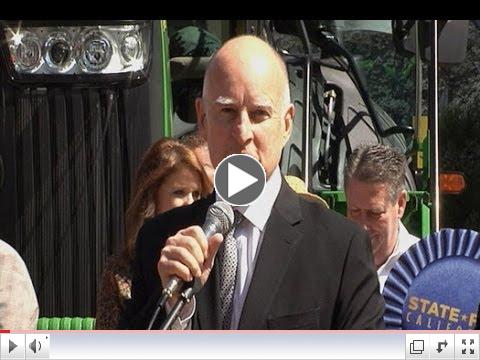 | | California Agriculture Day 2014 |
|
| Final Decision on AB 327 Net-Metering Transition Period | |
On March 27, 2014, the California Public Utilities Commission (CPUC) adopted the decision to establish a transition period for existing net energy metering (NEM) customers and those who install a NEM system before the existing NEM tariff expires. The transition period is 20 years from the date of interconnection of the system.
This means that a utility customer can continue to receive full retail credit for electricity generated for 20 years from the date of interconnection of its facility, as long as interconnection (defined as receipt of permission to operate (PTO)) occurs prior to the earlier of:
- July 1, 2017, or
- the date that Pacific Gas & Electric, Southern California Edison, and San Diego Gas & Electric reach their NEM program limits of 5% of each utility's aggregate customer peak demand.
- As of December 31, 2013 PG&E was at 2.04% of capacity, SCE was at 1.54% of capacity as of February 28, 2014, SDG&E was at 1.98% of capacity as of February 28, 2014.
In addition:
- The proposed decision clarifies that non-material replacement of system components that increase the production of an existing system by 1 kW or less will not trigger a shift to the new NEM tariff, but any increase in production in excess of 1 kW would (at least for the additional production).
- If an existing system is sold to a new owner during the 20-year transition period, it would remain on the existing NEM tariff (i.e., it would not be shifted to the new tariff).
- PG&E, SCE and SDG&E will be required to post their progress towards reaching the NEM Cap transition trigger level on a monthly basis so that the public will be alerted if it looks like the existing NEM tariff will be ending prior to July 1, 2017.
|
| McCarthy Staunch in Defense of EPA, RFS; NCGA Blasts Livestock Coalition | |
While refusing to give details as to what her agency will ultimately do to the Renewable Fuels Standard (RFS) when it finalizes its blend mandate later this year, EPA Administrator Gina McCarthy told House appropriators this week the agency's recommendations to reduce RFS biofuel blend levels are based on the fact "energy markets cannot absorb the levels of biofuels required by the law." She hinted that despite enormous pressure from the biofuels industry to increase the 2015 RFS mandate, the agency may not make significant changes to its proposal to cut the mandate.
Meanwhile, the political name calling continues, with the National Corn Growers Assn. (NCGA), March 24 newsletter column calling livestock interests pushing to lower the RFS for corn ethanol "The Free Corn Coalition." NCGA contends it's understandable to complain about $8 corn, but to return to $2 corn is impractical.
McCarthy told lawmakers she couldn't talk about the RFS proposed blend mandate details, but assured them all comments are being reviewed, adding she's heard clearly the concerns of the ethanol industry and that they'll be taken into account in the final rule. She added the agency will take a "reasonable approach" to the infrastructure and market limits that inhibit EPA's ability to set the blend limits at levels prescribed by law, and that the goal of the 2002 RFS law is "really trying to get to, advanced cellulosic."
|
| Vilsack Explains FSA Closures, Farm Bill Deadlines to Appropriators |
In defending his FY2015 budget request, Secretary of Agriculture Tom Vilsack this week tried to play up the good things USDA does, but spent the majority of his testimony before the Senate Appropriations Committee's ag/FDA subcommittee defending and explaining department actions.
Vilsack said by April 15, producers should be able to apply for disaster assistance based on the permanent disaster assistance programs included in the 2014 Farm Bill. He said getting the Agriculture Revenue Coverage (ARC) and Price Loss Coverage (PLC) commodity risk management programs up and running is more problematic. Producers will be able to update production records this summer and should be able to make elections on program coverage this fall or early winter, but definitely by the end of the year, he said.
Chief among contentious issues is the potential closing or "realignment" of over 200 Farm Service Administration (FSA) county offices. Subcommittee Chair Mark Pryor (D, AR) said the "realignment" referred to in Vilsack's testimony translates to "quite a few closures." Vilsack responded the FSA budget has taken serious hits in the last few years, reducing the workforce by 20%. While he does not expect to close any FSA offices in 2014, 2015 is another matter. Vilsack said 30 FSA offices have no full time employees, and another 111 have one employee and are within 20 miles of another office. "I think it's time we look at how we restructure," he said.
Vilsack wants to see a system of central FSA offices, branch offices and satellite offices, saying it's not about saving money but making the system more efficient. Sen. Jon Tester (D, MT) warned of office closures as new Farm Bill programs come on line. "Be very, very, very careful," Tester warned.
|
| FDA's Hamburg told "No" on FSMA User Fees; GM Labeling to Stay Voluntary |
While the President's FY2015 budget request for FDA wants $260 million in new user fee authority, including fees for industry to register under the Food Safety Modernization Act (FSMA), House ag appropriators this week told FDA Commissioner Margaret Hamburg, M.D., not to count on any new fees.
Rep. Robert Aderholt (R, AL), chair of the House Appropriations Committee subcommittee on ag/FDA, said, "In total, FDA is requesting $260 million in new fees, but has failed to gain support from the stakeholders most impacted by the such fees - the regulated food industry. The authorizing committees have not authorized the fees, and I see little chance that would happen during this Congress." His prediction was echoed by Rep. Nita Lowey (D, NY), ranking member of the subcommittee. Hamburg said FDA needs an additional $400 million to meet her obligations under FSMA.
Hamburg, in response to a question on whether FDA would change its policy on voluntary labeling of foods containing genetically modified (GM) ingredients, said the agency won't pursue mandatory GM labeling of foods, but would stick with the policy of allowing food producers to label for the presence of GM ingredients if they want. "We have supported voluntary labeling," she said, saying a recently proposed labeling guidance would be finalized soon. She said, "We've found no evidence of safety risks," in justifying her policy.
|
| House Democrats Push on Immigration Reform Vote; Ryan says it's "When, not If" |
A long-discussed discharge petition move by House Democrats to try and force a floor vote on immigration reform and give GOP lawmakers incentives to speed up work on the issue, picked up steam this week. However, to be successful, every House Democrat must sign on and a good number of Republicans must also join the effort.
The overall issue of immigration reform legislation moving in 2014 also got a boost from Rep. Paul Ryan (R, WI), chair of the House Budget Committee, when he said, "it's not a question of if, but when" the House will vote on reform. Immigration reform is necessary to accelerate growth in the U.S. economy, Ryan told a meeting of the U.S. Hispanic Chamber of Commerce this week.
A bill already introduced in the House nearly identical to the Senate-passed omnibus immigration reform package will be the target of the discharge petition procedural gambit.
|
| American Soybean Assn. not Happy with Imported Argentine Biodiesel Qualifying for RFS |
EPA is currently evaluating whether imported Argentine biodiesel qualifies under the U.S. Renewable Fuels Standard (RFS) and the American Soybean Assn. (ASA) isn't happy. ASA says the trade association of Argentina's biodiesel producers - CARBIO, representing about 1.3 billion gallons in production - which made application to EPA, enjoys government export subsidies that could have a major impact on U.S. biodiesel producers.
ASA called for "exhaustive review" of the Argentine application, as well as a public comment period for stakeholders and input from other U.S. agencies, including USDA and the Office of U.S. Trade Representative. ASA also pointed out the European Union (EU) has already imposed anti-dumping duties on Argentine biodiesel "due to significant subsidies that Argentine biodiesel receives as a result of Argentina's different export tax system."
|
| NLRB "Ambush" Union Election Rule Comments Due April 7; Board to Hold Public Hearing |
The comment period on a controversial proposed rule by the National Labor Relations Board (NLRB) to rewrite the rules governing workplace union elections closes April 7, and the board announced it will hold a public hearing on the proposal that week.
The proposed rule would shorten the time required between a union filing for an organizing election and holding the election from six weeks to three weeks. At the same time, challenges to the election filing by employers could not be filed until after the union election. Employers would also be required to provide employee contact information to union organizers to make electronic filing and communication easier.
The rules were first published in 2011 and generated more than 65,000 comments and two days of public hearings. When the NLRB implemented the rules in 2012, a federal court struck down the rules because there weren't enough NLRB members to constitute a quorum when it finalized the rulemaking.
GOP lawmakers in both the House and Senate this week attacked the NLRB and the rulemaking saying the rules give preference to the unions during organization of elections. Bills have been filed to block the NLRB from finalizing or implementing the rules. A bill by Sen. Lamar Alexander (R, TN) would allow for a 35-day waiting period between filing for an election and holding an election. The bill would also maintain an employer's right to file court actions before the election is held. Rep. John Kline (R, MN) introduced an identical House bill. Rep. Phil Roe (R, TN) introduced a bill that would limit the amount of employee information an employer would have to provide to union organizers, with employees choosing how they prefer to be contacted. While the bills have little chance of reaching the President's desk - where a veto would be likely - they've turned up the political heat on the NLRB and the White House.
|
How To Ditch Multitasking for Better Productivity
|
By Katie Golde Quick reality check: We live in a busy world where a million things are happening at once. For many of us, multitasking is a way to keep up with the flow and feel like we're not getting left behind. From checking email at brunch with friends to finishing a status report during a staff meeting, a lot of us are trying to accomplish a whole lot, all at the same time. Here's the problem: Only 2 percent of us multitask effectively. That means the remaining 98 percent of us are running around like headless chickens in the name of "productivity." Increased productivity is available to us all -- and surprisingly, it may come in the form of doing only one thing at a time. What to do? It's time to put down the smartphone, lift up your head and actually listen to that funny joke your friend is telling or that question your boss is about to throw your way at the meeting. Increased productivity is available to us all -- and surprisingly, it may come in the form of doing only one thing at a time. 
|
|
|
|
|
|
|



