~~~~~~~~~~~~~~~~~~~~~~~~~~~~~~~~~~~~~~~~~~
"Political Calculus"
Making sense of mixed emotions, inalienable rights, and the Inaugural Address
by Bill Moyer
~~~~~~~~~~~~~~~~~~~~~~~~~~~~~~~~~~~~~~~~~~
 "Harmonize your expectations with your aspirations!" is
what I wrote
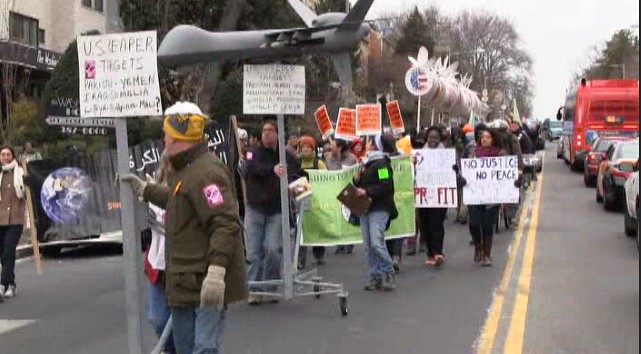
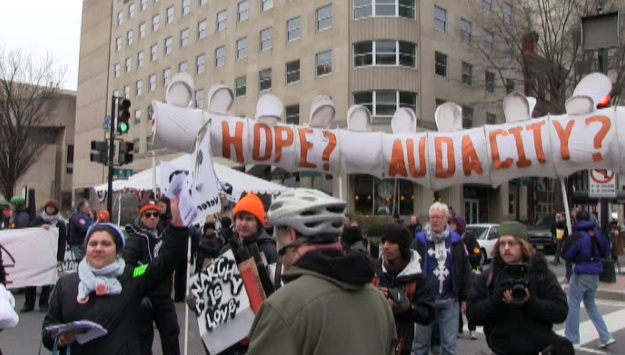
Monday morning, Martin Luther King Jr. Day and the day of President
Obama's second Inaugural Address as our giant Backbone marched
through DC streets with a primarily anti-drone, Inauguration day
demonstration.
"Harmonize your expectations with your aspirations!" is
what I wrote
Monday morning, Martin Luther King Jr. Day and the day of President
Obama's second Inaugural Address as our giant Backbone marched
through DC streets with a primarily anti-drone, Inauguration day
demonstration.
We participated on the principle that the sympathetic President Obama
should be held no less accountable for his failures and violations of
law as the despicable figurehead G. W. Bush. And it was MLK Day, a day
to stand up for our highest aspirations and deepest principles. So,
while our giant spine was protesting moral and policy failures in DC,
our We the People and Earth celebrated Dr. King, social movement and our
place in journey along the the arc of justice.
After a very long day, I finally got a chance to sit down and listen to
the inaugural address. I replayed it a number of times with competing
emotions of skepticism and admiration. I am clearly no apologist for the
Obama administration, nor a person who invested my hope for change in
his presidency. Yet, as valid as the many critiques of President Obama
are, i.e. his support of NDAA, counter -productive, illegal drone
assassinations, the TPP, a general allegiance to Wall St., (the list
goes on), I was still very impressed by his speech, his use of language,
and the construction of his arguments.
Despite my skepticism, I found it fascinating and hopeful.
Most interesting to me was that while President Obama used 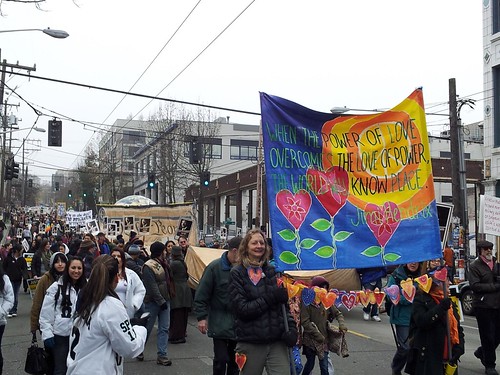 "We the
People" from the preamble to the US Constitution as a theme, he was
really grounding the appeals within his speech upon the "self-evident,"
inalienable rights that formed the foundation of the Declaration of
Independence.
"We the
People" from the preamble to the US Constitution as a theme, he was
really grounding the appeals within his speech upon the "self-evident,"
inalienable rights that formed the foundation of the Declaration of
Independence.
The US Constitution, came into being through clever maneuvering to
strengthen central government. Amongst other things, Federalists and
anti-Federalists argued whether natural rights and liberties were
guaranteed or granted by government. The Bill of Rights was the
compromise that enabled the Constitution to be ratified.
So, though Backbone also utilizes the Constitution's opening words We
the People to create a sense of shared identity, it is the
Enlightenment based concepts of social contract, natural law, and
inalienable rights articulated in the Declaration of Independence which
remain the philosophical foundation of
our movement for universal human rights. 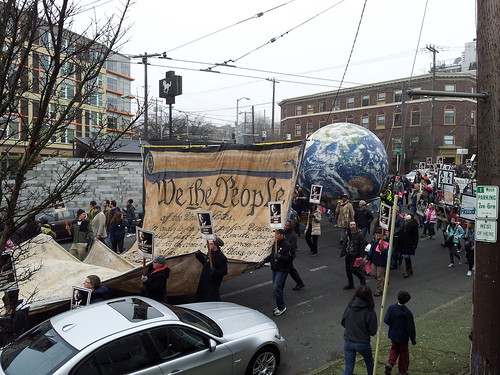 A social contract based on
universal human rights is the counter vision to corporate rule, investor
rights and and the trashing of people and the planet in service of the
paradigm of profit with impunity.
A social contract based on
universal human rights is the counter vision to corporate rule, investor
rights and and the trashing of people and the planet in service of the
paradigm of profit with impunity.
If nothing else, social movement progressives should feel affirmed that
the rhetoric used by the President to articulate his vision in his
second Inaugural address is at the very least, aligned with us at in its
philosophical foundation. We should celebrate that the universal human
rights framework is alive and well. Whether President Obama's actions
live up to his language is yet to be seen. But this language would not
have been used at such an important moment were it not considered the
true underpinnings of our social contract and the deepest penetrating
political rhetoric in our society.
So, how do we... or rather how do I, as a movement oriented progressive
hold the 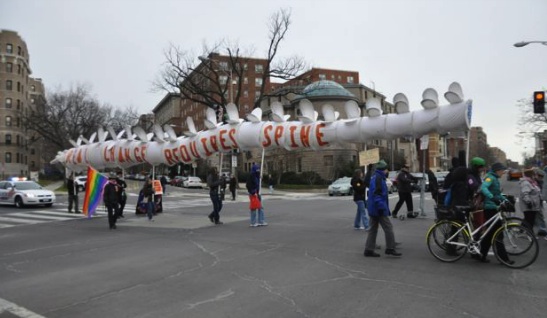 complexity of these seemingly contradictory impulses? How
do I simultaneously critique and admire without artificially exiling
one emotion as too naive, nor abandon my principles and divorce
my expectations from my progressive aspirations?
complexity of these seemingly contradictory impulses? How
do I simultaneously critique and admire without artificially exiling
one emotion as too naive, nor abandon my principles and divorce
my expectations from my progressive aspirations?
Here is something that helps me and I'd like to share it with others who
also feel this dilemma. In my presentations and workshops, I often take
people through a deconstruction of the term "Political Calculus". I
believe it clarifies roles,
and deepens our understand the dynamic relationship implied by the
statement "When
the People lead, the Leaders follow."
"Political Calculus"
- Politics for politicians is the "Art of the Possible."
- Calculus is the mathematics of changing variables.
- Thus political calculus is the political calculations of what
is politically possible in an emergent and changing world.
The politician's role is to have their finger in the wind, and
pushing the buttons on the calculator of political
expediency/exigency/self-preservation.
Our role, as change makers, social movement activists,
organizers, and cultural workers is to change the
social/political/economic variables and expand the scope of what is
politically possible in tune with our principles and aspirations.
Simultaneously, we must make politically toxic the world view that we
oppose, lessening its appeal, reducing its claim in the territory of
the politically possible.
A lofty speech by the President may inspire hope or trigger our
justifiable skepticism. Regardless of your response, let us be
emboldened in our work to grow a movement that continues to change the
variables. Let us recommit to expanding the territory of what is
politically possible, and the rhetorical purchase and mandate for
policies that affirm universal human rights, the rights of communities,
and the preservation of our biosphere. Let us raise our and others
expectations to be in harmony with our deepest aspirations.
Bill Moyer
Executive Director
BackboneCampaign.org
Follow our day to day actions and communications on Facebook
Donate to support
our work.


