|
|
|
|
|
| The ECN Newsletter | Vol. 5 Issue 4 (Oct - Dec) 2009 |
|
|
ECN Mission 
ECN is a small non-profit organisation which relies on grants and private donations to do its work. Any financial support you give will be gratefully received

|
|
|
Dear Friends and Supporters,
|
| |
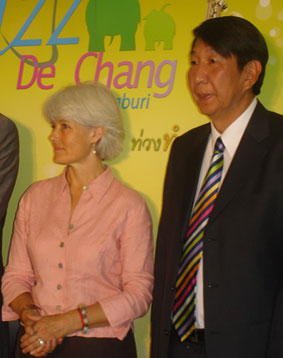
Me with the Governor of Kanchanaburi at the Jazz-4-Eles press conference to promote the value of this province for wild elephant conservation in Thailand |
|
The most exciting news of this quarter is that the Governor of Kanchanaburi has made wild elephant conservation a provincial priority. Better still, Salakpra will be at the heart of this policy, serving as a model for human-elephant conflict mitigation measures elsewhere in the province. This means that in two years time, when the next action plan and budget comes into effect, money will be available for local HEC and elephant conservation activities - unless more sartorial politics colours Thailand's political agenda and the economy takes a turn for the worse.
We are thrilled that our collaborative efforts and dedicated information sharing inspired this landmark policy. We are especially thrilled because it is so well deserved. Kanchanaburi is the third largest province in Thailand but has more intact forest than any other province, and it supports well over half the country's largest, most important conservation area, the Western Forest Complex. WEFCOM has 17 protected areas covering almost 20,000 km2. Nine of them are in Kanchanaburi.
Because of this pioneering policy, we are planning two new activities that will encourage Kanchanaburi residents to take action for elephants every year. Watch out for our next newsletter. It won't be far behind, as this one is so late!
As ever, our heartfelt thanks to all of you for your support.
Belinda Stewart-Cox
ECN Director |
|
| 1. Cattle project gets underway
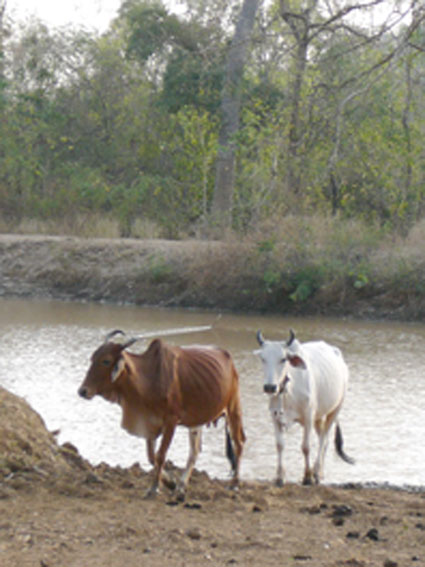
With support from the Whitley Fund for Nature (part of Jittin Ritthirat's Whitely Conservation Award), we have begun a new project to survey the cattle kept within 2kms of Salakpra. Many of these are taken into the sanctuary to feed and water, sometimes for days at a time, and are thought to exacerbate crop-raiding by competing with wild elephants. So far we have interviewed 160 families from 24 villages and find that most of them are small-medium sized herders with 20-50 cattle, and a third of them are landless. Apart from lack of land, common problems for all cattle keepers appear to be the high cost of medical care and the low cost of market prices for beef cattle. Few of them use local herbs to treat their cattle in traditional ways, mainly because they do not have the knowledge. |
| 2. Recycling project launched
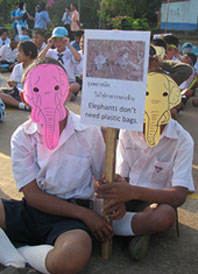
Over Christmas, ECN was super busy launching a joint venture with Srisawat Secondary School to recycle plastic and other waste products for profit. Money earned for collecting rubbish is traded by students for stationery or saved up to help start their own income-earning initiative when they leave school as part of the Salakpra Elephant Ecosystem Conservation Alliance ( SEECA) helped by US Fish & Wildlife. The launch day began with an instructive presentation and some learning games. Then, 250 students, 10 teachers, scores of parents, local officials and forest rangers donned home-made elephant masks to help collect over 60 kilos of rubbish from around the school, including the forest margins of Salakpra. It was a day of much laughter and learning. |
|
3. FORRU teams exchange visits
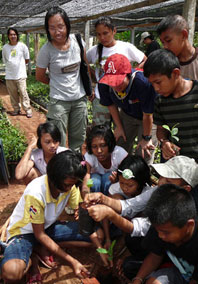
We are great believers in the value of targeted study trips, especially village to village. So, in October, under our Keidanren-funded FORRU project, the ECN team visited a similar forest restoration initiative in Krabi, southern Thailand. During a guided tour of the community-run nursery and planting sites, each team discussed problems they have encountered and lessons learned. The next day, the ECN team watched various educational activities with local children. Four of the Krabi team came back to see ECN's project having learned that we have already germinated 75 indigenous tree species and have a fully mapped and labelled phenology trail with over 300 identified trees which we monitor monthly along with seedling/sapling growth rates. |
| 4. Smithsonian-ZOO workshop
In December, Belinda and Jittin joined a super-intensive workshop of the Smithsonian Institution's Conservation Ecology Centre entitled 'the role of zoos in the conservation of Asian elephants'. As well as members of nine Asia-based NGOs working on human-elephant conflict, the workshop included senior representatives from five top American zoos that have Asian elephants. Our aim was to discuss ways in which zoos could ensure that their huge investments in elephant exhibits and infrastructure make a more useful and effective contribution to the conservation of wild Asian elephants. We discussed what more zoos could do to raise awareness and funds, and what more Asian elephant conservation NGOs could do were they to get more money from America zoos. It was an inspiring and enlightening experience for Jittin and Belinda. |
| 5. Jazz 4 Elephants concert
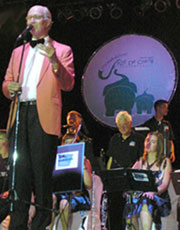
When the Dutch Embassy in Bangkok asked the Governor of Kanchanaburi if he would like to host a sponsored jazz concert, he said yes - provided the event was used to raise awareness of ECN's work and the importance of Kanchanaburi province in conserving wild elephants in Thailand. So after much preparation and a well-attended press conference with the Dutch Ambassador, Kanchanaburi Governor, ECN director and other local dignatories, the Biggles Big Band rattled the railway on the River Kwai Bridge and raised the profile of ECN and wild elephants while entertaining local residents, including a hundred Harley Davidson bikers and their enormous machines. The funds raised, though modest, were useful, but the persuasive ECN team did a roaring trade in t-shirts designed in-house to promote our work with wild elephants |
| 6. Joining national wildlife week
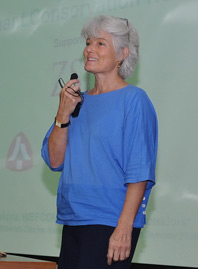
Once again, ECN was invited to support the joint effort of Kasetsart University and the Department of Nature Conservation in highlighting the advances made in wildlife conservation research in Thailand. ECN's director, Belinda Stewart-Cox, gave a closing address at the annual 2-day wildlife seminar for students, academics and researchers. She highlighted the fact that Thailand's celebrated Western Forest Complex is at risk of becoming fragmented unless effective wildlife corridors are established in vulnerable areas. A week later, ECN manned an informative, eye-catching booth at the national wildlife fair and adviced several village leaders and national park chiefs on how to document and calculate the cost of crop-raiding, a problem they would like to address in their area too. |
| 7. Sharing ideas with India
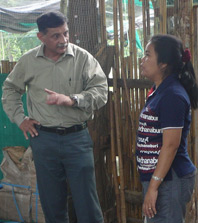
In October, Colonel C. P. Muthanna, principal advisor of the Coorg Wildlife Society, visited us to find out how we are reducing the economic and psychological impacts of human-elephant conflict because the situation in his area of southern India is not dissimilar - a sub-population of wild elephants squeezed by expanding human settlement that threatens to cut off their corridors to a larger habitat and population. Colonel Muthanna was particularly interested in our highly participatory approach to HEC mitigation and the way in which we have engaged local communities and protected area staff in a series of collaborative projects which they help plan and manage. As secretary of India's Environment and Health Foundation and Kodagu Model Forest Trust, Colonel Muthanna also found our forest restoration project really instructive. |
|
|
In the last four years, ECN has been supported by:
 We are extremely grateful to our donors and supporters |
| ECN is also supported, or sponsored in kind, by:
|
Contact Info
Elephant Conservation Network (ECN)
37/1 Moo 8, Kaeng Sian, A. Muang
Kanchanaburi, Thailand, 71000
+66 (0) 34 624-684
info@ecn-thailand.org
|
|
|
|
|