|
|
|
|
|
| The ECN Newsletter |
Vol. 5 Issue 3 (July - Sept) 2009 |
|
|
ECN Mission 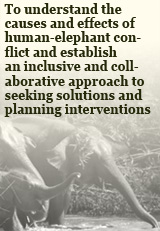
ECN is a small non-profit organisation which relies on grants and private donations to do its work. Any financial support you give will be gratefully received

|
|
|
Dear Friends and Supporters,
|
|
|
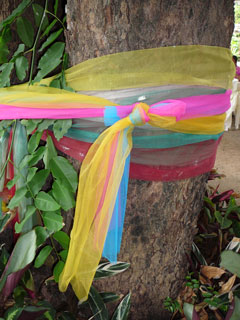
An old tree beside ECN's office thought to accommodate a watchful female spirit
| |
This quarter has involved a lot of learning new skills, sharing the skills and knowlege we have, and reaching out. As its reputation grows, our Forest Restoration Research team has been extra busy with visitors and other people's events as well as its own demanding schedule, while the SEECA team has been flat out organising training sessions and study trips with forest users who have joined its new livelihood programme. Five village groups started new micro-enterprises using mini-loans from a modest revolving fund set up by ECN. More investment is needed to help these enterprises become viable sources of income for each group member, but they are an encouraging first step and will, we hope, enable the owners to reduce their dependence on exploiting Salakpra for a living. Meanwhile, the HEC team continues to monitor crop-raiding.
In July, after a year in residence, we finally arranged a religious blessing at our new office. Inviting everyone we know in Kanchanaburi, we used the occasion to give a presentation about our work as most people don't really know what we do. They just know it's good! The Governor of Kanchanaburi presided over this Sunday morning event, with the abbot and senior monks of Ban Nong Khao leading the chanting and prayers. Afterwards, we lunched in the shade of our Pterocarpus tree, the home of a locally revered female spirit who protects this plot of land and its well-meaning occupants.
Once again, our heartfelt thanks to all of you for your support.
Belinda Stewart-Cox
ECN Director | |
| 1. FORRU project visitors
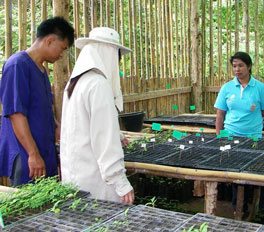
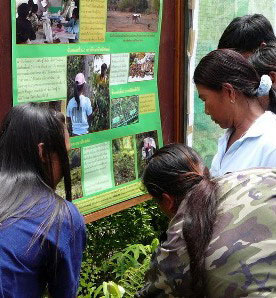
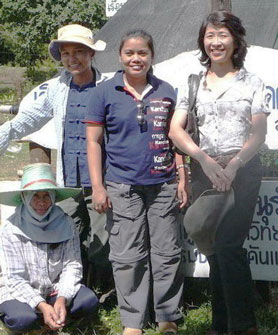
Our Forest Restoration Research Unit's native tree nursery in Kaeng Plakod village is now attracting regular visitors who want to learn about our seed & seedling trials, our phenology study and how we help restore community forest and areas inside the Salakpra sanctuary that opened up after the massive die-back of bamboo this year. In July, 150 people came from the Dept. Industry Promotion, in August a team of local councillors came from nearby sub-districts, and in September, ten community leaders travelled all the way from southern Thailand. Two of these groups were brought to see this community nursery by Salakpra's management team. |
| 2. French TV films ECN at work
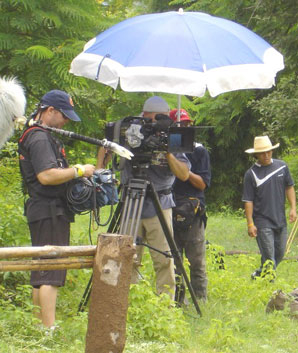
In July, a French TV crew spent two days in Kanchanaburi filming the ECN teams at work for a documentary on human-elephant conflict in Asia and the methods used to tackle the problem. Unable to film the elephants that star in our story, the film-makers focused on farmers whose crops are regularly raided, and the work being done by ECN to help them and other villagers reduce human-elephant conflict in and around Salakpra. Those that took part in the filming were intrigued and astonished in equal measure by the time it took to get the footage required. Now we await the film itself with eager anticipation. |
| 3. Belinda's telecast to Tokyo
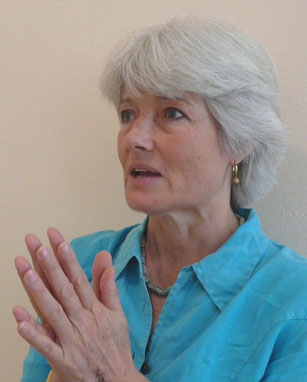
On a hot, muggy day in July, Belinda Stewart-Cox sat in an ice cold meeting room at the World Bank Bangkok office and gave the annual presentation to the Keidanren Nature Conservation Fund donors in a large auditorium in Tokyo.KNCF funds our FORRU project and, before that, the corridor surveys in northern Salakpra, so it was an honour to give this talk and a pleasure to interact in the Q&A session with such well informed, supportive benefactors. But it was a novel experience for Belinda, alone in the room, talking to an enormous TV screen, unable to see or hear her audience. |
| 4. FORRU outreach activities
Nowadays the FORRU team is often asked to help other tree planting projects by providing indigenous saplings. Word has spread that our products are 'the real thing'. Robust, home-grown Kanchanaburi natives! The biggest event was organised by the Electricity Generating Authority as part of the government's 'Plant 9 Million Saplings' scheme to honour H.M.the King. The guest of honour was former prime minister General Sarayudh Chulanond whose support for conservation is well known. Two weeks later, the FORRU team manned a stand at the Pong Pat fair to celebrate its success in winning a Village Self-Help Improvement Award. ECN works with Pong Pat folk to reduce crop-raiding. |
| 5. SEECA study trips
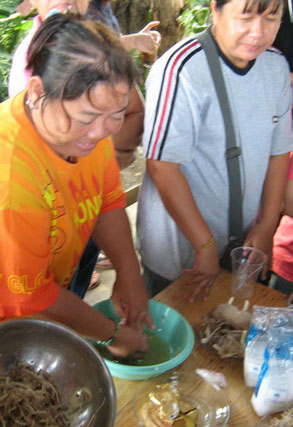
The Salakpra Elephant Ecosystem Conservation Alliance alternative livelihood initiative now involves seven villages. In a series of training workshops supported by US Fish & Wildlife, eleven groups of 5-15 forest users developed micro-business plans, and five groups joined three study trips organised by ECN. On one trip, villagers studied the options available in Kanchanaburi for communities to make money by recycling waste, another group of herbalists went to a fair of traditional and non-traditional herbal products, while a third group went on a 4-day course on mushroom production. Everyone was thrilled by the opportunities open to them. |
| 6. SEECA start-up enterprises
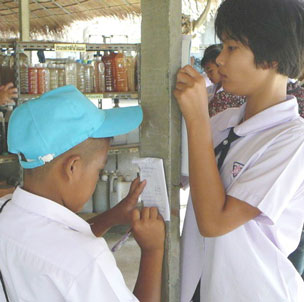
To maintain the enthusiasm generated by the study trips, ECN used its modest resources to help the forest user groups with good project plans start their micro-enterprises. Three groups built small mushroom huts and are already selling their produce to the local market. The herbal group is propogating seedlings in a spare backroom while it seeks a loan to help it build a nursery. And students at the local secondary school are collecting and selling recyclable rubbish to help them save money for future enterprises. Every loan is made under a revolving fund agreement so that one group's success can help another group get going. |
| 7. FORRU trains SEECA groups
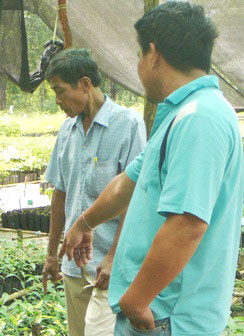
Two villages in the SEECA project are so keen to restore their community forest and to plant native trees on other public land that they have asked our FORRU team to teach them nursery design & management, and to show them how to propogate valued indigenous species not normally found in tree nurseries. The SEECA working groups spent two days at the FORRU nursery learning what they needed to know, and both groups have since established small nurseries and are germinating a few tree species. We are delighted that one project can support another in this way and forge links between partner communities. |
| 8. Jittin joins AsESG workshop
This year, the Asian Elephant Specialist Group held a 2-day workshop in Beijing before the Society for Conservation Biology conference. ECN's projects manager, Jittin Ritthirat, joined around 50 other participants most of whom were Asian elephant range-state nationals. The four other members of the Thai team came from Dept. Nature Conservation, WWF and WCS-Thailand. The aim of the workshop was to draw on the knowledge and field experience of the participants to develop a practical framework to assess human-elephant conflict and to draw up guidelines on tackling it more effectively using well researched approaches that can be adapted for different situations. |
|
9. FORRU-CMU trains ECN team
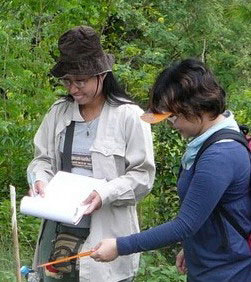
In late September, the Forest Restoration Research Unit of Chiang Mai University, led by Dr Stephen Elliott, returned to Kanchanaburi for 5-days to continue the capacity building component of our joint FORRU project around Salakpra Wildlife Sanctuary. This time, the training course focused on measuring and photographing growth rates and on analysing data so that by the end of year three, we can produce guidelines for restoring native forest in west Thailand. Dr Elliott was mighty impressed by project progress, and by the hard work, commitment and capability of the project team. |
|
10. Taiwan donor visit
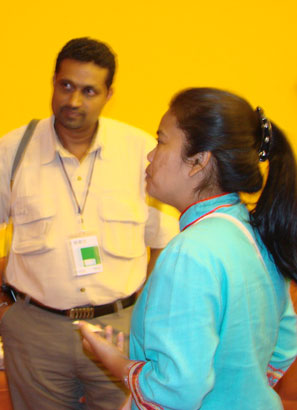
For two years, ECN has received a small but immensely welcome grant from the Taiwan Forestry Bureau for its forest restoration work. This September, we had the pleasure of meeting the director of the Taipei Economic & Cultural Office, Ms Jane Hsu, who came on behalf of TFB to visit our project office, the two project nurseries and the newly planted restoration sites inside the sanctuary and in Kaeng Plakod's community forest. Ms Hsu was taken around by ECN projects manager, Ms Jittin Ritthirat, and seemed delighted by what she saw and learned about our work from project staff and partners in the village and the sanctuary. | |
|
Over the last four years, ECN has been supported by:
 We are extremely grateful to our donors and supporters |
| ECN is also supported, or sponsored in kind, by:
|
Contact Info
Elephant Conservation Network (ECN)
37/1 Moo 8, Kaeng Sian, A. Muang
Kanchanaburi, Thailand, 71000
+66 (0) 34 624-684
info@ecn-thailand.org
|
|
|
|
|