|
|
|
|
|
| The ECN Newsletter |
Vol. 4 Issue 3 (Oct - Dec) 2008 |
|
|
ECN Mission 
ECN is a small non-profit organisation which relies on grants and private donations to do its work. Any financial support you give will be gratefully received

|
|
Dear Friends and Supporters,
 |
|
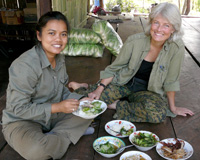
Jittin and Belinda enjoying lunch in one of the villages in the SEECA network | | Newsletters are misleading because they report new developments or milestone events but not the regular work that underpins a lot of what we do. One routine task is to monitor incidents of Human-Elephant Conflict with local people so that, in time, we will know if our efforts to reduce HEC are making any difference. So far they have, but elephants are bright enough to find a way round most interventions, so only time and monitoring will tell.Another regular kind of work is our frequent interaction with villagers, sanctuary staff and local leaders - meeting often, sharing thoughts, seeking advice - none of it newsworthy, but all of it important in knitting the fabric and plaiting the ties of our cooperative network.
As ever, our heart-felt thanks to you all for your support,
Belinda Stewart-Cox ECN Director | |
| 1. Study trip to FORRU-North
In October, 13 people from our FORRU-West Thailand project (ECN staff, villagers and Salakpra rangers) went to Chiang Mai for an exhilarating 5-day training course in forest restoration research with the parent FORRU of CM University. The trainees learned first-hand from FORRU staff and village associates who've had years of experience restoring forest, managing nurseries, running seed trials, and incorporating local knowledge into action research. The visitors stayed with villagers of Ban Maesa Mai in Doi Suthep NP, talking late into the night about life and work in north and west Thailand. |
|
2. FORRU project on-site training
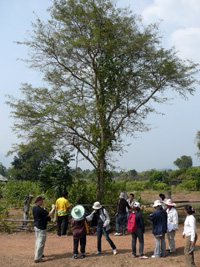
In December, Dr Steve Elliott and two of his colleagues from FORRU-CMU came to Kanchanaburi for five days to give more training to the ECN, Ban Kaeng Plakod and Salakpra forest restoration team. On Day 1, the trainers reviewed the local team's work -- nursery construction, seed preparation, potting seedlings and germination methods, experimental design, and the phenology trail (right). They were astonished by the local project's dramatic progress, and by the evident competence, enthusiasm and cooperation in the Kanchanaburi team. The training also focused on data collection, recording methods, and using phenology data to produce seed collection schedules.
|
| 3. EcoSystems-India visits ECN
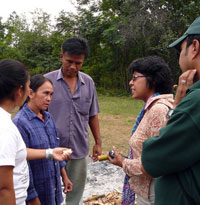
In November, ECN hosted Nandita Hazarika and four colleagues from EcoSystems-India who run a human-elephant conflict (HEC) project in Assam, India. The ESI team wanted to see how ECN helps tackle HEC around Salakpra. Jittin took them to meet villagers (right) who adopted two crop protection measures (electric fence and earth trench) as a result of our participatory trials. The Indian team also visited our forest restoration tree nurseries. In time, we hope to collaborate with ESI to tap into its work on more sustainable technologies for rural communities.
|
| 4. Networking in Khao Yai NP
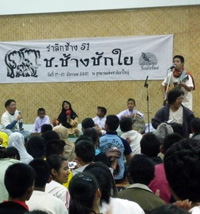
In December, ECN was invited to the annual 5-day event in Khao Yai NP to commemorate the eight elephants that drowned in 1991. Mon joined 200-plus wildlife researchers, cnservationists, teachers, and youth leaders. The event was chaired by former Prime Minister, General Surayuth Chulanond. It aimed to be a forum for educators, researchers, and project managers to share ideas on achieving effective conservation. Mon's talk on ECN's work was well received and many participants were keen to help our proposed Salakpra Revival Project and associated work. |
| 5. ECN at DNC's wildlife fair
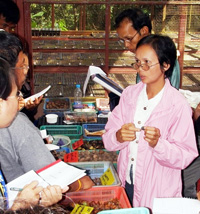
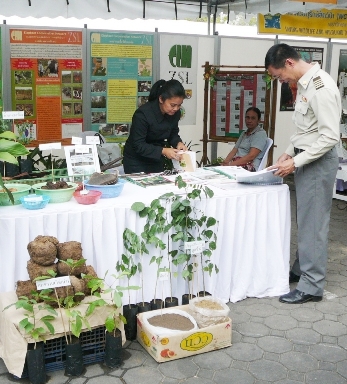
In December, ECN hosted a booth at Department of Nature Conservation's wildlife fair. This year's special guest was HRH Princess Sirindhorn whose interest in elephants and forest is well-known. ECN worked feverishly to create an attractive and informative stand with posters outlining our work and displays of seeds, saplings, and elephant dung (used in potting soil) as illustration.Lung Wan and Pannor, Salakpra and Kaeng Plakod nursery managers, joined us. Our colourful stand caught the eye of many fair-goers but only a brief glance from HRH whose priority was to honour DNC's work rather than NGOs.
|
| 6. Two new ECN recruits
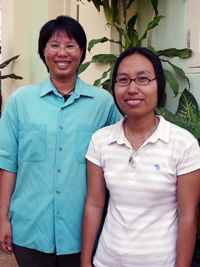
In October, ECN welcomed two new team members. Oranuch (Ning) Suk-in and Anchalee (Joy) Subhantupong are both from Kanchanaburi province, but Ning studied Plant Sciences at Mae Jo University in Chiang Mai, while Joy read agriculture (focusing on botany) at Rajaphat University, Kanchanaburi. Ning (right in photo) manages the FORRU-West Thailand project, assisted by Joy. Asked what they like about this work, Ning's response was "I love the variety, going often to the field, working with different people, doing experiments to find out what we need to know to help", while Joy added "I love trees, I love working with local people, and this project is so valuable for them".
|
| 6. AsESG strategic workshop
In October, Belinda joined the Asian Elephant Specialist Group range-wide mapping and strategic Conservation planning workshop for wild Asian Elephants. The workshop gathered 70 'wild ele people' from all 13 range states, international donors and NGOs. Facilitated by Dr Simon Hedges, the WCS Asian Elephant Coordinator and co-chair of AsESG, the workshop had two objectives: to compile available information on the distribution of, and threats to, wild Asian elephants into one database, and to draft a conservation strategy and action plan that identifies priority areas of research and conservation. The next step is for each country to produce its own action plan.
| |
|
Over the last four years, ECN has been supported by:
 We are extremely grateful to our donors and supporters |
| ECN is also supported, or sponsored in kind, by:
|
Contact Info
Elephant Conservation Network (ECN)
37/1 Moo 8, Kaeng Sian, A. Muang
Kanchanaburi, Thailand, 71000
+66 (0) 34 624-684
info@ecn-thailand.org
|
|
|
|
|