|
ECN Mission 
ECN is a small non-profit organisation which relies on grants and private donations to do its work. Any financial support you give will be gratefully received

|
ECN is also
sponsored by:
|
 |
 |
 |
 |
 |
|
Dear Friends and Supporters,
This has been a time of building on past work to launch follow-on projects, reaching out to new collaborators while also writing up findings, and seeking renewed support from our loyal and much valued donors.
The recurring theme of activities reported here is partnership. Every activity involves collaboration, with government agencies, universities, local communities, other NGOs and the private sector. It is heartening to see our name become reality at last. We're networking a lot these days!
By the time you get this, the new year will be upon us. May all of you enjoy happiness, health and good fortune throughout 2009.
Our thanks to you all for your support,
Belinda Stewart-Cox
ECN Director
|
|
|
1. Forest restoration launch
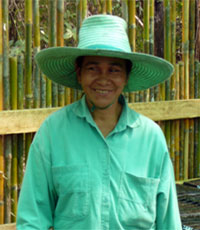
In August, ECN launched its Salakpra forest restoration project, funded by Keidanren Nature Conservation Fund. Working with villagers, sanctuary staff and the Forest Restoration Research Unit (FORRU) Chiang Mai University, this project will restore forest in and around Salakpra and establish a FORRU-West Thailand training centre. The first site is Ban Kaeng Plakod where logging, cattle and fire have damaged community forest alongside Salakpra. Mrs Pannor (right) manages the village nursery. Her counterpart in Salakpra is Lung Wan, a forest ranger. Both have a passion for trees.
|
|
2. Salakpra tree planting
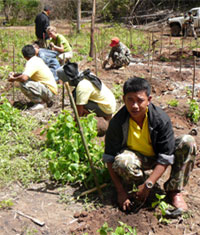
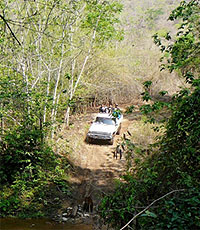
Peripheral parts of Salakpra have been degraded by years of logging and fire, so are now dominated by bamboo. This year, blocks of bamboo seeded and died, leaving huge gaps. With support from the Keidanren Fund and Bring The Elephants Home, ECN is working with Salakpra to reforest these areas with indigenous trees. In August, 104 villagers, local leaders, district officials and other volunteers joined our first tree planting day, planting 7,000 trees in 30 rai (4.8 hectares). Plantings are monitored monthly and weeded bi-monthly. So far, 80% of them have survived, but now they must endure the dry season.
|
|
3. Electric fences for Salakpra
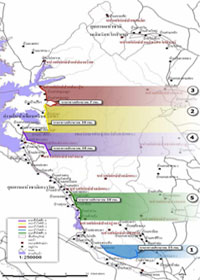
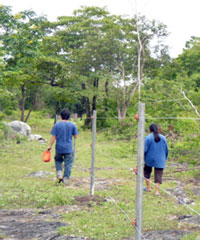
After 2-years monitoring crop-raiding, ECN can now use its data to help communities, Salakpra, and district officials formulate plans to erect community-managed electric fences around 52 kms of the protected area boundary (right). Adopting a concept pioneered by Rhino Ark (which ECN visited on its 2006 study trip to Kenya), this project will start fencing areas most affected by crop raiding, starting with Kaeng Plakod (#1 right). Some funds are promised by district councils, but EGAT is also asked to help communities that were, and still are, greatly affected by its Srinakarin Hydro-Dam, the ultimate cause of the crop-raiding and most other human-elephant conflicts in/around Salakpra.
|
|
4. Tree planting alliance
In July, ECN was asked to join the Volunteer Spirit Tree Planting Alliance to review the lessons learned from reforestation projects implemented by the Ratchapreuk Foundation, Volunteer Spirit Organisation, Forest Research Restoration Unit (FORRU) Chiang Mai University and other groups around Thailand. Gip and Joy (right), members of ECN's forest restoration team, joined this three-day gathering in Chiang Mai to tell participants about ECN's work for Salakpra and to share project findings and experiences. It was an invaluable learning experience for both of them.
|
|
5. Local CSR initiative
In September, the Rural Development Institute and DTAC, Thailand's second largest mobile phone company, held a corporate social responsibility (CSR) meeting for government officials, NGOs and private sector leaders to identify projects worthy of DTAC support. Tu and Mon attended the first meeting in Kanchanaburi to promote the work of ECN. Two weeks later, they were invited to the second meeting in Nakhon Sawan, four hours north-east of Kanchanaburi, where the short-listed candidates gave presentations on their project proposals. ECN requested funds for electric fencing around Salakpra.
|
|
6. River Kwai Watershed Alliance
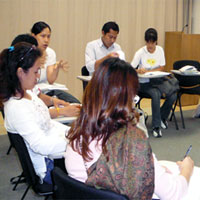
In September, Tu and Gib represented ECN at two meetings held by Mahidol University's River Kwai Basin Environmental Education Project. The twenty other participants included community leaders, local teachers and councillors from districts around Salakpra. The aim of these meetings was to discuss setting up an integrated development centre in the Lum Tapern Basin to coordinate conservation development projects in this area, to distribute research findings to schools and other local organisations, and to raise awareness among residents of the importance of the River Kwai to local livelihoods.
|
|
|