ECN Mission
ECN is a small non-profit organisation which relies on grants and private donations to do its work. Any financial support you give will be gratefully received

|
|
 |
Dear Friends and Supporters,
We've been furiously busy here in west Thailand, wrapping up some projects while preparing new ones with local partners. Much effort has gone into analyzing the different sets of data we've collected in the last two years, from monitoring crop-raiding and crop-protection trials, to land use mapping and forest surveys. Some interesting results are emerging, including the fact that most crop-raids occur on traditional elephant routes to the River Kwae Yai (disrupted by the Srinakarin Dam); 96% of raids are by bull elephants; and key tracts of land between the sanctuary and river are owned by absentee landlords who acquired them as investments a decade or so ago.
It is thrilling to be supported again by Japan's Keidanren Foundation, and we are delighted that local councils will help fund community electric fencing. Also many, many thanks to those of you who helped us buy patrol equipment for the rangers of Tham Than Lod National Park. We, and they, appreciate your kindness. It has greatly boosted their efficacy and morale.
Our best wishes to you all,
Belinda Stewart-Cox
ECN Director
|
|
1. Keidanren supports another project
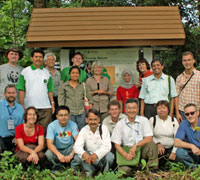 |
| ECN's Jittin and Belinda on a FORRU-CMU site visit after FAO's 2007 Future of Forests meeting |
The ECN team and colleagues at ZSL are delighted to be the recipients of another grant from Japan's Keidanren Nature Conservation Fund. For the new project, ECN will team up with the Forest Research and Restoration Unit (FORRU) of Chiang Mai University in north Thailand to establish a FORRU-West Thailand. The aim is to provide the knowledge base and technical skills for local communities to help restore natural forest in degraded areas inside Salakpra and on community-owned land around it. Building on FORRU-CMU's experience of community-based forest restoration, the project's first year will entail workshops with local participants; forest surveys led by FORRU's resident botanist; training courses in Chiang Mai and Kanchanaburi; establishing a tree nursery; conducting phenology surveys; and monitoring tree seedling growth to identify the best 'framework' species. The project will be managed by Tidarach (Joy) Toktang, an MSc graduate who is joining ECN from FORRU-Chiang Mai.
|
2. New HEC publication with ECN paper
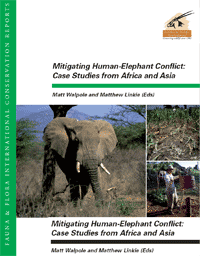 |
| Cover of the FFI Conservation Report |
In April, Fauna & Flora International (FFI) published proceedings from the human-elephant conflict (HEC) workshop held in Kenya in 2006. Entitled 'Mitigating Human-Elephant Conflict: Case Studies from Africa and Asia', the report was edited by Dr Matt Walpole, of FFI, and Dr Matthew Linkie, of the Durrell Institute of Conservation and Ecology (DICE). The workshop was planned as part of ECN's HEC mitigation project funded by the Darwin Initiative, and was organised for ECN by Matt Walpole and Dr Noah Sitati, both of whom have been valued advisors to ECN since 2004. The report contains nine papers by HEC researchers in Africa and one by ECN's project leaders. The workshop was also supported by the Zoological Society of London, WWF, Frankfurt Zoological Society, Kenya Wildlife Service and the Dutch Ministry of Foreign Affairs.
|
3. ECN advises community fence project
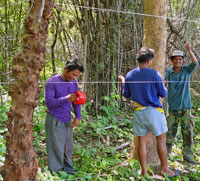 |
A cooperative effort by villagers,
Salakpra, and ECN to erect an electric fence between the forest and the
village of Tha Sanun |
In June, ECN staff got together with 50 villagers from Wang Dong and Chong Sadao sub-districts and Salakpra staff to plan construction of a 15-kilometre electric fence along the sanctuary boundary. "The fence will be a double benefit -- deterring elephant from raiding crops (and risking retaliation from villagers) while also protecting elephant habitat, according to Jittin Ritthirat, ECN's community coordinator. "Apart from protecting crops, and therefore elephants, the fence should also reduce human pressure on the forest."
A fence supplier joined the on-site discussion, but villagers decided to do most of the work themselves, under professional supervision, from making the concrete posts to erecting them and the electric lines. Several villagers will also be trained in fence maintenance, repair, and long-term management. The estimated cost of construction is 4.5 million baht ($132,000). With a budget of only 600,000 baht ($18,000) from local government, villagers are now seeking funds to complete this much valued project. If you would like to help, please contact us or donate using PayPal.
|
4. Study trip to FORRU-Chiang Mai
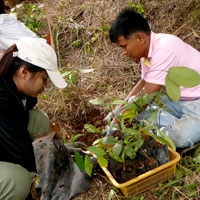 |
| ECN's Tu planting seedlings with Mr. Wasant, headman of Kaeng Plakod village |
In late June, ECN staff Gip, Mon, and Tu accompanied two Salakpra rangers and four community leaders to a 'planting day' in Doi Suthep-Pui National Park near Chiang Mai. Despite being a protected area, land inside the park has been cleared by resident villagers using slash-and-burn. Ten years ago, they decided to restore native forest on land above their village, Ban Mae Sa Mai, when they realised that forest clearance was taking its toll on their water supply.
Villagers now plant native tree saplings once a year at the start of the wet season, helped by local school children and other supportive visitors. Tidarach Toktang (Joy) facilitated the trip with FORRU-CMU which originally trained the villagers in nursery and forest restoration techniques, including monitoring seedling survival. By joining this undertaking for three days and staying with local villagers, ECN staff and their colleagues gained valuable insights into the do's and don'ts of habitat restoration and community conservation. "It was a really worthwhile trip" said Mr. Wasant Sunjirat, headman of Kaeng Plakod village. "We can use what we learned when we implement our own forest restoration projects with Salakpra."
|
5. Man & Nature music festival in Kanchanaburi
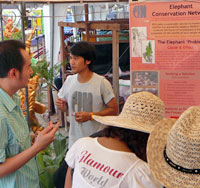 |
| Mon describes ECN's conservation efforts to visitors at the festival. |
Chatting over noodles at a classic street stall, ECN' s Belinda Stewart-Cox and singer-songwriter turned TV personality, Todd Lavelle (Lavelle Entertainment), hatched a plan for a 'Man and Nature Music Festival' in Kanchanaburi. Held beside the historic River Kwai Bridge at the end of May, the festival was organised by Todd and his team with help from ECN and its tourism partner Jumbo Travel. The three-day festival consisted of lively seminars about forest, wildlife, and conservation, followed by heady nights of world music and cultural plays performed by local teenagers. ECN had a prominent booth at the fair, providing a great opportunity to interact with local people and tourists. "It was fun telling local people and visitors from around the world about our various projects" remarked ECN intern Erik Rogers. "I think we really raised awareness about problems facing wild elephants and their forest habitat. ECN definitely benefited from the exposure, as we made some valuable new alliances."
Supplementing ECN's posters and powerpoint presentations, co-founder Jittin Ritthirat led a well-attended discussion at the Felix Hotel entitled "Elephants of Kanchanaburi - Enemies or Friends?" She was also interviewed by Todd for his popular TV show that was broadcast the following week.
|
6. ECN asked to help other HEC villages
 |
| Jittin surveys elephant damage to a banana plantation in Sawaengba after telling villagers about ECN's work |
Sawaengba village occupies a luxuriant valley in Srisawat National Reserve, the triangular tract of poorly protected forest that connects northern Salakpra to Huai Kha Khaeng, the world heritage core of the Western Forest Complex. During its 2007 Srisawat corridor survey funded by the Keidanren Foundation, ECN found that the Sawaengba valley is the most accessible through-route for elephants, but is almost blocked by the fruit and vegetable fields of the village's sixteen households. Needless to say, elephants help themselves to a snack when they encounter edible intrusions on their traditional route. Word of ECN's work with similarly afflicted farmers has spread, and the villagers of Sawaengba asked us to help them as well. "I am glad these villages came to us for help as it tells us that we are winning the trust and respect of local communities," observed ECN's Jittin Ritthirat.
ECN proposed various solutions, e.g installing an early warning bells-on-string system, broadcasting human sound such as radio through speakers, simple electric fencing around fields or, best of all, plant crops not eaten by elephants.
|
7. ECN raises funds for ranger patrol equipment
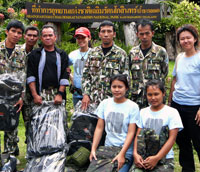 |
| ECN staff present Tham Than
Lod rangers with the equipment needed to patrol the Srisawat reserve effectively |
In response to ECN's Srisawat corridor report, the Ministry of Environment has asked the nearby national park (Chalerm Rattanakosin, known locally as Tham Thanlod) to patrol the reserve and prevent more logging and encroachment until it is upgraded to a fully protected area. Tham Thanlod has recruited eight rangers but has no budget for patrol equipment. ECN was asked if it could help. We, in turn, asked friends and colleagues for donations and were thrilled with the response. Now, thanks to Diethelm Travel Group, David Lyman, Paya Shop and other kind friends, ECN could buy backpacks, hammocks, plastic fly sheets, cookware, cameras and other kit, and still have some funds in reserve to help other patrol teams.
"Rangers are the unsung heroes of the protected area system, and yet they're chronically under-equipped and under-paid" comments Belinda Stewart-Cox. "Ultimately, we would like to persuade the government to provide adequate funding for its forest conservation teams, but until then, ECN is pleased to help when it can." This donation was warmly welcomed by the Thanlod team. "This kind of support really helps us do a better job. It's practical, but it's also good for morale to know we have supporters like ECN who understand our difficulties and care enough to help" said head ranger Surin Sangkannok. ECN will also help the new Salakpra HEC Community Support Unit with equipment, but what they need most is a dedicated vehicle which would cost more than we have. If you would like to assist financially with this, please contact us or donate using PayPal.
|
|
8. New ECN office
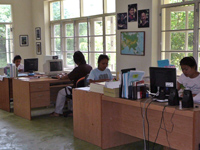 |
| Jittin, Krit, Gip and Tu in the new office |
ECN rang in the Thai New Year in April, at the height of the hot season, with a welcome upheaval: the long-awaited move to our new office. We did not have far to move -- we are still in Kaeng Sian district, a short drive from the famous River Kwai Bridge -- but we now have a lot more space. "We'd long outgrown our old office" according to Mem, ECN's assistant community coordinator. "The new office is much nicer. It's a lot airier, and has many features from traditional Thai buildings such as tall rooms, ceiling fans, a ventilated roof and shady trees all around, so we won't need air-conditioning, unless future hot seasons get even hotter than we're used to!" In the meantime, ECN is hoping to reduce its environmental impact as well as its electricity bills.
|
|
|