|
|
|
|
|
| The ECN Newsletter |
Vol.
4 Issue 1: 2008 |
| |
ภาษาไทย  |
|
ECN Mission
ECN is a small non-profit organisation which relies on grants and private donations to do its work. Any financial support you give will be gratefully received

|
Click to join our
growing community
on Facebook!

Get even more news and photos about elephant conservation in Thailand.
|
|
|
|
|
1. ECN co-hosts first national HEC workshop in
Thailand

|
| Local leaders at the workshop |
In March, ECN organized the first national human-elephant conflict (HEC) workshop in Thailand entitled 'Human
Elephant Conflict: The Way Forward'. It was co-hosted by Salakpra Wildlife Sanctuary. Held at the Pavilion Hotel near sanctuary
headquarters and supported by ZSL and the Darwin Initiative, it brought together 109 people (not including the ECN and Salakpra teams) from local communities, government agencies,
NGOs, universities and the private sector. The aim of this two-day workshop was
to share lessons learned from HEC research and mitigation projects
around Thailand and to suggest practical solutions.
There were 19 presentations in all, five given
by government officials, two by university researchers, three by local
community members, and nine by NGO representatives including ECN, WCS Thailand, and WWF-Thailand with whom ECN enjoys good collaborative
relations. On the second day, participants were divided into working groups to consider
what should be done to help conserve Salakpra,
how and by whom. Using these deliberations, ECN is currently working with
Salakpra officials to draft an integrated conservation development plan which
will be circulated for comment to other stakeholders in due course. Many people
at the workshop commended ECN for facilitating such a useful gathering, giving
those involved with HEC in Thailand the opportunity to meet each other in this
way. Every working group also noted that active and sincere collaboration between
stakeholders in the HEC equation is absolutely essential for the success of any
long-term solution. |
|
2. Crop-raiding field trials
completed
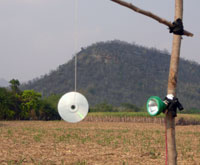 |
| An ingenious use for old CD's -- if it works |
In early 2007, ECN initiated crop-protection
trials with farmers whose fields are raided by elephants. The aim was to find
out which protection methods work, and which are cost-effective. Some of the methods
tested were local schemes which villagers believed in but had not proven, e.g. plastic
bags tied along string to mimic a simple electric fence, and CDs dangling in
front of torches (right) which flash when they twirl. Other methods used
effectively elsewhere e.g. chilli and tobacco oil fences, and well designed
electric ones, were also tested. Farmers were keen to try these other methods
when they heard about them at the feedback meeting after ECN's study trip to
Kenya in 2006. Results from these trials are now being analysed.
|
3. Srisawat corridor plan approved by Cabinet
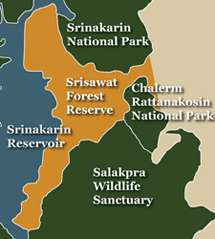 |
| Srisawat forest reserve corridor area |
As the south-eastern arm of the Western Forest Conservation
Complex (WEFCOM), Salakpra
supports at least 150 elephants, almost 20% of Thailand's largest surviving wild
population. But their future is at risk unless the Srisawat forest reserve, a
crucial conservation corridor connecting northern Salakpra to the rest of
WEFCOM, is properly protected. With support from Japan's Keidanren Nature Conservation Fund and US Fish and Wildlife Service, ECN surveyed the corridor in 2007 to map elephant distribution
and human impacts. In December, Jittin reported our findings to the Kasetsart
University's annual wildlife conference as a result of which, we were invited
to man a booth at the Department of Nature Conservation's annual wildlife fair.
At the fair, our four posters caught the attention of the Minister of Environment and
his team who were developing a national conservation corridor plan. That plan,
which incorporated maps and data from our corridor report, was approved by Cabinet on 22 January 2008.
|
4. Study trip to other HEC wildlife sanctuaries
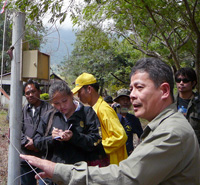 |
Learning that regular maintenance is
what makes an electric fence effective |
From 3-6 February, a team from Salakpra visited the Phu Luang and
Phu Khieo wildlife sanctuaries in north-east Thailand to learn about the effective
HEC mitigation methods of these royally-sponsored conservation areas. The
study trip was partially supported by ECN but was organised by Salakpra. Mem and
Joy went to learn on ECN's behalf along with four Salakpra staff, two members
of Kanchanaburi's Livestock Department, ten local community leaders and a protected area volunteer. At Phu Luang the team learned about the electric fence
that stops around 100 elephants from raiding nearby fields. At Phu Khieo, they met
local villagers and sanctuary staff to learn about the EU-funded participatory
management project.
|
5. River
Kwae Yai crossing routes surveyed
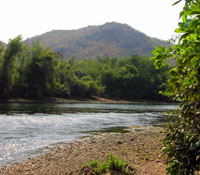 |
Crop-raiding by elephants started
soon after the Kwae Yai river was
blocked by the Srinakarin Dam |
As part
of mapping land-use around Salakpra and identifying corridors, ECN also investigated
past and present routes used by elephants to leave the sanctuary and cross the
River Kwae Yai (aka River Kwai). Field surveys were done by Mon and Gip, first
by interviewing twenty-two of the most knowledgeable local residents e.g. hunters, village
chiefs, farmers, cattle herders, and fishermen. Accompanied by their
informants, they then surveyed the land routes on foot and the river banks by
boat. A report, with maps, is in the pipeline. The team was told of eight
routes used by elephants in the past, all following streams or valleys to reach
the main river (right). Five are still used, though only one crosses the river,
and three are blocked by the Srinakarin hydro-electric reservoir or villages.
Six of the original elephant routes are associated with persistent crop-raiding.
The other two have no crops nearby. We hope to identify another potential
corridor to link the southern side of Salakpra to the Erawan National Park on
the opposite side of the River Kwae Yai, thereby linking those two elephant
populations.
|
6. Volunteer web designer
 |
| Erik Rogers, ECN's web designer, a diligent, multi-skilled night-owl |
In January, Erik Rogers joined the ECN team as a volunteer to help increase
our visibility beyond Salakpra by telling the world about our grassroots work
with local associates and by sharing what we have learned. Our moniker ECN is
an aim as well as a name, so building a collaborative network of people seeking
sustainable solutions to HEC is a key objective. After spending several years developing
commercial websites, including one for Green Tortoise Adventure Travel, Erik volunteered
to build one for Thailand's North Andaman Tsunami Relief (NATR)
where he also taught English as part of an innovative vocational training
programme. With its tsunami relief work done, NATR became Andaman Discoveries, a community-based ecotourism initiative with mutually supportive links
to ECN.
|
|
|
The Elephant Conservation Network
ECN is a small non-government organisation
(NGO), based in Kanchanaburi, west Thailand, that is seeking sustainable solutions to human-elephant conflict. Its current aim is
to secure the future of the Salakpra Wildlife Sanctuary's elephants and their forest ecosystem for the
benefit of local people and wildlife. It is supported by the Zoological Society
of London(ZSL) and works with local communities, government agencies and other
NGOs. We are extremely grateful to our donors and supporters:
|
Contact Info
Elephant Conservation Network (ECN)
37/1 Moo 8, Kaeng Sian, A. Muang
Kanchanaburi, Thailand, 71000
+66 (0) 34 624-684
info@ecn-thailand.org
|
|
|
|
|