Kenya - New World Heritage Site
Two Kenyan sites have been added to Unesco's World Heritage List, Fort Jesus in Mombasa and Kenya Lake System in the Great Rift Valley.
 | |
Fort Jesus, Mombasa, Kenya
|
Fort Jesus was built by the Portuguese from 1593-1596 to the designs of Giovanni Battista Cairati to protect the port of Mombasa. The fort's layout and form reflect the Renaissance ideal that perfect proportions and geometric harmony are to be found in the human body. The property covers an area of 2.4 hectares and includes the fort's moat and immediate surroundings.
 | |
Lake Bogoria, Kenya
|
The Kenya Lake System comprises three interlinked relatively shallow lakes (Lake Bogoria, Lake Nakuru and Lake Elementaita) and covers a total area of over 32,000 hectares. The property is home to thirteen globally threatened bird species and is the single most important foraging site in the world for the lesser flamingo, and a major nesting and breeding ground for Great White pelicans. It also features sizeable mammal populations, including Black rhino, Rothschild's giraffe, greater kudu, lion, cheetah and wild dog.
|
Kenya Camping - Private Conservancies
 | |
Mobile Camping, Selenkay Conservancy, Kenya
|
We have a new adventure camping product for Kenya. Unlike most adventure camping products - these camps are sited in private conservancies with a wealth of wildlife and where you can go on walks with Maasai guides and take night drives, but they are also conveniently located for easy access to Amboseli National Park and the Maasai Mara Reserve.
This camping safari has been designed to offer the same high quality wildlife safari experience provided by the top-end safari camps, with 4x4 game viewing escorted by top class guides and in exclusive wildlife conservancies away from the tourist minibuses, but at a hugely reduced price by staying in small basic mobile camps, "real camping" instead of the luxury accommodation of the expensive up-market tented lodges.
Click here for more information ...
|
2012 and 2013 Guided African Safaris
We will be running at least 2 guided African Safaris in 2012, with exact dates and pricing to be confirmed.
- July 2012 - 21-day Kenya and Tanzania Wildlife Safari + optional Uganda or Tanzania extension
- August 2012 - 15-day Botswana Wildlife Safari
- February 2013 - 14-day Tanzania Calving Safari + optional Uganda or Kenya extension
Email us or call us on 0800 528 101 and register your interest.
 | | Elephant blowing out water, Serengeti National Park, Tanzania |
|
Guest Feedback
 | | Wildebeest about to cross the Mara River, Kenya |
It is always great to receive feedback from our guests. Mel, Jonathon, Amanda and Sophia travelled to Kenya in August and had the time of their lives! They say:
"We got back from Kenya yesterday. It was one of the best holidays I've ever been on!! Thank you soooo much for creating the itinerary and sorting everything. It was all perfect - every minute of it.
The Kenyan people were fantastic. The food and accommodation was great. We saw the big 5 - Leopard three times and Cheetah twice as well as a Serval, so we were very blessed. The Wildebeest crossing happened right in front of us at Entim! I now have about 800 photos to trawl through!
Claire - thanks so much again for all your efforts!"
|
|
Latest news from Africa ...
Check out our blog. It contains insights on safari travel, African wildlife, and topical safari related issues. Some of our latest articles include:
|
Photo Draw Winner
 | |
Wildebeest crossing the Mara River, Kenya
|
Thank you to all those who entered our August photo draw.
CONGRATULATIONS to Ian Turnball. He has won an A3 print of Wildebeest crossing the Mara River in the Masai Mara Game Reserve, Kenya.
Click here to enter our September photo draw.
|
Monthly Desktop Wallpaper
 | |
Vervet Monkey, Uganda
|
September's desktop wallpaper features a young Vervet Monkey. Vervet monkeys are the most common monkey of the African savanna, found throughout the continent from Senegal to Sudan and all the way down to the southern tip of Africa.
Unlike other African primates that have remained in the equatorial rain forests, the Vervet Monkey has come down from the trees and adapted instead to wooded habitats outside of the rain forests. Although it no longer lives in the trees, it never ventures too far from the safety of wooded areas.
Click here to download September's desktop wallpaper.
|
|
Book Giveaway
 | |
African Wildlife - Through the eyes of a Kiwi
|
CONGRATULATIONS to Annette Hymes - winner of our August Book Giveaway.
To get your 'safari juices' going, we are giving away another copy of Rod East's book - "African Wildlife - Through the eyes of a Kiwi".
Simply forward this email to two friends and go in to September's draw to win this fabulous photo-essay!
|
Do you know ...
 | |
Nxai Pan National Park, Botswana
|
Nxai Pan National Park in Botswana is adjacent to the Makgadikgadi Pans National Park and is approximately 2,578 km² in size. The area was initially government land and was declared a game reserve in 1970. In 1992 the borders were extended and status was granted to make it a National Park.
The highlight of the Nxai Pan is the water hole, situated in the centre of the park in a large grassy plain. Approximately 20km south-east of Nxai Pan, is the beautiful Kudiakam Pan complex. Apart from the abundance of wildlife, Kudiakam Pan is also significant as the site of 'Baines' Baobabs', a clump of seven Baobab trees, known as the 'seven sisters' or the 'sleeping sisters' commemorated on canvas by painter and explorer Thomas Baines on 22 May 1862. It is commonly believed that if Thomas Baines were to repaint these Baobabs today, 140 years later, there would be no visible difference.
More recently Nxai Pan has achieved fame from the IMAX movie "Roar" - where Tim Liversedge and National Geographic filmed this epic documentary that showcases a battle between an aging lion and ayoung challenger, who wants the older lion's wives and the water hole. Watch the trailer below ...
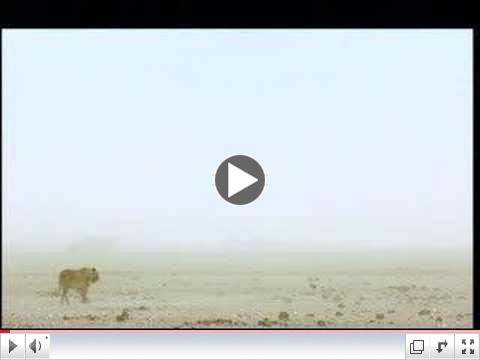 | |
"Roar" of the Kalahari
|
|








