|
|
Keep your dog young!
Five tips to keep your old dog young at heart.
As our dogs live longer lives, we have to rethink how we care for them. Everyone knows that they need regular medical check ups and labwork, but what about their mental well-being? There are things that you can do to keep your dog's brain young too. Follow the 5 tips below to keep your dog young at heart through her golden years.
Hit the road
Many of our elderly pets suffer from arthritis, heart disease or obesity and can't walk near as far as they used to, but they can still benefit from getting out of the house. If your dog is small, you can take her in a stroller. If you are running errands and you won't be leaving the car, you can take your dog with you. You can even take your dog down the driveway to get the mail or to put out the garbage. These field trips may seem of little significance to you, but they will be very important to your dog allowing her to sniff the grass, enjoy the sun and watch the birds go by.
Teach and old dog new tricks
Yes, an old dog can learn new tricks! Make a goal to teach your dog a new trick each month. It doesn't really matter what you teach her as long as you spend quality time with her stimulating her mind. Make sure that you use only positive reinforcement training. Don't get wrapped up in whether your old girl is perfect at what she does. Instead, just focus on having a good time with her. Be sure to choose behaviors which do not aggravate underlying medical conditions. For example, if your dog has arthritis, don't ask her to roll over. Instead, teach her to pick something up with her mouth, push a toy with her nose, bark on cue or high five.
Give her a puzzle
Just as you play Soduku to keep your brain young, your dog can play games to keep her brain young. Food toys are a great way to spice up your dog's life. Some examples of food toys are: Twist and Treat (Premier), Kong (black is for the toughest chewers), Stuff-a-ball (Kong), and Buster Cube. At first, put only ¼ of her meals into the food toys. When she is accustomed to eating out of them, work up to giving her ½ of her meals from food toys. This way, she can keep busy when you are at work.
Try a supplement
There are lots of supplements on the market to improve or restore brain health in older dogs. They include: Novifit (Virbac), Proneurozone (Animal Health Options), Senilife (Ceva) and Neutricks (Quincy Animal Health). Before starting a supplement of any type, your dog should be examined by a veterinarian. During the appointment, be sure to ask your veterinarian about what is right for your dog.
Stand back and watch
Sometimes, because we see our dogs everyday, it is easy to miss subtle behavior changes which represent larger medical diseases. For example, if your dog is barking at you a lot, she may be losing her hearing. She may also be too painful or weak to stand up herself on slick tile or marble floors. If she is starting to get into the garbage, she may have a metabolic disease which is increasing her appetite. If she is staring into the corner and barking at walls, she could have Canine Cognitive Dysfunction. If you think that there is something wrong with your dog, there probably is, so bring your dog to your veterinarian to get checked out. When you catch a problem early, there are more options for treatment. Besides medical treatment, you can make changes to the environment to help old dogs cope. Deaf dogs can be trained with light or vibration. Dogs who have difficulty moving around can be fitted with booties or non skid carpet runners can be laid down in common areas.
Click here to download article
|
|
Unleash Your Cat's Potential - Try Clicker Training
By Cheryl Kolus

Think you can't train a cat? Think again. We've all seen cats on TV or in movies. Do you think those cats have something your cat doesn't? Probably not. Cat "actors" may be more comfortable than your cat would be in front of all the cameras and lights, but the only other advantage they have is a patient and knowledgeable trainer to work with them. In fact, you can bet that many of those cats you see on film were rescued from a shelter.
You may not envision stardom for your cat, but you can still teach your cat a few tricks and impress your friends and family. Tricks like sit, high-five, come, stay, and jump (on or over something) are relatively easy to teach. You can also use training to decrease unwanted behaviors like jumping on counters or scratching your furniture. Training is fun and will strengthen the bond between you and your feline friend. Patience and a sense of humor are key. Anger and frustration have absolutely no place in training.
Clicker Training
One great training method used for cats and many other animals is called "clicker training." This method is often used with performing marine mammals and zoo animals that must learn to accept human handling. It involves using a specific sound IMMEDIATELY after or as the desired behavior is performed. The sound can be a click (purchase a cheap clicker from a pet store or just use a click of your tongue), or it can be a key word ("yes," "good," etc.). The trick (for you!) is to make sure you use the same sound or word all the time until the behavior you're training is reliable.
The idea behind clicker training is that the click (or whatever sound you choose) serves as a "bridge" between the desired behavior and the cat's reward (after clicking, you'll give your cat a food treat). So the order of go is: (1) The desired behavior occurs, (2) you click and (3) you give your cat a reward.
The reason for having a bridge is simply that animals live in the present. To make it easy for them to learn, we must let them know RIGHT AWAY when they do a good thing. Say your cat sits. In the seconds it takes you to fumble around for a treat to reward her for the sit, your cat may have turned her head to look out the window. For all she knows, turning her head is what got her the reward, not sitting. Eliminate that confusion by clicking the moment her butt hits the floor.
Of course, clicking in itself is not a particularly motivating reward for your cat. So now you must link the click with the treat. With cats, we can create this association at the same time that we teach them their first trick, as explained below.
Targeting and Loading the Clicker
Targeting simply means having the cat touch its nose to an object, or "target." Loading the clicker means teaching the cat that a "click" means a treat is coming. We're going to put the two together. Kitty will learn her first new behavior at the same time she learns what the clicker signifies. Remember, the click is used to mark the desired behavior and indicate that a reward is coming.
Choose a target. You can buy a "target stick" online but that's not necessary. Your target could be a pencil or pen, a wooden spoon, or the wand from an old wand and feather cat toy. It could also be a lid from a coffee can or something similar.
In a quiet room with few distractions, hold the target about an inch away from your cat's nose. Most cats will be curious and want to sniff it. The second her nose touches the target, click and treat (C/T). Do this several times in a row. Some cats will get the idea in just a few trials that touching the target means a click and then a treat. Others may take several days of a few practice sessions a day. Keep sessions short, maybe 5-10 tries at a time, so Kitty doesn't get bored. If she's not interested in touching the target, try dipping it in tuna juice or spraying it with catnip. If needed, you can also click for almost touching the target at first, and then after a few times, wait for an actual touch before the C/T.
More Targeting
After Kitty figures out that touching the target means a C/T, start making the behavior a little more challenging. Work in small steps to encourage success. At this point, you can also add a cue word, such as "touch" or "target" a second before you present the target. Move the target far enough away that she has to stretch her neck out to touch it. After a few times doing that, move it even farther so that she has to take a step toward it, then a few steps. Then try moving it to the side or above her. You get the idea. Just remember not to make things too difficult too soon as she's learning this new game. Eventually, you can have Kitty running across the room to touch the target, or use it to teach her to heel beside you or jump onto a chair, or even have her touch other objects.
Go to Mat
After Kitty's got targeting down, the next trick many cat trainers teach is "go to your mat." Having your cat go to his bed or a mat on cue can be a very useful behavior. For instance, it can help keep him from running out the door or jumping on counters while you're busy in the kitchen. To train this behavior, we'll use shaping. This means we'll reward small steps on our way to getting the complete behavior of sitting or lying on the mat. To start, lay the mat on the floor in front of you. C/T any interaction the cat has with the mat. C/T each of the steps below about 3-4 times before holding out for the next step. If Kitty understands clicker training, he should start trying new things when the previous behavior no longer gets him a reward. In other words, after being C/T'd for sniffing the mat a few times but not the next time, he should try something else like touching it with his paw. Try the following steps, but note that some cats might move along more quickly or may throw some unclickable behaviors in there, too (such as meowing or pawing at you). In the latter case, just ignore that behavior and wait him out.
(1) sniff the mat, (2) one foot on the mat, (3) two feet on the mat, (4) all four feet on the mat, (5) sit on the mat, (6) lie down on the mat
These steps can take several sessions. Be patient. Your kitty is learning how to learn, or rather learning how to get you to C/T! Each time you start a new training session, reward a step or two earlier than when you last left off. For instance, if the last session ended when he put all four feet on the mat, start this session by C/Ting a few times for one or two feet on the mat again. Add a cue word or phrase once you're sure he'll do the complete behavior. We don't want him to learn to ignore the cue simply because he doesn't know the behavior yet.
If Kitty is having a hard time and won't interact with the mat, or it's taking a long time to progress through the steps, you can use your target to lure him toward or onto the mat. However, be sure to click when he touches the mat but ideally before he touches the target (and remove the target out of his reach before he touches it). We're using the target as a lure, but the behavior we're rewarding is touching the mat. Only use the target 2-3 times before trying again to shape the behavior without it.
Treats and Training Tips
Training should last only a few minutes at a time. To speed up progress, do short training sessions several times a day. But also keep in mind how many food treats your cat is getting, and adjust her diet accordingly if necessary. Initially, treats should be of high value, something your cat really loves but doesn't get very often. They could be small pieces of tuna, deli meat, boiled chicken, canned cat food, baby food (with no onions or garlic), etc. Some cat trainers swear by bonita flakes, which you can find at some pet stores. Once Kitty is a seasoned clicker cat, you can probably get by using her regular kibble. If your cat is currently free fed, it may help her motivation to switch to meal feeding. Talk to your veterinarian about healthy treats and a good diet for your kitty in training.
Want to download the entire article? Click here
|
EVERYBODY NEEDS "A MURPHY"
Michele Gojkovich

You say that you are a dog lover? Adopt an old dog!
I may know what you're thinking - "But it will die soon. It will break my heart." Yes, it will, on both counts. But the love you will experience outweighs the pain tenfold.
My husband, John, is a cop. In February, 2010, he was on patrol when he heard the call over the radio about an older Chihuahua walking alone on a side street in our city. We were the owners of 3 Chi's at the time, and John was on his way. He had already named the dog Murphy, because we found an older dog a few years before and decided to call him Murphy. We found that dog's owner, but from that point on, every time we saw an older dog we called it "a Murphy."
By the time he got there Animal Control (AC) had already picked up the dog. John went over to the car and peered in to see a very skinny and sickly looking dog on the front seat of the car. He asked the AC officer if he could keep the dog while they tried to locate the owner, but the paperwork involved in these things had already been started. Murphy was on his way to the Animal Control kennels and then to the Humane Society where they would try to locate an owner and, if none found, decide his fate. Judging by how old he looked and other obvious problems, we were sure he wouldn't last long without an owner.
I hadn't even seen him yet, but my maternal instincts took over. I was on the phone with the Humane Society daily, begging them to let us be the first in line to adopt him, and assuring them we would take care of him regardless of his health problems. In the meantime, my husband went to the shelter and filled out the paperwork. Questions like, "Where will the dog sleep?" and "What kind of food will he eat?" were answered with the sentence, "Wherever and whatever he wants." We got lucky. Nobody claimed him, and we got the call that he was ours.
The Humane Society personnel had taken very good care of him. Regardless of his age and physical condition they gave him the same excellent care and medical treatment they do for all of the animals they shelter. The only thing they couldn't do was neuter him, because he had what looked like a tumor in that area. He had other problems too. He was completely deaf and blind in one eye. When he walked, his back legs couldn't keep up with his front legs. As a result he looked like a newborn colt toddling with every step.
The only explanation I can give about how I felt when I first saw him is an overwhelming feeling of love and a fierce protectiveness for this dog I knew nothing about. He was black and white, grey from old age, and very skinny. He looked a little out of it, but he hadn't been sedated. In addition to his other problems we were told he might have brain damage. That seemed true, because would learn that he always looked that way and would kid around that Murphy always looked like "he was a little high."
We took him to our vet, who confirmed his medical issues. She said he was "at least 10 years old," and her suggestion was for us to just "take him home and love him." So, that's what we did. We carried him out to our backyard so our other 3 dogs could get acquainted with him easier, and he acted as if he was at home from the beginning. He was obviously used to his disabilities and went about his business and interacting with the others with no problems at all. Our other dogs accepted him right away. Although they are normally competitive for attention, they seemed to naturally show him the respect his age and condition commanded.
We had some things to learn about having a disabled dog. We were used to taking our dogs into our fenced-in backyard and letting them do their thing. Murphy needed to be watched. We found this out quickly when he fell into the pool. My husband was standing right next to him but had turned his back for a moment and then heard the splash. Within seconds, John was pulling out a soaking wet Murphy, who acted like nothing happened, except he was soaking wet. We knew we would no longer have him outside without a watchful eye.
Our dogs all sleep in bed with us, and we expected Murphy to do the same, but he had other ideas. He would allow us to put him on the bed and hold him for awhile, but all of a sudden, he would jump up as if startled by something and try to run and jump off the bed. We had placed a body sized pillow with baby blankets in front of my closet along with bowls of food and water, and that became Murphy's favorite place to lie. He was also housebroken. Anyone who has Chihuahuas knows they are not easy to housebreak, but Murphy always let us know when he had to go. If we were sleeping, he would be sure to make it to the puppy pads.
Our life with Murphy had begun. He slept most of the time but was a joy to be around when awake. He was funny to watch. It was impossible not to smile at his colt-like walk and laugh at his "high" appearance. He could stand and sniff at the flower of a weed endlessly. He was in his own little world and seemed pleased to be there. We held him as long as he would let us before he'd get that startled feeling and need to be put down.
Our other dogs ate dry food, but Murphy needed the wet kind, so I had to feed him separately. I fed him in the bathroom so he could eat undisturbed, and he quickly learned the routine. Although there were times I'd swear he was on his last legs, he would skip down the hall after me for his bathroom mealtime. It was hysterical. He made everyone he met smile and fall in love with him. Some would say, "Oh, poor Murphy," but he didn't know there was anything to feel sorry for. He wasn't concerned about his disabilities - in his mind all was right with the world.
My friend Sylvia watched him when we traveled. She and her daughter loved him too and didn't mind his special needs. Sylvia has 2 dogs as well, and they would all chase each other around the living room furniture in circles. He was just a joy to watch and impossible not to laugh at. Sylvia's daughter would wrap him in one of his baby blankets and tell me that "Murphy is an angel." Sylvia kept asking me when we were going away again. She said her daughter asked her that all the time, and they couldn't wait to baby-sit.
During the spring John and I traveled to our second home in Tennessee. Sylvia had conflicting plans for one of our trips, and we had to take Murphy with us. We hadn't done so before because we thought it might be too much for him, but he traveled the 14-hour trip like a trooper. He was used to living in a flat state, and the slope of our backyard was a bit of a challenge, but he got used to it. Murphy had a great time toddling around the yard and getting familiar with all the new smells. It was also a little chillier than he's used to. I'm not sure if that's the reason, but it was during that trip that Murphy let John and I hold him with us in bed as long as we wanted without getting skittish. What a wonderful feeling to cuddle with him in bed and in front of the fire - it was just a joyful experience. Looking back, I know that letting us hold him like that was the beginning of his decline.
When we got home, he wasn't his old self. His appetite had diminished, and I was willing to do anything to get him to eat. We bought him hamburgers and cheeseburgers I could heat in the microwave, and anything else that would encourage a skip down the hall. The skips still happened, but a lot less often. He had days where he didn't eat at all. We had so many times that we thought we were losing him only to see him bounce back to himself the next day.
Not long after his first trip, we had to take another longer one. John's mother was being operated on, and we had no idea how long we would be away. Mom developed complications, and we were there for a month. During that time, Murphy got very sick. He lost the use of his legs completely. I had to carry him outside and position his legs so he could go the bathroom. When we went to the hospital, I diapered him to keep him as clean as possible until we got home. I had to hold him to give him food and water, and he learned to eat from a fork.
If this sounds like a lot of work - it wasn't. It was just an indescribable feeling of love, and we would go to any effort to make him as comfortable as possible. I knew that his body was shutting down, and I should have eased his misery, but I didn't want to do it in an unfamiliar state with a vet he had never seen before. He continued to decline when we got home, and making that call to the vet was very hard to do. I had to hear from her that it was time, even though I knew it anyway. He was already dying, and I couldn't let him suffer anymore.My husband and I were sobbing as we drove to the vet. I held him and kissed him, and told him over and over how much we loved him. I know he couldn't hear me, but I also know there is no way he couldn't feel how much he was loved. We both held him and felt our hearts break as he was given the shot to give him peace. When she told us he was gone, we were surprised. He had the same "high" look he always did. It gave us a smile and made a terrible moment a little more bearable. We knew we had given him the best life possible. Our vet said Murphy had "hit the lottery when we found him," but we were the lucky ones. We were so fortunate to have had him almost a year and a half. Nobody expected him to live that long. Murphy never licked our hands or gave any outward reciprocation of the love we gave him. Still, we knew he loved us, it was just there. It was impossible not to feel the love that emanated from that little dog's being as we cuddled him or just carried him around. Yes, it was a short time, but I wouldn't trade the amount of time we had that dog in our lives for anything. Of course it wasn't easy to lose him, but not adopting him would have been the biggest loss of all. He taught me so much. He taught me about strength and resilience in spite of physical deficiencies. He taught me that you don't need a dog to lick your face or come running to greet you to know how much he loves you. He taught me not to be selfish - to love a dog for his needs instead of my own. He taught me that we will definitely get another "Murphy." There are so many "Murphys" in shelters who desperately need homes. They sit and watch the younger ones go to their forever homes while feeling more and more hopeless. Most don't have the disabilities we had with Murphy - they're just old. Let one teach you not to be selfish. Let one love you and give you the kind of joy and fulfillment that Murphy gave us. I promise, there's no greater gift you can give for yourself or your "Murphy." If you're considering adoption, ask to see the older dogs, and PLEASE, consider adopting a Murphy of your own. Please give them another chance for a forever home, and to share the tremendous amount of love they have to give. You won't regret it. Click here to download Murphy's story.
|
Lisa Radosta, DVM, DACVB
Florida Veterinary Behavior Service
|
|
|
|
|
Volume 2, No. 2
April 2011 |
Follow
Florida Veterinary Behavior Service on

|
Does your dog lunge, bark and growl on the leash?

Take the Reactive Dog Class taught by Dr. Radosta to learn how to control your dog and teach her to relax on walks.
Reactive Dog Class starts in June
For more information, click here
|
Body Language Spotlight: Tail Tucked

Picture courtesy: Dr. Jeanine Berger
Generally, the tail is a good indicator of a dog's state of mind. This article covers just the carriage, not the movement of the tail. When a dog holds her tail down she is indicating that she is stressed, unsure or fearful. When the tail is tucked beneath the abdomen, the dog is very frightened.
When the tail is held just below the topline, the dog might simply be unsure. The degree to which the tail is tucked, depends on the dog, the breed, the level of fear and reinforcement or punishment of that body language signal. Some dogs will not tuck their tail when they are frightened. The author has observed this in some Chow Chows and terrier breeds although there are most likely many more dogs outside of these breeds who do not consistently display this body language signal. That is why it is vitally important to consider all body language cues including: the dog's breed, the context and the movement of the dog in order to yield the most accurate interpretation.
Interpretation of tail carriage should be done with consideration of the normal tail carriage of the breed of dog. If the breed's normal tail carriage is up over the body, an unfurled tail should be taken as a sign of fear, uncertainty or stress in that dog.The tail carriage of the individual dog should also be considered.
Click here to read the entire article with pictures of different tail postures
|
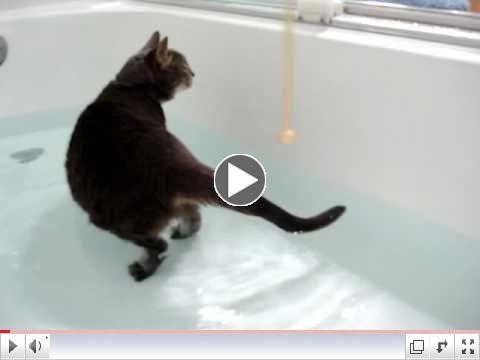
Does your elderly cat have arthritis?
Cats are not generally amenable to hydrotherapy which can be very helpful for osteoarthritis. Watch what Cheryl Kolus taught her cat Peanut with a little clicker training so that she could enjoy her twilight years.
 | | Cat Hydrotherapy 2 |
|
Can you teach an old bird new tricks? Lisa Radosta DVM, DACVB, Alison O'Kell BS 
Of course you can and there are many reasons why you should! Geriatric birds can suffer from many of the same ailments that other pets face when growing older; including arthritis, cataracts, muscle wasting and weight changes. As a result, as your bird ages she should receive a physical exam and labwork on a regular basis. Training is a great way to help your bird prepare for her veterinary visits making them stress free for everyone. Two great indicators of a healthy bird are feather condition and weight. With a little training, you can monitor both of these areas at home.
Clicker training is a great way to teach your bird new behaviors. Before you can use the clicker to train or capture behaviors you must teach your bird what the clicker means. You will need a few tools to get started: a clicker and your bird's favorite treats. Pair the clicker with treats by clicking and handing your bird a treat immediately. Do this until your bird looks at you when you click. When he does you know that he has made an association between treats and the clicker. Now you can begin to use your clicker to help you capture or mark behaviors that will help you monitor your bird's health and give him the best care possible as he ages.
Teaching your bird to weigh herself
Weight changes can indicate infection or disease. By simply monitoring your bird's weight you can help her to have a better quality of life in her twilight years. Monitoring your birds weight is as easy as teaching her to step up onto a perch. There are many types of inexpensive digital scales that can be purchased online. Choose one with a range up to 1500g.
Once you have found your scale, a sturdy perch that can be placed on the scale must be constructed;. If you are not handy, scales with perches attached can be readily purchased. Keep in mind your bird will feel most comfortable stepping on the scale perch that is similar to the perches she uses now. The perch must be strong enough to support your bird and make her feel secure. Once you have your scale and perch ready you can then begin training your bird. If you bird knows how to step up onto a perch, simply ask her to do so onto the scale perch. Remember to reward her when she does. Be patient, some birds are afraid of novelty. Give her some time. Once she will step onto the scale perch, begin to lengthen the amount of time that she has to stand on it to get the treat.
If your bird is not comfortable stepping up onto new things, you may have to shape this behavior using treats and a clicker. Start by luring your bird towards the perch by putting a treat near it. This may take several training sessions. Click and treat your bird for moving close to the perch. Over multiple training sessions, click and treat her for touching the perch with her foot, then stepping onto the perch and then staying on the perch for longer and longer periods of time. In the wild your bird would stand on tree perches all day long, so if you make your perch secure your bird will feel comfortable on it just as if she where perching in a tree or a cage. Once you have taught your bird to perch on a scale you should weigh her monthly. A weight fluctuation up or down 2.5-5% may be an indicator that something might be off with your bird's health and you should consult your veterinarian.
Inspecting your bird's feathers
Good feather quality is another great indicator of a healthy bird. You can teach your bird to open its wings by capturing the behavior using a clicker and treats. Captive birds will at times spread their wings to stretch or to preen. This is the best time to capture this behavior. Simply click and treat each time you see your bird spreading her wings. The more your reward the behavior, the more frequently your bird will offer the behavior. Essentially your bird will start to realize that every time she opens her wings she gets a treat. Then begin to add a cue to tell your bird to open her wings when you ask her too. When your bird opens her wings add your cue "wings" and click and treat for the behavior. Now you are essentially pairing your cue with the behavior. Once you have practiced this numerous times, test your bird by asking her to open her wings by saying "wings." If she spreads her wings, click and treat. This behavior also gives you the opportunity to see your bird's wings and feather condition in a way that is not stressful to you or your bird. If you begin to see that your bird's feather quality is declining or she is not preening her feathers like she used to, consult your veterinarian.
As your bird ages, you will inevitably be taking her to the veterinarian's office more frequently.These visits can be stressful to your bird if she is not use to traveling in a crate. You should begin counter conditioning your bird to the crate well before she needs to go the veterinarian's office. You can do this simply by pairing good things with your bird's travel crate. You bird may be frightened by the sight of the crate in the beginning. If this is the case, leave it near his cage in an area where she can see the crate without being frightened of it. Once your bird is no longer showing signs of fear when she sees the crate you can begin to feed her near or on the crate. When your bird will readily eat from the edge of the crate door, you can begin tossing treats into the crate. When your bird is going into the crate you can begin closing the crate door for a second at first. Then, over many training sessions, you close the door for longer and longer periods of time. Don't forget to keep rewarding your bird for not being scared of the crate. Teaching your bird to like her crate could take a week or months (longer if she only associates the crate with stressful events) so begin crate training early. All of these behaviors can help your bird to grow old gracefully and live a long healthy life with you.
Click here to download the entire article |
Do you have a great story of success with your pet?
Your story could inspire someone else! If you would like to share your story, write it in 500 words or less and email it to us at info@flvetbehavior.com.
If we use it in the next newsletter, we will let you know!
|
Do you want to..
Contact information:
Florida Veterinary Behavior Service
|
|


 Lisa Radosta DVM, DACVB

